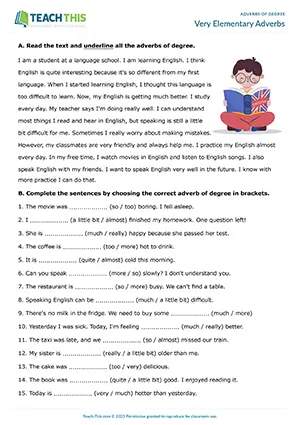
Very Elementary Adverbs

Elementary (A1-A2) 30 minutes
ESL adverbs of degree worksheet for elementary A1-A2, matching, error correction, sentence writing, pair speaking

ESL Adverbs of Degree Worksheet - Reading, Vocabulary and Writing Exercises: Matching, Binary Choice, Gap-fill, Guided Writing - Speaking Activity - Pair Work

In this productive adverbs of degree worksheet, students learn how to use 'very', 'really', 'quite' and 'too' correctly and build confidence using them in...

ESL Adverbs of Degree Worksheet - Reading, Vocabulary and Writing Exercises: Matching, Binary Choice, Error Correction, Gap-fill, Guided Writing - Speaking Activity: Asking and Answering Questions - Pair Work In this productive adverbs of degree worksheet, students learn how to use 'very', 'really', 'quite' and 'too' correctly and build confidence using them in everyday conversation. First, students read four sentences and match the bold adverb in each one to the correct meaning. Students then underline the correct adverb of degree in each sentence. Next, students find the wrong word in each sentence and rewrite it correctly. After that, students complete each sentence with 'too' or 'really'. Students then write one sentence for each adverb using the topic word in brackets as a guide. Finally, students read questions and write 'yes' or 'no' in the column marked 'Me'. Students then ask a partner the questions and write their answers.

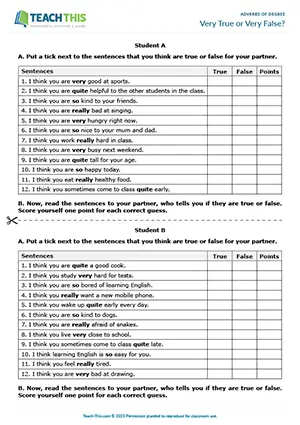
Very True or Very False?

Elementary (A1-A2) 20 minutes
ESL adverbs of degree game for elementary A1-A2, true or false, guessing, pair work

ESL Adverbs of Degree Game - Vocabulary: True or False, Guessing - Pair Work

In this insightful adverbs of degree game, students test how well they know their partner by deciding if sentences about them are true or false, practicing the adverbs of degree: very, so, really and quite. Working alone, students read sentences...

ESL Adverbs of Degree Game - Vocabulary: True or False, Guessing - Pair Work In this insightful adverbs of degree game, students test how well they know their partner by deciding if sentences about them are true or false, practicing the adverbs of degree: very, so, really and quite. Working alone, students read sentences and decide if each one is true or false for their partner, ticking either 'True' or 'False'. Students then take turns reading the sentences to their partner, who tells them if they are true or false. Students score one point for each correct guess. The student with the most correct guesses wins the game.

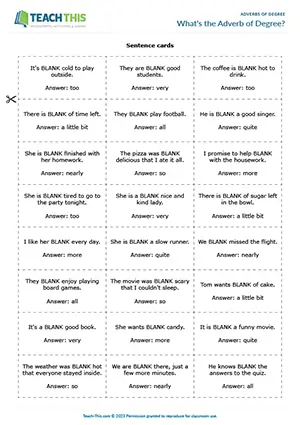
What's the Adverb of Degree?

Elementary (A1-A2) 20 minutes
ESL adverbs of degree game for elementary A1-A2, matching, gap-fill, group work

ESL Adverbs of Degree Game - Vocabulary: Matching, Gap-fill - Group Work

In this fast-paced adverbs of degree game, students race to complete everyday sentences using three common adverbs of degree: very, too and quite. In groups, the reader picks up a card and reads the sentences aloud to the...

ESL Adverbs of Degree Game - Vocabulary: Matching, Gap-fill - Group Work In this fast-paced adverbs of degree game, students race to complete everyday sentences using three common adverbs of degree: very, too and quite. In groups, the reader picks up a card and reads the sentences aloud to the players, using the word 'blank' for the missing adverb of degree, e.g. 'My bag is BLANK heavy. I need some help.' The players listen and then race to grab the correct adverb of degree card to complete the sentence. The first player to grab the correct card and give it to the reader wins and keeps the sentence card. The player must say the adverb of degree aloud at the same time, e.g. very. The student with the most sentence cards at the end of the game wins. Afterwards, students repeat the game with a different student reading the sentences.

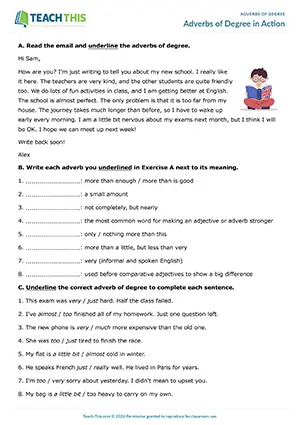
Adverbs of Degree in Action

Pre-intermediate (A2) 30 minutes
ESL adverbs of degree worksheet for pre-intermediate A2, identifying, matching, binary choice, error correction, gap-fill, unscrambling, asking and answering questions, pair work

ESL Adverbs of Degree Worksheet - Reading, Vocabulary and Writing Exercises: Identifying, Matching, Gap-fill - Speaking: Asking and Answering Questions - Pair Work

In this adverbs of degree worksheet, students explore how eight essential adverbs of degree work, from reading a relatable email to practicing the language in...

ESL Adverbs of Degree Worksheet - Reading, Vocabulary and Writing Exercises: Identifying, Matching, Binary Choice, Error Correction, Gap-fill, Unscrambling - Speaking: Asking and Answering Questions, Controlled and Freer Practice - Pair Work In this adverbs of degree worksheet, students explore how eight essential adverbs of degree work, from reading a relatable email to practicing the language in conversation with a partner. First, students read an email and underline the adverbs of degree. Students then write each adverb next to its meaning. Next, students complete sentences by choosing the correct adverb of degree. After that, students rewrite sentences by identifying and correcting the wrong adverb of degree in each sentence. Students then complete sentences with adverbs of degree from a box. Following that, students reorder words to make questions containing adverbs of degree. Finally, students ask and answer the questions with a partner.

That's a Really Good Question!

Pre-intermediate (A2) 30 minutes
ESL adverbs of degree speaking activity for pre-intermediate A2, gap-fill, conversation, group and pair work

ESL Adverbs of Degree Activity - Vocabulary and Speaking: Gap-fill, Asking and Answering Questions - Group and Pair Work

In this enjoyable adverbs of degree speaking activity, students practice using adverbs of degree with adjectives and verbs by completing, asking and answering conversation questions...

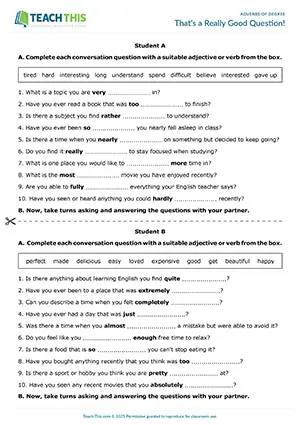
ESL Adverbs of Degree Activity - Vocabulary and Speaking: Gap-fill, Asking and Answering Questions - Group and Pair Work In this enjoyable adverbs of degree speaking activity, students practice using adverbs of degree with adjectives and verbs by completing, asking and answering conversation questions. First, in two groups, students complete each conversation question with a suitable adjective or verb from a box. Next, students pair up with someone from the other group. Students then take turns asking the conversation questions to their partner, who responds using the corresponding adverb of degree and verb or adjective. Finally, students share what they learned about their partner with the class.

Adverbs of Degree Dominoes

Intermediate (B1) 25 minutes
ESL adverbs of degree dominoes game for intermediate B1, matching, sentence completion, group work

ESL Adverbs of Degree Game - Vocabulary and Grammar: Matching, Sentence Completion - Group Work

In this creative adverbs of degree game, students play dominoes by making sentences with adjectives modified by adverbs of degree. The first player places one of their dominoes at either end...

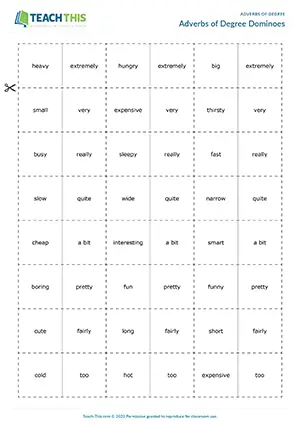
ESL Adverbs of Degree Game - Vocabulary and Grammar: Matching, Sentence Completion - Group Work In this creative adverbs of degree game, students play dominoes by making sentences with adjectives modified by adverbs of degree. The first player places one of their dominoes at either end of the domino on the table, pairing an adverb of degree with an adjective or vice versa. The player then makes a sentence using the adverb of degree and adjective and says it to the group, who judge the sentence, e.g. 'The movie was very funny'. If the sentence is grammatically correct and makes sense, the domino remains in place. If not, the player must take back the domino. The player then writes down the subject of the sentence to keep track of the nouns used. The same subject may not be repeated in subsequent sentences. Play then passes to the next student and so on. The first player to get rid of all their dominoes wins the game. As a variation, students can play the game using a points system. For each correctly matched adverb of degree and adjective, students score a point. Then for an extra point, students try to make a sentence with the two words.

Adverbs of Degree Practice

Intermediate (B1) 30 minutes
ESL adverbs of degree worksheet for intermediate B1, matching, categorising, gap-fill, true or false pair game

ESL Adverbs of Degree Worksheet - Grammar and Vocabulary Exercises: Matching, Categorising, Gap-fill - Speaking Game: True or False - Pair Work

This free adverbs of degree worksheet helps students practice modifying adverbs, adjectives, and verbs with adverbs of degree. To begin, students read...

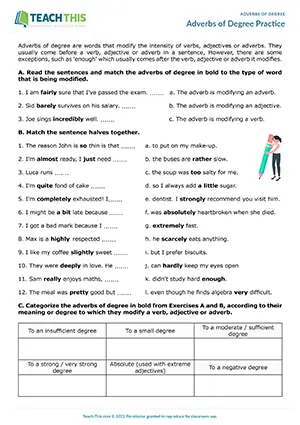
ESL Adverbs of Degree Worksheet - Grammar and Vocabulary Exercises: Matching, Categorising, Gap-fill - Speaking Game: True or False - Pair Work This free adverbs of degree worksheet helps students practice modifying adverbs, adjectives, and verbs with adverbs of degree. To begin, students read sentences and match adverbs of degree to the type of word that is being modified. Next, students match sentence halves that contain adverbs of degree. Students then categorize the adverbs of degree, according to their meaning or degree to which they modify a verb, adjective or adverb. Students then underline the correct adverbs of degree in a set of sentences. After that, students arrange words to make sentences containing adverbs of degree. Next, students complete sentences with one of the adverbs of degree shown. In the last exercise, students complete four sentences with true information and four with false information. Finally, students read the sentences to a partner to see if they can guess which sentences are true and which are false.

How cool are you?

Intermediate (B1) 25 minutes
ESL adverbs of degree activity for intermediate B1, writing, asking and answering how questions, pair work

ESL Adverbs of Degree Activity - Grammar, Vocabulary and Speaking: Writing, Asking and Answering Questions, Freer Practice - Pair Work

In this engaging adverbs of degree speaking activity, students practice responding to How questions with adverbs of degree. First, students write a set of...

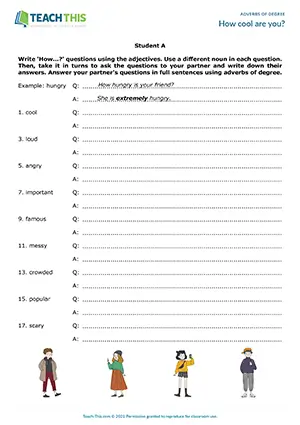
ESL Adverbs of Degree Activity - Grammar, Vocabulary and Speaking: Writing, Asking and Answering Questions, Freer Practice - Pair Work In this engaging adverbs of degree speaking activity, students practice responding to How questions with adverbs of degree. First, students write a set of 'How...?' questions with the adjectives shown. Next, students take it in turns to ask the questions to their partner, who answers each question in sentence form using an adverb of degree, modifying the adverb with not to express minimal degree when needed. The student then writes the response down on the worksheet. Finally, students share what they found out with the class.

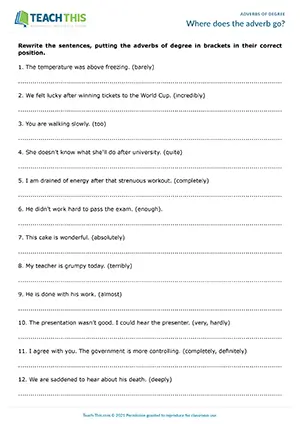
Where does the adverb go?

Intermediate (B1) 20 minutes
ESL adverbs of degree worksheet for intermediate B1, rewriting sentences, word order

ESL Adverbs of Degree Worksheet - Grammar and Vocabulary Exercise: Rewriting Sentences

In this useful adverbs of degree word order worksheet, students practice the position of degree adverbs in a sentence. First, students rewrite sentences, putting adverbs of degree in brackets in their correct...

ESL Adverbs of Degree Worksheet - Grammar and Vocabulary Exercise: Rewriting Sentences In this useful adverbs of degree word order worksheet, students practice the position of degree adverbs in a sentence. First, students rewrite sentences, putting adverbs of degree in brackets in their correct position. When the students have finished, check the answers with the class and review the meanings of the adverbs of degree.

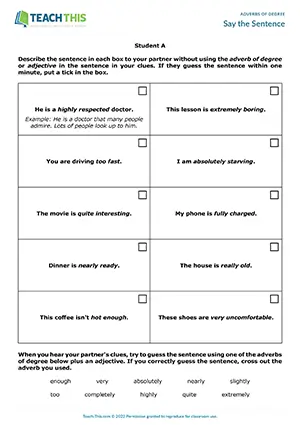
Say the Sentence

Upper-intermediate (B2) 25 minutes
ESL adverbs of degree game for upper-intermediate B2, giving clues, describing, guessing, pair work

ESL Adverbs of Degree Game - Vocabulary and Speaking: Giving Clues, Describing, Guessing - Pair Work

In this fun adverbs of degree game, students describe and guess sentences that contain adverbs of degree and adjectives. One student begins by choosing a sentence from their worksheet and giving...

ESL Adverbs of Degree Game - Vocabulary and Speaking: Giving Clues, Describing, Guessing - Pair Work In this fun adverbs of degree game, students describe and guess sentences that contain adverbs of degree and adjectives. One student begins by choosing a sentence from their worksheet and giving clues to describe it without using the adverb of degree or adjective in the sentence. Their partner then has one minute to say the sentence using one of the adverbs of degree at the bottom of their worksheet and an adjective. If their partner guesses the sentence within one minute, the student puts a tick in the box. It is then the other student's turn to describe a sentence. The student with the most correct guesses at the end of the game wins.

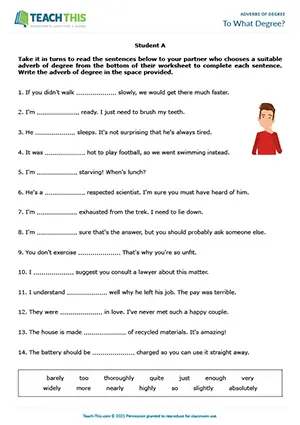
To What Degree?

Upper-intermediate (B2) 20 minutes
ESL adverbs of degree game for upper-intermediate B2, sentence completion, pair race

ESL Adverbs of Degree Game - Vocabulary: Sentence Completion - Pair Work

In this entertaining adverbs of degree game, pairs of students race against each other to complete sentences with adverbs of degree. Students take it in turns to read out sentences to their partner who chooses a suitable adverb of degree from the...

ESL Adverbs of Degree Game - Vocabulary: Sentence Completion - Pair Work In this entertaining adverbs of degree game, pairs of students race against each other to complete sentences with adverbs of degree. Students take it in turns to read out sentences to their partner who chooses a suitable adverb of degree from the bottom of their worksheet to complete each sentence. The student who reads the sentence then writes the adverb of degree down in the space provided. Students continue taking it in turns reading out sentences until they are all complete. The first pair to correctly complete all the sentences wins.

Understanding Adverbs of Degree

Adverbs of degree are words that modify adjectives, verbs, or other adverbs to show how much or how little something applies, such as 'very,' 'quite,' 'almost,' 'barely,' and 'extremely.' When students leave out adverbs of degree or swap one for another incorrectly, they lose the ability to express important shades of meaning, and a sentence like 'I finished the work' tells a listener far less than 'I almost finished the work' or 'I barely finished the work.'

This page covers adverbs of degree from A1 to B2, with eleven resources spanning games, worksheets, and speaking activities totaling 275 minutes of practice, including one free download.

The table below shows common adverbs of degree grouped by their function and intensity, with an example sentence for each.

FunctionAdverbs of DegreeExample
Amplifiers (maximum intensity) absolutely, completely, utterly, totally 'She was absolutely exhausted.'
Strong intensifiers very, extremely, incredibly, terribly 'The exam was extremely difficult.'
Mid-range intensifiers quite, fairly, rather, pretty 'The film was quite interesting.'
Diminishers slightly, a little, a little bit, somewhat 'I was slightly confused by the instructions.'
Approximators almost, nearly, barely, hardly 'He almost missed the bus.'
Multipliers and comparators much, far, a lot, even 'She runs much faster than before.'

When to Use Adverbs of Degree

Qualifying a Strong Claim: A writer uses a diminishing adverb of degree when they want to show that something is partially rather than fully true, which makes their writing more precise and credible, as in 'The results were almost identical to last year's figures.'

Adding Emotional Intensity in Conversation: Speakers use intensifying adverbs of degree to show how strongly they feel about something, because a bare adjective often undersells the emotion, as when someone says 'I was absolutely exhausted after the meeting' rather than just 'I was tired.'

Signaling Caution in Academic Writing: Academic writers reach for adverbs of degree to avoid overstating findings, since labeling a result as 'extremely significant' or only 'slightly above average' gives readers a far more accurate picture than an unmodified adjective alone, as in 'The difference was marginally significant.'

3-Step Framework for Teaching Adverbs of Degree

1. Build the Foundation with Controlled Writing: Start with a worksheet that takes students from reading and identifying adverbs of degree through to writing their own sentences. The core construction task is deliberately constrained: students use words from a box to make six sentences, and each sentence must contain exactly one adjective or verb and one adverb of degree. That rule keeps students focused on the form rather than simply filling blanks.

2. Put the Grammar Under Peer Pressure: Move to a dominoes game where students pair an adverb of degree with an adjective and then earn the right to place their domino by saying a grammatically correct sentence aloud to the group. The group judges every sentence: if it makes sense, the domino stays; if not, the player takes it back. A running constraint adds vocabulary pressure throughout, because the same subject cannot be repeated in subsequent sentences across the whole game.

3. Push into Freer Production: Finish with a speaking activity built around 'How...?' questions. Students write their own questions using a set of given adjectives, then ask them in pairs. The productive challenge sits in the answers: partners must respond in full sentences using an adverb of degree, and when the degree is minimal, they must modify the adverb with 'not' to express that, which keeps the grammar active rather than formulaic.

Common Mistakes with Adverbs of Degree

Using 'Very' with Extreme Adjectives: Students often place 'very' before extreme adjectives like 'exhausted,' 'furious,' or 'freezing,' not realizing these adjectives already carry maximum intensity and pair with amplifiers like 'absolutely' or 'utterly' instead. Wrong: 'I was very exhausted after the hike.' Correct: 'I was absolutely exhausted after the hike.'

Placing the Adverb After the Adjective: Students often put an adverb of degree after the adjective it modifies rather than before it, following word order patterns from their first language. Wrong: 'The test was difficult very.' Correct: 'The test was very difficult.'

Common Questions About Teaching Adverbs of Degree

What is a fun game for practicing adverbs of degree?

The game What's the Adverb of Degree? is a fast card-grabbing race. The reader reads a sentence aloud, saying 'blank' for the missing adverb of degree. Players race to grab the correct adverb card and say it aloud. The first to grab the right card wins the sentence card and keeps it.

What is a good worksheet for teaching adverbs of degree?

The free worksheet Adverbs of Degree Practice covers matching, categorizing, gap-fill, and sentence unscrambling, all focused on how adverbs of degree modify verbs, adjectives, and other adverbs. It closes with a speaking task where students write four true and four false sentences, then read them to a partner who guesses which are which.

What is an engaging speaking activity for practicing adverbs of degree?

The activity That's a Really Good Question! gets students asking and answering conversation questions using adverbs of degree. Students first complete each question with a suitable adjective or verb, then take turns asking their partner, who responds using the matching adverb of degree in a full sentence. They then share what they learned about their partner with the class.

Become a Teach This Member

Get unlimited access to the full library, plus new resources added every week.

Unlimited Resource Access

Download from 3000+ worksheets, activities, and games.

Save 5+ Hours Weekly

Cut lesson prep time with ready-to-use resources, plus teacher notes and answer keys.

Trusted Professional Quality

Classroom-tested, editable resources created by experienced ESL professionals.

Fresh Content Weekly

Get 5 new resources added to the library each week.

Join Now Just $29.99 quarterly