
Countable & Uncountable Nouns ESL Games, Worksheets & Activities
Countability Crossword
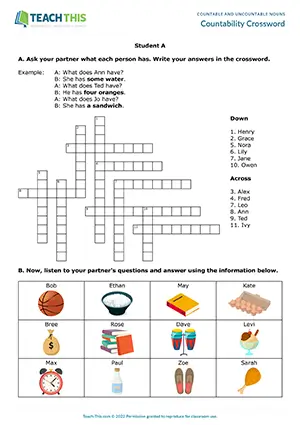
ESL Countable and Uncountable Nouns Crossword - Grammar and Speaking Activity: Asking and Answering Questions - Pair Work
In this countable and uncountable nouns speaking activity, students ask and answer questions about possessions to complete crosswords. In pairs...
Countability Go Fish

ESL Countable and Uncountable Nouns Game - Grammar, Vocabulary and Speaking: Matching, Asking and Answering Questions - Group Work
In this engaging countable and uncountable nouns game, students practice making and responding to requests to collect matching sets of cards. In groups...
Flip and Match

ESL Countable and Uncountable Nouns Game - Vocabulary and Grammar: Matching, Pelmanism, Gap-fill - Group Work
In this free countable and uncountable nouns game, students practice choosing nouns to complete sentences in a memory challenge. In groups, students take turns turning over one sentence card and one word...
Noun Sort Showdown
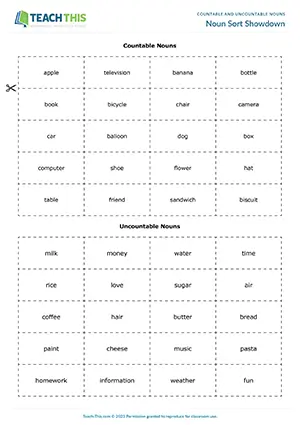
ESL Countable and Uncountable Nouns Game - Grammar, Vocabulary and Speaking: Categorising, Forming Sentences - Group Work
In this fun countable and uncountable nouns game, students sort nouns by throwing a ball into labelled containers and make sentences to score points. Ask a member...
The Shopping List

ESL Countable or Uncountable Noun Worksheet - Vocabulary Exercise: Categorising, Gap-fill
This useful countable and uncountable nouns worksheet helps students practice using 'a', 'an', 'some' and 'any' with shopping items. First, students sort shopping items into countable and uncountable...
A bit of Trivia

ESL Countable and Uncountable Nouns Game - Grammar and Vocabulary: Gap-fill, Binary Choice, Multiple Choice, Guessing - Pair Work
In this engaging countable and uncountable nouns game, students insert countable and uncountable nouns into trivia facts and then quiz a partner to complete...
Can you count it?

ESL Countable and Uncountable Nouns Worksheet - Grammar and Vocabulary Exercises: Categorising, Matching, Binary Choice, Error Correction, Multiple Choice
This free countable and uncountable nouns worksheet helps students learn and practice singular and plural forms of countable and uncountable nouns...
Claim It

ESL Countable and Uncountable Nouns Board Game - Vocabulary and Speaking: Completing Sentences, Freer Practice - Group Work
In this entertaining countable and uncountable nouns board game, students race to claim squares by completing sentences with similar countable and uncountable...
Countable or Uncountable 1

ESL Countable or Uncountable Nouns Game - Grammar and Vocabulary: Categorising, Forming Sentences and Questions - Pair Work
This rewarding countable or uncountable nouns game helps to teach students the difference between these two types of nouns. The game also helps...
Dinner for Two

ESL Countable or Uncountable Nouns Worksheet - Vocabulary Exercises: Gap-fill, Categorising - Speaking Activity: Guessing, Freer Practice - Pair Work
Here is a comprehensive countable and uncountable nouns worksheet for pre-intermediate students. First, students complete a story using...
Name Two Nouns
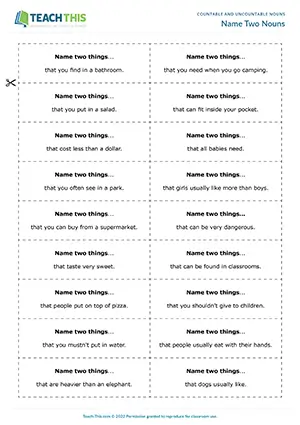
ESL Countable and Uncountable Nouns Game - Vocabulary: Brainstorming, Word Association, Freer Practice - Group Work
In this creative countable and uncountable nouns game, students race to say two countable or uncountable nouns belonging to different categories. In groups, students take it in turns to pick up a card...
Countable or Uncountable 2
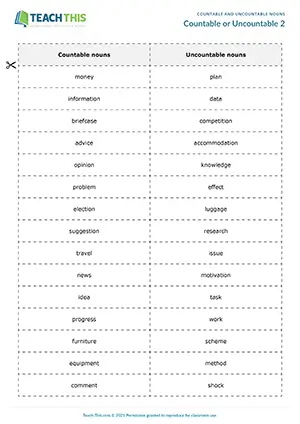
ESL Countable or Uncountable Nouns Game - Grammar and Vocabulary: Categorising, Forming Sentences and Questions - Pair Work
This enjoyable countable or uncountable nouns game can be used to teach students more advanced countable and uncountable nouns and which quantifiers...
Educated Guesses
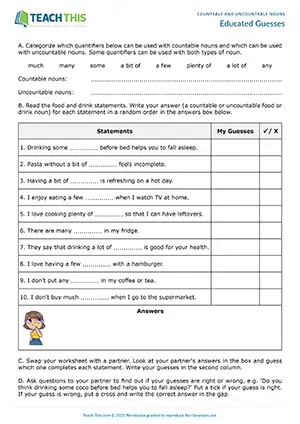
ESL Countable or Uncountable Nouns Game - Grammar, Vocabulary and Speaking: Categorising, Gap-fill, Guessing, Asking Questions - Pair Work
Here is a free countable and uncountable nouns game to help students practice using countable and uncountable food and drink nouns with quantifiers...
Going Places
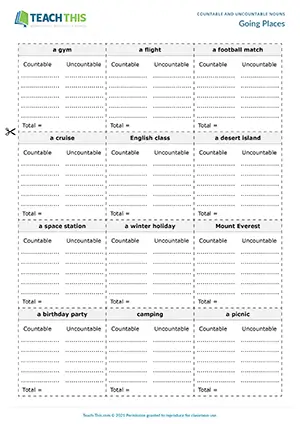
ESL Countable and Uncountable Nouns Game - Vocabulary: Brainstorming, Word Association - Pair Work
In this imaginative countable and uncountable nouns game, students race to write lists of countable and uncountable nouns for things they need in different situations. Give each pair of students a copy of...
Make it Count
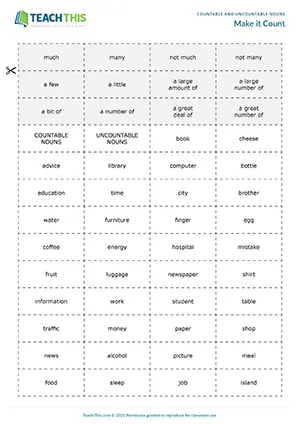
ESL Countable and Uncountable Nouns Game - Grammar, Vocabulary and Speaking: Matching, Categorising, Forming Sentences - Group Work
This memorable countable and uncountable nouns game is ideal for practicing or reviewing countable and uncountable nouns and their use with quantifiers...
Understanding Countable and Uncountable Nouns
Countable nouns name individual things you can number, like 'an apple' or 'two chairs,' while uncountable nouns name things treated as a whole, like 'furniture' or 'information.' Students who confuse the two end up writing 'an advice' or 'furnitures,' errors that signal a lack of accuracy to any reader and are particularly damaging in formal or professional writing.
This page covers countable and uncountable nouns across Elementary, Pre-intermediate, and Intermediate levels (A1-A2 to B1), with 15 resources including crosswords, card games, board games, worksheets, and brainstorming activities, with three available as free downloads.
The table below compares how countable and uncountable nouns behave, covering articles, plural forms, quantifiers, and question words.
| Category | Countable Nouns | Uncountable Nouns | Examples |
|---|---|---|---|
| Articles | a or an + singular noun | no article, or some | 'I need a pen.' / 'I need some water.' |
| Plural form | can be pluralised | cannot be pluralised | 'two chairs' / NOT 'two furnitures' |
| Quantifiers (small amount) | a few | a little | 'a few apples' / 'a little rice' |
| Quantifiers (large amount) | many | much | 'many students' / 'much time' |
| Universal quantifier | some / any | some / any | 'some books' / 'some advice' |
| Question word | How many? | How much? | 'How many eggs?' / 'How much milk?' |
| Example nouns | chair, apple, idea, question | water, rice, advice, furniture | n/a |
When to Use Countable and Uncountable Nouns
Ordering or requesting quantities: When shopping, ordering in a restaurant, or making any kind of request, the countable and uncountable distinction determines which article or quantifier to use, turning an unnatural 'I would like a bread' into the correct 'I would like some bread' or 'a loaf of bread.'
Writing reports and academic texts: Academic and professional writers reach for uncountable nouns like 'research,' 'evidence,' and 'knowledge' because these words carry a sense of scope and abstraction that their countable versions cannot, as in 'The research shows a clear pattern' rather than 'The researches show a clear pattern.'
Describing places and environments: When describing a physical space, writers naturally blend countable and uncountable nouns since some features are individual items while others are continuous substances or conditions, as in 'The kitchen had three windows and plenty of light.'
3-Step Framework for Teaching Countable and Uncountable Nouns
1. Make the Decision Physical: Before students write a single word, get them on their feet deciding. Call out a noun card and one student at a time tries to throw a ball into a labelled container based on whether the noun is countable or uncountable. If the throw lands correctly, the class confirms the answer and the student earns a point. For an extra point, the student then has to make a sentence using that noun. The throwing mechanic forces a split-second decision that exposes uncertainty far more quickly than a written exercise.
2. Teach the Tricky Middle Ground: Once students have the basic distinction, push them into nouns that can be both countable and uncountable. Students complete a story using nouns from a box, then go back through the text and label each noun 'C' for countable, 'U' for uncountable, or 'B' for both. The 'B' category is the productive one: it forces students to notice that the same word shifts meaning depending on context.
3. Generate Under Pressure: At intermediate level, students are ready to produce nouns spontaneously rather than choose from a list. Give pairs a situation card such as a gym and have them race to brainstorm five countable and five uncountable items they might need to take with them, writing the nouns under the two headings on their card. Speed and accuracy compete, which is exactly the pressure students need to stop over-relying on familiar safe words.
Common Mistakes with Countable and Uncountable Nouns
Using 'much' with countable nouns: Students often use 'much' with countable nouns when they should use 'many,' producing errors that sound unnatural even in otherwise correct sentences. Wrong: 'There aren't much students in the class.' Correct: 'There aren't many students in the class.'
Using 'less' with countable nouns: Students often use 'less' with countable nouns when they should use 'fewer,' a mistake so common that even native speakers make it, most visibly on supermarket signs that read '10 items or less.' Wrong: 'There were less people at the meeting than expected.' Correct: 'There were fewer people at the meeting than expected.'
Common Questions About Teaching Countable and Uncountable Nouns
What is a fun countable and uncountable nouns game?
The game Flip and Match is a free pelmanism activity where students turn over one sentence card and one word card. The memory challenge of tracking which cards are where keeps students engaged, and the moment when the group agrees a noun fits the sentence gives the activity a satisfying payoff. A correct match wins the pair.
What is a useful worksheet for teaching countable and uncountable nouns?
The free worksheet Can you count it? covers the full range of countable and uncountable noun skills in one activity. Students categorize nouns, complete plural forms, match singular and plural pairs, correct errors, and choose multiple-choice answers to complete sentences. Each exercise builds on the last, moving from recognition through to accurate production.
What is a good activity for practicing countable and uncountable nouns with quantifiers?
The game Make it Count works in two stages, which is what makes it effective. The matching stage locks in which nouns are countable and which are uncountable before students attempt the quantifier stage, so they are building sentences from a secure base rather than guessing. A correct sentence with the quantifier wins the noun card.
Become a Teach This Member
Get unlimited access to the full library, plus new resources added every week.
Unlimited Resource Access
Download from 3000+ worksheets, activities, and games.
Save 5+ Hours Weekly
Cut lesson prep time with ready-to-use resources, plus teacher notes and answer keys.
Trusted Professional Quality
Classroom-tested, editable resources created by experienced ESL professionals.
Fresh Content Weekly
Get 5 new resources added to the library each week.
Here's what our members are saying...


