
Past Simple Regular Verbs ESL Games & Worksheets
-ED Sorting Race

ESL -ed Sounds Game - Pronunciation: Pronunciation Accuracy, Categorising, Freer Practice - Pair Work
In this fun -ed pronunciation game, students learn to recognise and produce the three -ed endings in regular past simple verbs: /d/, /t/ and /id/. In pairs, students take turns picking up a verb card and...
-ED Sounds
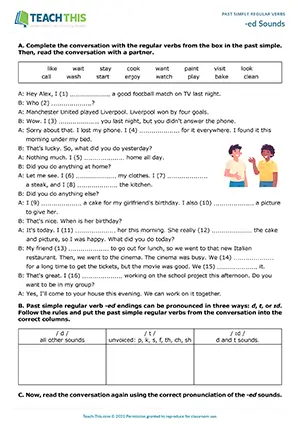
ESL -ed Sounds Worksheet - Grammar Exercises: Gap-fill, Categorizing - Speaking Activity: Pronunciation - Pair Work
In this free -ed sounds worksheet, students practice past simple regular verbs in a conversation and then sort the verbs by their -ed pronunciation. Students start by completing a conversation...
Regular Verbs Connect 4
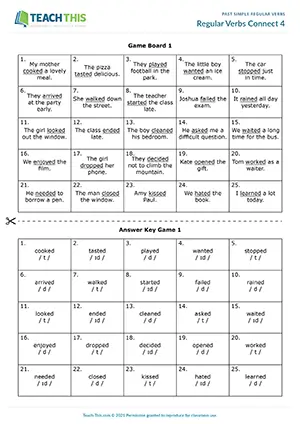
ESL -ed Sounds Game - Pronunciation: Pronunciation Accuracy, Controlled Practice - Group Work
In this engaging -ed sounds game, students practice the -ed pronunciation of past simple verbs by identifying the sound and reading them aloud in sentences. The first player starts by choosing...
-ED Sound Showdown
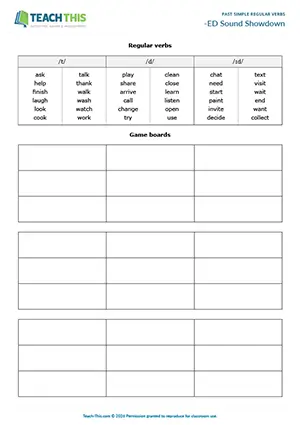
ESL ed Pronunciation Game - Pronunciation and Speaking: Forming Sentences, Freer Practice - Pair Work
In this productive -ed pronunciation game, students choose regular verbs, make short past simple sentences, and say them aloud using the correct -ed pronunciation as they play a three-in-a-row game...
-ED Sounds and Spelling Game
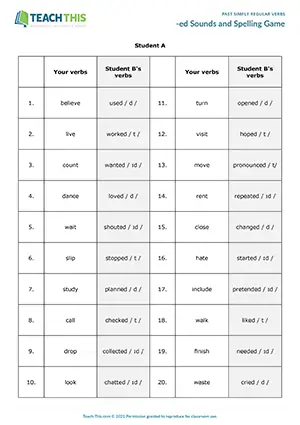
ESL Past Simple Regular Verbs Game - Pronunciation: Pronunciation Accuracy, Spelling - Pair Work
In this entertaining -ed pronunciation game, students practice pronouncing and spelling the past simple forms of regular verbs and identifying how the -ed ending is pronounced (/t/, /d/ or /id/). Student...
Past Simple Regular Verbs
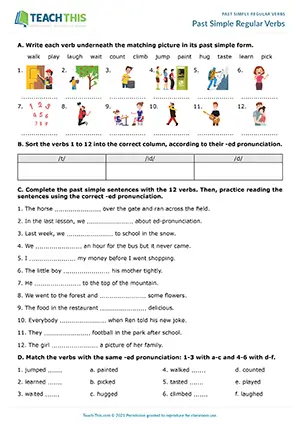
ESL Past Simple Regular Verbs Worksheet - Vocabulary and Pronunciation Exercises: Matching, Categorising, Gap-fill
In this useful -ed pronunciation worksheet, students write 12 regular verbs in the past simple, sort them by -ed pronunciation, complete sentences, and match verbs with the same -ed pronunciation...
Too Good To Be True!
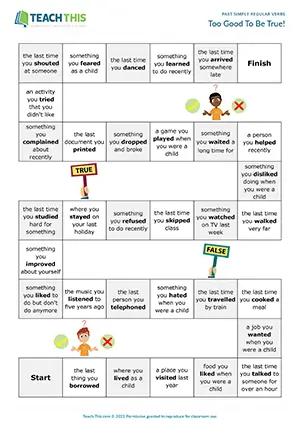
ESL -ed Pronunciation Board Game - Pronunciation and Speaking: Forming Sentences, Pronunciation - Group Work
In this free past simple -ed pronunciation board game, make short true or false statements about past experiences, and try to pronounce past simple regular verbs correctly. In groups, players...
True or False?
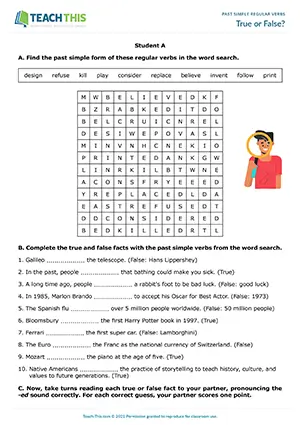
ESL Past Simple Regular Verbs Game - Vocabulary, Grammar and Pronunciation: Word Search, Gap-fill, Pronunciation Practice, Guessing - Pair Work
In this rewarding past simple regular verbs game, students complete statements with past simple regular verbs from a word search, and then play a true or false...
Understanding Past Simple Regular Verbs
Past simple regular verbs form the past tense by adding -ed to the base verb, following consistent spelling rules, as in 'walk' becoming 'walked' or 'stop' becoming 'stopped.' The -ed ending does not always sound the same, and students who apply an /id/ sound to every regular verb, pronouncing 'walked' as 'walk-id' or 'talked' as 'talk-id', sound unnatural to a native speaker and can be harder to understand.
This page covers past simple regular verbs across A1-A2, A2, and B1 levels, with eight activities ranging from pronunciation worksheets and categorizing games to board games and a word search activity, with two available as free downloads.
The table below shows the spelling rules for forming the past simple of regular verbs, with an example for each pattern.
| Verb Ending | Rule | Example |
|---|---|---|
| Most verbs (consonant ending) | Add -ed | 'clean' becomes 'cleaned' |
| Verbs ending in -e | Add -d only | 'love' becomes 'loved' |
| Verbs ending in consonant + -y | Change -y to -ied | 'study' becomes 'studied' |
| Verbs ending in vowel + -y | Add -ed (no change to -y) | 'play' becomes 'played' |
| Short verbs ending in consonant-vowel-consonant | Double the final consonant, add -ed | 'plan' becomes 'planned' |
| Verbs ending in -w or -x | Add -ed (no doubling) | 'fix' becomes 'fixed' |
When to Use Past Simple Regular Verbs
Narrating a Sequence of Events: Speakers use regular past simple verbs to recount what happened in order, with each -ed verb marking a completed step in a sequence, as in 'I arrived at the hotel, checked in, unpacked, and called home.'
Describing a Past Process Step by Step: Writers use regular past simple verbs to explain how something was done, where each -ed form signals that one action finished before the next began, as in 'She measured the ingredients, mixed them together, and baked the cake for thirty minutes.'
Reporting Another Person's Completed Actions: Regular past simple verbs are the natural choice when reporting what someone else did, making the account feel concrete and factual, as in 'He finished the report, emailed it to his manager, and logged off for the day.'
3-Step Framework for Teaching Past Simple Regular Verbs
1. Ground the Form and Pronunciation in Context: Begin with a gap-fill worksheet built around a real conversation. Students complete the conversation using regular verbs in the past simple, then sort all the verbs from the conversation into three columns according to their -ed pronunciation. The payoff comes at the end, when students read the conversation again with a partner, this time applying the correct -ed sound to every verb they placed in the grid.
2. Make Pronunciation the Price of Entry: Once students have a feel for the three sounds, move into a game where accurate pronunciation is the only way to claim a square. Students take turns choosing a regular verb for their partner, who must make a grammatically correct past simple sentence and pronounce the -ed ending correctly. Only then can the student choose an empty square on the board and write the sentence and their initial in it. One slip on the -ed sound costs them the turn.
3. Combine Form, Vocabulary, and Pronunciation in One Task: Round off the sequence with an activity that layers all three skills at once. Students first hunt for ten regular verbs in their past simple form inside a word search, then use those verbs to complete a set of true or false statements. When students read their statements aloud to a partner for guessing, they must pay close attention to the -ed pronunciation, so accuracy on the page and accuracy in speaking both count toward the score.
Common Mistakes with Past Simple Regular Verbs
Forgetting to Double the Final Consonant: Students often forget to double the final consonant of short consonant-vowel-consonant verbs before adding -ed, applying the basic add -ed rule without checking whether the spelling pattern requires doubling. Wrong: 'He stoped the car.' Correct: 'He stopped the car.'
Not Changing -y to -ied: Students often add -ed directly to verbs ending in a consonant plus -y, keeping the -y instead of changing it to -i before adding -ed. Wrong: 'She studyed all night.' Correct: 'She studied all night.'
Common Questions About Teaching Past Simple Regular Verbs
What is a good game for practicing -ed pronunciation?
The free board game Too Good To Be True! is a good choice for -ed pronunciation practice. Players land on a square, pick up a true or false card, and make a past simple sentence with the correct -ed sound. If the grammar and pronunciation are right, the other students guess whether the statement is true or false.
What is a useful worksheet for -ed pronunciation?
The worksheet Past Simple Regular Verbs covers -ed spelling, categorizing, and pronunciation. Students write twelve regular verbs in the past simple under matching pictures, sort them into columns by -ed sound, complete gap-fill sentences, and finish by matching verbs that share the same -ed pronunciation.
What is an engaging speaking game for -ed spelling and pronunciation?
In the game -ed Sounds and Spelling Game, Student A pronounces a regular verb in the past simple with the correct -ed sound for one point, then spells the past simple form aloud for an extra point. Student B confirms whether each answer is right or wrong, making pronunciation and spelling both count toward the final score.
Become a Teach This Member
Get unlimited access to the full library, plus new resources added every week.
Unlimited Resource Access
Download from 3000+ worksheets, activities, and games.
Save 5+ Hours Weekly
Cut lesson prep time with ready-to-use resources, plus teacher notes and answer keys.
Trusted Professional Quality
Classroom-tested, editable resources created by experienced ESL professionals.
Fresh Content Weekly
Get 5 new resources added to the library each week.
Here's what our members are saying...


