
Present Perfect Yes/No Questions ESL Games & Activities
Have I guessed right?
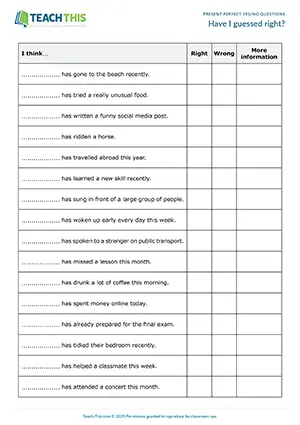
ESL Have You Questions Game - Grammar and Speaking: Guessing, Gap-fill, Asking and Answering Questions, Freer Practice
In this engaging present perfect yes/no questions game, students make guesses and complete present perfect statements about their classmates and then find out if their guesses are right or wrong by...
Have you...?
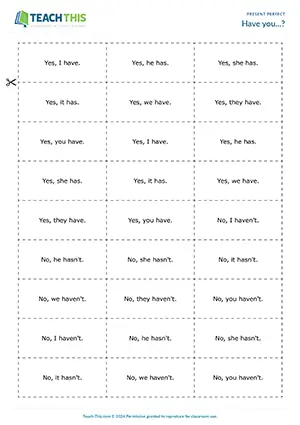
ESL Present Perfect Yes No Questions Game - Grammar and Speaking: Forming, Asking and Answering Questions
This enjoyable present perfect questions game helps students practice present perfect yes/no questions and short answers. In groups, players take turns choosing one of their short answer cards...
Have you done this?
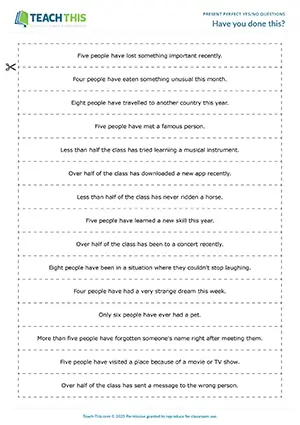
ESL Present Perfect Yes No Questions Activity - Grammar and Speaking: Asking and Answering Questions
In this insightful present perfect yes/no questions activity, students ask 'Have you...?' questions in order to find out if certain statements about the class are true or false. First, students prepare the...
Have you got it?
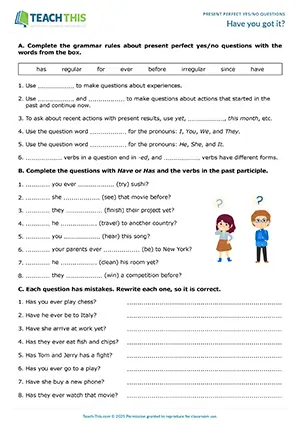
ESL Present Perfect Yes No Questions Worksheet - Grammar Exercises: Gap-fill, Error Correction - Speaking Activity: Asking and Answering Questions, Freer Practice
In this comprehensive present perfect yes/no questions worksheet, students learn the structure and function of 'Have...?' and 'Has...?' questions. First...
Perfect Pair Snap
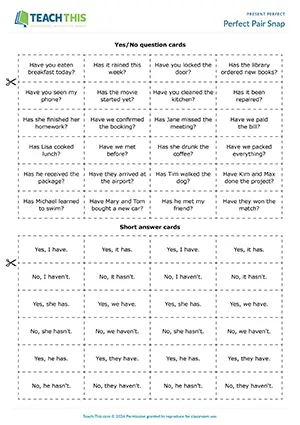
ESL Have and Has Questions Game - Grammar: Snap, Matching Questions and Answers
In this fun present perfect game, students play snap by matching 'Have...?' and 'Has...?' questions with short answers. In pairs, both students turn over a card from their pile at the same time and place them...
Present Perfect Bingo
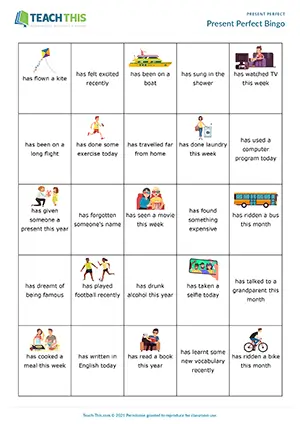
ESL Have You Questions Game - Grammar: Asking and Answering Questions
In this free present perfect yes/no questions game, students play bingo by asking and answering 'Have you...?' questions. Students go around asking their classmates present perfect 'Have you...?' questions from the squares on the bingo grid...
What have you learned about me?
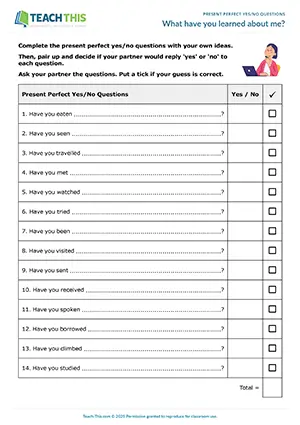
ESL Have You Questions Game - Grammar and Speaking: Completing, Asking and Answering Questions, Guessing
In this intriguing present perfect yes/no questions game, students practice forming, asking and answering questions with 'Have you...?' First, students complete present perfect yes/no questions...
Who has written this?
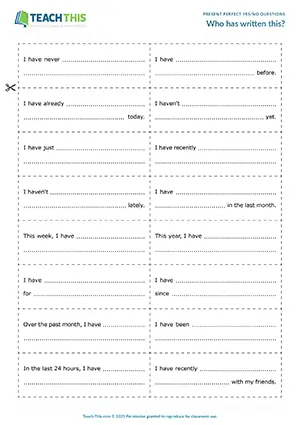
ESL Have You Questions Game - Grammar and Speaking: Sentence Completion, Forming, Asking and Answering Questions
This productive present perfect yes/no questions game helps students to practice asking and answering 'Have you...?' questions about experiences and recently completed actions. First, students...
Life as a Dancer
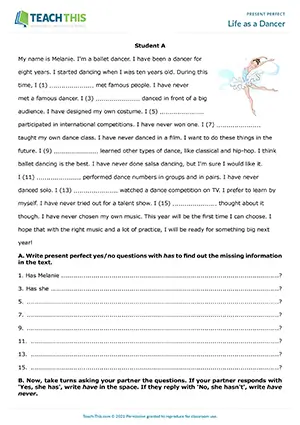
ESL Has Questions Activity - Grammar and Speaking: Information Gap, Writing, Asking and Answering Questions, Gap-fill, Freer Practice - Group and Pair Work
In this rewarding present perfect information gap activity, students write and ask present perfect questions with 'has' in order to complete a text about a dancer...
Understanding Present Perfect Yes/No Questions
Present perfect yes/no questions use 'Have' or 'Has' at the start to ask whether someone has or hasn't done something, and they take a short answer: 'Yes, I have' or 'No, I haven't.' When students leave out the auxiliary or use 'Did' instead of 'Have' or 'Has', the question stops being present perfect entirely, and they end up asking about a specific past event rather than a general experience or current relevance.
This page covers present perfect yes/no questions at A2 and B1 levels, with nine resources including games, a worksheet, speaking activities, and an information gap task, including one free download.
This table shows how to form present perfect yes/no questions with 'Have' and 'Has' and the short answers that go with each.
| Subject | Auxiliary | Question Structure | Example Question | Short Answer (Yes) | Short Answer (No) |
|---|---|---|---|---|---|
| I / you / we / they | Have | Have + subject + past participle? | 'Have you visited Paris?' | 'Yes, I have.' | 'No, I haven't.' |
| he / she / it | Has | Has + subject + past participle? | 'Has she finished the report?' | 'Yes, she has.' | 'No, she hasn't.' |
When to Use Present Perfect Yes/No Questions
Checking Task Completion: A speaker uses a present perfect yes/no question to find out quickly whether something has been done, without asking for details, as in 'Have you sent the report?'
Finding Common Ground: 'Have you ever...?' questions give speakers a natural way to open a conversation and discover shared experiences, as in 'Have you ever been to Japan? I just got back.'
Confirming Readiness: A teacher, manager or host uses a present perfect yes/no question to check that everyone is ready to proceed, making it a natural fit for instructional or professional settings, as in 'Has everyone finished the first section?'
3-Step Framework for Teaching Present Perfect Yes/No Questions
1. Build Accuracy Before Fluency: Start with a worksheet that tests the form before students speak. Students work through gap-fill exercises and a dedicated error correction task where they identify mistakes in questions and rewrite them so that they are grammatically correct, then move on to writing present perfect yes/no questions to match a set of given responses. Building in error correction at this stage catches the most common form mistakes before students take the structure into speaking.
2. Give Every Question a Real Reason: Move students into a class mingle once the form is secure. Each student picks a classmate they think a statement might be true for, writes that person's name at the start of the sentence, for example 'Katie has gone to the beach recently,' then finds Katie and asks 'Katie, have you gone to the beach recently?' to check their guess. The guessing element gives every question a real reason to be asked.
3. Use the Answers to Drive the Activity: Push students into a more demanding information gap where the auxiliary choice carries meaning. Students write and ask present perfect yes/no questions with 'has' to fill gaps in a text, and the answer they receive determines exactly what they write: 'Yes, she has' means writing 'have' in the space, while 'No, she hasn't' means writing 'have never.' The information gap ensures every question serves a genuine communicative purpose.
Common Mistakes with Present Perfect Yes/No Questions
Using the Base Form Instead of the Past Participle: Students often use the base form of the main verb instead of the past participle, particularly with irregular verbs. Wrong: 'Have you ever eat sushi?' Correct: 'Have you ever eaten sushi?'
Confusing 'Have' and 'Has' with the Wrong Subject: Students often use 'Has' with plural subjects or 'Have' with third-person singular subjects, mixing up the two auxiliary forms. Wrong: 'Has they finished the work?' Correct: 'Have they finished the work?'
Common Questions About Teaching Present Perfect Yes/No Questions
What is a good game for practicing present perfect yes/no questions?
The free game Present Perfect Bingo is a class mingle where every student is both asking and answering 'Have you...?' questions at the same time, so nobody sits idle. Students fill squares by finding classmates who answer yes, and the winner must produce five present perfect sentences on the spot before the game continues.
How can I help students practice forming 'Have' and 'Has' questions?
The game Have you...? builds question formation skills because each player must construct a present perfect yes/no question that produces a specific short answer. A player picks a card such as 'Yes, it has,' thinks of a question that will get that response, then asks it. Getting the form wrong means the answer won't match, so accuracy matters immediately.
How can I get students to ask present perfect yes/no questions about experiences?
Giving students a genuine information gap makes the questions feel real rather than mechanical. In the game Who has written this?, each student writes present perfect sentences about their own experiences, and classmates then circulate asking 'Have you...?' questions to track down who wrote each one. Students are motivated to ask accurately because a wrong question gets no useful answer.
Become a Teach This Member
Get unlimited access to the full library, plus new resources added every week.
Unlimited Resource Access
Download from 3000+ worksheets, activities, and games.
Save 5+ Hours Weekly
Cut lesson prep time with ready-to-use resources, plus teacher notes and answer keys.
Trusted Professional Quality
Classroom-tested, editable resources created by experienced ESL professionals.
Fresh Content Weekly
Get 5 new resources added to the library each week.
Here's what our members are saying...


