Last, Yesterday and Ago

Elementary (A1-A2) 30 minutes
ESL time expressions worksheet preview for elementary A1-A2 with vocabulary, writing, and pair speaking practice

ESL Time Expressions Worksheet - Vocabulary and Writing Exercises: Rewriting Sentences - Speaking Activity: Answering Questions - Pair Work

In this handy past time expressions worksheet, students practice time expressions with last, yesterday and ago. First, students underline past time expressions...

ESL Time Expressions Worksheet - Vocabulary and Writing Exercises: Rewriting Sentences - Speaking Activity: Answering Questions - Pair Work In this handy past time expressions worksheet, students practice time expressions with last, yesterday and ago. First, students underline past time expressions in questions and then ask and answer the questions with a partner. Next, students categorise time words and phrases according to the adverb they are used with. Students then add more time expressions of their own under each adverb. After that, students choose the correct past time expression to complete each sentence. Students then circle the odd word out and write why the word is different. Following that, students rewrite sentences using suitable past time expressions from a box. Students then complete time expressions in sentences with last, yesterday, or ago. Next, students complete four of the sentences with true information and four with false information. Finally, students take turns reading the sentences to their partner, who guesses whether they are true or false. For each correct guess, students put a tick. The student with the most correct guesses at the end of the game wins.

Me Too

Elementary (A1-A2) 25 minutes
ESL time expressions activity preview for elementary A1-A2 with categorising, sentence completion, and pair work

ESL Time Expressions Activity - Vocabulary: Categorising, Sentence Completion, Making and Responding to Statements, Controlled Practice - Group and Pair Work

Here is an enjoyable time expressions activity to help students practice present simple time expressions with the prepositions: in, on and at. First, in two groups...

ESL Time Expressions Activity - Vocabulary: Categorising, Sentence Completion, Making and Responding to Statements, Controlled Practice - Group and Pair Work Here is an enjoyable time expressions activity to help students practice present simple time expressions with the prepositions: in, on and at. First, in two groups, students categorise time expressions according to the preposition they are used with: in, on or at. Students then add two more time expressions of their own to each preposition. Next, students complete sentences about themselves using the time expressions, e.g. 'I drink coffee at breakfast.' Students then pair up with someone from the other group and take turns reading their sentences to their partner. If their partner does the activity at the same time, they answer 'Me too', and the student ticks the sentence. If their partner does the activity at a different time, they answer 'I don't', and the sentence is not marked. Afterwards, students count the ticks to see which pair have the most in common. Finally, students report back to the class on which activities they and their partners do at the same time.

A Perfect Match

Pre-intermediate (A2) 25 minutes
ESL time expressions game preview for pre-intermediate A2 with matching and card sentence completion

ESL Time Expressions Game - Vocabulary: Matching, Gap-fill - Pair Work

In this rewarding time expressions game, students match and complete sentences with time expressions. In pairs, students take it in turns to turn over one sentence card and one time expression card. If the time expression can be used to complete...

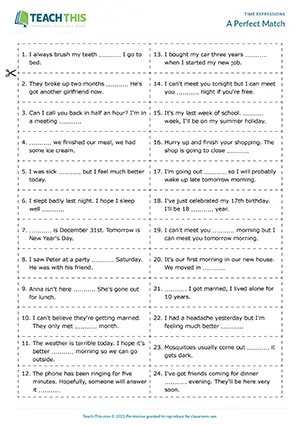
ESL Time Expressions Game - Vocabulary: Matching, Gap-fill - Pair Work In this rewarding time expressions game, students match and complete sentences with time expressions. In pairs, students take it in turns to turn over one sentence card and one time expression card. If the time expression can be used to complete the sentence, the student reads the sentence aloud, replacing the missing word with the time expression on the card. The student then keeps the two cards and has another turn. The student with the most pairs of cards at the end of the game is the winner.

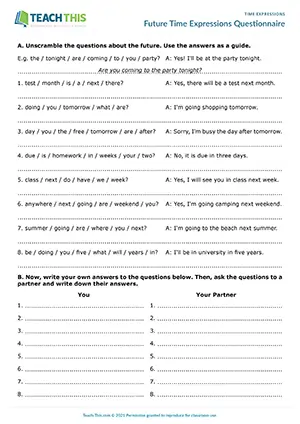
Future Time Expressions Questionnaire
Pre-intermediate (A2) 25 minutes
ESL future time expressions activity preview for pre-intermediate A2 with unscrambling, writing, and pair questions

ESL Future Time Expressions Activity - Vocabulary and Speaking: Unscrambling, Writing, Asking and Answering Questions, Controlled and Freer Practice - Pair Work

In this productive future time expressions speaking activity, students unscramble, ask and answer questions that contain time expressions about the future...

ESL Future Time Expressions Activity - Vocabulary and Speaking: Unscrambling, Writing, Asking and Answering Questions, Controlled and Freer Practice - Pair Work In this productive future time expressions speaking activity, students unscramble, ask and answer questions that contain time expressions about the future. Students begin by reordering words to make questions with future time expressions using the answers shown as a guide. After that, students write their own answers to the questions. In pairs, students then ask their partner the same questions and record their answers. Finally, students give feedback to the class.

Last, Yesterday or Ago?

Pre-intermediate (A2) 20 minutes
ESL past time expressions game preview for pre-intermediate A2 with matching, sentence prompts, and group work

ESL Past Time Expressions Game - Grammar and Speaking: Matching, Forming Sentences, Freer Practice - Group Work

In this fun past time expressions game, students race to make time-related sentences using the words last, yesterday and ago. Students take it in turns to pick up a word card (last, yesterday or ago) and...

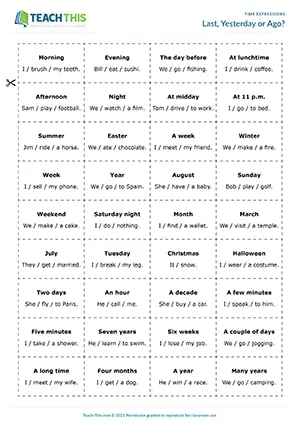
ESL Past Time Expressions Game - Grammar and Speaking: Matching, Forming Sentences, Freer Practice - Group Work In this fun past time expressions game, students race to make time-related sentences using the words last, yesterday and ago. Students take it in turns to pick up a word card (last, yesterday or ago) and place it on the table for everyone to see, e.g. yesterday. Each student then picks up the top sentence card from their pile and looks at it to see if their sentence and time can be used with the word. If it can, the student races to say the sentence on their card using the time with the word, e.g. 'Yesterday morning, I brushed my teeth'. The first student to make a complete past simple sentence, incorporating the past time expression wins and discards their card. The first player to get rid of all their cards is the winner.

Present Time Expressions

Pre-intermediate (A2) 25 minutes
ESL present time expressions worksheet preview for pre-intermediate A2 with matching, categorising, and grammar practice

ESL Present Time Expressions Worksheet - Vocabulary and Grammar Exercises: Matching, Categorising, Gap-fill, Binary Choice

This comprehensive present time expressions worksheet helps to teach students time expressions that are used with the present simple and present continuous...

ESL Present Time Expressions Worksheet - Vocabulary and Grammar Exercises: Matching, Categorising, Gap-fill, Binary Choice This comprehensive present time expressions worksheet helps to teach students time expressions that are used with the present simple and present continuous. First, students match sentence halves together that contain present time expressions. Next, students categorise the time expressions in bold in the sentences, according to whether they are used with the present simple or the present continuous. After that, students complete grammar rules by writing either the present simple or the present continuous in each sentence. Students then move on to underline the correct verb tenses in a set of sentences. Afterwards, students do a gap-fill exercise where they complete sentences with present time expressions. Finally, students match questions with appropriate answers.

Time Expressions Survey

Pre-intermediate (A2) 20 minutes
ESL time expressions survey activity preview for pre-intermediate A2 with group questions and class feedback

ESL Time Expressions Activity - Speaking: Forming, Asking and Answering Questions, Controlled and Freer Practice - Group Work

In this free time expressions speaking activity, students conduct a survey where they ask and answer questions that use past, present and future time expressions. Students begin by preparing the yes/no...

ESL Time Expressions Activity - Speaking: Forming, Asking and Answering Questions, Controlled and Freer Practice - Group Work In this free time expressions speaking activity, students conduct a survey where they ask and answer questions that use past, present and future time expressions. Students begin by preparing the yes/no question they need to ask to find out the information on their card, e.g. 'Did you check your email this morning?' Students then go around their group, asking and answering the questions. Students keep a record of who answers 'yes' or 'no' on the back of the card. When the students have finished, they tally up the 'yes' answers and report their findings back to the class.

Past Time Expressions

Intermediate (B1) 35 minutes
ESL past time expressions worksheet preview for intermediate B1 with unscrambling, matching, and pair questions

ESL Past Time Expressions Worksheet - Vocabulary and Writing Exercises: Matching, Gap-fill, Writing Sentences  - Speaking Activity - Pair Work

This useful past time expressions worksheet helps students practice different time expressions used to talk about the past. First, students unscramble words to...

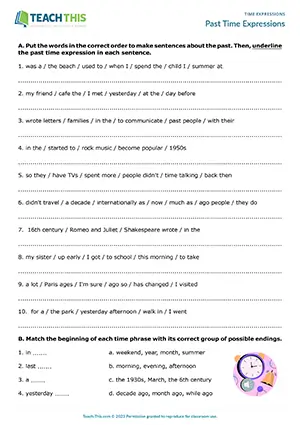
ESL Past Time Expressions Worksheet - Vocabulary and Writing Exercises: Matching, Gap-fill, Writing Sentences - Speaking Activity - Pair Work This useful past time expressions worksheet helps students practice different time expressions used to talk about the past. First, students unscramble words to form sentences about the past. Students then identify and underline the past time expression in each sentence. Next, students match the beginning of a past time expression with its correct group of possible endings. After that, students use past time expressions from a box to complete sentences. Students then move on to write two true sentences and one false sentence about their life using suitable past time expressions from the worksheet. Students then read these sentences to a partner, who guesses which statement is false. Finally, students correct mistakes in questions and then ask and answer the questions with their partner.

Present Time Mime

Intermediate (B1) 30 minutes
ESL present time expressions game preview for intermediate B1 with miming, guessing and sentence formation

ESL Present Time Expressions Game - Grammar and Vocabulary: Miming, Guessing, Forming Sentences - Group Work

In this engaging present time expressions game, students mime sentences on cards for others to guess in order to practice time expressions in the present simple and present continuous. In groups, players...

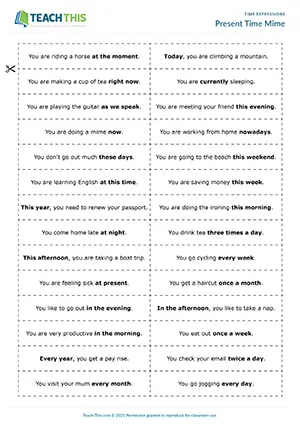
ESL Present Time Expressions Game - Grammar and Vocabulary: Miming, Guessing, Forming Sentences - Group Work In this engaging present time expressions game, students mime sentences on cards for others to guess in order to practice time expressions in the present simple and present continuous. In groups, players take it in turns to pick up a card, read out the time expression at the top of the card and mime the sentence written at the bottom. The other players watch the mime and try to guess the sentence using the time expression with either the present simple or present continuous. The first player to say the correct sentence wins and keeps the card. The player with the most cards at the end of the game wins.

Time Expressions and Idioms

Upper-intermediate (B2) 30 minutes
ESL time expressions and idioms worksheet preview for upper-intermediate B2 with matching, gap-fill, and pair discussion

ESL Time Expressions and Idioms Worksheet - Vocabulary Exercises: Matching, Gap-fill, Sentence Completion - Speaking: Discussion, Freer Practice - Pair Work

This free time expressions and time idioms worksheet helps to teach upper-intermediate students some common expressions and idioms that use the word 'time'...

ESL Time Expressions and Idioms Worksheet - Vocabulary Exercises: Matching, Gap-fill, Sentence Completion - Speaking: Discussion, Freer Practice - Pair Work This free time expressions and time idioms worksheet helps to teach upper-intermediate students some common expressions and idioms that use the word 'time'. Students start by matching sentence halves together that use expressions and idioms with the word 'time'. Next, students match the time expressions and idioms to their definitions. Students then move on to complete gap-fill sentences with the time expressions and time idioms. After that, students complete sentences with true information about themselves. Finally, in pairs, students take it in turns to read their sentences to their partner and discuss them.

Time to Talk

Upper-intermediate (B2) 25 minutes
ESL time expressions board game preview for upper-intermediate B2 with impromptu speech and multiple-choice questions

ESL Time Expressions Board Game - Vocabulary and Speaking: Impromptu Speech, Multiple-Choice Questions, Communicative Practice - Group Work

Here is a communicative time expressions board game to help students practice time expressions and time idioms. Players take turns rolling the dice and...

ESL Time Expressions Board Game - Vocabulary and Speaking: Impromptu Speech, Multiple-Choice Questions, Communicative Practice - Group Work Here is a communicative time expressions board game to help students practice time expressions and time idioms. Players take turns rolling the dice and moving their counters along the board. If a player lands on a 'Talk about' square, they talk about the time-related topic on the square for 20 seconds without stopping. If a player can't think of anything to say or stops talking before the 20 seconds are up, they go back two squares. If a player lands on an 'Answer a question' square, another student picks up a card and reads out the time question along with three possible answers. The player then chooses an answer. If it's correct, the player stays on the square. If not, they move their counter back two squares. The first player to reach the finish wins the game.

Using Time Expressions

Time expressions show when something happens, how often it happens or how long it lasts. Using them with an appropriate verb form helps students distinguish routines, current situations, past events and future plans.

This page contains 11 resources from elementary (A1-A2) to upper-intermediate (B2), including two free downloads. The materials cover past, present and future time expressions, time prepositions and idioms containing 'time'.

Use the examples below to connect each expression with its meaning. A time phrase is a clue to the intended meaning, not an automatic rule that determines the tense in every sentence.

PurposeTime expressionsExample
Describe a routine every day, on Mondays 'I walk to work every day.'
Describe a current action now, at the moment 'She is studying at the moment.'
Locate a finished past event yesterday, last week, two days ago 'We visited them two days ago.'
Refer to the future tomorrow, next month 'We are meeting tomorrow.'
Give a time or period at six, on Friday, in July 'The course starts in July.'
Use an idiomatic expression in no time 'She finished the task in no time.'

How to Use Time Expressions

Establish the time reference: Use a calendar or a simple timeline before asking students to choose an expression. Make clear when the speaker is talking so words such as 'yesterday' and 'next week' have a shared reference point.

Teach complete phrases: Record 'last night', 'yesterday morning' and 'three weeks ago' as combinations. Have students replace the time unit or number where appropriate, checking word order rather than translating each word separately.

Check meaning alongside verb form: Compare a routine with a temporary action, then ask students to explain the difference. Avoid teaching that every expression belongs exclusively to one tense; the complete sentence and context matter.

3-Step Framework for Teaching Time Expressions

For elementary to pre-intermediate students, move from choosing phrases in context to comparing routines and exchanging future information. Review the verb forms needed for each stage before combining the tasks.

1. Match expressions to sentences: Students turn over a sentence card and a time-expression card, keeping matching pairs after reading the completed sentence aloud. This gives them practice checking whether a phrase makes sense in context before producing personal examples.

2. Compare routines: Students sort expressions under 'in', 'on' and 'at', then complete statements about themselves. Partners read their statements and respond according to whether they do the same activity at the same time. Reporting shared routines makes accurate time phrases useful for comparing information.

3. Exchange future information: Students reorder words to form questions containing future time expressions and prepare their own answers. They then interview a partner, record the responses and report back. This extends practice from prepared statements to asking for information about another person's future.

Common Mistakes with Time Expressions

Putting 'ago' before the time period: Place 'ago' after the amount of time when counting back from now. Incorrect: 'I saw her ago two days.' Correct: 'I saw her two days ago.'

Adding a preposition before 'last' or 'next': Omit 'in', 'on' and 'at' before expressions such as 'last week' and 'next Monday'. Incorrect: 'We are meeting on next Monday.' Correct: 'We are meeting next Monday.' Without 'next', 'We are meeting on Monday' is correct.

Common Questions About Teaching Time Expressions

What free speaking activity helps students practice time expressions?

The activity Time Expressions Survey gives students a reason to use past, present and future time expressions in questions. They prepare a yes/no question from a card, interview classmates and record responses. Counting the positive answers and reporting their findings adds a clear outcome to the exchanges.

What game helps students practice last, yesterday and ago?

In the game Last, Yesterday or Ago?, students turn over a time-expression word card and check whether their sentence card fits it. They race to say a complete past simple sentence using the expression correctly. Successful players discard their cards, so winning depends on combining the words in a suitable sentence.

What worksheet can I use for teaching time expressions?

The worksheet Present Time Expressions helps students connect time phrases with the present simple and present continuous. Students match sentence halves, sort expressions, complete grammar rules and choose suitable verb forms. Gap-fill sentences and question-and-answer matching then check whether they can use the expressions appropriately in context.

Become a Teach This Member

Get unlimited access to the full library, plus new resources added every week.

Unlimited Resource Access

Download from 3000+ worksheets, activities, and games.

Save 5+ Hours Weekly

Cut lesson prep time with ready-to-use resources, plus teacher notes and answer keys.

Trusted Professional Quality

Classroom-tested, editable resources created by experienced ESL professionals.

Fresh Content Weekly

Get 5 new resources added to the library each week.

Join Now Just $29.99 quarterly