
Coursework & Assignment Skills EAP Activities
Where’s the Line?
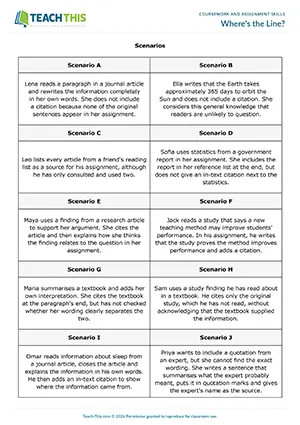
EAP Academic Integrity Activity - Reading, Speaking and Writing: Categorising Scenarios, Discussion, Writing a Short Explanation - Pair Work
Students use an academic integrity checklist to judge ten examples of source use. In pairs, they explain their choices and discuss how to acknowledge sources...
Understanding Academic Integrity in Coursework
Academic integrity in coursework means making clear which ideas and words are your own and which come from another source. Readers need to be able to follow that distinction even when a paragraph moves from reporting a finding to interpreting it.
This page includes one 40-minute activity for upper-intermediate (B2) learners, available with membership or as an individual purchase. Students work in pairs to judge examples of source use and explain their decisions.
| Writing choice | What the reader needs to know | A question to ask students |
|---|---|---|
| Quoting | Which words are taken directly from the source and where they came from. | ‘Where does the quotation end and your explanation begin?’ |
| Paraphrasing | Whose idea you are explaining in your own words. | ‘Could a reader find the original idea from your citation?’ |
| Drawing a conclusion | Which evidence comes from the source and which interpretation you are adding. | ‘Did the author draw this conclusion, or did you?’ |
How to Discuss Source Use with Students
Whose idea is this? Ask students to underline the claim and identify who first made it. If the writer builds on someone else’s finding, have the pair mark the point where the writer’s own interpretation begins.
Whose words are these? Compare a short passage with the student’s wording. Ask learners to circle any distinctive phrase they have kept and decide whether to quote it or explain the idea afresh.
What would you need to check before deciding? Give pairs a sentence starter such as ‘Our decision would change if…’. Ask them to finish it with a specific missing detail, such as whether the preceding sentence already identifies the source.
A Two-Step Framework for Teaching Academic Integrity
1. Make a judgement and give a reason. Pairs use the checklist to classify ten scenarios as acceptable, borderline or problematic. When partners disagree, ask each to point to the detail behind their choice. Have them record any question they need answered before settling a borderline case.
2. Turn the judgement into advice. Pairs revisit a borderline or problematic case and write two or three sentences explaining the issue and what the student should do differently. Ask a partner to identify the exact change they would make after reading the advice.
Common Mistakes with Source Use
Swapping a few words in a paraphrase. Suppose a source says ‘Travel costs limited attendance at evening classes.’ Changing this to ‘Travel expenses restricted attendance at evening lessons’ still follows the source closely. Ask students to set it aside, explain the idea aloud, then write their explanation and cite the source. One possibility is ‘Some learners could not afford the journey to evening classes.’ Have them check that the meaning still fits the original context.
Giving a reference while leaving copied words unmarked. A citation identifies the source, but readers also need to see where its exact wording starts and ends. If a student keeps a distinctive phrase, ask them to mark it as a quotation and cite it in the style required for the assignment.
Common Questions About Teaching Academic Integrity
How can I help students discuss borderline cases of source use?
In the activity Where’s the Line?, pairs use a checklist to judge ten examples of source use. When a case is borderline, students explain what else they need to know. They then choose one case and write two or three sentences explaining the problem and what the student should do differently.
Become a Teach This Member
- 3,000+ ESL activities, games and worksheets
- Online teaching platform with unlimited student access
- Full access to Game Maker, Worksheet Maker and Slide Maker
Here’s What Our Members Are Saying


