
Adjective Opposites ESL Activities, Worksheets & Games
Do you prefer...?
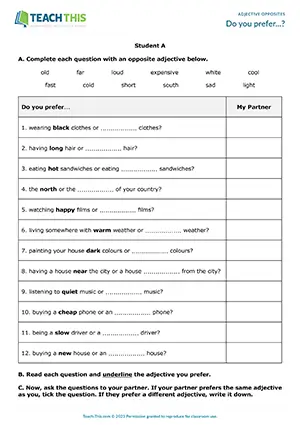
ESL Adjective Opposites Game - Vocabulary and Speaking: Gap-fill, Guessing, Asking and Answering Questions - Group and Pair Work
In this fun adjective opposites game, students find out how well they know their partner by guessing their preferences, and then checking their answers by asking...
Hot or Cold? Adjective Opposites
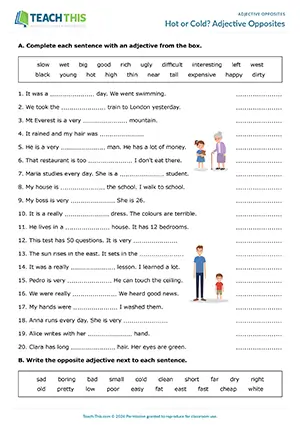
ESL Adjective Opposites Worksheet - Vocabulary Exercises: Gap-fill, Matching, Crossword - Speaking Activity: Asking and Answering Questions - Pair Work
In this productive adjective opposites worksheet, students build their knowledge of common adjective opposites and practice using them in conversation...
Opposites Search
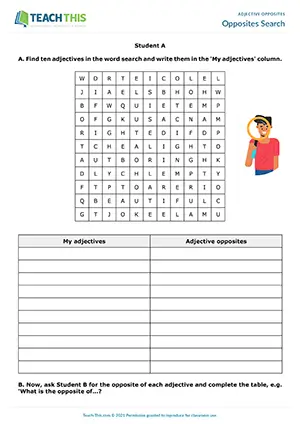
ESL Opposite Adjectives Activity - Vocabulary: Word Search, Asking and Answering Questions, Writing Sentences - Group and Pair Work
In this memorable adjective opposites activity, students find adjectives in a word search and then work with a partner to find each adjective's opposite, before...
Pat and Pete

ESL Opposite Adjectives Activity - Vocabulary: Matching, Gap-fill - Pair Work
In this enjoyable adjective opposites activity, students practice adjective opposites by reading and completing sentences about two very different men, Pat and Pete. Explain that Pat and Pete are opposites in every way and that one student has...
Adjective Opposites 1
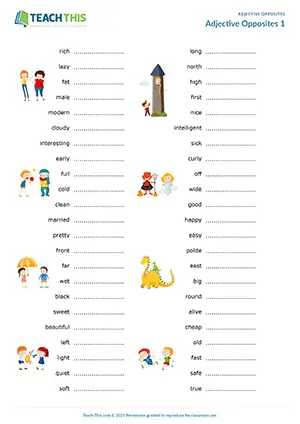
ESL Adjective Opposites Activities - Vocabulary Game: Forming Sentences - Group Work - Writing Activity: Writing Sentences, Story Writing - Pair Work
These free adjective opposites activities help to increase students' knowledge of adjectives and their opposites. Read an adjective at random from the worksheet...
Adjective Opposites Bingo
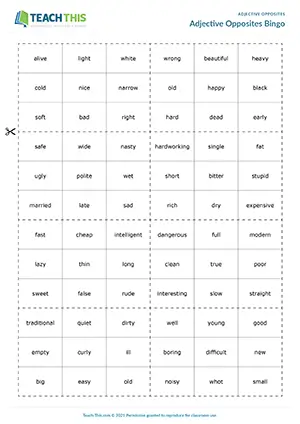
ESL Opposite Adjectives Game - Vocabulary: Matching
In this fun opposite adjectives game, students listen to adjectives and match them to their opposites. Call out adjectives from the caller's sheet in a random order. If students have the opposite of the adjective on their card, they cross it off. When a student...
What's the opposite?

ESL Adjective Opposites Activities - Vocabulary: List Completion, Providing Antonyms, Guessing, Matching - Pair Work
This useful adjective opposites worksheet and game helps students to identify and memorise common adjectives and their opposites. First, students use use adjectives from a box to complete an adjective...
Opposites Attract
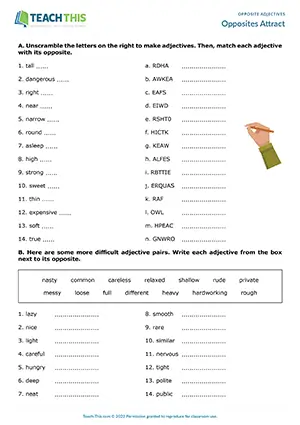
ESL Adjective Opposites Worksheet - Vocabulary Exercises: Matching, Identifying, Error Correction, Gap-fill
Here is a comprehensive adjective opposites worksheet for intermediate students. First, students unscramble letters to make adjectives and then match each adjective with its opposite. Next, students...
Similar or Opposite?
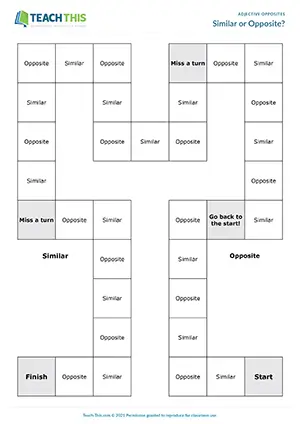
ESL Adjective Opposites Board Game - Vocabulary: Naming Opposites and Synonyms - Group Work
In this free adjective opposites board game, students name adjectives that have a similar or opposite meaning to another adjective. Players take it in turns to roll the dice and move their counter along...
Adjective Opposites 2
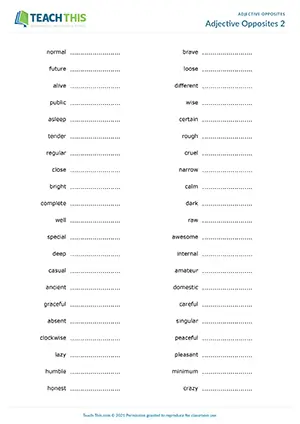
ESL Adjective Opposites Activities - Vocabulary Game: Providing Antonyms, Forming Sentences - Group Work - Writing Activity: Story Writing - Pair Work
This engaging set of adjective opposites activities helps to increase students' knowledge of more advanced adjectives and their opposites. First, read...
Awesome Opposites
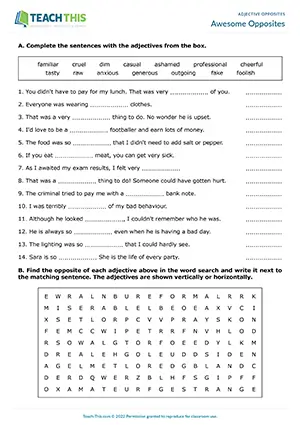
ESL Adjective Opposites Worksheet - Vocabulary Exercises: Gap-fill, Word Search, Matching - Speaking Activity: Asking and Answering Questions - Pair Work
Here is an insightful adjective opposites worksheet for upper-intermediate students. First, students complete sentences with adjectives from a box. Next...
Understanding Adjective Opposites
Adjective opposites, also called antonyms, are pairs of adjectives that express opposite meanings, such as 'hot' and 'cold' or 'generous' and 'mean'. Students who learn adjectives in isolation without their opposites often plateau quickly, because they can describe one end of a quality but cannot express contrast, disagreement, or nuance when they need it.
This page covers adjective opposites across A1-A2, A2, B1, and B2 levels, with eleven resources spanning worksheets, speaking activities, games, and a board game, including two free downloads.
The table below lists common adjective opposite pairs by category, with an example sentence showing both words in use.
| Category | Adjective | Opposite | Example Sentence |
|---|---|---|---|
| Size | big | small | 'The room is big, but the bathroom is small.' |
| Temperature | hot | cold | 'The coffee is hot, but the water is cold.' |
| Age | old | new | 'My car is old. His car is new.' |
| Speed | fast | slow | 'The train is fast. The bus is slow.' |
| Appearance | clean | dirty | 'Her desk is clean. His desk is dirty.' |
| Personality | friendly | unfriendly | 'She is friendly. He is unfriendly.' |
| Difficulty | easy | difficult | 'The first question was easy. The last was difficult.' |
| Price | cheap | expensive | 'This bag is cheap. That one is expensive.' |
| Weight | heavy | light | 'The suitcase is heavy. The bag is light.' |
| Height | tall | short | 'My brother is tall. My sister is short.' |
When to Use Adjective Opposites
Giving a Balanced Description: Writers reach for adjective opposites when they want to present two sides of something fairly rather than giving a one-sided impression, as in 'The course was long and demanding, but also rewarding and inspiring.'
Describing Change Over Time: Speakers use adjective opposites when describing how something has shifted from one state to another, giving the listener an immediate sense of the scale of the change, as in 'The neighborhood used to be dangerous and run-down, but now it's safe and well-maintained.'
Creating a Vivid Picture: Pairing an adjective with its opposite helps a reader or listener picture exactly where something sits on a scale, as in 'The soup was neither too hot nor too cold, just warm enough to be comfortable.'
3-Step Framework for Teaching Adjective Opposites
1. Information-Gap Recognition: Start with a pair activity built around two characters who are opposites in every way. One student holds information about one character, the other holds information about the second, and they take turns reading out sentences while their partner listens and completes each corresponding sentence with the opposite adjective. The information-gap format means students cannot copy; they have to process meaning to find the right word.
2. Recall Under Pressure: Shift to a fast-paced whole-class game where students listen for an adjective and cross off its opposite on their card. The payoff mechanic builds in accountability: when a student crosses off all nine adjectives and shouts 'Bingo', they must read back all nine pairs aloud, and if the student makes a mistake, the game continues rather than awarding the win.
3. Production in Context: Finish with a team game that escalates naturally into writing. One team scores a point by calling out the opposite of a given adjective, then earns a bonus point by using that opposite correctly in a sentence. Students then work individually to write ten sentences using two adjectives from the worksheet in each, such as 'The tall man drove a black car', before swapping with a partner and rewriting every adjective as its opposite.
Common Mistakes with Adjective Opposites
Using the Wrong Negative Prefix: Students often apply the wrong prefix when forming a negative opposite, treating all adjectives as though they follow the same rule. Wrong: 'He was very unpoliteful to the waiter.' Correct: 'He was very impolite to the waiter.'
Choosing a Near-Synonym Instead of the True Opposite: Students often substitute an adjective that overlaps in meaning but does not accurately pair with the target adjective in context. Wrong: 'He is not tall. He is small.' Correct: 'He is not tall. He is short.'
Common Questions About Teaching Adjective Opposites
What is a useful worksheet for practicing adjective opposites?
The worksheet Opposites Attract gives students a structured workout across five exercise types, moving from unscrambling and matching through to error correction, where students identify incorrect adjectives in sentences, and a final gap-fill stage using suitable adjectives. It covers more demanding adjective pairs, making it a clear step up from beginner material.
What is an engaging game for practicing adjective opposites?
Conversation questions built around personal choices give students a natural reason to use adjective opposites. The game Do you prefer...? puts students in a speaking context where they use opposite adjectives to ask and answer questions about preferences, moving from controlled practice with a word box to a structured conversation with a partner.
What is a fun board game for practicing adjective opposites and synonyms?
The free board game Similar or Opposite? challenges students to produce both antonyms and synonyms in the same activity. Two card categories drive the game: for the opposite category, players name the antonym of a given adjective; for the similar category, they name an adjective close in meaning. A wrong answer sends the player back two squares.
Become a Teach This Member
Get unlimited access to the full library, plus new resources added every week.
Unlimited Resource Access
Download from 3000+ worksheets, activities, and games.
Save 5+ Hours Weekly
Cut lesson prep time with ready-to-use resources, plus teacher notes and answer keys.
Trusted Professional Quality
Classroom-tested, editable resources created by experienced ESL professionals.
Fresh Content Weekly
Get 5 new resources added to the library each week.
Here's what our members are saying...


