
Interjections ESL Games & Worksheets
Interjection Dominoes

ESL Interjections Game - Vocabulary: Matching - Group Work
This enjoyable interjections game helps students practice recognising and using common interjections appropriately. The first player then puts a domino down before or after the domino on the table, making sure that the interjection matches...
Check Off
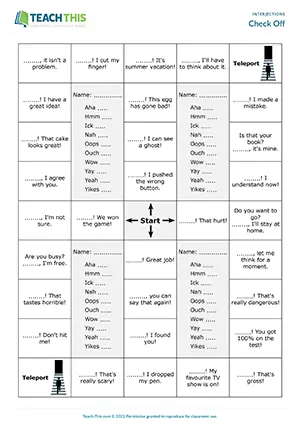
ESL Interjections Board Game - Vocabulary: Sentence Completion - Group Work
In this fun interjections board game, students race to check off interjections from a list by using them appropriately in sentences. Players take it in turns to roll the dice and move their counter along the board in any direction. When a player...
Common Interjections
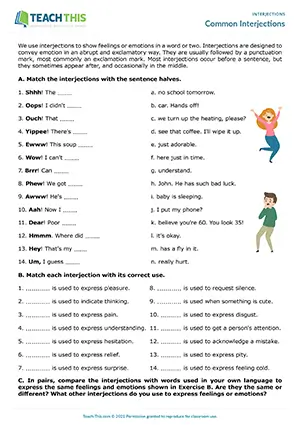
ESL Interjections Worksheet - Grammar and Vocabulary Exercises: Matching, Gap-fill, Writing Sentences - Speaking Activities: Discussion, Guessing Game - Pair Work
This insightful interjections worksheet helps students learn and practice some interjections that are commonly used in the English language. Students begin...
Interjections Race

ESL Interjections Game - Vocabulary: Matching, Sentence Completion - Group and Pair Work
In this free interjections game, students race to match interjections with sentences. In two groups, students match each interjection on their worksheet with an appropriate meaning. Next, students pair up with...
Interjections Bingo
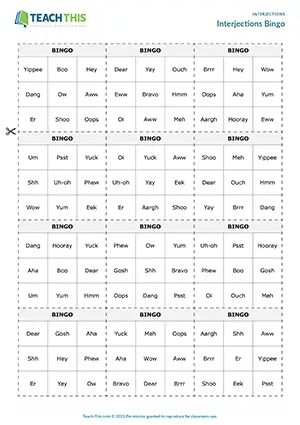
ESL Interjections Game - Vocabulary: Matching, Sentence Completion - Group Work
In this engaging interjections game, students play bingo by matching interjections with sentences. You or a student reads a sentence at random from the caller's sheet, saying the word 'blank' where the...
Interjections Practice

ESL Interjections Worksheet - Vocabulary Exercises: Matching, Unscrambling, Binary Choice, Gap-fill - Speaking Activity: Discussion, Freer Practice, Pair Work
Here is a handy interjections worksheet for upper-intermediate students. First, students match interjections with their meanings. Next, students unscramble...
Understanding Interjections
Interjections are short words or sounds like 'wow,' 'oops,' and 'ugh' that express a sudden emotion or reaction and stand apart from the grammar of the sentence around them. Students who skip interjections in conversation and writing come across as flat and emotionally distant, since these words are often what makes a response sound warm, surprised, or natural rather than rehearsed.
This page covers interjections at A2, B1, and B2 levels, with six activities including dominoes, a board game, bingo, and two worksheets, with one free download available.
This table maps ten common English interjections to the emotion or situation they express, with a short example sentence for each.
| Interjection | Emotion / Situation | Example in Context |
|---|---|---|
| Wow | Surprise or admiration | 'Wow, I had no idea you could sing!' |
| Oops | Mild mistake or accident | 'Oops, I forgot to send the email.' |
| Ouch | Pain | 'Ouch, that really hurt!' |
| Ugh | Disgust or frustration | 'Ugh, I can't believe I failed again.' |
| Yay | Excitement or happiness | 'Yay, we won the match!' |
| Phew | Relief | 'Phew, I thought I had lost my passport.' |
| Hmm | Hesitation or thought | 'Hmm, I'm not sure about that.' |
| Uh-oh | Worry or anticipation of a problem | 'Uh-oh, I think I left the oven on.' |
| Hey | Greeting or getting attention | 'Hey, have you seen my keys?' |
| Shh | Requesting silence | 'Shh, the baby is sleeping.' |
When to Use Interjections
Showing Empathy in Conversation: A listener uses an interjection to signal they are emotionally present and reacting to what is being said, so someone hearing unexpected bad news would say 'Oh no, that's terrible' rather than 'That is bad news' to sound genuinely engaged rather than detached.
Softening a Mistake or Apology: A short interjection before an apology reduces the formality and makes the speaker sound more human, so a colleague who has just made a small error at work might say 'Oops, my mistake' rather than launching straight into 'I apologize' to keep the tone light and natural.
Expressing Reactions in Informal Writing: In text messages, emails to friends, and social media, interjections replace the facial expressions and tone of voice that face-to-face conversation provides, so a friend replying to good news might write 'Wow, that is amazing!' rather than 'That is good news' to make the written message feel warmer and more spontaneous.
3-Step Framework for Teaching Interjections
1. Build Recognition and Production with a Worksheet: Open with a worksheet that takes students from recognizing interjections to producing them. After matching and gap-fill exercises, students write eight interjections from the worksheet and create a follow-up sentence for each one, then read just the sentence to a partner without saying the interjection to see if their partner can guess which one fits.
2. Put Production Under Pressure with a Board Game: Follow with a board game where players roll the dice and move in any direction, and when a player lands on a gap-fill sentence square, they complete it with an interjection from their personal list. The rest of the group acts as judge, a correct answer lets the player check that interjection off their list, and the first player to check off every interjection wins.
3. Review with a Whole-Class Bingo Game: Round off with a bingo game that doubles as a review activity. A caller reads sentences from a sheet using the word 'blank' where the interjection belongs, and students cross off any matching interjection on their bingo card. The first student to cross off all their interjections shouts 'Bingo!' and reads them back to verify the win.
Common Mistakes with Interjections
Using a Formal Response Where an Interjection Is Expected: Students often respond to surprising or emotional news with a full formal sentence rather than a natural interjection, which makes their response sound stiff and unnatural in conversation. Wrong: 'That is very surprising to hear.' Correct: 'Wow, that is very surprising!'
Confusing Interjections with Similar Meanings: Students often confuse interjections that cover similar ground, using one where the other clearly fits, because they have not yet mapped each word to its specific situation. Wrong: 'Oops! I burned my hand on the stove.' Correct: 'Ouch! I burned my hand on the stove.'
Common Questions About Teaching Interjections
What is a fun game for introducing interjections?
Matching games help students connect interjections with the situations that call for them before they try to produce them independently. In the game Interjection Dominoes, players build a chain by placing dominoes so that each interjection matches the appropriate situation or expression at the join. It is a 20-minute activity.
What is a good worksheet for teaching interjections?
Vocabulary worksheets work best when they move from meaning to form to production, and the worksheet Interjections Practice follows that sequence. After matching interjections with meanings, students unscramble feeling and emotion nouns and match them to the interjections used to express them, then move through binary choice, gap-fill, and sentence-matching tasks.
What is an effective activity for practicing interjections in English?
Pair reading activities give interjection practice a natural back-and-forth rhythm. In the free game Interjections Race, students take turns reading sentences to their partner, who has to find and provide a suitable interjection to begin each sentence, with both students agreeing before writing it down. The first pair to complete all their sentences wins.
Become a Teach This Member
Get unlimited access to the full library, plus new resources added every week.
Unlimited Resource Access
Download from 3000+ worksheets, activities, and games.
Save 5+ Hours Weekly
Cut lesson prep time with ready-to-use resources, plus teacher notes and answer keys.
Trusted Professional Quality
Classroom-tested, editable resources created by experienced ESL professionals.
Fresh Content Weekly
Get 5 new resources added to the library each week.
Here's what our members are saying...


