
Integrating Sources EAP Worksheets & Activities
Beyond the Numbers
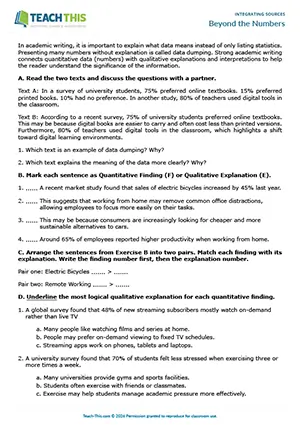
EAP Data Commentary Worksheet - Reading and Writing Exercises: Categorising, Paragraph Writing - Speaking Activity: Discussion, Freer Practice - Pair Work
In this data commentary worksheet, students learn how to move beyond 'data dumping' by explaining what numbers mean and linking findings to plausible...
Building Citation Clusters
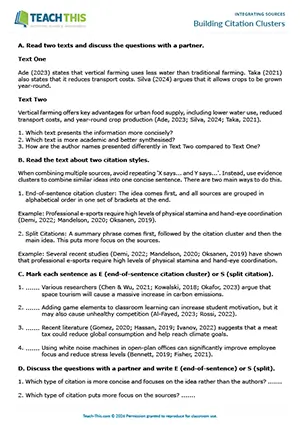
EAP Citation Clusters Worksheet - Reading and Writing Exercises: Identifying, Matching, Writing and Rewriting Sentences
In this citation clusters worksheet, students explore two common citation patterns and learn how to blend information from multiple sources so their academic writing sounds more concise and...
Building Definitions from Sources
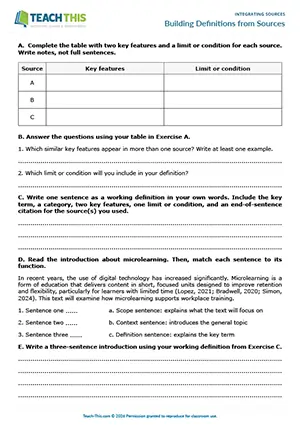
EAP Source-Based Definitions Worksheet - Reading and Writing Exercises: Identifying, Matching, Table Completion, Short-answer Questions, Sentence and Paragraph Writing
In this source-based definitions worksheet, students learn to combine ideas from three short texts to write a clear working definition with a citation and use it to...
Build the Argument
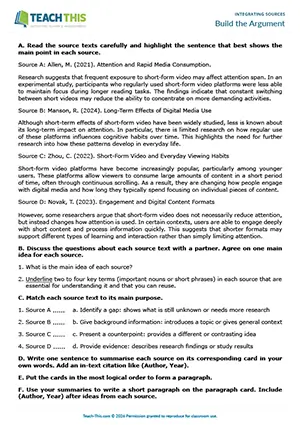
EAP Source-Based Argument Activity - Reading, Writing and Speaking: Identifying, Summary Writing, Paragraph Writing, Discussion, Freer Practice - Pair Work
In this source-based argument activity, students identify the key point in each short text, summarise it in their own words, and combine the ideas into a...
Checking the Evidence
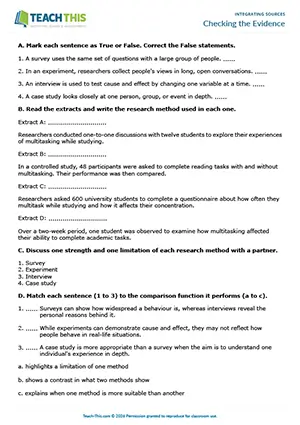
EAP Evaluating Evidence Worksheet - Reading and Writing Exercises: True or False, Writing Sentences, Paragraph Writing - Speaking Activity: Discussion - Pair Work
In this evaluating evidence worksheet, students evaluate research-style extracts about multitasking, compare the strengths and limitations of different methods...
Citation Practice Workshop
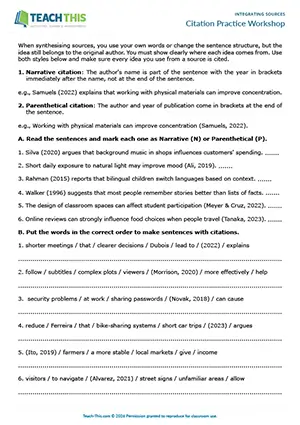
EAP Citation Practice Worksheet - Reading and Writing Exercises: Binary Choice, Rewriting Sentences, Rewriting a Paragraph, Peer Feedback - Pair Work
In this citation practice worksheet, students practice identifying and using narrative and parenthetical citations and correcting citation errors in a short synthesis...
Claim-Evidence-Reasoning Paragraphs
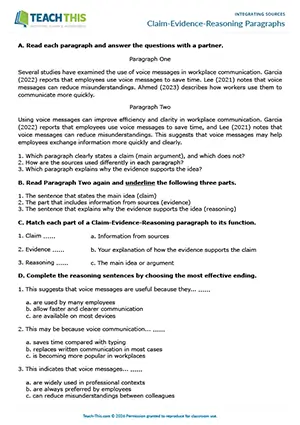
EAP Claim-Evidence-Reasoning Worksheet - Reading and Writing Exercises: Identifying, Multiple Choice, Short Answer Questions, Table Completion, Paragraph Writing
In this free claim-evidence-reasoning worksheet, students explore how source information can be combined into a clear argument before writing a short...
Common Themes and Evidence
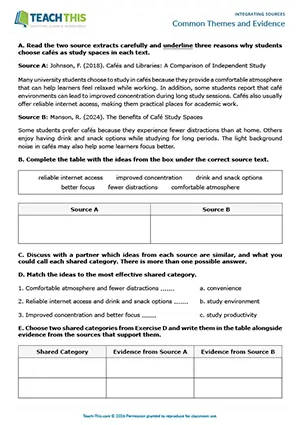
EAP Theme-Based Synthesis Worksheet - Reading and Writing Exercises: Categorising, Matching, Paragraph Writing, Peer Feedback - Speaking Activity: Discussion - Pair Work
In this theme-based synthesis worksheet, students practice identifying shared themes in two short texts and using evidence to write a clear synthesis paragraph...
From Sources to Synthesis
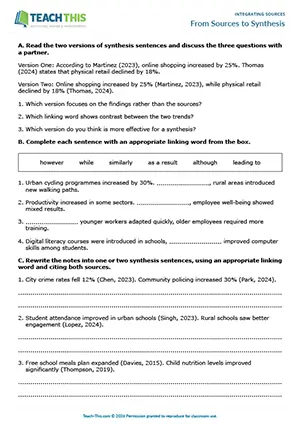
EAP Synthesis Paragraph Worksheet - Reading, Vocabulary and Writing Exercises: Gap-fill, Rewriting Sentences, Table Completion, Paragraph Writing
In this synthesis paragraph worksheet, students practice selecting and grouping key ideas from multiple sources and then writing a short synthesis paragraph...
Introduce, Quote, Explain
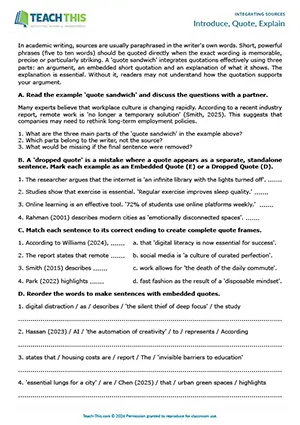
EAP Quote Sandwiches Worksheet - Reading, Vocabulary and Writing Exercises: Categorising, Matching, Binary Choice, Writing Sentences, Writing Direct Quotes
In this quote sandwiches worksheet, students practice integrating short quotations by building complete 'quote sandwiches' that include an argument...
Source Synthesis Practice
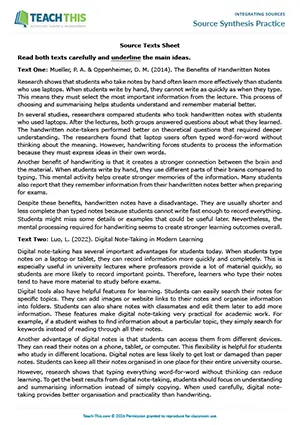
EAP Compare and Contrast Synthesis Worksheet - Reading and Writing Exercises: Identifying, Categorising, Paragraph Writing
In this compare and contrast synthesis worksheet, students practice writing a short synthesis paragraph about two texts in their own words, using compare and contrast linkers and simple...
Trend or Exception?
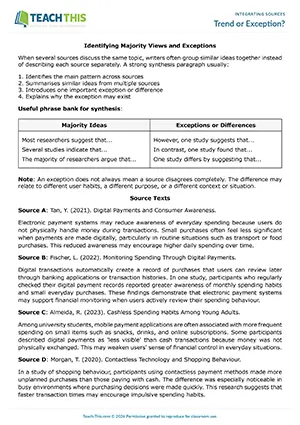
EAP Trend and Exception Synthesis Worksheet - Reading and Writing Exercises: Table Completion, Sentence Completion, Multiple-choice, Paragraph Writing
In this trend and exception synthesis worksheet, students compare four short texts about digital payments, spot which one breaks the pattern, and write a short...
Understanding Source Integration
Source integration involves selecting relevant information from other texts, representing it accurately and connecting it to a writer's own purpose. Readers need to understand both where an idea comes from and how it supports, qualifies or challenges the point being developed.
This page contains twelve B2 resources covering synthesis, quotations, citations, evidence evaluation, source-based definitions and data commentary. One worksheet is available as a free download.
The table shows decisions students make when integrating sources. Citation and quotation formats should follow the style required by the assignment.
| Technique | Purpose | Checking question |
|---|---|---|
| Summarise a source | Present the main point briefly and accurately | 'Have I retained the central idea and any important qualification?' |
| Synthesise sources | Organise information around shared themes or differences | 'What relationship between these sources helps answer my question?' |
| Integrate a quotation | Use exact wording where it serves the analysis | 'Have I introduced the quotation and explained its relevance?' |
| Interpret data | Explain a finding without claiming more than it shows | 'Am I distinguishing the reported result from my interpretation?' |
| Attribute information | Make the origin and scope of borrowed ideas clear | 'Can the reader tell which source supports each claim?' |
| Evaluate evidence | Consider how methods and limitations affect a claim | 'What does this evidence establish, and what remains uncertain?' |
How to Integrate Sources in Academic Writing
Let the question guide selection: Ask students to identify the point they need to develop before choosing source material. A detail belongs in the paragraph because it helps address that point, not simply because it appears in an assigned text.
Keep notes traceable: Record the source alongside each note and clearly distinguish copied wording from a summary or personal comment. Before drafting, check that shortened notes preserve the original meaning and do not omit conditions that limit the claim.
Make the writer's reasoning visible: After presenting source information, explain the connection to the paragraph's purpose. A citation identifies the source; it does not replace analysis or establish that an interpretation is justified.
3-Step Framework for Teaching Source Integration
Use this sequence across B2 lessons to develop judgement about evidence, organise relationships between sources and check attribution.
1. Establish what the evidence supports: Students examine research-style extracts about multitasking, identify the methods and compare their strengths and limitations. They record their observations, write comparison sentences and develop a paragraph explaining what two extracts do and do not show. This prepares them to select evidence without overstating its implications.
2. Organise sources around shared themes: Students identify reasons in two texts about cafes as study spaces and group similar ideas into shared categories. They select supporting details for two categories, complete synthesis sentences and write a paragraph before exchanging checklist feedback. Emphasise the move from separate source notes to a paragraph organised by ideas.
3. Check attribution within the paragraph: Students distinguish narrative and parenthetical citations, rewrite sentences and correct five citation problems in a synthesis paragraph. They then use a peer checklist to discuss and correct remaining issues. Ask them to apply these checks to the earlier paragraph, following the required citation style and ensuring that each attribution supports the intended claim.
Common Mistakes with Source Integration
Treating citation as a substitute for quotation marking: Adding a citation does not turn copied wording into a paraphrase. Problem: A sentence repeats a source's exact words with a citation but does not identify them as a quotation. Better approach: Mark the wording as a quotation using the required format, or genuinely paraphrase it while preserving its meaning and retaining the citation.
Hiding differences between sources: A synthesis should preserve relevant disagreement and conditions rather than merge every finding into one broad claim. In this hypothetical example, one source reports a benefit only under a particular condition, while another finds no benefit. Overstatement: 'Both sources show that the approach is effective.' More accurate synthesis: 'The findings differ: one source reports a benefit under a specific condition, whereas the other reports no benefit.'
Common Questions About Teaching Source Integration
How can I teach students to combine sources in writing?
The worksheet From Sources to Synthesis guides students from linking ideas in sentences to organising information around a research question. They select relevant points from three sources, group them under headings and record notes in a table. Writing a synthesis paragraph then gives those grouped ideas a connected form with citations.
What worksheet helps teach students to integrate quotations?
The worksheet Introduce, Quote, Explain shows students how to connect a quotation to an argument and explain its significance. They distinguish embedded quotations from dropped quotations, build quote frames and evaluate explanations. Students then write their own explanations and complete quotation-based paragraphs, practicing the reasoning that makes a quotation relevant.
What free worksheet helps teach evidence-based writing?
The worksheet Claim-Evidence-Reasoning Paragraphs helps students distinguish a claim from its evidence and the reasoning that connects them. They analyse model paragraphs, evaluate reasoning sentences and organise information from sources about background audio and concentration. Students then write a short paragraph integrating two sources, making the connection between evidence and argument explicit.
Become a Teach This Member
Get unlimited access to the full library, plus new resources added every week.
Unlimited Resource Access
Download from 3000+ worksheets, activities, and games.
Save 5+ Hours Weekly
Cut lesson prep time with ready-to-use resources, plus teacher notes and answer keys.
Trusted Professional Quality
Classroom-tested, editable resources created by experienced ESL professionals.
Fresh Content Weekly
Get 5 new resources added to the library each week.
Here's what our members are saying...


