
Business Negotiations Worksheets, Role-Plays & Games
Expressing a Negotiation Position
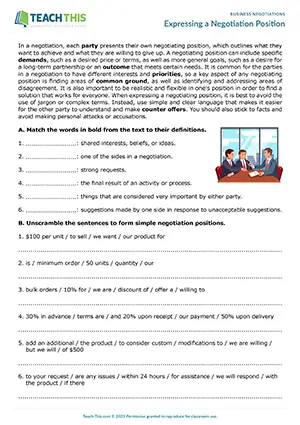
Business English Negotiations Worksheet - Vocabulary, Reading and Writing Exercises: Matching, Unscrambling, Labelling, Writing Sentences
In this useful negotiation positions worksheet, students learn and practice expressing simple negotiation positions. First, students match keywords related to...
Make the Deal
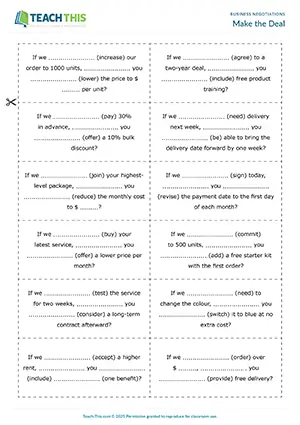
Business English Negotiations Activity - Completing, Asking and Answering Questions, Discussion, Freer and Communicative Practice - Group Work
In this engaging business negotiations activity, students use second conditional questions to negotiate offers and counteroffers, justify choices...
Offers and Counteroffers
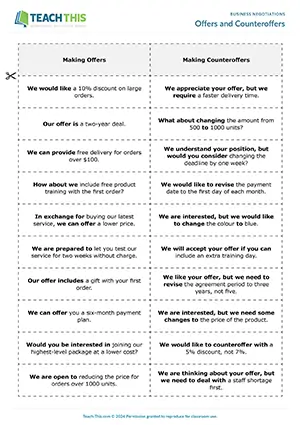
Business English Negotiation Games - Vocabulary and Speaking: Categorising, Gap-fill, Role Play, Controlled and Freer Practice - Pair Work
Here are two engaging business negotiation games to help students learn and practice language for making offers and counteroffers in negotiations. First, in pairs...
Employment Contract Negotiation
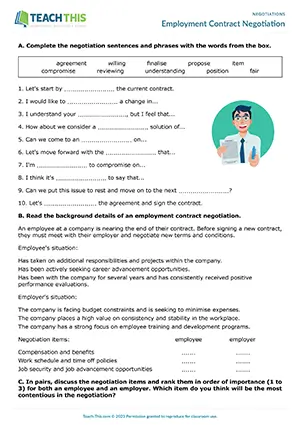
Business English Negotiations Role Play - Vocabulary, Reading and Speaking: Gap-fill, Discussion, Role-Play, Communicative Practice - Pair and Group Work
In this authentic negotiations role-play activity, students simulate an employment contract negotiation between an employee and an employer. First, students...
First Conditional Business
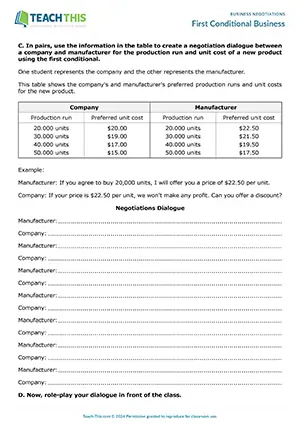
Business English Negotiations Worksheet and Role-Play - Grammar and Reading Exercises: Changing Word Forms - Speaking Activity: Creating a Dialogue - Pair Work
In this business negotiations worksheet and role-play, students practice the first conditional in a business negotiation context. First, students complete...
Negotiations Pelmanism
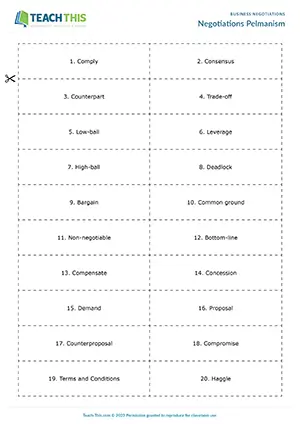
Business English Negotiations Game - Vocabulary: Matching, Pelmanism - Group Work
Here is a free business negotiations game to help students review and practice vocabulary that is commonly used in business negotiations. In groups, students take it in turns to turn over one...
Negotiation Stages
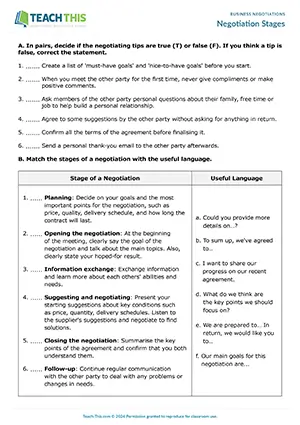
Business English Negotiations Worksheet - Reading and Vocabulary Exercises: True or False, Matching, Binary Choice - Speaking Activity: Role Play - Pair Work
In this productive business negotiations worksheet and role-play, students practice language for the various stages of a business negotiation. To begin, in pairs...
Price Negotiations
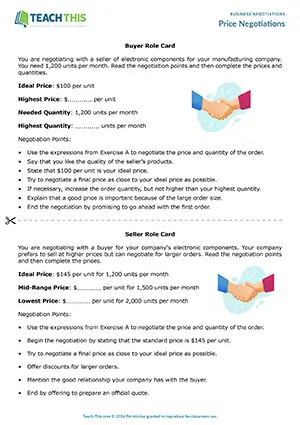
Business English Negotiations Worksheet - Reading and Vocabulary Exercises: Matching, Gap-Fill - Speaking Activity: Role-Play, Communicative Practice - Pair Work
In this handy business negotiations worksheet and role-play, students practice expressions for price negotiations. First, students match expressions for price...
Taking Part in Business Negotiations
Taking part in business negotiations involves explaining a position, responding to proposals and checking the terms of a possible agreement. Students need language that makes preferences, conditions and commitments clear while allowing both parties to explore alternatives.
This page contains eight resources across B1 and B2, including worksheets, role-plays, discussion activities and games, with one free game.
The table shows negotiation functions with hypothetical examples for classroom practice.
| Negotiation function | Purpose | Example language |
|---|---|---|
| State a priority | Explain what matters to your side. | 'Our main priority is delivery before the end of the month.' |
| Make an offer | Put forward terms for consideration. | 'We can offer a unit price of $12 for this order.' |
| Explore a conditional exchange | Connect a possible concession with something in return. | 'If we increased the order, would you reduce the unit price?' |
| Make a counteroffer | Respond with an alternative proposal. | 'Could we agree on $11 per unit with a larger order?' |
| Clarify a term | Check what a proposal includes. | 'Does that price include delivery?' |
| Confirm agreement | Check that both sides understand the accepted terms. | 'So, we have agreed on 500 units at $11 each, including delivery. Is that correct?' |
How to Communicate in Business Negotiations
Explain the position and its reason: Give students a clear role and relevant background information. Encourage them to connect a preference with a reason, such as why a delivery date matters, instead of repeating a demand without explanation.
Make conditions explicit: When an offer depends on another action, state the connection clearly. Distinguish an exploratory question such as 'Would you consider...?' from a commitment that has already been accepted.
Check the complete agreement: Confirm quantities, prices, dates and other relevant terms before reporting an outcome. Students should stay within their role information and recognise that a negotiation may end with some points still unresolved.
3-Step Framework for Teaching Business Negotiations
The first two stages develop positions and offers at B1. The final B2 stage extends the language into a negotiation involving several terms, so use the sequence across lessons according to learners' readiness.
1. Express a Negotiation Position: Students match negotiation vocabulary with definitions, reconstruct example sentences and identify different position types. They then use background information about an apartment sale to write positions. This establishes clear starting points before students need to respond to another party.
2. Exchange Offers and Counteroffers: Pairs categorise language cards, then use them in negotiation role-plays, earning points for successful use of the target expressions. They swap offer and counteroffer roles in a second scenario. This moves from recognising a phrase's purpose to selecting it during an exchange.
3. Negotiate Priorities and Review the Outcome: Students prepare negotiation phrases, rank employment-contract items from both parties' perspectives and plan using role information. They then negotiate in employee-employer pairs and compare the resulting scores and terms. The scoring supports classroom reflection on the simulated agreement rather than defining success in every real negotiation.
Common Mistakes with Business Negotiation Language
Adding to after a modal verb: Use the base verb after could or would. Incorrect: 'Could you to reduce the price?' Correct: 'Could you reduce the price?'
Treating a conditional proposal as a firm agreement: An offer linked to another condition does not stand alone. Inaccurate summary: Reporting 'They agreed to a discount' after hearing 'We could offer a discount if you doubled the order.' Accurate summary: 'They proposed a discount on condition that we doubled the order; we have not accepted yet.'
Common Questions About Teaching Business Negotiations
What worksheet helps teach business negotiations?
The worksheet Negotiation Stages connects useful language with different stages of a negotiation. Students examine negotiating tips, identify expressions in a dialogue and check prepositions before taking part in a role-play. Reporting the outcome afterwards gives them practice explaining what they agreed, as well as using the language during the negotiation.
What activity helps students practice offers and counteroffers?
The activity Make the Deal uses second conditional questions to set up negotiations. Students complete prompts with realistic numbers or terms, then group members respond from the other party's perspective and give reasons. Discussing and recording an agreed response encourages students to consider alternatives rather than simply accept or reject an offer.
What free game helps students practice negotiation vocabulary?
The game Negotiations Pelmanism has students turn over a vocabulary card and a definition card to find matching pairs. Correct matches are read aloud and kept, earning another turn. Unmatched cards are returned to the same positions, combining recall of word meanings with a memory challenge as students collect pairs.
Become a Teach This Member
Get unlimited access to the full library, plus new resources added every week.
Unlimited Resource Access
Download from 3000+ worksheets, activities, and games.
Save 5+ Hours Weekly
Cut lesson prep time with ready-to-use resources, plus teacher notes and answer keys.
Trusted Professional Quality
Classroom-tested, editable resources created by experienced ESL professionals.
Fresh Content Weekly
Get 5 new resources added to the library each week.
Here's what our members are saying...


