
Air Travel ESL Activities, Games & Worksheets
A Horrible Flight

ESL Air Travel Worksheet - Vocabulary, Reading, and Writing Exercises: Matching, Writing and Presenting a Story - Speaking Activity: Asking and Answering Questions
In this comprehensive air travel vocabulary worksheet, students learn and practice words related to air travel. First, students discuss three air travel questions in...
Can I check your boarding pass?

ESL Flight Information Activity - Speaking: Forming, Asking and Answering Questions, Form Completion - Pair Work
In this free air travel speaking activity, students ask and answer questions about flight information in order to complete a boarding pass. First, students write their full name on their boarding pass...
Air Travel Flowchart

ESL Air Travel Vocabulary Activity - Reading: Ordering - Pair Work
In this creative air travel activity, students practice air travel vocabulary and expressions by making a flowchart detailing how to travel by air. In pairs, students construct a flowchart representing a complete journey by airplane, from booking a flight to...
Come Fly With Me!

ESL Air Travel Board Game - Speaking: Role-Play, Asking and Answering Questions, Communicative Practice - Group and Pair Work
In this communicative air travel information board game, students role-play asking for air travel information and practice booking airline tickets with a ticket agent...
Race through the Sky
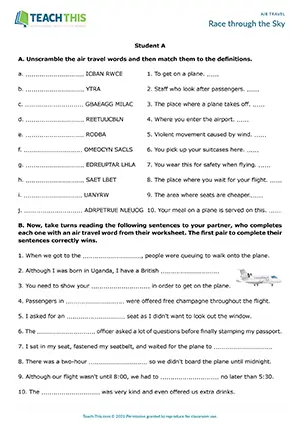
ESL Air Travel Activity - Vocabulary Exercises: Unscrambling, Matching - Speaking Activity: Sentence Completion, Gap-fill - Pair Work
In this engaging air travel activity, students practice air travel vocabulary and use the words in a sentence completion race. First, in two groups, students...
Airport Check-in

ESL Airport Check-in Activity - Reading and Vocabulary Exercises: Ordering, Matching - Writing and Speaking Activity: Writing a Dialogue, Role-Play - Pair Work
In this enjoyable air travel activity, students practice vocabulary and language used to check in at an airport. In pairs, students begin by arranging sentence strips...
Air Travel Collocations

ESL Air Travel Collocations Activity - Vocabulary Exercise: Matching, Forming Collocations - Speaking Game: Forming Collocations and Sentences - Pair Work
In this productive air travel activity, students form air travel collocations from a set of words and play a game to practice the collocations. First, students...
Air Travel Crossword
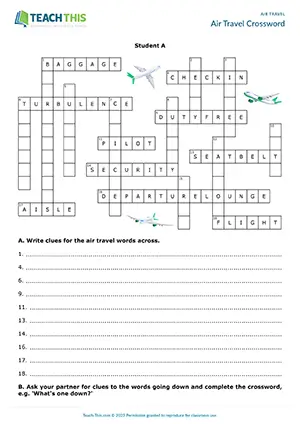
ESL Air Travel Activity - Vocabulary, Writing and Speaking: Crossword, Writing Clues, Describing, Guessing - Group and Pair Work
In this useful air travel vocabulary activity, students complete a crossword by describing and guessing words related to air travel. In two groups, students invent and write down clues for the air travel words...
In-flight Safety Procedures
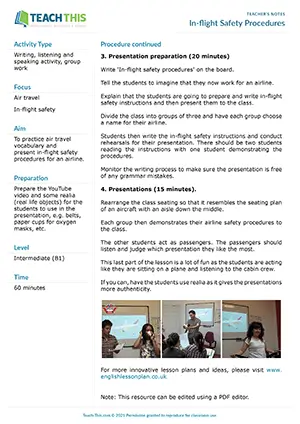
ESL Air Travel Lesson - Vocabulary Exercise: Brainstorming - Listening: Listening for Details - Writing and Speaking: Writing and Presenting Instructions - Group Work
In this free air travel lesson, students practice air travel vocabulary and present in-flight safety procedures for an airline. Students begin by brainstorming ideas...
Using Air Travel Language
Air travel language includes the vocabulary and expressions passengers and airline staff use to discuss flights, exchange travel details and make requests. Combining these words with questions and responses helps students explain what they need and check that they have understood the information given.
This page has nine resources from A2 to B2, covering air travel vocabulary, flight information, airport check-in and in-flight instructions, with two free downloads.
The table connects stages of a journey with vocabulary and example language.
| Situation | Vocabulary | Example language |
|---|---|---|
| Choosing a flight | return flight, stopover, baggage allowance | 'Does this flight include a stopover?' |
| Checking in | boarding pass, aisle seat, checked luggage | 'Could I have an aisle seat, please?' |
| Finding the departure gate | gate, boarding time, departure | 'Which gate does the flight leave from?' |
| Speaking to cabin crew | seat belt, overhead locker, blanket | 'Could I have a blanket, please?' |
| Reporting a baggage problem | baggage reclaim, suitcase, missing luggage | 'My suitcase hasn't arrived.' |
How to Use Air Travel Language
Choose questions that identify the missing detail: Contrast 'What time does boarding start?' with 'What time does the flight depart?' so students distinguish boarding from departure. Encourage them to name the flight when more than one is being discussed.
Check information before moving on: Practice repeating a gate number or time and asking for confirmation, as in 'Gate fourteen, is that right?' If the answer is unclear, 'Could you repeat that, please?' lets students repair the exchange.
Explain a problem and make a request: Help students separate what has happened from the help they want. For example, 'My suitcase hasn't arrived. Could you help me report it?' gives the listener both the problem and the requested next step.
3-Step Framework for Teaching Air Travel Language
This sequence uses the page's intermediate resources, moving from understanding a journey to exchanging flight information.
1. Put the Journey in Order: Have pairs arrange sentence cards into a flowchart, using arrow cards to connect the stages from booking a flight to leaving the arrival airport. Review the order and vocabulary together so students can connect each expression with its place in the journey.
2. Recall Vocabulary from Spoken Context: Students unscramble air travel words and match them with definitions, then pair up to read sentences for a partner to complete with the missing words. This moves from recognising the journey stages to selecting vocabulary from what another person says.
3. Exchange Information in Role-Play: Use the board game in which pairs act as a customer and a ticket agent, asking about flights or making bookings according to the square they land on. The flight details on the board give students information to consult. As a follow-up, ask them to confirm the selected flight's details before ending the conversation.
Common Mistakes with Air Travel Language
Using 'lose' when a passenger arrives too late: Use 'miss a flight' to say that someone did not catch it. 'Lose' does not express this meaning in the usual air travel collocation. Incorrect: 'I lost my flight because I arrived late.' Correct: 'I missed my flight because I arrived late.'
Making 'luggage' plural: 'Luggage' is uncountable. Use 'bags', 'suitcases' or 'pieces of luggage' when stating a number. Incorrect: 'I have two luggages.' Correct: 'I have two pieces of luggage.'
Common Questions About Teaching Air Travel Language
Which worksheet helps teach air travel vocabulary?
The worksheet A Horrible Flight links vocabulary practice to storytelling. Students match sentence halves and definitions, then use air travel words to complete a story. They finish by writing a true or false flight story for classmates to judge, giving them a reason to use the vocabulary in a connected account.
What game helps students practice air travel collocations?
The activity Air Travel Collocations includes a speaking game that moves from word combinations to sentences. After matching words to form collocations, students respond to a partner's prompts. They earn one point for a collocation and another for a meaningful sentence, so practice extends beyond recalling the word pair.
How can students practice asking about flights?
Use the free speaking activity Can I check your boarding pass? Students prepare questions from the fields on a blank boarding pass, then ask a partner for the flight information needed to complete it. Comparing worksheets afterwards checks whether their questions and answers communicated the details accurately.
Become a Teach This Member
Get unlimited access to the full library, plus new resources added every week.
Unlimited Resource Access
Download from 3000+ worksheets, activities, and games.
Save 5+ Hours Weekly
Cut lesson prep time with ready-to-use resources, plus teacher notes and answer keys.
Trusted Professional Quality
Classroom-tested, editable resources created by experienced ESL professionals.
Fresh Content Weekly
Get 5 new resources added to the library each week.
Here's what our members are saying...


