
Expressing Preferences ESL Games, Activities & Worksheets
Both, Either or Neither?
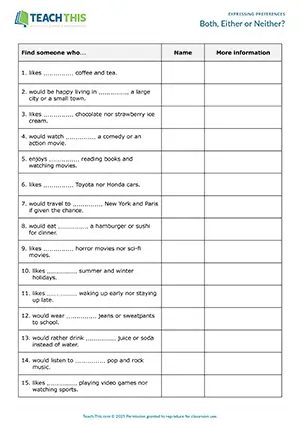
ESL Both, Either and Neither Activity - Vocabulary and Speaking: Gap-fill, Asking and Answering Questions, Controlled and Freer Practice
In this both, either and neither speaking activity, students ask and answer questions to learn about their classmates' preferences using the conjunctions...
Hypothetical Bets
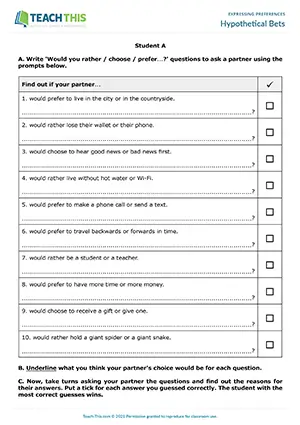
ESL Expressing Preferences Game - Speaking: Writing, Asking and Answering Questions, Guessing - Pair Work
In this free expressing preferences game, students write hypothetical 'Would you...?' questions for a partner and guess which choices they would make. First, in groups, students write 'Would you...
Would you rather...?
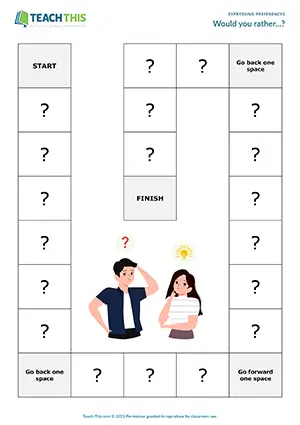
ESL Would You Rather Board Game - Speaking: Discussions, Responding to Questions, Giving Reasons - Group and Pair Work
In this intriguing expressing preferences board game, students discuss 'Would you rather...?' questions with a partner and race to make choices they agree on...
I'd opt to...
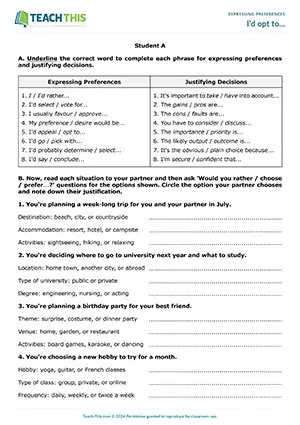
ESL Expressing Preferences Activity - Vocabulary and Speaking: Binary Choice, Asking and Answering Questions, Controlled and Freer Practice - Pair Work
This useful expressing preferences activity helps students practice language to express preferences and justify decisions. First, students underline the...
Mastering Preference Phrases
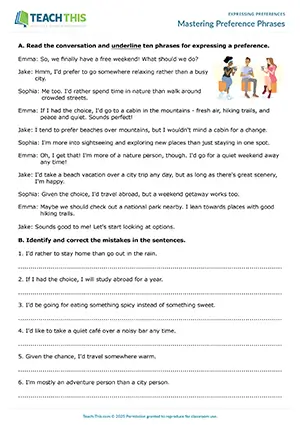
ESL Expressing Preferences Worksheet - Reading and Vocabulary Exercises: Error Correction - Speaking Activity: Delivering a Dialogue, Freer Practice - Group Work
In this comprehensive expressing preferences worksheet, students practice ten phrases to express preferences. First, students read a dialogue and identify...
Make Your Choice!
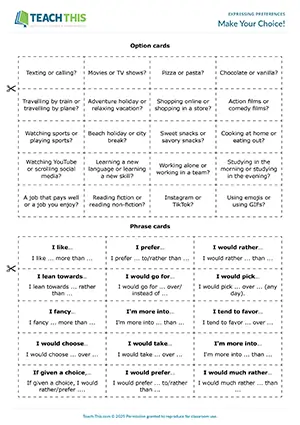
ESL Expressing Preferences Game - Vocabulary and Speaking: Forming Sentences, Freer Practice - Pair Work
In this fun expressing preferences game, students practice phrases to express a preference between two options. In pairs, students take turns picking up an option card that shows two choices...
Rank and Defend
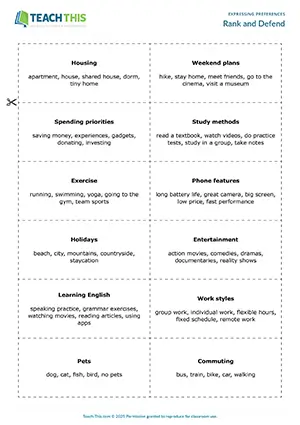
ESL Expressing Preferences Activity - Vocabulary and Speaking: Ranking, Presenting, Discussion, Freer and Communicative Practice - Group Work
In this free expressing preferences activity, students rank everyday options by category, present and justify their top choices with target phrases, and respond...
Would Rather and Would Prefer

ESL Would Rather and Would Prefer Board Game - Grammar: Reforming Sentences, Freer practice - Group Work
In this productive would rather and would prefer board game, students practice reforming sentences and questions with 'would rather' and 'would prefer'. One student begins by picking up a...
Using Phrases for Expressing Preferences
Preference phrases in English give students the language they need to say which option, activity, or situation they like more than another, using expressions such as 'I'd rather,' 'I'd prefer,' or 'I like... more than...' Students who only know one or two of these expressions can get their meaning across, but they come across as repetitive and limited, while a broader set of phrases lets them say the same thing with more natural variation and a better match to the situation.
This page covers expressing preferences at B1 and B2 level, with eight activities including a mingle, a board game, and a ranking group discussion, with two available as free downloads.
When to Use Phrases for Expressing Preferences
Softening a Refusal: A speaker reaches for 'I'd rather not' or 'I'd prefer not to' when they want to decline a suggestion without sounding blunt or dismissive, as in 'I'd rather not meet on Fridays if we can avoid it.'
Choosing Between Alternatives: When someone offers two or more options, preference phrases let the listener respond clearly and naturally without simply saying yes or no, as in 'I'd choose the morning slot over the afternoon, if that works for everyone.'
Explaining Personal Reasoning: A writer or speaker uses preference phrases when they want to show that a choice comes from their own thinking rather than habit or default, as in 'I tend to prefer remote work because I concentrate better without interruptions.'
3-Step Framework for Teaching Preferences
1. Get Students Talking From the Start: Open with a mingle that gets students using 'both', 'either', and 'neither' to talk about their own preferences straight away. Students complete 'Find someone who...' prompts using those three words, then move around the class asking questions. When a classmate's answer matches the conjunction in the question, the student notes down their name and asks a follow-up question to find out more, recording the extra detail in a final column. Everyone stays on their feet and talking throughout.
2. Build Accuracy With the Key Phrases: Move to a board game that pushes students to swap between two key preference expressions accurately. A caller reads a sentence to a player along with a prompt, for example 'Do you want to take a break now or later? (would rather)', and the player must restate it using the right expression to roll the dice and move. The competitive format means students get plenty of repeated exposure to both expressions without the activity feeling like a drill.
3. Push Students to Defend Their Choices: Finish with a freer group activity where students rank everyday options by category, then present their top choices to the group using target preference phrases. After each student presents, the others ask one follow-up question or give a polite challenge, which means every student has to do more than just state a preference — they have to defend it too. Groups then agree on a shared top-three list and present it to the class for a final vote.
Common Mistakes with Expressing Preferences
Adding 'to' After 'Would Rather': Students often add 'to' after 'would rather' because they confuse it with 'would prefer to,' which does take the infinitive with 'to.' Wrong: 'I would rather to stay at home tonight.' Correct: 'I would rather stay at home tonight.'
Using 'Than' Instead of 'To' After 'Would Prefer': Students often write 'would prefer... than' when comparing two options, borrowing the pattern from comparative adjectives instead of using the correct preposition. Wrong: 'I would prefer staying at home than going out.' Correct: 'I would prefer staying at home to going out.'
Common Questions About Teaching Preferences
What is a fun game for practicing expressing preferences?
Make Your Choice! is a game that gets students using preference phrases from the start. One student picks up a phrase card and reads the expression in bold while their partner picks up an option card showing two choices, such as 'Texting or calling?', and uses that phrase to say which they prefer. Correct sentences win the option card.
What is a useful worksheet for teaching expressing preferences?
Mastering Preference Phrases is a worksheet that gives students ten expressions for stating a preference and puts all of them to immediate use. Groups of three read a situation and write a dialogue that includes all ten phrases, then perform it for the class. Students leave the lesson with a full set of phrases they have actually used.
What is an engaging activity for practicing expressing preferences?
The activity I'd opt to... builds from accuracy to fluency. Students first underline the correct words to complete a set of preference phrases, then put those phrases straight to use, taking turns reading a situation and asking 'Would you rather / choose / prefer...?' questions about the given choices while their partner makes a selection and justifies it.
Become a Teach This Member
Get unlimited access to the full library, plus new resources added every week.
Unlimited Resource Access
Download from 3000+ worksheets, activities, and games.
Save 5+ Hours Weekly
Cut lesson prep time with ready-to-use resources, plus teacher notes and answer keys.
Trusted Professional Quality
Classroom-tested, editable resources created by experienced ESL professionals.
Fresh Content Weekly
Get 5 new resources added to the library each week.
Here's what our members are saying...


