
Jobs & the Workplace ESL Activities, Games & Worksheets
Jobs Bingo
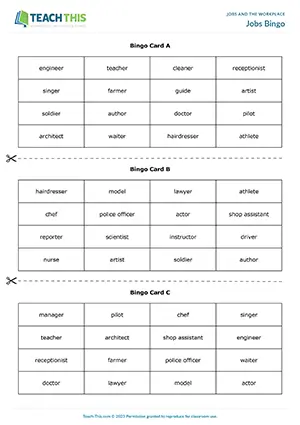
ESL Jobs Game - Vocabulary: Bingo, Matching - Group Work
In this enjoyable jobs vocabulary game, students play bingo by listening to definitions and matching them to the names of common professions. In groups, the bingo caller reads a definition at random from the caller's sheet and then puts a tick beside...
Scrambled Jobs
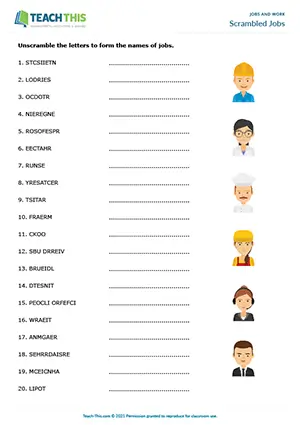
ESL Jobs Worksheet - Vocabulary: Unscrambling, Spelling
This free jobs vocabulary worksheet helps students to practice the names of jobs and their spelling. Students have ten minutes unscramble the letters on the worksheet to form the names of jobs. Students score one point for each correct job...
What's the Job?
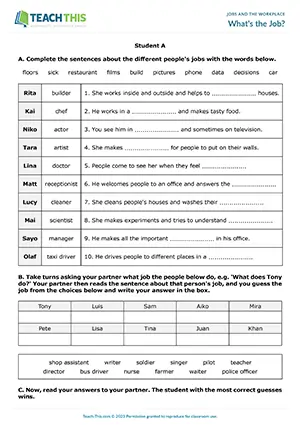
ESL Jobs Game - Vocabulary and Speaking: Gap-fill, Information Gap, Asking and Answering Questions, Guessing, Controlled Practice - Pair Work
This fun jobs guessing game helps students practice vocabulary related to jobs and the workplace. In two groups, students begin by completing sentences...
9 to 5
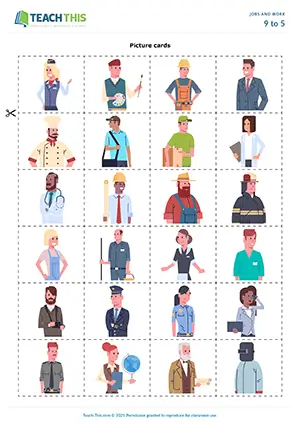
ESL Jobs Games - Speaking and Vocabulary: Pelmanism, Asking and Answering Questions, Forming Sentences, Freer Practice, Guessing - Group Work
In these engaging jobs vocabulary games, students practice the names of jobs and describing jobs with has to. To begin, students play a pelmanism game...
Before they were famous
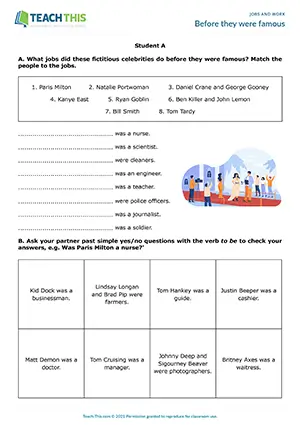
ESL Celebrity Jobs Activity - Speaking: Matching, Asking and Answering Questions - Pair Work
In this intriguing celebrity jobs speaking activity, students guess what jobs fictitious celebrities did before they were famous and check their answers by asking past simple yes/no questions with...
Find Someone Who...
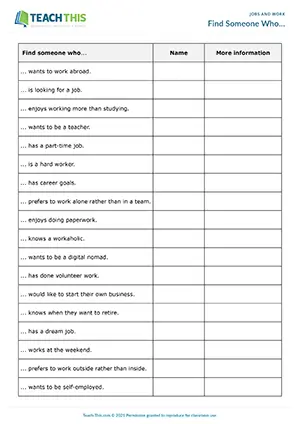
ESL Talking about Jobs Activity - Speaking: Asking and Answering Questions, Controlled and Freer Practice
In this insightful talking aout jobs speaking activity, students learn and practice jobs and work-related vocabulary by asking and answering questions in a Find Someone Who activity. Students start by...
Fun Jobs Games
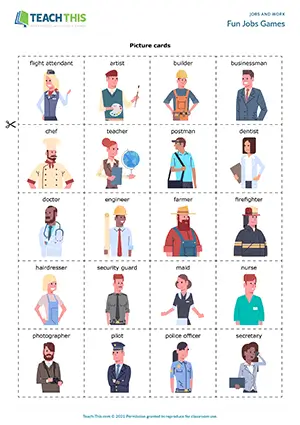
ESL Jobs Games - Vocabulary: Matching, Miming, Guessing, Asking and Answering Questions, Describing - Group Work
These fun jobs vocabulary games consists of a matching game, miming game, quiz game and describing game to help students practice the names of jobs and their related duties. The aim of each game is to...
Guess the Job
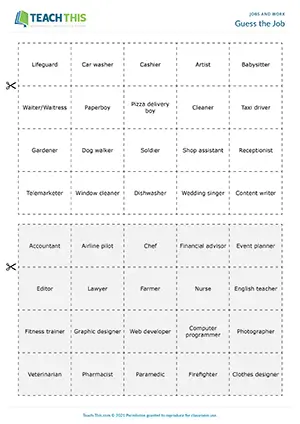
ESL Jobs Guessing Game - Vocabulary and Speaking: Forming Sentences, Describing, Guessing - Group Work
In this entertaining guessing jobs game, students describe past and present job duties using the past simple and present simple. In groups, students take turns picking up a white card and a grey card...
Likes and Dislikes at Work

ESL Word-Related Tasks Activity - Speaking: Rating, Asking and Answering Questions, Freer Practice - Pair Work
In this free job tasks activity, students ask and answer questions about likes and dislikes for different work-related tasks and choose a job for a partner based on their likes. First, students think about...
The Job Interview
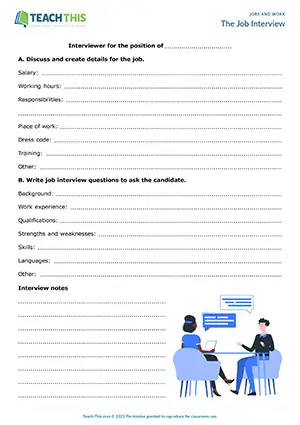
ESL Job Interview Role-Play - Speaking Activity: Discussion, Form Completion, Role-Play, Asking and Answering Questions - Group and Pair Work
In this useful job interview role-play, students create and practice job interview questions. First, students decide on a job they would like to apply for. Next, in two...
The Right Person for the Job
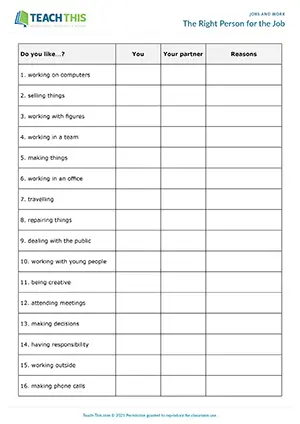
ESL Job Tasks Activity - Speaking: Asking and Answering Questions - Pair Work
In this work-related tasks activity, students ask and answer questions about their likes and dislikes for tasks related to work. First, students answer 'Do you like...?' questions about work-related tasks. Next, in pairs, students ask their partner...
This job...
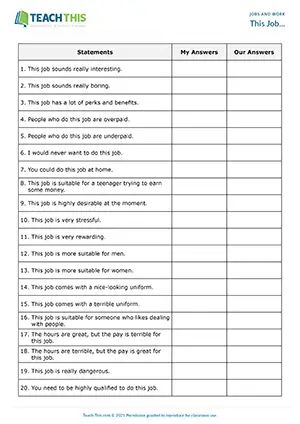
ESL Jobs Discussion - Speaking Activity: Matching, Discussion - Group Work
In this productive jobs discussion activity, students match jobs to statements and then discuss the statements in groups to collectively agree on one job for each statement. Working alone, students think of a job that describes each...
What do I do?
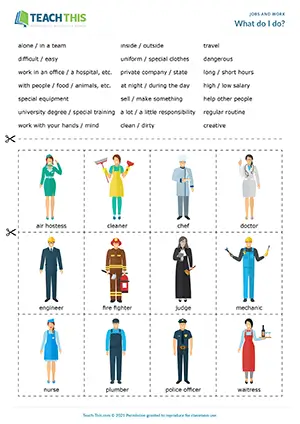
ESL Jobs Guessing Game - Speaking: Writing, Asking and Answering Questions, Freer Practice - Group Work
In this creative 20 questions jobs game, students ask yes/no questions in order to find out someone's job. In groups, students begin by writing down as many yes/no questions as they can think of using...
What do they do?
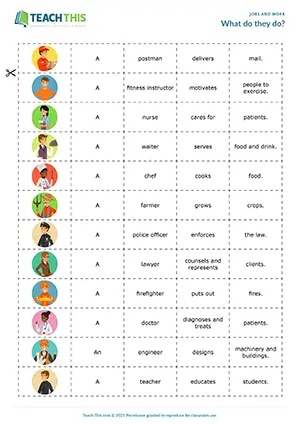
ESL Job Descriptions Game - Vocabulary: Matching, Forming Sentences - Pair Work
In this enjoyable describing jobs game, students match cards together to make sentences about jobs. In pairs, students take it in turns to turn over a card. If a student turns over a job picture card, they place the card face up on the table and...
Jobs Taboo
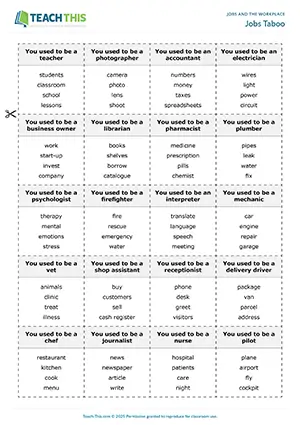
ESL Describing Jobs Game - Grammar, Vocabulary and Speaking: Describing, Guessing - Group Work
In this fun jobs game, students practice talking about past jobs and work routines using 'used to', 'would' and the past simple. In groups, students take turns picking up a card, without showing it to...
Phrasal Verbs at Work
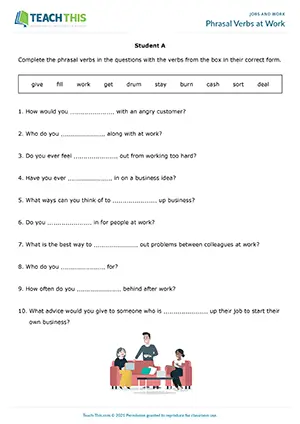
ESL Work Phrasal Verbs Activity - Speaking: Gap-fill, Asking and Answering Questions, Discussion - Group and Pair Work
In this free work-related phrasal verbs speaking activity, students complete questions with phrasal verbs relating to work and then ask the questions to a partner and discuss the answers...
What's my job?
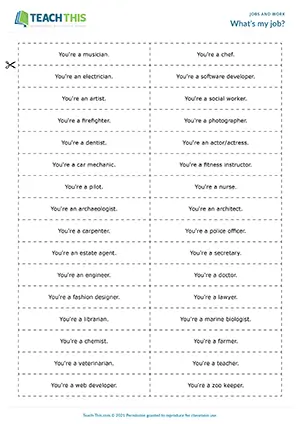
ESL Describing Jobs Game - Vocabulary and Speaking: Describing, Guessing - Group Work
In this rewarding job descriptions game, students describe and guess jobs. In groups, students prepare five clues for the job shown on their card. Students then take turns saying their clues to the other...
Work Skills and Preferences

ESL Work Skills and Preferences Activity - Speaking: Asking and Answering Questions, Discussion, Gap-fill - Pair and Group Work
Here is a memorable job skills speaking activity to help students practice talking about work skills and preferences. In pairs, students take turns interviewing their partner about work skills and preferences...
Using Jobs and Workplace Vocabulary
Jobs and workplace vocabulary includes job titles and the words used to describe duties, working conditions, skills and preferences. Connecting a job with what someone does helps students explain roles and ask meaningful questions about work.
This page has 18 resources across A1-A2, A2, B1 and B2, including games, a worksheet, speaking activities and a job interview role-play, with three free downloads.
The table connects workplace vocabulary with short examples of its use.
| Word or phrase | Meaning or use | Example |
|---|---|---|
| job | A paid position or occupation | 'She has a job in a hotel.' |
| work | Tasks or activities done as part of employment | 'His work involves helping customers.' |
| duties | Tasks someone is responsible for | 'Her duties include answering calls.' |
| working hours | The times or number of hours someone works | 'What are the working hours for this job?' |
| work experience | Knowledge and skills gained through working | 'He has experience working in a shop.' |
| apply for a job | Ask formally to be considered for a position | 'I want to apply for a job at the museum.' |
How to Use Jobs and Workplace Vocabulary
Explain a role through its duties: Add an action to a job title rather than stopping at the name. 'A receptionist welcomes visitors and answers calls' helps a listener understand the role.
Separate preferences from abilities: 'I enjoy working with customers' describes a preference, while 'I can explain information clearly' describes an ability. Encourage students to support either statement with an example.
Ask for practical information: Use questions about duties, hours and experience to learn more about a role. 'What would I do each day?' invites a more detailed answer than 'Is it a good job?'
3-Step Framework for Teaching Jobs and Workplace Vocabulary
This sequence suits pre-intermediate classes, progressing from recognising job names to describing responsibilities and exchanging ideas about work.
1. Connect Job Names with Pictures: Students turn over picture and word cards to find matching jobs. They then take on a job from a card and ask classmates 'What do you do?' to identify their roles. This moves recognition into a supported question-and-answer exchange.
2. Identify Jobs from Descriptions: Students complete sentences about people's jobs, then read the descriptions to a partner who selects the correct occupation. This connects job titles with actions and workplace details, preparing students to understand more than the name alone.
3. Ask and Follow Up: Students prepare yes/no questions about jobs and work, then speak to classmates. After a yes answer, they record a name and ask a follow-up question before reporting their findings. The follow-up extends short answers into reasons, preferences and plans.
Common Mistakes with Jobs and Workplace Vocabulary
Using a with work when referring to employment: 'Job' is countable, while 'work' is normally uncountable in this meaning. Incorrect: 'I'm looking for a work.' Correct: 'I'm looking for work.' You can also say 'I'm looking for a job.'
Leaving out the article before a singular job title: Use 'a' or 'an' when stating someone's occupation. Incorrect: 'She is engineer.' Correct: 'She is an engineer.'
Common Questions About Teaching Jobs and Workplace Vocabulary
What game helps students practice jobs vocabulary?
The game Jobs Bingo turns job definitions into a listening challenge. Students match the descriptions they hear to job names on their cards and cross them off. A completed row must be checked against the caller's definitions, so winning depends on understanding what each profession involves rather than recognising its name alone.
What worksheet can I use for teaching job names?
The free worksheet Scrambled Jobs focuses on job names and spelling. Students have ten minutes to rearrange letters into the names of jobs, earning a point for each correctly spelt answer. It works as a review after introducing the vocabulary, helping teachers check which written forms students can recall.
How can students practice talking about work preferences?
The free activity Likes and Dislikes at Work gives students a purpose for discussing work preferences. They rate tasks, interview a partner and ask for explanations, then suggest a job based on the answers. Explaining their choice to the class encourages students to connect specific tasks with reasons and preferences.
Become a Teach This Member
Get unlimited access to the full library, plus new resources added every week.
Unlimited Resource Access
Download from 3000+ worksheets, activities, and games.
Save 5+ Hours Weekly
Cut lesson prep time with ready-to-use resources, plus teacher notes and answer keys.
Trusted Professional Quality
Classroom-tested, editable resources created by experienced ESL professionals.
Fresh Content Weekly
Get 5 new resources added to the library each week.
Here's what our members are saying...


