
Compare & Contrast Essays EAP Worksheets & Games
Compare and Contrast Challenge
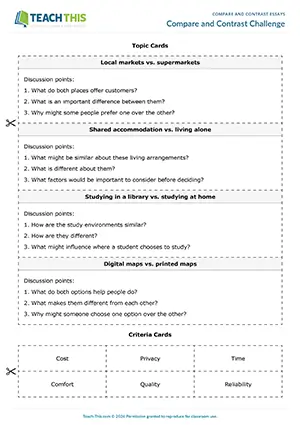
EAP Compare and Contrast Essays Game - Speaking and Writing: Guided Discussion, Table Completion, Writing Sentence Pairs- Group Work
In this compare and contrast game, students discuss familiar topics, choose a criterion to compare them, and then write clear similarity and difference sentences...
The Compare-and-Contrast Toolkit
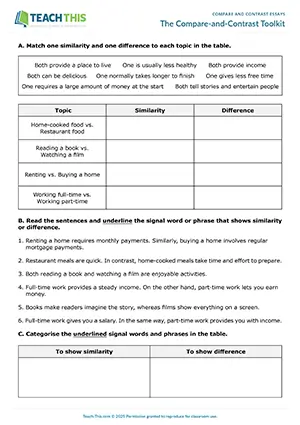
EAP Compare and Contrast Essays Worksheet - Reading, Vocabulary and Writing Exercises: Matching, Gap-fill - Speaking Activity Discussion - Pair Work
In this compare and contrast essay worksheet, students practice using compare and contrast signal words and outline a compare and contrast essay...
Compare and Contrast Essays 1
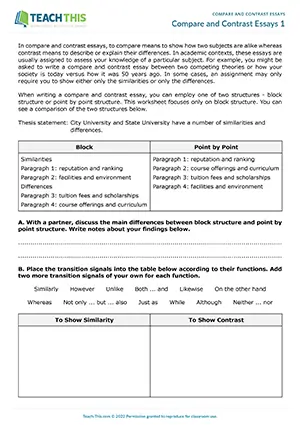
EAP Compare and Contrast Essays Worksheet - Writing Exercises: Categorising, Gap-fill, Identifying, Creating an Essay Outline, Writing an Essay
In this informative compare and contrast essays worksheet, students are introduced to compare and contrast essay structure and attempt an essay writing...
Compare and Contrast Essays 2
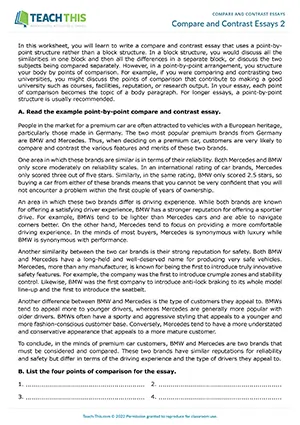
EAP Compare and Contrast Essays Worksheet - Writing Exercises: Identifying, Gap-fill, Unscrambling, Outline and Essay Writing, Peer Review and Feedback
In this free compare and contrast essays worksheet, students learn and practice point-by-point compare and contrast essay structure. First, students read...
Comparison Matrix Challenge

EAP Compare and Contrast Essays Activity - Writing and Speaking: Discussion, Presenting, Paragraph Writing - Group Work
In this useful compare and contrast essay activity, students make comparisons using selected criteria in a matrix, present their ideas, and then collaboratively write a structured point-by-point...
Point-by-Point Puzzle
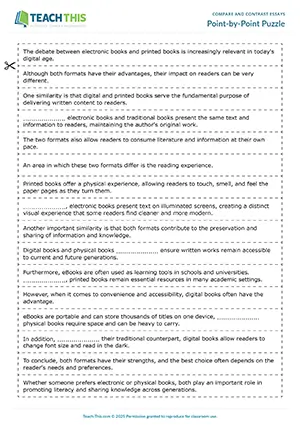
EAP Compare and Contrast Essays Game - Reading and Vocabulary: Ordering, Gap-fill - Pair Work
In this engaging compare and contrast essay game, students arrange parts of an example point-by-point essay into a logical order and then complete gaps with transition words and phrases. First, pairs have...
Wind and Solar
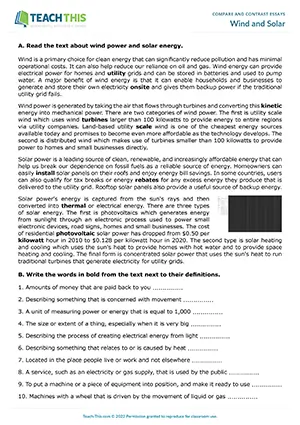
EAP Compare and Contrast Essays Worksheet - Reading and Writing Exercises: Writing an Essay - Speaking Activity: Discussion, Communicative Practice
In this useful compare and contrast essay writing practice, students plan and write a compare and contrast essay about wind power and solar energy...
Understanding Compare and Contrast Essays
A compare and contrast essay examines similarities and differences between subjects to develop a meaningful overall point. Effective comparisons use shared criteria and explain why the findings matter, rather than present two unrelated descriptions.
This page contains seven resources from intermediate (B1) to upper-intermediate (B2), including one free worksheet. The materials cover comparison criteria, signal words, model essays, block and point-by-point organisation, planning, drafting and peer feedback.
Use the reference below to connect comparison decisions with their purpose. The sentence examples illustrate possible wording, not factual claims about particular courses or institutions.
| Focus | Purpose | Example or guidance |
|---|---|---|
| Shared criteria | Compare the same feature of both subjects | Compare the cost of both courses, then their flexibility, rather than comparing one course's cost with the other's teaching quality. |
| Similarity | Identify a relevant feature the subjects share | 'Both courses include weekly tutorials.' |
| Difference | Express a contrast using a clear sentence pattern | 'Course A offers evening classes, whereas Course B runs during the day.' |
| Block organisation | Discuss each subject in a separate section | Cover the same criteria in a consistent order for each subject and make the comparisons explicit. |
| Point-by-point organisation | Discuss both subjects under each criterion | Compare both courses on cost before moving to flexibility and support. |
| Significance | Explain what the comparison helps the reader understand | 'This difference may matter to students who work during the day.' |
How to Develop Compare and Contrast Essays
Choose criteria that serve the purpose: Start with what the comparison needs to explain. Ask students to select relevant features that apply to both subjects and gather examples for each side before deciding on an overall conclusion.
Connect organisation with the argument: Show how block and point-by-point plans arrange the same material differently. Students should explain why their chosen structure suits their ideas and assignment; neither pattern removes the need for clear comparisons.
Make comparisons meaningful: After each similarity or difference, ask 'Why does this matter here?' Encourage students to explain its relevance and support their claims. A comparison essay need not declare a winner unless the task requires an evaluation.
3-Step Framework for Teaching Compare and Contrast Essays
Across lessons, move from supported comparisons to planning and extended writing. The first two stages suit intermediate learners; the final stage draws on upper-intermediate essay work and should follow once students are ready to develop a longer argument.
1. Compare using a shared criterion: Groups discuss familiar topics, select a relevant criterion and record one similarity and one difference. They turn their notes into sentence pairs using linking expressions. Check that both sentences address the chosen criterion before students read them aloud.
2. Organise ideas into an outline: Students identify and categorise signal words, complete sentences and discuss a model essay. They then choose a topic, record similarities and differences and build an outline. Partner discussion helps them explain their language choices and check that their planned points connect.
3. Develop a complete essay: Students compare organisational patterns and analyse transition language in a model. They select two subjects, list relevant similarities and differences and prepare a block-structure outline before drafting. Ask them to check that both subject sections cover corresponding criteria and contribute to the essay's overall point.
Common Mistakes with Compare and Contrast Essays
Comparing unrelated features: A contrast is difficult to interpret when each subject is judged by a different criterion. Unbalanced comparison: 'Course A is inexpensive, whereas Course B has helpful tutors.' Better approach: Compare the cost of both courses first, then compare the support available on each. Obtain the missing information rather than invent details to complete the comparison.
Using the wrong structure after 'despite': Use 'although' before a clause, or 'despite' before a noun phrase or an '-ing' form. Incorrect: 'Despite Course A is cheaper, it offers more tutorials.' Correct: 'Although Course A is cheaper, it offers more tutorials.' Another option is 'Despite being cheaper, Course A offers more tutorials.'
Common Questions About Teaching Compare and Contrast Essays
What free worksheet helps teach compare and contrast essays?
The worksheet Compare and Contrast Essays 2 develops point-by-point organisation through a model essay. Students identify comparison points, practice transition language and assemble topic sentences. They then plan and write their own essay before exchanging feedback with a partner, connecting analysis of a model with independent writing and review.
How can I help students develop ideas for a comparison essay?
The activity Comparison Matrix Challenge helps groups compare two subjects using shared criteria. Students record examples and evidence for both sides, present a comparison and explain its significance. They then turn another comparison into a paragraph and exchange feedback, developing their notes into supported writing rather than simply listing differences.
What game helps students practice compare and contrast essay structure?
The game Point-by-Point Puzzle asks pairs to arrange sentence strips into a logically organised example essay. They then complete gaps using transition cards. Both stages are timed and earn points for correct answers, giving students a focused way to examine essay organisation and the language that connects its ideas.
Become a Teach This Member
Get unlimited access to the full library, plus new resources added every week.
Unlimited Resource Access
Download from 3000+ worksheets, activities, and games.
Save 5+ Hours Weekly
Cut lesson prep time with ready-to-use resources, plus teacher notes and answer keys.
Trusted Professional Quality
Classroom-tested, editable resources created by experienced ESL professionals.
Fresh Content Weekly
Get 5 new resources added to the library each week.
Here's what our members are saying...


