His, Her or Their?

Beginner (A1) 30 minutes
Match It - ESL Possessive Adjective Games - Vocabulary, Grammar and Speaking: Matching, Forming Sentences

ESL Possessive Adjective Games - Vocabulary, Grammar and Speaking: Matching, Forming Sentences

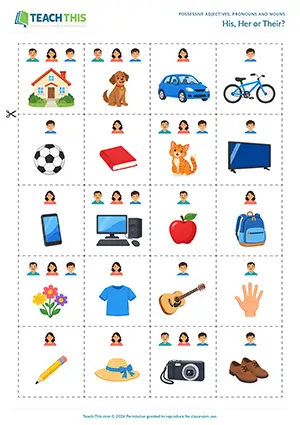
In this engaging set of possessive adjective games, students practice talking about who owns different objects using his, her and their. In groups, students take turns turning over a picture card and a...

ESL Possessive Adjective Games - Vocabulary, Grammar and Speaking: Matching, Forming Sentences In this engaging set of possessive adjective games, students practice talking about who owns different objects using his, her and their. In groups, students take turns turning over a picture card and a possessive adjective card. If the cards match, the student makes a sentence, e.g. 'It's his bike'. If the group agrees that the match and sentence are correct, the student keeps the pair. If not, the cards are returned to the same places. Play passes after every turn. The student with the most pairs of cards wins the game. Next, one student shows a picture card to the other two students and says 'It's...' if it shows one object or 'They're...' if it shows more than one. The other two students race to find the correct possessive adjective card and say the complete sentence, e.g. 'It's their house'. The student who first selects the correct card and says the sentence correctly keeps both cards if the group agrees. The student with the most pairs wins. Students then rotate roles and play again.

My Things, Your Things

Elementary (A1-A2) 35 minutes
My Things, Your Things - ESL Possessive Adjectives Worksheet - Grammar Exercises: Matching, Labelling, Underlining, Gap-fill, Unscrambling, Correcting

ESL Possessive Adjectives Worksheet - Grammar Exercises: Matching, Labelling, Underlining, Gap-fill, Unscrambling, Correcting

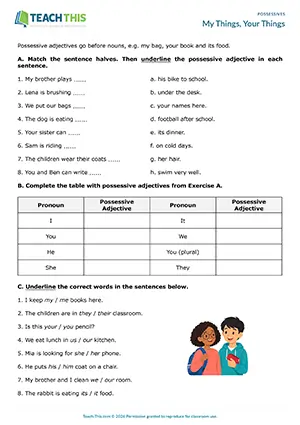
This comprehensive possessive adjectives worksheet helps students identify and use possessive adjectives in sentences about everyday things. First...

ESL Possessive Adjectives Worksheet - Grammar Exercises: Matching, Labelling, Underlining, Gap-fill, Unscrambling, Correcting This comprehensive possessive adjectives worksheet helps students identify and use possessive adjectives in sentences about everyday things. First, students match sentence halves and underline the possessive adjective in each completed sentence. Students then complete a table with the possessive adjectives. Next, students underline the correct possessive adjectives in sentences. After that, students complete each second sentence with a possessive adjective, using the first sentence to help them. Students then read the first sentence and put the words in order in the second sentence, adding a possessive adjective. Finally, students look at pictures of people and the objects that belong to them. Students then underline the wrong possessive adjective in each sentence and write the correct word in the gap.

Possessive Adjectives Connect Four

Elementary (A1-A2) 20 minutes
Possessive Adjectives Connect Four - ESL Possessive Adjectives Game - Grammar: Gap-fill

ESL Possessive Adjectives Game - Grammar: Gap-fill

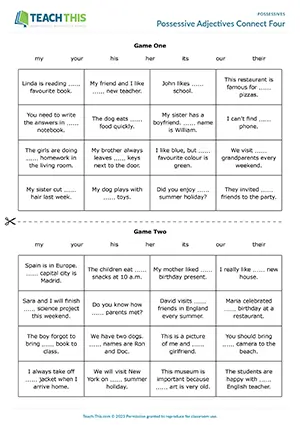
In this rewarding possessive adjectives game, students play Connect Four by completing sentences with my, your, his, her, its, our and their. In groups, two students play and a third student checks their answers. The two players choose 'X' or 'O'...

ESL Possessive Adjectives Game - Grammar: Gap-fill In this rewarding possessive adjectives game, students play Connect Four by completing sentences with my, your, his, her, its, our and their. In groups, two students play and a third student checks their answers. The two players choose 'X' or 'O'. Players then take turns choosing a square and saying the complete sentence with the possessive adjective. The third student checks the answer sheet. If the answer is correct, the player marks the square with their symbol. Play then passes to the other player. The first player to get four squares in a row wins the game. Students then swap roles and play Game Two, giving the third student a chance to play.

What's your favourite...?

Elementary (A1-A2) 30 minutes
What's your favourite...? - ESL Possessive Adjectives Game - Speaking and Writing Activity: Writing Short Answers, Asking and Answering Questions, Writing Sentences

ESL Possessive Adjectives Game - Speaking and Writing Activity: Writing Short Answers, Asking and Answering Questions, Writing Sentences

In this fun possessive adjectives game, students play a true or false guessing game about favourites to practice the possessive adjectives: my, your, his...

ESL Possessive Adjectives Game - Speaking and Writing Activity: Writing Short Answers, Asking and Answering Questions, Writing Sentences In this fun possessive adjectives game, students play a true or false guessing game about favourites to practice the possessive adjectives: my, your, his and her. First, students complete the 'My answer' column in a chart with five true and five false answers about their favourites. Students then take turns asking and answering questions using the possessive adjectives 'my' and 'your' and guessing whether their partner's answers are true or false. Their partner confirms whether each guess is correct and gives their real favourite if the original answer was false. Students record their partner's real answers in the chart and score one point for each correct guess. The student with the most points wins the game. Afterwards, students use the recorded answers to write ten sentences about their partner's favourites using 'his' or 'her'. Finally, students tell a new partner or the class about their partner's favourites.

Who Owns What?

Elementary (A1-A2) 20 minutes
Who Owns What? - ESL Possessive Adjectives Game - Grammar and Speaking: True or False, Correcting Sentences

ESL Possessive Adjectives Game - Grammar and Speaking: True or False, Correcting Sentences

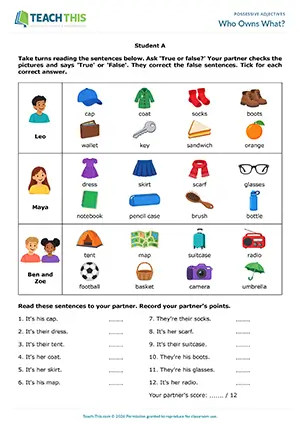
In this free possessive adjectives game, students use pictures to identify who owns different objects and correct statements with 'his', 'her' and 'their'. In pairs, students take turns reading sentences...

ESL Possessive Adjectives Game - Grammar and Speaking: True or False, Correcting Sentences In this free possessive adjectives game, students use pictures to identify who owns different objects and correct statements with 'his', 'her' and 'their'. In pairs, students take turns reading sentences about the people and belongings on their worksheet and asking 'True or false?' Their partner checks the pictures on their own worksheet and answers 'True' or 'False'. For a false statement, they also say the correct complete sentence, e.g. 'False. It's her pen.' The reader checks the response against the pictures. If the response is correct, they tick beside the sentence to give their partner one point. If not, no point is scored. After both students have read all 12 sentences, they count the ticks and tell their partner their score. The student with the higher score wins the game. Finally, the class checks the answers.

Accurate Apostrophes

Pre-intermediate (A2) 25 minutes
ESL apostrophe games preview featuring grammar and speaking activities, matching exercises, sentence formation practice for pre-intermediate A2 level students

ESL Apostrophe Games - Grammar and Speaking: Matching, Forming Sentences, Freer Practice

In these two entertaining apostrophe games, students make nouns possessive by adding an apostrophe or apostrophe+s. Each student stands up with an apostrophe card and an apostrophe+s card...

ESL Apostrophe Games - Grammar and Speaking: Matching, Forming Sentences from Prompts, Freer Practice In these two entertaining apostrophe games, students make nouns possessive by adding an apostrophe or apostrophe+s. Each student stands up with an apostrophe card and an apostrophe+s card. Students then play a game where they listen to nouns and hold up the correct possessive ending card to make the noun possessive. If any students hold up the wrong card, they sit down and are out of the game. The last student left standing is the winner. After that, in two teams, one player from each team comes to the front of the class and stands in front of an apostrophe card and apostrophe+s card. Call out a singular or plural noun at random. The first player to grab the correct possessive ending card to make the noun possessive scores a point for their team. The winning player then tries to make a sentence using the possessive noun. If the player does this successfully, their team scores an extra point. Students then take it in turns to come to the front of the class and play for their team. The team with the most points at the end of the game wins.

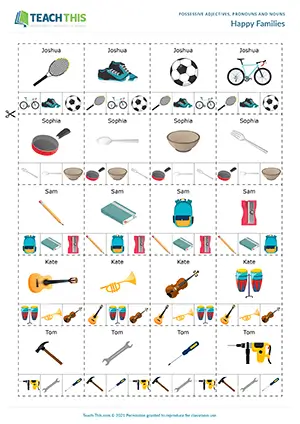
Happy Families

Pre-intermediate (A2) 25 minutes
ESL possessive nouns game preview featuring grammar and speaking activities, question-answer practice, group work exercises for pre-intermediate A2 students

ESL Possessive Nouns Game - Grammar and Speaking: Asking and Answering Questions, Freer Practice

In this productive possessive nouns game, students play a Happy Families card game to practice possessive nouns. Each card contains a picture of an object and the name of the person who the item...

ESL Possessive Nouns Game - Grammar and Speaking: Asking and Answering Questions, Freer Practice In this productive possessive nouns game, students play a Happy Families card game to practice possessive nouns. Each card contains a picture of an object and the name of the person who the item belongs to. There are also three small pictures at the bottom which are the other items the student needs to collect to complete the set. Students collect cards by taking it in turns to ask another group member for an item belonging to the set they want to collect, e.g. 'Do you have / Have you got Joshua's tennis racket?' If the group member has the card, they give it to the student. The student then gives the group member one of their unwanted cards in return, so students always have five cards. If the group member doesn't have the card, play passes to the next student. Students continue in this way until someone has collected a set of four cards. That student wins the round and scores a point. The students then shuffle the cards and deal them out again and so on. The student with the most points at the end of the game is the winner.

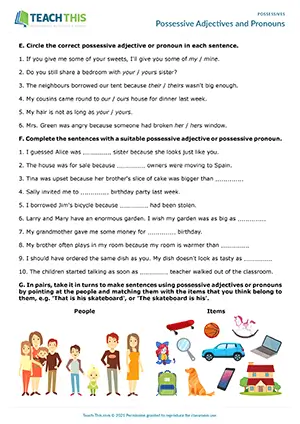
Possessive Adjectives and Pronouns

Pre-intermediate (A2) 35 minutes
ESL possessive adjectives and pronouns worksheet preview featuring vocabulary and grammar exercises, binary choice activities, gap-fill practice, speaking activities for pre-intermediate A2 students

ESL Possessive Adjectives and Pronouns Worksheet - Vocabulary and Grammar Exercises: Binary Choice, Gap-fill - Speaking Activity: Forming Sentences

This useful possessives worksheet helps students learn and practice possessive adjectives and pronouns. Students begin by completing a table with...

ESL Possessive Adjectives and Pronouns Worksheet - Vocabulary and Grammar Exercises: Binary Choice, Gap-fill - Speaking Activity: Forming Sentences This useful possessives worksheet helps students learn and practice possessive adjectives and pronouns. Students begin by completing a table with missing possessive adjectives and pronouns. Next, students circle the correct words to complete the grammar rules for using possessive adjectives and possessive pronouns. Students then complete sentences with the correct possessive adjectives and possessive pronouns. Students then move on to circle the correct possessive adjective or pronoun for each sentence shown. Next, students complete sentences with a suitable possessive adjective or possessive pronoun. Lastly, in pairs, students take it in turns to make sentences using possessive adjectives or pronouns by pointing at the people and matching them with the items that they think belong to them, e.g. 'That is his skateboard', or 'The skateboard is his'.

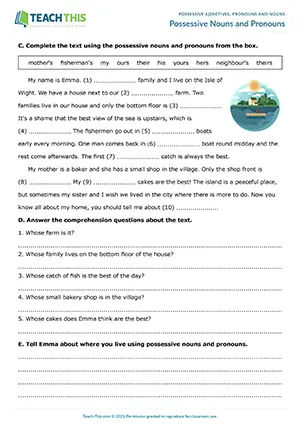
Possessive Nouns and Pronouns

Pre-intermediate (A2-B1) 25 minutes
ESL possessive nouns and pronouns worksheet preview featuring grammar exercises, rewriting phrases, gap-fill activities, reading comprehension questions for pre-intermediate A2-B1 students

ESL Possessive Nouns and Pronouns Worksheet - Grammar Exercises: Rewriting, Gap-fill, Answering Comprehension Questions, Writing Sentences

In this insightful possessives worksheet, students practice possessive nouns and possessive pronouns. Students begin by writing the correct...

ESL Possessive Nouns and Pronouns Worksheet - Grammar Exercises: Rewriting Phrases, Gap-fill, Answering Reading Comprehension Questions, Writing Sentences In this insightful possessives worksheet, students practice possessive nouns and possessive pronouns. Students begin by writing the correct possessive noun using 's or s'. Next, students fill in gaps in sentences with the correct possessive pronoun. After that, students complete a text using possessive nouns and pronouns from a box and answer comprehension questions about the text. Finally, students write about where they live in response to the text using possessive nouns and pronouns.

Possessive Pronoun Race

Pre-intermediate (A2) 25 minutes
ESL possessive pronouns game preview featuring grammar activities, matching exercises, sentence completion practice, group work for pre-intermediate A2 students

ESL Possessive Pronouns Game - Grammar: Matching, Sentence Completion

In this fast-paced possessive pronouns game, students race to complete sentences with possessive pronouns. Students take it in turns to pick up a sentence card and read it to the other two students. The students listen to the sentence and then race...

ESL Possessive Pronouns Game - Grammar: Matching, Sentence Completion In this fast-paced possessive pronouns game, students race to complete sentences with possessive pronouns. Students take it in turns to pick up a sentence card and read it to the other two students. The two students listen to the sentence and then race to grab the correct possessive pronoun card to finish the sentence. The first student to grab the correct card and say the possessive pronoun wins and keeps the two cards. The student with the most cards at the end of the game wins.

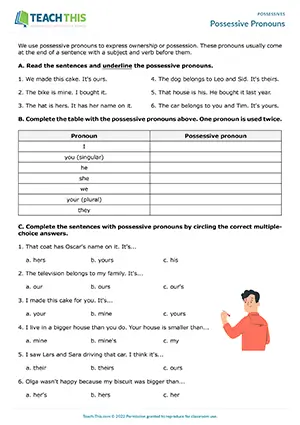
Possessive Pronouns

Pre-intermediate (A2) 30 minutes
ESL possessive pronouns worksheet preview featuring grammar exercises, identifying activities, multiple choice questions, table completion, sentence rewriting for pre-intermediate A2 students

ESL Possessive Pronouns Worksheet - Grammar Exercises: Identifying, Multiple Choice, Table and Sentence Completion, Rewriting Sentences, Unscrambling

In this free possessive pronouns worksheet, students practice the possessive pronouns: mine, yours, his, hers, ours, yours, theirs. First, students read...

ESL Possessive Pronouns Worksheet - Grammar Exercises: Identifying, Multiple Choice, Table and Sentence Completion, Rewriting Sentences, Unscrambling In this free possessive pronouns worksheet, students practice the possessive pronouns: mine, yours, his, hers, ours, yours, theirs. First, students read sentences and underline the possessive pronoun in each one. Students then write possessive pronouns in a table. Next, students complete sentences with possessive pronouns by circling the correct multiple-choice answers. Students then move on to complete each sentence with the correct possessive pronoun. After that, students rewrite sentences to include possessive pronouns. Lastly, students put words in the correct order to create sentences, adding a suitable possessive pronoun.

Whose is it?

Pre-intermediate (A2) 25 minutes
ESL possessive pronouns game preview featuring speaking activities, labelling exercises, sentence formation practice, pair work for pre-intermediate A2 students

ESL Possessive Pronouns Game - Speaking: Labelling, Forming Sentences

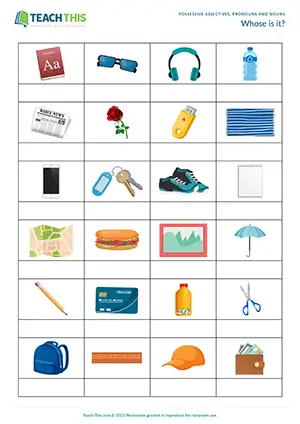
In this enjoyable possessive pronouns speaking activity, students play a memory game to practice possessive pronouns. Give each student a picture of an object and each pair a picture to share. The students then play a memory game where...

ESL Possessive Pronouns Game - Speaking: Labelling, Forming Sentences from Prompts In this enjoyable possessive pronouns speaking activity, students play a memory game to practice possessive pronouns. Give each student a picture of an object and each pair a picture to share. The students then play a memory game where they try to remember who owns what object. Students go around the class telling each other the object they have, including the object they share with their partner. Students then join back up with their partner and try to remember who owns which object by writing the name of the person under the corresponding picture on their worksheet. Students then use the information to make sentences with possessive pronouns, e.g. 'The dictionary is his'. 'The sunglasses are mine'. 'The MP3 player is hers', etc. Each object is then called out in turn. The first pair to make a correct statement with a possessive pronoun scores a point. The pair with the most points at the end of the game wins.

Correct it

Intermediate (B1) 15 minutes
ESL possessive adjectives and nouns game preview featuring grammar activities, error correction exercises, pair work for intermediate B1 level students

ESL Possessive Adjectives and Nouns Game - Grammar: Error Correction

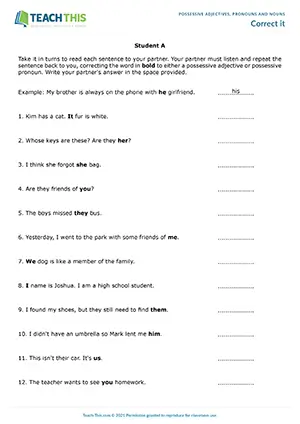
In this handy possessive adjectives and nouns error correction game, students correct sentences by changing subject pronouns to possessive adjectives or object pronouns to possessive pronouns. The sentences on the worksheet contain errors...

ESL Possessive Adjectives and Nouns Game - Grammar: Error Correction In this handy possessive adjectives and nouns error correction game, students correct sentences by changing subject pronouns to possessive adjectives or object pronouns to possessive pronouns. The sentences on the worksheet contain errors. There are subject pronouns where the possessive adjectives should be and object pronouns where the possessive pronouns should be. The students' task is to take it in turns to read a sentence to their partner and have them correct the mistake. Their partner listens to the sentence and repeats it back to their classmate, correcting it with either a possessive adjective or possessive pronoun. The student then writes their partner's answer in the space provided. The first pair of students to complete all the answers correctly wins.

Who does this belong to?

Intermediate (B1) 30 minutes
ESL possessives activity preview featuring speaking exercises, reading and listening practice, summarizing activities, matching exercises for intermediate B1 students

ESL Possessives Activity - Speaking: Reading, Listening, Summarizing, Matching

In this creative possessives speaking activity, students practice language for talking about possessions. Students take it in turns to read the text on their biography card to the other group members who listen and summarize the important facts on their...

ESL Possessives Activity - Speaking: Reading, Listening, Summarizing, Matching In this creative possessives speaking activity, students practice language for talking about possessions. Students take it in turns to read the text on their biography card to the other group members who listen and summarize the important facts on their summary cards. Next, students take it in turns to give an object to the student with the matching biography card, explaining the reason for their choice, e.g. 'I think this is Richard's laptop because...' or 'This laptop belongs to Richard because...' When the students have placed all the cards, they are told that there should be three objects for each person. Students then review each person's belongings and make any necessary changes. When the groups have finished, they explain how they divided the possessions and why. Afterwards, review the correct answers with the class. As an extension, in their groups, each student writes down three of their favourite possessions on slips of paper and passes them to another group, who uses the target language to guess who wrote each possession and why.

Understanding Possessive Adjectives, Pronouns and Nouns

Possessive adjectives such as 'my' and 'her' sit before a noun to show ownership, possessive pronouns such as 'mine' and 'hers' replace the noun entirely, and possessive nouns use an apostrophe to attach ownership directly to a name, as in 'Sarah's bag.' When students confuse a possessive adjective with a possessive pronoun, they produce sentences like 'That bag is her' instead of 'That bag is hers,' which sounds immediately wrong to any native speaker.

This page covers possessive adjectives, pronouns, and nouns across A1 to B1 levels with fourteen resources including card games, worksheets, speaking activities, and a board game format, with two activities available as free downloads.

Possessive nouns add 's to singular nouns and most names, as in 'the dog's lead' or 'James's coat,' and add only an apostrophe after the s of plural nouns, as in 'the students' books.' Each subject pronoun pairs with a distinct possessive adjective and possessive pronoun, and the table below shows all seven sets alongside example sentences.

Subject PronounPossessive AdjectivePossessive PronounExample Sentence
I my mine 'That is my bag. The bag is mine.'
you your yours 'Is that your coat? Yes, it's yours.'
he his his 'That is his phone. The phone is his.'
she her hers 'Those are her keys. The keys are hers.'
it its — 'The cat hurt its paw.'
we our ours 'This is our table. The table is ours.'
they their theirs 'That is their car. The car is theirs.'

When to Use Possessive Adjectives, Pronouns and Nouns

Avoiding repetition with possessive pronouns: A speaker switches from a possessive adjective to a possessive pronoun when the noun has already been mentioned and repeating it would sound clunky, so a response like 'I left mine at home' flows far more naturally than 'I left my bag at home' when the topic is already clear.

Signalling ownership in descriptions: Writers use possessive nouns when they want to attach an object or quality directly to a named person or thing, making descriptions more specific and immediate, so 'the teacher's desk' locates ownership in a way that 'the desk of the teacher' does not in everyday English.

Asking about possession in conversation: A speaker uses a possessive adjective when asking about something that belongs to the person they are talking to, because it personalises the question and invites a direct answer, as in 'Is this your umbrella?' rather than the more formal 'Does this umbrella belong to you?'

3-Step Framework for Teaching Possessive Adjectives, Pronouns and Nouns

1. Introduce Possessive Adjectives Through Sentence Construction: Open with a card-based game that puts possessive adjectives to work immediately. Students arrange possessive adjective, noun, and predicate cards into sentences about themselves and others within a ten-minute time limit, then read their sentences aloud as a group, scoring one point for each true or believable sentence. The truth-value scoring means students have to think carefully about meaning, not just grammar.

2. Tackle Possessive Nouns With a Physical Response Game: Shift the focus to possessive nouns with a fast elimination game. Every student stands holding an apostrophe card and an apostrophe+s card, and when a noun is called out they hold up the correct possessive ending to make it possessive. Any student who holds up the wrong card sits down and is out, which keeps every student alert and deciding actively throughout.

3. Consolidate All Three Forms Through Reasoned Speaking: Finish with a speaking activity that requires students to produce possessive language in a sustained, reasoned context. Students listen to biography cards and assign objects to the right person, explaining their reasoning using structures like 'I think this is Richard's laptop because...' or 'This laptop belongs to Richard because...' The justification requirement pushes students well beyond single-word answers.

Common Mistakes with Possessive Adjectives, Pronouns and Nouns

Using a subject pronoun instead of a possessive adjective: Students often write the subject pronoun where a possessive adjective is needed, particularly at lower levels, because both forms share the same position before a noun and the distinction is not yet automatic. Wrong: 'She left she bag on the bus.' Correct: 'She left her bag on the bus.'

Confusing its with it's: Students often write 'it's' where 'its' is needed, because the apostrophe signals possession for nouns everywhere else in English, making the possessive form without an apostrophe feel like an error even when it is correct. Wrong: 'The company released it's annual report.' Correct: 'The company released its annual report.'

Common Questions About Teaching Possessive Adjectives, Pronouns and Nouns

What is a free worksheet for teaching possessive pronouns?

The worksheet Possessive Pronouns is a free download that covers mine, yours, his, hers, ours, and theirs through six exercises. Students move from identifying possessive pronouns in sentences and completing a reference table, through multiple-choice and gap-fill practice, to rewriting sentences and unscrambling word-order puzzles, building toward independent production.

What is a fun game for practicing possessive nouns?

The game Happy Families is a card-collecting game where students ask for items using possessive nouns, for example 'Do you have Joshua's tennis racket?' Students collect sets of four cards by asking others, handing over an unwanted card in exchange for each one they receive. Every question requires a correctly formed possessive noun to score.

What is a good speaking activity for practicing possessive adjectives?

Students use my, your, his, and her in natural conversation with the activity What's your favourite...? They write answers about their favorites, marking five as true and five as false, then quiz a partner who guesses which answers are lies. A follow-up writing stage extends the practice to his and her, for example 'Her favorite place is the beach.'

Become a Teach This Member

Get unlimited access to the full library, plus new resources added every week.

Unlimited Resource Access

Download from 3000+ worksheets, activities, and games.

Save 5+ Hours Weekly

Cut lesson prep time with ready-to-use resources, plus teacher notes and answer keys.

Trusted Professional Quality

Classroom-tested, editable resources created by experienced ESL professionals.

Fresh Content Weekly

Get 5 new resources added to the library each week.

Join Now Just $29.99 quarterly