
Modal Verbs of Obligation & Prohibition ESL Activities, Games & Worksheets
Those Are the Rules
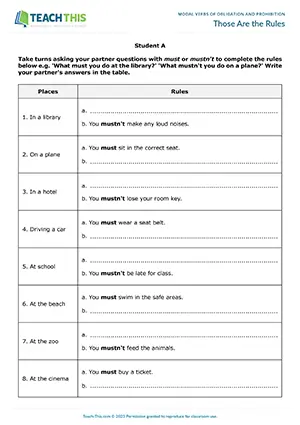
ESL Must and Mustn't Activity - Grammar and Speaking: Information Gap, Asking and Answering Questions - Pair Work
In this must and mustn't information gap activity, students discover the missing rules for eight familiar places by asking their partner questions. In pairs, students take turns asking 'What must...
Class Contracts

ESL Modal Verbs of Obligation and Prohibition Activity - Vocabulary and Writing Exercise: Writing Sentences - Group Work
In this light-hearted modal verbs of obligation and prohibition activity, students write an imaginary classroom contract for their teacher. In groups, students read the student contract on the worksheet...
David's Day

ESL Have to Worksheet - Grammar, Vocabulary and Writing Exercises: Writing Sentences, Paragraph Writing
This free modal verbs of obligation worksheet helps to teach students how to express obligation with have to and has to. First, students write sentences about what David has to do today by looking...
Do you have to...?
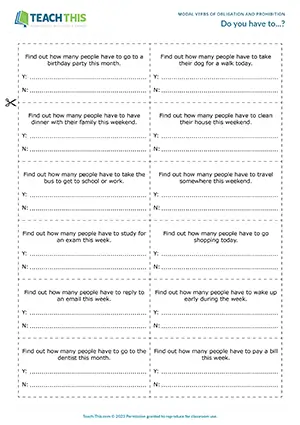
ESL Have to Activity - Speaking: Forming, Asking and Answering Questions, Conducting a Survey, Reporting Results - Group Work
In this free 'have to' speaking activity, students compare everyday responsibilities by surveying their classmates and sharing what they find out. First, students...
How to...
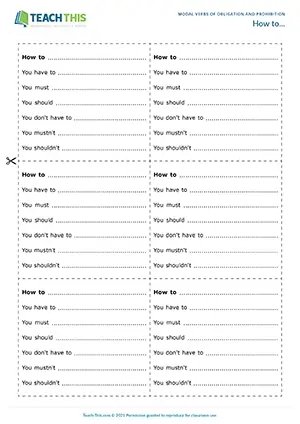
ESL Modal Verbs of Obligation Game - Vocabulary and Writing: Writing and Reading Sentences, Guessing - Pair Work
In this engaging modal verbs of obligation game, students complete sentences expressing obligation for 'How to...' topics and then use the sentences in a guessing game. In pairs, students think of...
It's Prohibited

ESL Modal Verbs of Prohibition Worksheet - Grammar and Vocabulary Exercises: Matching, True or False, Gap-fill, Sentence Completion
In this useful modal verbs of prohibition worksheet, students practice 'can't', 'mustn't' and 'may not' to communicate prohibited actions in a variety of situations...
It's the Law
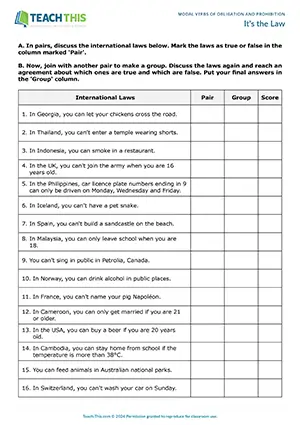
ESL Can and Can't Activity - Speaking: Guided Discussion, True or False, Guessing - Pair and Group Work
Here is an insightful can and can't activity to help students practice 'can' for permission and 'can't' for prohibition by discussing international laws and guessing which ones are true and false. First...
Perfect People

ESL Must and Mustn't Activity - Speaking: Sentence Completion, Discussion, Freer Practice - Group Work
In this free must and mustn't speaking activity, students write and discuss how they would like people to behave in a perfect world using the modal verbs 'must' for obligation and 'mustn't' for prohibition...
Rules to Remember
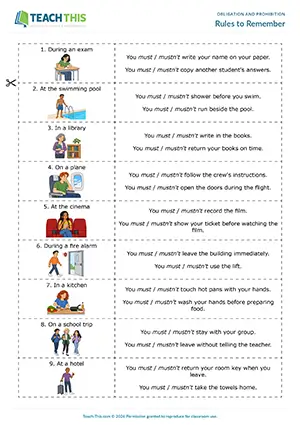
ESL Must and Mustn't Game - Grammar: Matching, Pelmanism, Binary Choice - Group Work
In this useful must and mustn't game, students compete to match everyday situations with the rules people need to follow. In groups, students take turns turning over one situation card and one...
Running Rules

ESL Modal Verbs of Obligation Activity - Speaking: Running Dictation, Freer Practice - Pair Work - Grammar Exercises: Gap-fill, Matching, Writing Sentences
In this enjoyable modal verbs of obligation running dictation activity, students practice completing and writing rules for various places. One student is the...
Ten Rules for English Class

ESL Modal Verbs of Obligation and Prohibition Activity - Vocabulary and Writing: Writing Sentences, Presenting - Pair Work
In this handy modal verbs of obligation and prohibition activity, students write ten rules for studying in English class using must, should and have to. In pairs...
The Modal Hotel
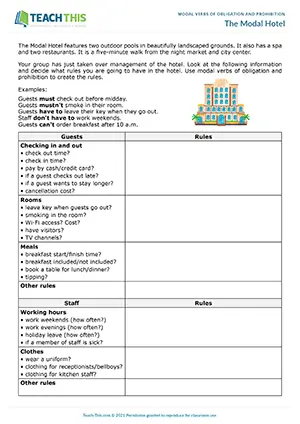
ESL Modal Verbs of Obligation and Prohibition Activity - Vocabulary, Writing and Speaking: Writing Sentences, Discussion, Freer Practice - Group Work
In this imaginative modal verbs of obligation and prohibition activity, students use modal verbs to make rules for guests and staff in a hotel using must, mustn't, have...
Who has to do what?

ESL Have to Activity - Vocabulary, Speaking and Writing: Information Gap, Asking and Answering Questions, Gap-fill, Identifying, Writing Sentences - Pair Work
This rewarding modal verbs of obligation activity can be used to help students practice have to, has to, don't have to, and doesn't have to. In pairs, students...
Job Descriptions

ESL Have to and Must Game - Speaking and Vocabulary: Reading and Writing Clues, Guessing - Pair Work
In this free have to and must game, students guess jobs from clues that contain expressions of obligation and prohibition with must, mustn't, have to, and don't have to. There are six clues for each...
School Rules
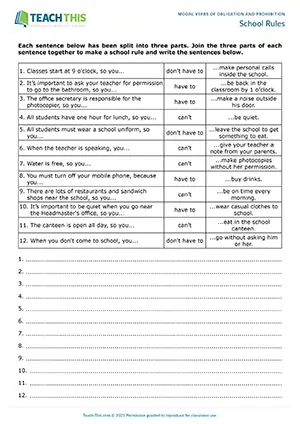
ESL Modal Verbs of Obligation and Prohibition Worksheet - Grammar and Writing Exercise: Matching, Forming Sentences
In this productive modal verbs of obligation and prohibition worksheet, students practice expressing obligation and prohibition with 'can't', 'have to' and 'don't have...
Should Survey

ESL Should Activity - Speaking: Forming, Asking and Answering Questions, Freer Practice
In this interesting should and shouldn't speaking activity, students practice asking and answering yes/no questions with should. This activity can be used to practice the modal verbs 'should' and...
Three Things

ESL Modal Verbs of Obligation and Prohibition Board Game - Speaking: Forming Sentences, Freer Practice - Group Work
In this fun modal verbs of obligation and prohibition board game, students review how to express past and present obligation, lack of obligation, and prohibition. Students take it in turns to roll the dice and...
What do you think?

ESL Have to and Should Activity - Speaking: Guessing, Guided Discussion, Freer Practice - Pair Work
In this thought-provoking have to and should speaking activity, students decide and discuss how strongly they agree or disagree with statements containing modal verbs and expressions of obligation...
When you were young...

ESL Had To and Didn't Have To Activity - Speaking: Asking and Answering Questions, Controlled and Freer Practice
This memorable past obligation speaking activity helps to teach students how to express obligation in the past with had to and didn't have to. In the activity, students ask and answer questions about...
Where is it?
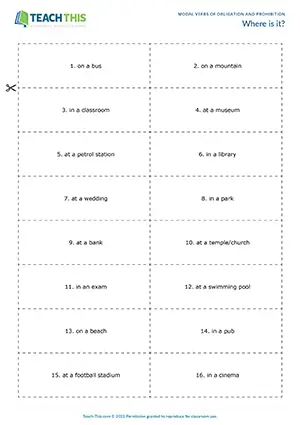
ESL Modal Verbs of Obligation and Prohibition Game - Grammar: Writing Sentences, Guessing - Pair Work
In this entertaining modal verbs of obligation and prohibition activity, students play a guessing game where they describe places and situations using modal verbs and expressions of obligation...
When you were a child

ESL Had To Activity - Speaking: Survey, Asking and Answering Questions, Freer Practice - Group Work
In this free past modal verbs of obligation and prohibition speaking activity, students ask and answer questions about what they were and weren't allowed to do and had to do when they were a child. This...
Understanding Modal Verbs of Obligation and Prohibition
Modal verbs of obligation and prohibition are words like 'must', 'have to', 'should', 'mustn't', and 'can't' that signal whether something is required, recommended, or forbidden. Choosing the wrong modal sends a stronger message than intended: writing 'You must finish this today' to a colleague, for example, sounds like a command where 'You should finish this today' would read as advice.
This page covers modal verbs of obligation and prohibition across four levels from Elementary (A1-A2) to Upper-intermediate (B2), with 22 activities spanning speaking surveys, board games, writing tasks, running dictations, and information gap activities, including five free downloads.
The main modal verbs of obligation and prohibition each carry a different strength of meaning, from a firm rule to a mild suggestion, and choosing between them changes the tone of what a speaker or writer communicates.
| Modal Verb | Meaning | Example Sentence | Negative Form |
|---|---|---|---|
| must | strong obligation (internal or authoritative) | 'You must wear a seatbelt.' | mustn't (prohibition: it is forbidden) |
| have to | obligation (external rule or requirement) | 'She has to submit the report by Friday.' | don't have to / doesn't have to (no obligation required) |
| should | mild obligation / recommendation | 'You should call before you arrive.' | shouldn't (mild advice against) |
| ought to | mild obligation / suggestion (slightly more formal) | 'He ought to apologize for being late.' | ought not to (formal advice against) |
| can't | prohibition (something is not allowed) | 'You can't park here.' | n/a (already a negative form) |
| may not | formal prohibition | 'Guests may not bring food into the hall.' | n/a (already a negative form) |
| had to | past obligation (something was required) | 'We had to leave before the show ended.' | didn't have to (no past obligation) |
When to Use Modal Verbs of Obligation and Prohibition
Reporting institutional rules: Writers and speakers use 'must' and 'mustn't' when they represent an institution or authority and need to convey that a rule is non-negotiable, as in a posted notice that reads 'Visitors must report to reception on arrival.'
Expressing no obligation: 'Don't have to' and 'doesn't have to' signal that something is not required but not forbidden either, which matters whenever a speaker wants to reassure someone without accidentally implying a ban, as in 'You don't have to bring a gift, but you're welcome to.'
Distinguishing advice from rules: Speakers reach for 'should' when they want to recommend an action without imposing it, making their tone sound helpful rather than directive, as in 'You should back up your files before updating the software.'
3-Step Framework for Teaching Modal Verbs of Obligation and Prohibition
1. Build the Grammar Base with Movement: Before students start producing modal verbs in context, get them on their feet. A running dictation format puts one student in the role of reader and the other as writer: the reader runs to a text, reads the first sentence, memorizes it, runs back and dictates it to the writer, who transcribes it on the back of their worksheet. Once students have physically collected all the sentences, they use that material to sort modal verbs of obligation into categories and decide which rules belong to which real-world setting. This memory-and-movement approach makes the grammar feel purposeful right from the start.
2. Move to Freer Production with a Board Game: Once students have the core forms, shift to a board game format that pushes them to produce modal verbs across a range of meanings in quick succession. Each square on the board carries a prompt that names the type of sentence required, so when a student lands on a square like 'Three things you mustn't do in class', they must respond immediately: 'You mustn't eat snacks, talk loudly or use your mobile phone in class.' Other group members act as judges, sending the speaker back two squares for any incorrect or nonsensical sentence. Peer evaluation in real time means students self-correct and monitor each other's accuracy without any teacher input needed.
3. Extend to Past Obligation: Round off the sequence by extending the grammar to past obligation with 'had to' and 'didn't have to'. A class mingle format generates genuine information gaps because students convert prompts into personal questions, such as 'When you were young, did you have to go to school by bus?', and circulate to find classmates who match each statement. The personal nature of childhood obligation questions generates real conversation, and the reporting stage pushes students to use 'had to' and 'didn't have to' naturally when they share findings with the class.
Common Mistakes with Modal Verbs of Obligation and Prohibition
Confusing 'mustn't' with 'don't have to': Students often use 'mustn't' when they mean there is no obligation, not realizing that 'mustn't' expresses prohibition while 'don't have to' expresses a lack of requirement. Wrong: 'It's a casual event, so you mustn't wear a suit.' Correct: 'It's a casual event, so you don't have to wear a suit.'
Adding 'to' after 'must' or 'should': Students often insert 'to' directly after 'must' or 'should' by analogy with 'have to', producing a structure that is ungrammatical because bare infinitives follow these modals. Wrong: 'You must to finish your homework before class.' Correct: 'You must finish your homework before class.'
Common Questions About Teaching Modal Verbs of Obligation and Prohibition
What is a good speaking activity for practicing should and shouldn't?
The activity Should Survey gets the whole class talking at once. Students form yes/no questions from prompts such as 'Should people eat meat?', move around asking everyone, and record their answers. When a classmate responds, the student writes down their name and asks a follow-up question. At the end, students report their findings to the class.
What is a useful worksheet for practicing have to and has to?
For practicing have to and has to, the free worksheet David's Day moves students from controlled to personal production. Students first write sentences about what David has to do today using items on his desk and a box of verbs and nouns as prompts, then write a short paragraph about their own obligations and read it to the class.
What is a fun game for practicing modal verbs of obligation?
Students in the free game Job Descriptions guess jobs from clue cards that run from hardest to easiest, scoring more points the earlier they guess correctly. Pairs then write their own job clue cards using 'must', 'mustn't', 'have to', and 'don't have to' and read them to the class.
Become a Teach This Member
Get unlimited access to the full library, plus new resources added every week.
Unlimited Resource Access
Download from 3000+ worksheets, activities, and games.
Save 5+ Hours Weekly
Cut lesson prep time with ready-to-use resources, plus teacher notes and answer keys.
Trusted Professional Quality
Classroom-tested, editable resources created by experienced ESL professionals.
Fresh Content Weekly
Get 5 new resources added to the library each week.
Here's what our members are saying...


