
Collective Nouns ESL Games & Worksheets
A Range of Exercises
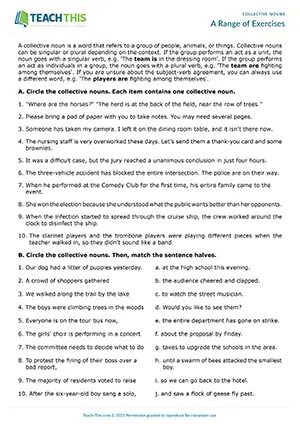
ESL Collective Nouns Worksheet - Vocabulary Exercises: Identifying, Matching, Gap-fill, Ranking, Writing Sentences
In this comprehensive collective nouns worksheet, students practice identifying and using 30 common collective nouns. Students start by circling collective nouns in a set of sentences. Students then...
Collective Nouns Bingo
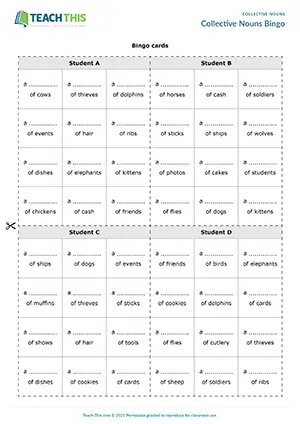
ESL Collective Nouns Worksheet and Game - Vocabulary: Matching, Gap-fill - Group Work
In this set of fun collective noun activities, students complete a worksheet to practice collective nouns and then use the nouns in a game of bingo. Students begin by matching words to one of six collective nouns. Next, students complete a set of...
Collective Quiz

ESL Collective Nouns Game - Vocabulary: Quiz, Guessing, Matching - Group Work
In this free collective nouns game, students take part in a quiz where they race to guess collective nouns related to animals, people and things. In the game, students play a jeopardy-style quiz game where they guess collective nouns from...
High Rollers
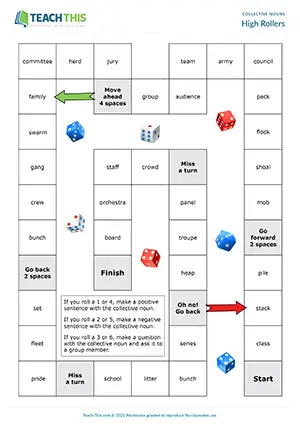
ESL Collective Nouns Board Game - Vocabulary and Speaking: Forming Sentences and Questions - Group Work
In this engaging collective nouns board game, students practice using collective nouns correctly in positive sentences, negative sentences, and questions. If a student rolls a one or four, they make a...
Understanding Collective Nouns
Collective nouns are words that name a group of people, animals, or things as a single unit, such as 'a swarm of bees,' 'a pride of lions,' or 'a panel of judges.' Students who rely on a vague word like 'group' for every situation miss the precision that native speakers expect, and using the wrong collective noun in formal writing can make a sentence sound unnatural or even comical.
This page covers collective nouns at B2 level with four activities including a vocabulary worksheet, a bingo game, a quiz game, and a board game, with one activity available as a free download.
This table groups the most commonly tested collective nouns by category so teachers and students can see at a glance which noun pairs with which group.
| Category | Collective Noun | Used With | Example Phrase |
|---|---|---|---|
| Animals | flock | birds / sheep | 'a flock of birds' |
| Animals | pack | wolves | 'a pack of wolves' |
| Animals | school | fish | 'a school of fish' |
| Animals | pride | lions | 'a pride of lions' |
| Animals | swarm | bees / insects | 'a swarm of bees' |
| Animals | pod | dolphins / whales | 'a pod of dolphins' |
| People | crowd | people | 'a crowd of people' |
| People | panel | judges / experts | 'a panel of judges' |
| People | crew | sailors / workers | 'a crew of sailors' |
| People | choir | singers | 'a choir of singers' |
| People | gang | thieves | 'a gang of thieves' |
| Things | bunch | keys / flowers | 'a bunch of keys' |
| Things | fleet | ships / vehicles | 'a fleet of ships' |
| Things | stack | papers / books | 'a stack of papers' |
| Things | sheaf | documents / wheat | 'a sheaf of documents' |
When to Use Collective Nouns
Describing Wildlife or Nature: When a writer or speaker describes animals moving or acting as a unit, the correct collective noun signals precision and natural fluency in a way that 'a group of' simply does not, as in 'A pride of lions was spotted near the watering hole.'
Writing About Professional Groups: When referring to people defined by a shared role or expertise, using the specific collective noun signals formality and precision far more effectively than a vague alternative, as in 'The panel of experts reviewed the proposal before the vote.'
Adding Texture When Describing Objects: When a writer wants to describe a collection of things precisely, a specific collective noun gives the sentence detail and weight that 'a lot of' or 'some' cannot deliver, as in 'She handed him a sheaf of documents and left without a word.'
3-Step Framework for Teaching Collective Nouns
1. Build Recognition First: Open with a worksheet that takes students through the full range of collective noun work in a single sitting: identifying, matching, and gap-fill exercises that build familiarity with 30 common collective nouns. The key finishing move is asking students to write down the eight collective nouns they found most difficult from the earlier exercises and then write original sentences using each one, turning their own weak spots into active practice.
2. Test Recall Under Pressure: Follow up with a bingo game that shifts students from controlled exercises into recall under gentle time pressure. One student acts as bingo caller, picks up a card, and reads a collective noun such as 'flock' aloud to the group. Students with a matching word on their card write the full collective noun phrase, for example 'a flock of birds,' before crossing off the square. The first student to cross off all 12 squares wins.
3. Push into Production: Close with a board game that challenges students to produce collective nouns across all three sentence forms. The dice roll determines the task: a one or four means a positive sentence, a two or five means a negative sentence, and a three or six means the player forms a question and directs it to a group member. This keeps every student alert across the whole game, not just when it is their turn.
Common Mistakes with Collective Nouns
Omitting the Article Before a Collective Noun: Students often drop the indefinite article 'a' before a collective noun, treating the collective noun phrase like a simple plural rather than a countable noun phrase. Wrong: 'We saw flock of birds flying over the lake.' Correct: 'We saw a flock of birds flying over the lake.'
Using a Generic Word Instead of the Specific Collective Noun: Students often substitute a general word like 'group' or 'herd' for every context, missing the specific collective noun that pairs naturally with a particular animal, person, or thing. Wrong: 'We saw a group of dolphins jumping near the boat.' Correct: 'We saw a pod of dolphins jumping near the boat.'
Common Questions About Teaching Collective Nouns
What is a good game for teaching collective nouns?
The game Collective Quiz is a free jeopardy-style game where students race to guess collective nouns from descriptions. The first student to say the correct collective noun wins that square and its points for their team. As a variation, a winning team can double their points by giving another example using the same collective noun.
What is a fun collective nouns board game?
The board game High Rollers pushes students to produce collective nouns across three sentence forms in a single activity. The dice roll decides the task: a one or four means a positive sentence, a two or five a negative sentence, and a three or six means the player forms a question and directs it to another student.
Become a Teach This Member
Get unlimited access to the full library, plus new resources added every week.
Unlimited Resource Access
Download from 3000+ worksheets, activities, and games.
Save 5+ Hours Weekly
Cut lesson prep time with ready-to-use resources, plus teacher notes and answer keys.
Trusted Professional Quality
Classroom-tested, editable resources created by experienced ESL professionals.
Fresh Content Weekly
Get 5 new resources added to the library each week.
Here's what our members are saying...


