Out and About

Elementary (A1-A2) 20 minutes
ESL Going Out and Entertainment Game, elementary A1-A2, gap-fill, guessing, pair work

ESL Going Out and Entertainment Game - Vocabulary: Gap-fill, Guessing - Speaking Activity: Asking and Answering Questions, Controlled and Freer practice - Pair Work

This fun going out and entertainment game helps students practice vocabulary for places they can go on a day out and activities associated with these places...

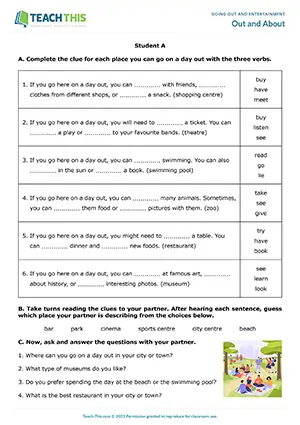
ESL Going Out and Entertainment Game - Vocabulary: Gap-fill, Guessing - Speaking Activity: Asking and Answering Questions, Controlled and Freer practice - Pair Work This fun going out and entertainment game helps students practice vocabulary for places they can go on a day out and activities associated with these places. First, in two groups, students use verbs to complete clues for different places they can go on a day out. Next, students pair up with someone from the other group and take turns reading each clue to their partner, who guesses which place is being described from the choices provided. For each correct guess, students score one point. The student with the most points at the end of the game wins. Finally, students ask and answer conversation questions about the places with their partner.

Going Out Survey

Pre-intermediate (A2) 25 minutes
ESL Going Out Survey, pre-intermediate A2, speaking, likes and dislikes, pair and group work

ESL Going Out Survey - Speaking Activity: Forming, Asking and Answering Questions, Freer Practice - Group and Pair Work

This insightful going out survey helps students practice going out and entertainment vocabulary by asking and answering questions about likes and dislikes. First, students find out which...

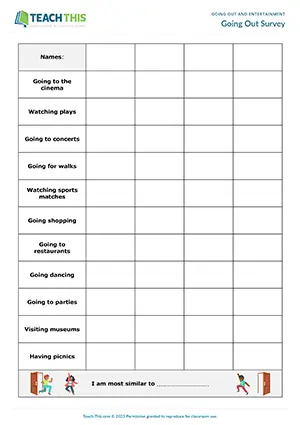
ESL Going Out Survey - Speaking Activity: Forming, Asking and Answering Questions, Controlled and Freer Practice - Group and Pair Work This insightful going out survey helps students practice going out and entertainment vocabulary by asking and answering questions about likes and dislikes. First, students find out which activities their group members like to do when they go out by asking 'Do you like...?' questions. The group members respond 'Yes, I do', or 'No, I don't' accordingly, and the student marks the answers in a chart. Next, students pair up with someone from another group and take turns asking their partner who they spoke to and their likes and dislikes using the third person, e.g. 'Does Jon like going to the cinema?' Afterwards, the two students review their answers and complete a sentence on the worksheet with the name of the person they are most similar to. Finally, students report back to the class on their findings.

Going Out Taboo

Pre-intermediate (A2) 25 minutes
ESL Entertainment Game, pre-intermediate A2, describing, guessing, group work

ESL Entertainment Game - Vocabulary and Speaking: Describing, Guessing, Freer Practice - Group Work

In this creative entertainment vocabulary game, students describe and guess places and actions related to going out and entertainment. In groups of four, students take turns picking up a card...

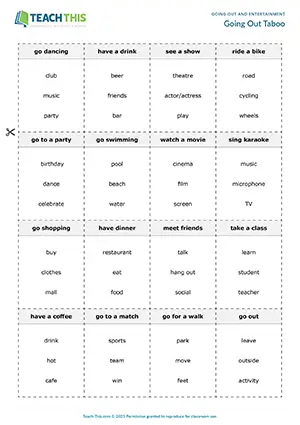
ESL Entertainment Game - Vocabulary and Speaking: Describing, Guessing, Freer Practice - Group Work In this creative entertainment vocabulary game, students describe and guess places and actions related to going out and entertainment. In groups of four, students take turns picking up a card and describing the place or action at the top of the card to the other students without saying any of the words shown on the card. The first student to successfully guess the place or action being described wins and keeps the card. The student with the most cards at the end of the game wins.

Leisure Lingo

Pre-intermediate (A2) 30 minutes
ESL Going Out and Entertainment Worksheet, pre-intermediate A2, word search, matching, categorising, gap-fill, discussion

ESL Going Out and Entertainment Worksheet - Vocabulary Exercises: Word Search, Matching, Categorising, Gap-fill - Speaking Activity: Discussion - Pair Work

In this comprehensive going out and entertainment worksheet, students learn and practice vocabulary related to a day out. In pairs, students begin by...

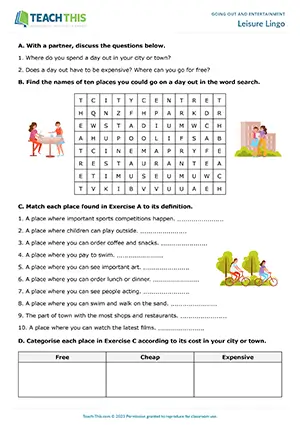
ESL Going Out and Entertainment Worksheet - Vocabulary Exercises: Word Search, Matching, Categorising, Gap-fill - Speaking Activity: Discussion, Freer Practice - Pair Work In this comprehensive going out and entertainment worksheet, students learn and practice vocabulary related to a day out. In pairs, students begin by discussing two questions about spending a day out. Students then find ten places to go on a day out in a word search. Next, students match the places to their definitions. After that, students categorise each place according to its cost in their town or city. Following that, students match nouns with verbs to make going out and entertainment collocations. Students then use the collocations to complete plans for a day out, adding four ideas of their own. Finally, in pairs, students discuss the plans and answer questions about them. When the students have finished, they share and discuss their answers with the class.

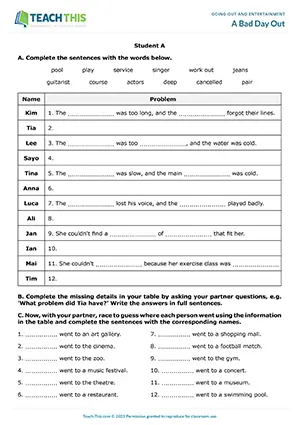
A Bad Day Out

Intermediate (B1) 25 minutes
ESL Going Out Activity, intermediate B1, gap-fill, information gap, matching, pair work

ESL Going Out Activity - Vocabulary, Reading and Speaking Activity: Gap-fill, Information Gap, Matching, Asking and Answering Questions - Pair Work

In this engaging going-out information gap activity, students complete sentences about problems people had on a day out and exchange information with...

ESL Going Out Activity - Vocabulary, Reading and Speaking Activity: Gap-fill, Information Gap, Matching, Asking and Answering Questions, Controlled Practice - Pair Work In this engaging going-out information gap activity, students complete sentences about problems people had on a day out and exchange information with a partner to find out where each person went. First, in two groups, students complete sentences about problems people had when they went out to different places with words from a box. Next, students pair up with someone from the other group and take turns asking their partner about the problems experienced by the people whose details are missing from their worksheet and writing their partner's responses in the table in sentence form. After that, pairs race to complete sentences by writing the correct person's name next to the corresponding place or event that they went to. The first pair to complete all their sentences correctly wins.

Entertainment Dilemmas

Intermediate (B1) 25 minutes
ESL Going Out and Entertainment Game, intermediate B1, gap-fill, multiple-choice, guessing, pair work

ESL Going Out and Entertainment Game - Vocabulary: Gap-fill, Multiple-choice Questions, Guessing - Pair Work

Here is a free going out and entertainment vocabulary game in which students ask a partner hypothetical questions about going out and guess which answers they would choose. Working alone...

ESL Going Out and Entertainment Game - Vocabulary: Gap-fill, Multiple-Choice Questions, Guessing - Pair Work Here is a free going out and entertainment vocabulary game in which students ask a partner hypothetical questions about going out and guess which answers they would choose. Working alone, students begin by completing questions with words from a box. Next, students underline the multiple-choice answer in each question they think their partner will choose. Students then take turns reading each question along with its three multiple-choice options to their partner, who chooses the answer that is true for them. If students guess correctly, they put a tick next to the question and score a point. The student with the most points at the end of the game wins.

That's Entertainment!

Intermediate (B1) 25 minutes
ESL Going Out and Entertainment Worksheet, intermediate B1, matching, unscrambling, gap-fill, pair work

ESL Going Out and Entertainment Worksheet - Vocabulary Exercises: Matching, Unscrambling, Binary Choice, Gap-fill - Speaking Activity - Pair Work

In this productive entertainment vocabulary worksheet, students learn and practice vocabulary related to going out and entertainment. To begin...

ESL Going Out and Entertainment Worksheet - Vocabulary Exercises: Matching, Unscrambling, Binary Choice, Gap-fill - Speaking Activity - Pair Work In this productive entertainment vocabulary worksheet, students learn and practice vocabulary related to going out and entertainment. To begin, students complete collocations related to going out and entertainment with verbs from a box. Next, students rearrange letters to spell place names and write the letter of the activity from Exercise A that someone would do at that place. Students then underline the correct place in each sentence. After that, students complete sentences with vocabulary from a box and write the place each sentence refers to. Next, students match sentence halves and complete the endings with words from a box. Lastly, in pairs, students ask and answer conversation questions about going out and entertainment.

A Day at the Theme Park

Upper-intermediate (B2) 30 minutes
ESL Theme Park Worksheet, upper-intermediate B2, matching, categorising, guided discussion, pair work

ESL Theme Park Worksheet - Vocabulary Exercises: Matching, Categorising - Speaking Activity: Discussion, Communicative Practice - Pair Work

In this useful theme park worksheet, students learn theme park vocabulary and engage in theme park discussions by sharing opinions and expressing agreement...

ESL Theme Park Worksheet - Vocabulary Exercises: Matching, Categorising - Speaking Activity: Guided Discussion, Communicative Practice - Pair Work In this useful theme park worksheet, students learn theme park vocabulary and engage in theme park discussions by sharing opinions and expressing agreement and disagreement. First, students match theme park attractions to pictures. Students then match each attraction to its description. Next, students sort agreeing and disagreeing phrases into four categories. After that, students read a theme park situation and use the phrases to discuss the positives and negatives of each theme park attraction and come to an agreement for the situation. Finally, students read and discuss statements about theme parks, giving their opinion and saying whether they agree or disagree.

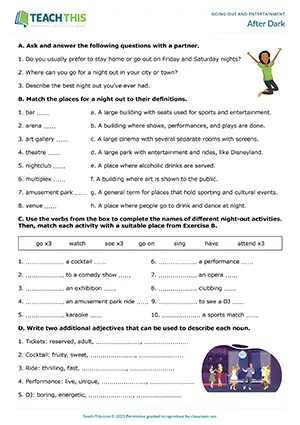
After Dark

Upper-intermediate (B2) 25 minutes
ESL Going Out and Entertainment Worksheet, upper-intermediate B2, matching, gap-fill, binary choice, questions

ESL Going Out and Entertainment Worksheet - Vocabulary Exercises: Matching, Gap-fill, Binary Choice - Speaking Activity: Asking and Answering Questions - Pair Work

In this handy going out and entertainment worksheet, students practice vocabulary related to having a night out. First, students discuss three questions...

ESL Going Out and Entertainment Worksheet - Vocabulary Exercises: Matching, Gap-fill, Binary Choice - Speaking Activity: Asking and Answering Questions - Pair Work In this handy going out and entertainment worksheet, students practice vocabulary related to having a night out. First, students discuss three questions about nights out in pairs. Students then match places for a night out to their definitions. Next, students use verbs to complete the names of different night-out activities and then match each activity with a suitable place. After that, students write down two additional adjectives that can be used to describe each noun. Following that, students use night-out vocabulary to complete sentences about what people did on Friday night. Finally, students underline the correct word to complete each conversation question and then ask and answer the questions with a partner.

Out on the Town

Upper-intermediate (B2) 25 minutes
ESL Entertainment Worksheet, upper-intermediate B2, matching, binary choice, gap-fill, pair work

ESL Entertainment Worksheet - Vocabulary Exercises: Matching, Binary Choice, Gap-fill - Speaking Activity: Asking and Answering Questions - Pair Work

This free entertainment vocabulary worksheet helps students practice words related to going out and entertainment. In pairs, students begin by asking each other...

ESL Entertainment Worksheet - Vocabulary Exercises: Matching, Binary Choice, Gap-fill - Speaking Activity: Asking and Answering Questions - Pair Work This free entertainment vocabulary worksheet helps students practice words related to going out and entertainment. In pairs, students begin by asking each other conversation questions about going out. Students then match sentence halves to make sentences about going out and entertainment. Next, students match the sentences with activities and underline the correct verb in each sentence. After that, students match verbs with their definitions. Students then underline the correct word in each sentence. Lastly, students complete conversation questions about entertainment and going out with words from a box and then ask and answer the questions with a partner.

Using Going Out and Entertainment Vocabulary

Going out and entertainment vocabulary covers leisure venues, activities and the phrases used to describe plans and experiences. Connecting places with actions, such as 'see an exhibition' or 'go bowling', helps students explain what they want to do and discuss their choices.

This page has 10 resources across A1-A2, A2, B1 and B2, including games, worksheets and speaking activities, with two free downloads.

The table connects places and activities with phrases students can use when discussing a day or evening out.

Word or phraseMeaning or useExample
see an exhibition Visit a public display of art or other objects 'We could see an exhibition at the gallery.'
go bowling Take part in a leisure activity 'Let's go bowling on Saturday.'
book tickets Reserve admission in advance 'We need to book tickets for the show.'
live music Music performed for an audience 'This café has live music on Fridays.'
sold out Having no tickets left to buy 'The concert is sold out.'
admission fee The amount paid to enter a place or event 'The admission fee includes all the rides.'

When to Use Going Out and Entertainment Vocabulary

Make workable plans: Include details that help someone decide whether to join you, such as cost, location or time. 'Let's go to the cinema after lunch; tickets are cheaper then' gives a suggestion a practical reason.

Compare preferences: Explain what appeals to you and leave room for another person's choice. 'I'd prefer a concert because I enjoy live music. What would you like to do?' supports a shared decision.

Describe an experience: Separate what happened from your reaction. 'We queued for an hour, so I felt frustrated' tells the listener both the problem and how it affected the outing.

3-Step Framework for Teaching Going Out and Entertainment Vocabulary

This sequence suits elementary to pre-intermediate classes, moving from supported clues to describing places and discussing plans.

1. Connect Places with Actions: Students complete clues with verbs, then read them to a partner who guesses the place from the choices provided. Linking each venue to what people do there gives students language to draw on when they describe places more independently.

2. Describe without Naming: Students take turns describing a place or activity on a card without using the listed words. The first successful guesser keeps the card. This extends clue practice by requiring students to choose their own explanations and respond to what listeners understand.

3. Use Phrases to Discuss Plans: Students match places to definitions, categorise them by local cost and combine verbs with nouns. They use these phrases to complete plans for a day out, add their own ideas and discuss the plans with a partner. This brings vocabulary into decisions about possible outings.

Common Mistakes with Going Out and Entertainment Vocabulary

Adding to before an activity ending in -ing: Use 'go' followed directly by activities such as bowling or dancing. Use 'go to' with a destination, as in 'go to the cinema'. Incorrect: 'Let's go to bowling.' Correct: 'Let's go bowling.'

Confusing bored and boring: Use 'bored' for how someone feels and 'boring' for something or someone that causes boredom. When describing your own lack of interest, choose 'bored'. Incorrect for this meaning: 'I was boring during the show.' Correct: 'I was bored during the show.'

Common Questions About Teaching Going Out and Entertainment Vocabulary

What game helps students practice entertainment vocabulary?

The free game Entertainment Dilemmas gives students a reason to read entertainment vocabulary closely. Students complete questions with words from a box, predict their partner's answers and take turns reading the questions and options aloud. Correct predictions earn points, turning the exchange into a competition based on their partner's choices.

What is a good worksheet for teaching going out vocabulary?

The free worksheet Out on the Town combines vocabulary exercises with conversation. Students match sentence halves and activities, choose appropriate verbs and connect verbs with definitions. They then complete questions and discuss them with a partner, moving from checking word meanings and combinations to using the language in conversation.

How can students practice talking about going out?

In the speaking activity Going Out Survey, students ask classmates about activities they enjoy and record their answers. They then exchange information with a new partner using third-person questions and identify someone with similar interests. This gives repeated question practice a purpose: finding out and reporting what other people enjoy.

Become a Teach This Member

Get unlimited access to the full library, plus new resources added every week.

Unlimited Resource Access

Download from 3000+ worksheets, activities, and games.

Save 5+ Hours Weekly

Cut lesson prep time with ready-to-use resources, plus teacher notes and answer keys.

Trusted Professional Quality

Classroom-tested, editable resources created by experienced ESL professionals.

Fresh Content Weekly

Get 5 new resources added to the library each week.

Join Now Just $29.99 quarterly