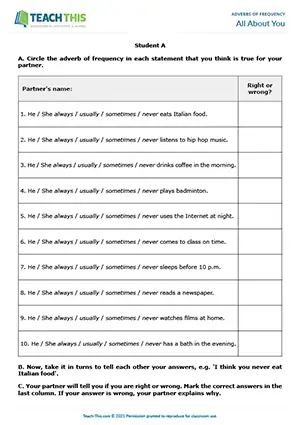
All About You

Elementary (A1-A2) 25 minutes
ESL adverbs of frequency guessing game for elementary A1-A2, multiple choice, guessing, forming sentences, pair work

ESL Adverbs of Frequency Game - Vocabulary and Speaking: Guessing, Forming Sentences - Pair Work

In this frun adverbs of frequency game, students guess their partner's habits using the adverbs of frequency: always, usually, sometimes and never. First, students circle the adverb of frequency in each...

ESL Adverbs of Frequency Game - Vocabulary and Speaking: Guessing, Forming Sentences from Prompts - Pair Work In this frun adverbs of frequency game, students guess their partner's habits using the adverbs of frequency: always, usually, sometimes and never. First, students circle the adverb of frequency in each sentence that they think is true for their partner. Students then take turns telling their partner their guesses for each sentence, e.g. 'I think you never eat Italian food'. Their partner says whether they are right or wrong. If the guess is wrong, their partner tells them the right one. The student then marks their guess right or wrong in the last column with a tick or cross. The student with the most correct guesses at the end of the game wins.

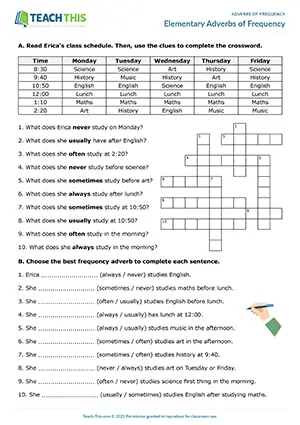
Elementary Adverbs of Frequency

Elementary (A1-A2) 30 minutes
ESL adverbs of frequency worksheet for elementary A1-A2, crossword, grammar, categorising, pair speaking

ESL Adverbs of Frequency Worksheet - Grammar and Vocabulary Exercises: Crossword, Binary Choice, Error Correction, Categorising - Speaking Activity - Pair Work

In this productive adverbs of frequency worksheet, students practice describing daily routines using five key adverbs of frequency: never, sometimes, often...

ESL Adverbs of Frequency Worksheet - Grammar and Vocabulary Exercises: Crossword, Binary Choice, Error Correction, Categorising - Speaking Activity: Forming Sentences - Pair Work In this productive adverbs of frequency worksheet, students practice describing daily routines using five key adverbs of frequency: never, sometimes, often, usually and always. First, students read Erica's class schedule and use clues to complete a crossword. Students then choose the best frequency adverb to complete sentences about Erica's schedule. Next, students find mistakes in sentences about Erica and rewrite them correctly. After that, students use adverbs of frequency to complete sentences with their own information. Students then sort activities into categories based on how often they do them. Finally, students tell a partner how often they do the activities in short sentences.

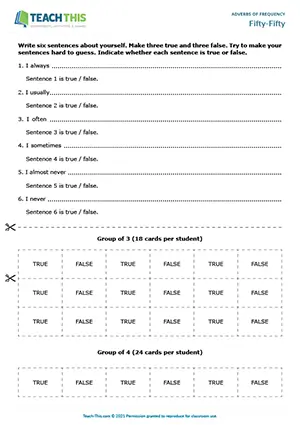
Fifty-Fifty

Elementary (A1-A2) 30 minutes
ESL adverbs of frequency guessing game for elementary A1-A2, writing true and false sentences, pair and group work

ESL Adverbs of Frequency Game - Grammar: Writing Sentences, Asking Questions, Guessing - Group Work

In this fun adverbs of frequency game, students write true and false sentences about themselves and try to trick their classmates into guessing wrong. First, students complete six sentences about themselves...

ESL Adverbs of Frequency Game - Grammar: Writing Sentences, Asking Questions from Prompts, Guessing - Group Work In this fun adverbs of frequency game, students write true and false sentences about themselves and try to trick their classmates into guessing wrong. First, students complete six sentences about themselves with the adverbs of frequency shown, making three sentences true and three false. For sentence 6, students choose their own adverb of frequency. Students indicate whether each sentence is true or false underneath. Next, in groups, students take turns reading one of their sentences to the other group members. Each group member then asks the student one question from the worksheet, and the student answers with a short sentence. After that, the group members guess whether the sentence is true or false by each placing one of their true or false cards on the table. The answer is then revealed by the student. Group members who guessed correctly take back their card. The remaining cards are taken by the student who read the sentence. The student with the most cards at the end of the game wins.

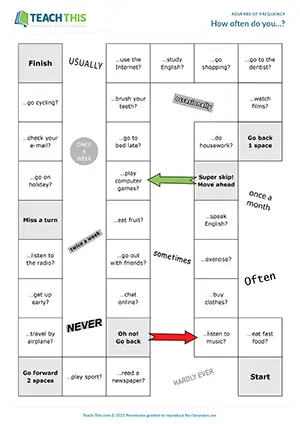
How often do you...?

Elementary (A1-A2) 25 minutes
ESL adverbs of frequency board game for elementary A1-A2, asking and answering how often questions, group work

ESL How Often Do You Board Game - Speaking: Asking and Answering Questions, Freer Practice - Group Work

In this free adverbs of frequency board game, students get talking about their everyday lives as they ask and answer 'How often do you...?' questions, using adverbs and expressions of frequency. In groups...

ESLHow Often Do You Board Game - Speaking: Asking and Answering Questions from Prompts, Freer Practice - Group Work In this free adverbs of frequency board game, students get talking about their everyday lives as they ask and answer 'How often do you...?' questions, using adverbs and expressions of frequency. In groups, players take turns rolling the dice and moving their counters along the board. When a player lands on a square, the student to their right asks a 'How often do you...?' question using the topic on the square. For example, if the square says 'eat fast food?', the student to their right asks 'How often do you eat fast food?' The player then answers the question using an adverb or expression of frequency from the game board. If a player cannot answer or does not use an adverb or expression of frequency correctly, they go back two squares. The first player to reach the finish wins the game.

My Partner's Daily Life

Elementary (A1-A2) 30 minutes
ESL adverbs of frequency pair activity for elementary A1-A2, daily routines, asking and answering questions

ESL Adverbs of Frequency Activity - Grammar and Speaking: Asking and Answering Questions - Pair Work

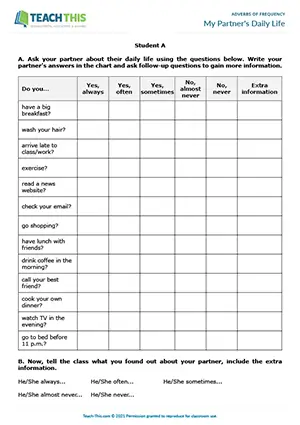
In this insightful adverbs of frequency activity, students find out about their partner's daily life by asking and answering questions, and then share what they discovered with the class. In pairs, students...

ESL Adverbs of Frequency Activity - Grammar and Speaking: Asking and Answering Questions from Prompts - Pair Work In this insightful adverbs of frequency activity, students find out about their partner's daily life by asking and answering questions, and then share what they discovered with the class. In pairs, students take turns asking their partner the questions on their worksheet, e.g. 'Do you drink coffee?' Their partner responds using one of the frequency adverbs from the worksheet, e.g. 'Yes, I often drink coffee.' Students tick their partner's answer in the chart. Finally, students tell the class what they found out about their partner. As an extension, students write about their partner's daily routine using the information they found out.

On the Same Frequency

Elementary (A1-A2) 25 minutes
ESL adverbs of frequency guessing game for elementary A1-A2, daily routines, how often questions, pair activity

ESL Adverbs of Frequency Game - Grammar and Speaking: Sentence Writing, Guessing, Asking and Answering Questions - Pair Work

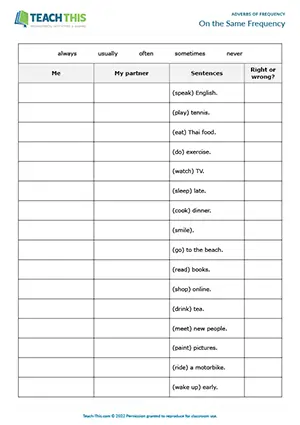
In this adverbs of frequency guessing game, students write sentences about their everyday habits and then see how well they can predict their partner's answers. First, students use each sentence prompt...

ESL Adverbs of Frequency Game - Grammar and Speaking: Sentence Writing, Guessing, Asking and Answering Questions from Prompts - Pair Work In this adverbs of frequency guessing game, students write sentences about their everyday habits and then see how well they can predict their partner's answers. First, students use each sentence prompt to write a sentence with an adverb of frequency and the correct verb form in the 'Me' column, e.g. 'I sometimes speak English.' When the students have finished, divide them into pairs. Working alone, students guess their partner's habits by writing a sentence with 'he' or 'she', an adverb of frequency and the correct verb form in the 'My partner' column, e.g. 'She often speaks English.' Students then take turns asking their partner a yes/no question based on their guess, e.g. 'Do you often speak English?' Their partner gives their true answer. If the guess was correct, the student puts a tick in the 'Right or wrong?' column. If not, the student puts a cross. The student with the most correct guesses in each pair wins.

About Me

Pre-intermediate (A2) 35 minutes
ESL adverbs of frequency worksheet and game for pre-intermediate A2, sentence completion, word order, guessing game

ESL Adverbs of Frequency Worksheet - Grammar Exercise: Sentence Completion - Grammar Game: Guessing

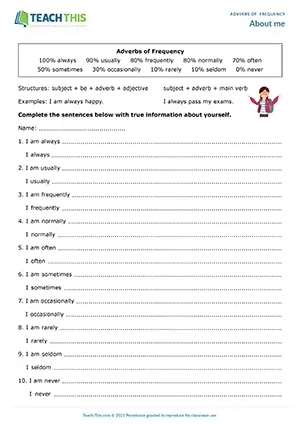
This free adverbs of frequency worksheet and game helps students to master adverb of frequency word order. Students begin by writing their name at the top of the worksheet. Students then complete...

ESL Adverbs of Frequency Worksheet - Grammar Exercise: Sentence Completion - Grammar Game: Guessing This free adverbs of frequency worksheet and game helps students to master adverb of frequency word order. Students begin by writing their name at the top of the worksheet. Students then complete sentences by writing true information about themselves based on the adverbs of frequency on the worksheet. Students write sentences using two structures. The first structure uses the verb 'to be' followed by a frequency adverb. The other uses a frequency adverb followed by a main verb. When students have finished writing, collect in the worksheets. Students then play a guessing game where you read some sentences from each worksheet to the class and they guess who wrote them. Students score one point for each correct guess. The student with the most points wins the game.

Find Someone Who...

Pre-intermediate (A2) 30 minutes
ESL adverbs of frequency speaking activity for pre-intermediate A2, asking how often questions, mingling

ESL Adverbs of Frequency Activity - Grammar and Speaking: Asking and Answering Questions, Controlled Practice

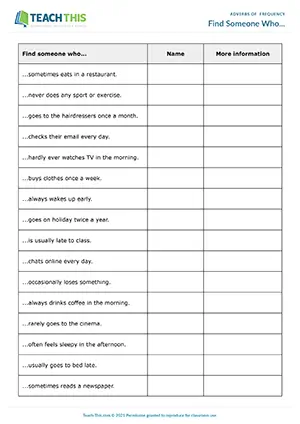
In this adverbs of frequency speaking activity, students ask 'How often do you...?' questions and answer with adverbs and expressions of frequency. Students start by going through the items on the worksheet...

ESL Adverbs of Frequency Activity - Grammar and Speaking: Asking and Answering Questions from Prompts, Controlled Practice In this adverbs of frequency speaking activity, students ask 'How often do you...?' questions and answer with adverbs and expressions of frequency. Students start by going through the items on the worksheet and forming the 'How often do you...?' questions they need to ask to do the activity, e.g. 'How often do you eat in a restaurant?' Students then go around the classroom asking the questions. When a classmate replies with the same adverb or expression of frequency that is written on the worksheet, the student writes down their name and asks a follow-up question. If their answer doesn't match with the adverb of frequency on the worksheet, the student repeats the question with other classmates until one of them gives a matching response. Finally, students give feedback to the class on what they found out about their classmates.

How often do you use English?

Pre-intermediate (A2) 40 minutes
ESL adverbs of frequency activity for pre-intermediate A2, forming true or false statements, survey, group work

ESL Adverbs of Frequency Activities - Vocabulary and Grammar Game: Forming Sentences, True or False, Guessing - Speaking Activity - Group Work

In these imaginative adverbs of frequency activities, students play a true or false game and conduct a survey about how often they use English outside the...

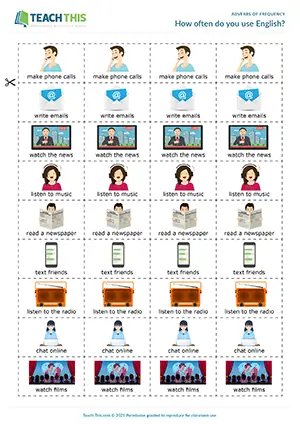
ESL Adverbs of Frequency Activities - Vocabulary and Grammar Game: Forming Sentences, True or False, Guessing - Speaking Activity: Freer Practice - Group Work In these imaginative adverbs of frequency activities, students play a true or false game and conduct a survey about how often they use English outside the classroom. First, students prepare true or false statements about how often they use English when doing the things shown on cards, e.g. 'I write emails in English every day'. Each group then competes against another group in a true or false game (Team A and B). A student from Team A chooses one of their cards and reads the statement to Team B who guesses whether the statement is true or false. If Team B guesses correctly, they score a point. The team with the most points at the end of the game wins. Next, on a worksheet, each student truthfully answers how often they use English when doing the things shown. Students then ask the 'How often do you...?' questions to their group members and complete the worksheet with their answers. Finally, groups give feedback to the class on their findings and discuss the results.

How well do you know me?

Pre-intermediate (A2) 35 minutes
ESL adverbs of frequency game for pre-intermediate A2, sentence completion, guessing, class activity

ESL Adverbs of Frequency Game - Grammar and Vocabulary: Sentence Completion, Guessing

In this intriguing adverbs of frequency game, students see how well they know their classmates by completing sentences with frequency adverbs. One student comes to the front of the class, sits in a chair...

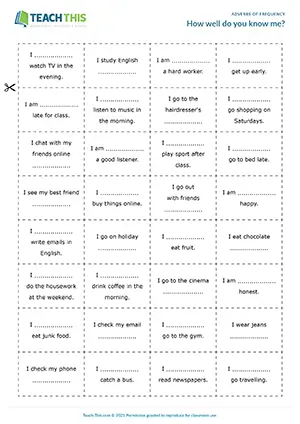
ESL Adverbs of Frequency Game - Grammar and Vocabulary: Sentence Completion, Guessing In this intriguing adverbs of frequency game, students see how well they know their classmates by completing sentences with frequency adverbs. One student comes to the front of the class, sits in a chair and picks a card. The student then reads the card to the class, saying the word 'blank' where the adverb or expression of frequency goes, e.g. 'I BLANK watch TV in the evening'. The student then writes down an adverb of frequency on the card to make the sentence true for him or herself. If the 'blank' comes at the end of the sentence, the student writes an expression of frequency. The other students then write down the adverb or expression of frequency that they think the student has written. Next, all the students hold up their cards. The student at the front then shows their answer. Anyone who has the same adverb or expression of frequency as the student at the front scores a point for themselves or their team. Then, another student comes to the front of the class and so on. The individual or team with the most points at the end of the game wins.

Knowing Me, Knowing You

Pre-intermediate (A2) 30 minutes
ESL adverbs of frequency guessing game for pre-intermediate A2, chart, making sentences, group work

ESL Adverbs of Frequency Game - Speaking: Guessing, Forming Sentences, Freer Practice - Group Work

In this free adverbs of frequency game, students guess how often their classmates do certain things and make sentences with frequency adverbs. First, students tick the adverb of frequency that...

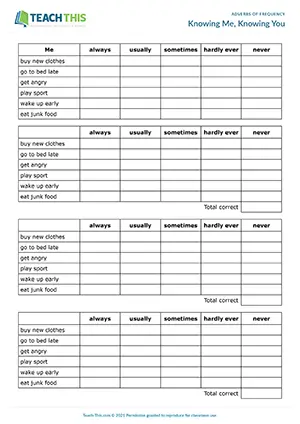
ESL Adverbs of Frequency Game - Speaking: Guessing, Forming Sentences, Freer Practice - Group Work In this free adverbs of frequency game, students guess how often their classmates do certain things and make sentences with frequency adverbs. First, students tick the adverb of frequency that demonstrates how often they do each thing shown in the chart on their worksheet. In groups, students then complete an identical chart for each student in their group by guessing how often the student does the things shown and ticking the appropriate adverb of frequency. Afterwards, students choose one group member and take turns telling the group what answers they gave for that student. Students do this by making sentences with adverbs of frequency, explaining their answers, e.g. 'I think Amy usually buys new clothes because she often wears different clothes to class'. After all the students have explained their answers, the student reveals the correct frequency adverbs. Students score one point for each correct guess. The student with the most correct guesses wins the game.

Six Surveys

Pre-intermediate (A2) 30 minutes
ESL adverbs of frequency speaking activity for pre-intermediate A2, conducting surveys, writing sentences

ESL Adverbs of Frequency Activity - Grammar and Speaking: Asking and Answering Questions, Writing Sentences - Group Work

In this enjoyable adverbs of frequency speaking activity, students conduct a survey where they ask each other present simple yes/no questions with...

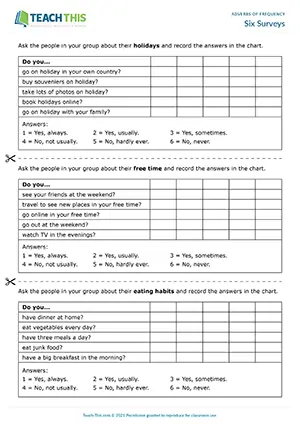
ESL Adverbs of Frequency Activity - Grammar and Speaking: Asking and Answering Questions from Prompts, Writing Sentences - Group Work In this enjoyable adverbs of frequency speaking activity, students conduct a survey where they ask each other present simple yes/no questions with 'Do you...?' and respond to questions with short answers and frequency adverbs. In groups, each student conducts a survey to find out about the topic on their form, e.g. holidays, eating habits, etc. Students ask each other the 'Do you...?' questions on their form and respond to their classmates' questions with short answers and frequency adverbs, e.g. 'Yes, usually', 'No, hardly ever', etc. Students record these answers in a chart on their form. Afterwards, students write sentences based on the results of their survey using phrases from the board. When the students have finished, they report back to the class on their findings.

Sort it out!

Pre-intermediate (A2) 30 minutes
ESL adverbs of frequency game for pre-intermediate A2, unscrambling, ordering text, team race

ESL Adverbs of Frequency Game - Vocabulary, Grammar and Reading: Unscrambling, Ordering - Group Work

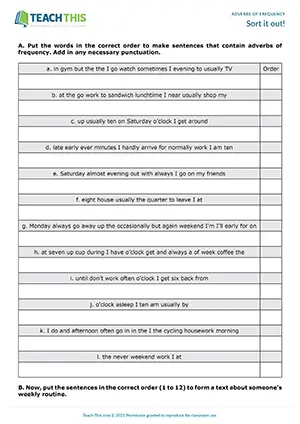
In this fast-paced adverbs of frequency game, teams race to put words in the correct order to make present simple sentences with adverbs of frequency, adding in any necessary punctuation...

ESL Adverbs of Frequency Game - Vocabulary, Grammar and Reading: Unscrambling, Ordering Parts of a Text - Group Work In this fast-paced adverbs of frequency game, teams race to put words in the correct order to make present simple sentences with adverbs of frequency, adding in any necessary punctuation. The first team to show and read out each sentence in the correct order scores three points. Teams that show or read out a wrong answer lose one point. This continues until all the sentences have been completed. When everyone has finished, students put the sentences into the correct order to form a text about someone's weekly routine. The first team to do this scores an additional five points. The team with the highest score at the end of the game wins.

True Detective

Pre-intermediate (A2-B1) 25 minutes
ESL adverbs of frequency game for pre-intermediate A2-B1, asking and answering how often questions, frequency cards

ESL How Often Do You Game - Vocabulary and Speaking: Asking and Answering Questions, Freer Practice - Group Work

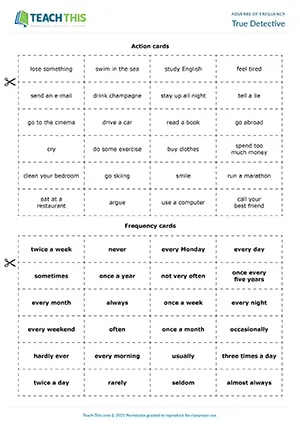
Here is a creative adverbs of frequency game to help students practice 'How often do you...?' questions and adverbs and expressions of frequency. In groups of three, students take it in turns to pick...

ESL How Often Do You Game - Vocabulary and Speaking: Asking and Answering Questions from Prompts, Freer Practice - Group Work Here is a creative adverbs of frequency game to help students practice 'How often do you...?' questions and adverbs and expressions of frequency. In groups of three, students take it in turns to pick up an action card and use the prompt on the card to ask the other two students a 'How often do you...?' question, e.g. 'How often do you lose something?' The other two students then look at their frequency cards and each choose one that is as close to the truth as possible. The two students then respond by making a sentence using the adverb or expression of frequency on their card, e.g. 'I hardly ever lose something'. The student who asked the question then decides whose answer is nearest to the truth and gives the action card to that student. That student lays the frequency and action card on the table for everyone to see and the two cards are removed from the game. The next student then picks up an action card and so on. The first student to get rid of all their frequency cards wins the game.

True or False Sentences

Pre-intermediate (A2-B1) 30 minutes
ESL adverbs of frequency true or false game for pre-intermediate A2-B1, sentence prompts, team guessing

ESL Adverbs of Frequency Game - Grammar: Forming Sentences, True or False, Guessing

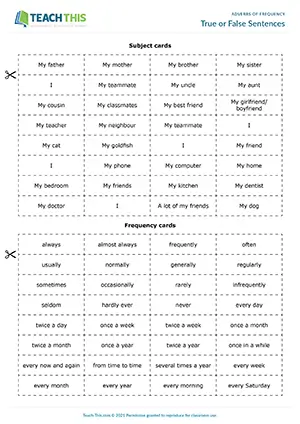
In this amusing adverbs of frequency true or false game, students practice making sentences with adverbs and expressions of frequency. A student from Team A picks up a subject card and a frequency card from each pile and places them face-up...

ESL Adverbs of Frequency Game - Grammar: Forming Sentences from Prompts, True or False, Guessing In this amusing adverbs of frequency true or false game, students practice making sentences with adverbs and expressions of frequency. A student from Team A picks up a subject card and a frequency card from each pile and places them face up on the desk. The student's task is to make a true or false sentence with the subject and adverb or expression of frequency on the cards. The student then says the sentence to the other team, e.g. 'My father always goes to work at eight o'clock'. The opposing team guesses whether the sentence is true or false. If the opposing team guesses correctly, they win and keep the cards. If they are wrong, the other team wins and keeps the cards. A student from Team B then picks up two cards and the process is repeated. The team with the most cards at the end of the game wins.

Which sentence?

Pre-intermediate (A2) 30 minutes
ESL adverbs of frequency guessing game for pre-intermediate A2, sentence completion, pair work

ESL Adverbs of Frequency Game - Grammar and Vocabulary: Sentence Completion, Guessing - Pair Work

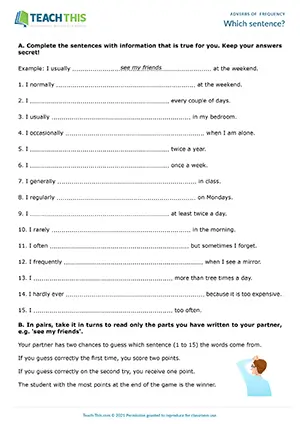
Here is a useful adverbs of frequency game to help students talk about themselves using more advanced adverbs and expressions of frequency. First, students look at sentences containing adverbs and...

ESL Adverbs of Frequency Game - Grammar and Vocabulary: Sentence Completion, Guessing - Pair Work Here is a useful adverbs of frequency game to help students talk about themselves using more advanced adverbs and expressions of frequency. First, students look at sentences containing adverbs and expressions of frequency on the worksheet and then complete the sentences with true information about themselves, e.g. 'I normally see my friends at the weekend'. In pairs, students then take it in turns to read only the parts they have written to their partner, e.g. 'see my friends'. Their partner then has two chances to guess which sentence (1 to 15) the words come from. If a student guesses correctly the first time, they score two points. If a student guesses correctly on the second try, they receive one point. The student with the most points at the end of the game is the winner.

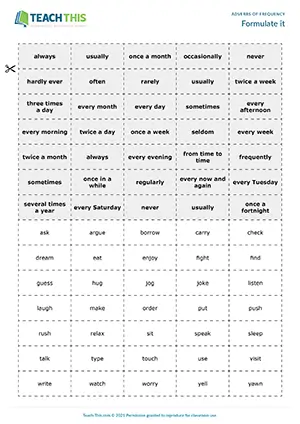
Formulate it

Intermediate (B1) 30 minutes
ESL adverbs of frequency group game for intermediate B1, how often questions, frequency cards

ESL How Often Do You Game - Grammar and Speaking: Asking and Answering Questions - Group Work

In this engaging adverbs of frequency game, students formulate 'How often do you...?' questions and give answers with adverbs and expressions of frequency. The first student picks up a verb card and...

ESL How Often Do You Game - Grammar and Speaking: Asking and Answering Questions from Prompts - Group Work In this engaging adverbs of frequency game, students formulate 'How often do you...?' questions and give answers with adverbs and expressions of frequency. The first student picks up a verb card and thinks of a 'How often do you...?' question using the verb on the card. The student then asks the question to the second student. If the student formulates the question correctly, they keep the card. The second student picks up a frequency card and answers by making a sentence with the frequency adverb or expression on the card. If the student forms their answer correctly, they keep the card. The second student then picks up a verb card and asks a question to the third student and so on. If a student makes a grammar mistake or is unable to form a question or answer, another student can steal their card by correctly forming it for them. The student with the most cards at the end of the game wins.

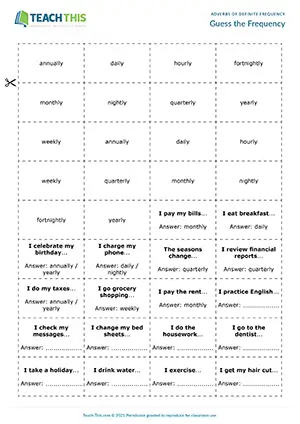
Guess the Frequency

Intermediate (B1) 25 minutes
ESL adverbs of definite frequency game for intermediate B1, sentence completion, guessing, group work

ESL Adverbs of Definite Frequency Game - Speaking and Vocabulary: Asking and Answering Questions, Sentence Completion, Guessing - Group Work

In this inventive adverbs of definite frequency game, students race to guess definite frequency adverbs for habitual activities. In groups, students take it in...

ESL Adverbs of Definite Frequency Game - Speaking and Vocabulary: Asking and Answering Questions from Prompts, Sentence Completion, Guessing - Group Work In this inventive adverbs of definite frequency game, students race to guess definite frequency adverbs for habitual activities. In groups, students take it in turns to pick up a card. If a student picks up an adverb card, they ask a 'How often do you...?' question to elicit the adverb of definite frequency on the card. For example, if the card reads 'hourly', the student might ask 'How often do you check your phone?' The first student to respond by making a sentence with the correct adverb of definite frequency wins and keeps the card, e.g. 'I check my phone hourly'. If a student picks up a sentence card, they check to see if an answer has been provided. If not, the student writes a definite frequency adverb on the card to reflect how often they do the activity. The student then reads the sentence in bold to the group, e.g. 'I celebrate my birthday...' The other students then race to guess the adverb of definite frequency, i.e. annually or yearly. The first student to correctly guess the adverb wins and keeps the card. The student with the most cards at the end of the game wins.

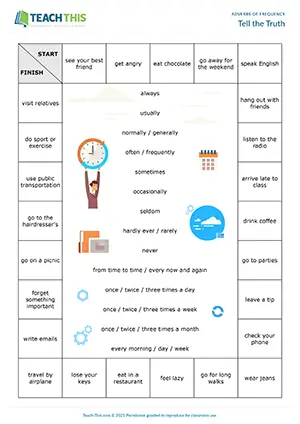
Tell the Truth

Intermediate (B1) 20 minutes
ESL adverbs of frequency board game for intermediate B1, forming sentences, group work

ESL Adverbs of Frequency Board Game - Grammar and Speaking: Forming Sentences - Group Work

In this interesting adverbs of frequency board game, students make true present simple sentences using adverbs and expressions of frequency. Players take it in turns to roll the dice and move their...

ESL Adverbs of Frequency Board Game - Grammar and Speaking: Forming Sentences from Prompts - Group Work In this interesting adverbs of frequency board game, students make true present simple sentences using adverbs and expressions of frequency. Players take it in turns to roll the dice and move their counter along the board. When a player lands on a square, they make a true present simple sentence using the phrase on the square and a frequency adverb or expression from the board. The other group members listen and judge the player's sentence. If the player makes a grammatically correct and believable sentence, they stay on the square. If the player makes a grammar mistake, they go back two squares. If the sentence seems unbelievable, the group members ask the player to explain more about their sentence. The first player to reach the finish wins the game.

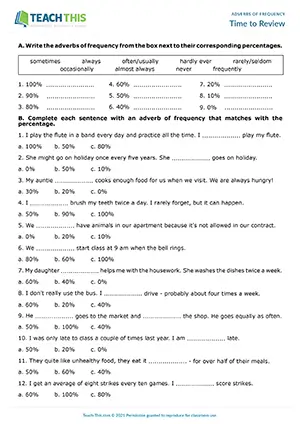
Time to Review

Intermediate (B1) 25 minutes
ESL adverbs of frequency worksheet for intermediate B1, labelling, matching, multiple choice, timetable, writing

ESL Adverbs of Frequency Worksheet - Reading and Vocabulary Exercises: Matching, Multiple Choice, Comprehension Questions, Writing Sentences

This comprehensive adverbs of frequency worksheet helps students review 11 frequency adverbs. Students begin by writing adverbs of frequency from a box...

ESL Adverbs of Frequency Worksheet - Reading and Vocabulary Exercises: Labelling, Matching, Multiple Choice, Table Completion, Comprehension Questions, Writing Sentences This comprehensive adverbs of frequency worksheet helps students review 11 frequency adverbs. Students begin by writing adverbs of frequency from a box next to their corresponding percentages. Next, students complete sentences with adverbs of frequency that match with percentages. Afterwards, students read a university student's timetable and write the number of hours the person spends on each of their commitments. Students then answer questions about the timetable using frequency adverbs. In the last exercise, students write sentences about their own timetable or routine using adverbs of frequency.

Understanding Adverbs of Frequency

Adverbs of frequency are words like always, usually, often, sometimes, rarely, and never that describe how often something happens. When students misplace these adverbs, putting them after a main verb instead of before it, their sentences sound unnatural to a native speaker and can make even simple statements about daily routines confusing.

This page covers adverbs of frequency across Elementary (A1-A2), Pre-intermediate (A2), and Intermediate (B1) levels, with 20 activities ranging from pair guessing games and board games to team races and surveys, including three free downloads.

The table below shows the most common adverbs and expressions of frequency, their approximate meanings, where they sit in a sentence, and a short example.

Adverb/ExpressionApproximate FrequencyPosition RuleExample
always 100% After 'to be'; before other main verbs 'She is always on time.' / 'She always arrives early.'
usually 70-90% After 'to be'; before other main verbs 'He usually has coffee for breakfast.'
often 50-70% After 'to be'; before other main verbs 'They often go for a walk.'
sometimes 30-50% After 'to be'; before other main verbs; also sentence-initial or final 'I sometimes work from home.' / 'Sometimes I work from home.'
rarely / seldom 10-20% After 'to be'; before other main verbs 'She rarely checks her email.'
never 0% After 'to be'; before other main verbs; do not use with a negative verb 'He never eats meat.' / 'She is never late.'
hourly / daily / weekly / monthly / annually Exact recurring frequency Usually at end of sentence 'We meet weekly.' / 'I check my phone hourly.'
every day / once a week / twice a month Exact recurring frequency Usually at end of sentence 'She goes to the gym three times a week.'

When to Use Adverbs of Frequency

Talking About Daily Habits: Speakers reach for adverbs of frequency when they want to describe a recurring personal routine without quoting an exact number, as when someone says 'I usually take the train to work but I sometimes drive when I have a lot to carry.'

Softening and Strengthening Claims: Writers and speakers use frequency adverbs to calibrate how absolute or tentative a statement sounds, which matters in professional contexts where 'always' signals firm commitment and 'occasionally' signals flexibility, as in 'I occasionally work late if a deadline is tight.'

Describing Others' Behavior Objectively: Adverbs of frequency give a neutral, factual tone when describing someone else's patterns, which makes them useful in written feedback or appraisals where a stark positive or negative judgment would sound too blunt, as in 'She rarely misses a deadline and always submits detailed reports.'

3-Step Framework for Teaching Adverbs of Frequency

1. Build the Foundation with Vocabulary and Reading: Start by giving students a solid grounding in the core vocabulary. A reading-based worksheet works well here: students meet a set of frequency adverbs in context, working through tasks that force them to notice which adverb fits which situation. The payoff comes when students sort activities into categories based on how often they do them, personalizing the language before any speaking begins.

2. Lock In Word Order with a Team Race: Once students know the adverbs, tackle word order head-on. A fast-paced team game gets the job done here. Teams race to put words in the correct order to make present simple sentences with adverbs of frequency, adding in any necessary punctuation. The scoring keeps every team alert: the first team to show and read out each sentence in the correct order scores three points, while teams that show or read out a wrong answer lose one point.

3. Push for Fluency with Question Formation: At this stage, shift the focus from controlled accuracy to free production. A card game that demands both question formation and instant answers pushes students to stay sharp even when it is not their turn. The mechanic that really drives this is the steal rule: if a student makes a grammar mistake or is unable to form a question or answer, another student can steal their card by correctly forming it for them, which means no one switches off.

Common Mistakes with Adverbs of Frequency

Double Negative with 'Never': Students often combine 'never' with a negative verb form, creating a double negative that contradicts the intended meaning. Wrong: 'I don't never eat fast food.' Correct: 'I never eat fast food.'

Wrong Position with 'To Be': Students often place a frequency adverb before the verb 'to be' rather than after it, applying the standard pre-verb rule where it does not belong. Wrong: 'She always is late for class.' Correct: 'She is always late for class.'

Common Questions About Teaching Adverbs of Frequency

What is a fun board game for practicing adverbs of frequency?

The board game How often do you...? is a free resource where players roll the dice and answer a 'How often do you...?' question on the square they land on using an adverb or expression of frequency. If a player can't answer or makes a grammar mistake, they go back two squares. The first player to reach the finish wins.

What is a useful worksheet for adverbs of frequency?

The worksheet About Me is a free resource that covers adverb of frequency word order through a whole-class guessing game. Students complete sentences using two structures: 'to be' followed by a frequency adverb, and a frequency adverb before a main verb. The teacher collects the sheets, reads sentences aloud, and the class guesses who wrote them.

What is an engaging speaking activity for teaching adverbs of frequency?

The game Guess the Frequency has students ask and answer 'How often do you...?' questions using a set of adverb and sentence cards. Students either form a question to elicit a target adverb or read a sentence aloud while classmates race to supply the correct frequency adverb. The student with the most cards at the end wins.

Become a Teach This Member

Get unlimited access to the full library, plus new resources added every week.

Unlimited Resource Access

Download from 3000+ worksheets, activities, and games.

Save 5+ Hours Weekly

Cut lesson prep time with ready-to-use resources, plus teacher notes and answer keys.

Trusted Professional Quality

Classroom-tested, editable resources created by experienced ESL professionals.

Fresh Content Weekly

Get 5 new resources added to the library each week.

Join Now Just $29.99 quarterly