
Persuasive Essays EAP Worksheets, Activities & Games
The Art of Persuasion
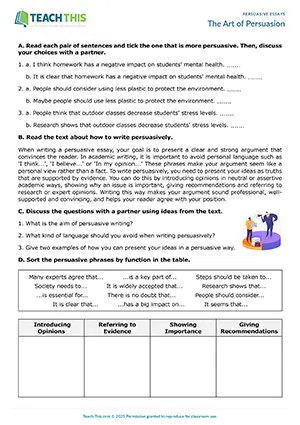
EAP Persuasive Essay Worksheet - Reading, Vocabulary and Writing Exercises:: Rewriting Sentences, Paragraph Writing - Speaking Activity: Discussion - Pair Work
In this handy persuasive essay worksheet, students learn and practice common academic phrases used in persuasive writing, compare the persuasiveness...
Argument Takedown
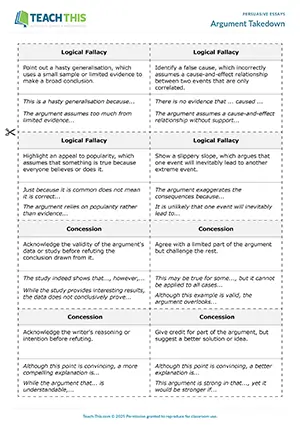
EAP Persuasive Essays Game - Speaking: Forming Refutations, Peer Feedback - Group Work
In this engaging persuasive essay game, students compete to create the strongest refutations of various arguments, using concession, assumption, evidence, and logical fallacy strategies...
Artificial Intelligence
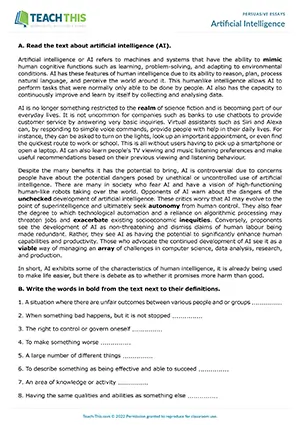
EAP Persuasive Essays Worksheet - Reading and Writing: Matching, Essay Outlining, Gap-fill, Essay Writing, Peer Review - Speaking Activity: Discussion - Group Work
In this useful persuasive essays worksheet, students read and discuss a text about artificial intelligence and then plan and write a persuasive essay on the topic...
Assumption Busters
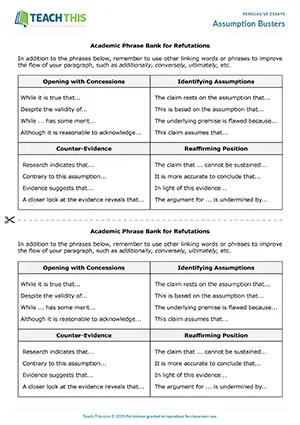
EAP Persuasive Essays Activity - Reading, Writing and Speaking: Guided Writing, Discussion, Opinion-sharing, Peer Feedback, Communicative Practice - Group Work
In this insightful persuasive essay activity, students develop critical analysis skills by identifying hidden assumptions in an argumentative text and writing...
Counter-Argument and Refutation
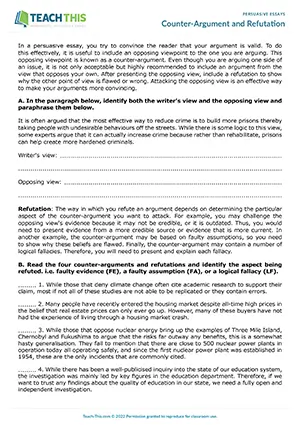
EAP Persuasive Essays Worksheet - Writing Exercises: Identifying, Paraphrasing, Writing Sentences, Paragraph Writing
In this free counter-argument and refutation worksheet, students learn how to write a counter-argument and refutation paragraph to include in a persuasive essay. First, students read a paragraph that...
Introduction to Persuasive Essays
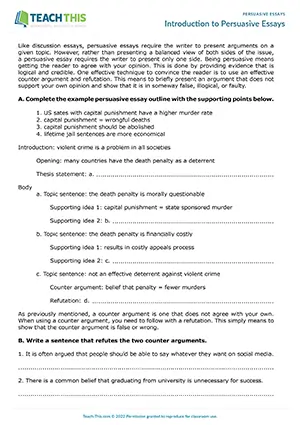
EAP Persuasive Essays Worksheet - Reading and Writing Exercises: Matching, Writing Sentences, Identifying, Paraphrasing, Writing an Outline and Essay, Peer Review
In this comprehensive persuasive essays worksheet, students learn about persuasive essay structure and attempt a persuasive essay writing practice...
Ten-Second Term
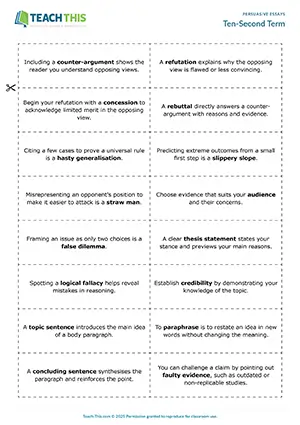
EAP Persuasive Essays Game - Vocabulary: Gap-fill, Guessing - Group Work
In this fun persuasive essays game, students practice key vocabulary and concepts for persuasive essay writing. In groups, students take turns picking up a sentence card and reading it to the student on their right, using the word 'blank' instead of...
Understanding Persuasive Essays
A persuasive essay develops a position through reasons, relevant support and responses to opposing views. Its strength depends on how well the reasoning supports the position, not simply on how confidently the writer states it.
This page contains seven resources across B1 and B2, including worksheets on persuasive language, essay structure and counter-arguments, an assumption-analysis activity and two games. One worksheet is available as a free download.
The table shows how different argument moves work together. These hypothetical examples illustrate reasoning about a proposed library-hours extension; they are not research findings.
| Argument move | Purpose | Example |
|---|---|---|
| State a position | Make the proposal or judgement clear | 'The university should trial longer library opening hours.' |
| Give a reason | Explain why the position deserves consideration | 'Students with evening commitments may have limited opportunities to use the library.' |
| Identify needed evidence | Specify what information could support or challenge the reason | 'A survey could establish how many students would use the additional hours.' |
| Present a counter-argument | Represent a relevant objection fairly | 'Longer opening hours could increase staffing costs.' |
| Make a concession | Acknowledge a valid part of the objection | 'The additional cost would need to be considered.' |
| Respond to the objection | Explain how the position could address the concern | 'A limited trial could help assess demand and costs before a permanent change.' |
How to Develop a Persuasive Argument
Define a position that can be defended: Ask students to state exactly what they want the reader to accept. Narrow broad claims to a particular proposal or context so that the essay can examine them within the available space.
Separate reasons from supporting evidence: For each reason, ask what would make it credible and what information is actually available. Explain how the support relates to the claim, and do not invent findings to make an argument appear stronger.
Choose a substantial objection: Address an opposing view that a reasonable reader might hold. Students can acknowledge part of it, challenge an assumption or qualify their own position; a response need not dismiss every concern completely.
3-Step Framework for Teaching Persuasive Essays
Begin with supported persuasive language at B1, then extend the sequence to critical analysis and essay writing at B2. Use the stages across suitable lessons rather than treating them as one mixed-level task.
1. Connect persuasive phrases with their functions: Students compare sentence pairs, explain which they find more persuasive and classify phrases by function. They rewrite sentences, complete a model paragraph and write a short paragraph using four persuasive phrases. Ask whether the phrases express a clear reason or relationship, rather than merely making a claim sound stronger.
2. Examine the reasoning behind a claim: Students analyse an argumentative text using cards that separate claims, assumptions, the author's evidence and counter-evidence. They select an analysis card, write a structured refutation with a phrase bank and exchange checklist feedback. This develops the judgement needed to respond to objections in a longer essay.
3. Plan, draft and review a complete position: Students read about artificial intelligence, match vocabulary and discuss advantages and disadvantages before choosing a stance and creating an essay outline. They write their essay and exchange checklist feedback. Ask them to draw on the earlier analysis by checking whether their reasons are supported and their treatment of opposing views is fair.
Common Mistakes with Persuasive Essays
Exaggerating an opposing position: A response is weaker if it attacks a claim the other side has not made. In this hypothetical debate, the objection concerns the cost of longer library hours. Distorted response: 'Opponents do not want students to have access to books.' Fair response: 'The cost concern deserves consideration; a limited trial could help assess whether additional access justifies the expense.'
Repeating a claim instead of supporting it: Rewording a judgement does not give the reader a reason to accept it. Circular reasoning: 'The proposal is beneficial because it offers benefits.' Developed reason: 'The proposal could widen access by allowing students with evening commitments to visit later.' The potential benefit would still need relevant support.
Common Questions About Teaching Persuasive Essays
What worksheet helps teach persuasive essay structure?
The worksheet Introduction to Persuasive Essays combines a model outline with an example essay about the four-day working week. Students organise supporting points, practice refutations and examine the model before planning and writing their own essay. A peer review checklist then helps them evaluate how clearly the finished essay develops its argument.
What free worksheet helps teach counter-arguments and refutations?
The worksheet Counter-Argument and Refutation helps students distinguish a writer's position from an opposing view and examine ways to respond. They identify the parts of a model paragraph, practice responses that include concessions and write two paragraphs. This connects recognising an opposing argument with addressing it in their own writing.
What game helps students practice refuting arguments?
The game Argument Takedown gives students thirty seconds to plan a one-minute refutation using a strategy card and an academic phrase. A rotating judge scores each response against criteria and explains the decision. Comparing responses and receiving feedback gives students practice selecting a relevant strategy rather than simply expressing disagreement.
Become a Teach This Member
Get unlimited access to the full library, plus new resources added every week.
Unlimited Resource Access
Download from 3000+ worksheets, activities, and games.
Save 5+ Hours Weekly
Cut lesson prep time with ready-to-use resources, plus teacher notes and answer keys.
Trusted Professional Quality
Classroom-tested, editable resources created by experienced ESL professionals.
Fresh Content Weekly
Get 5 new resources added to the library each week.
Here's what our members are saying...


