Deception

Pre-intermediate (A2) 30 minutes
ESL present perfect game preview: writing sentences, asking and answering, true or false, guessing, pair work, pre-intermediate

ESL Present Perfect Game - Grammar and Writing: Writing Sentences, Asking and Answering Questions, True or False, Guessing - Pair Work

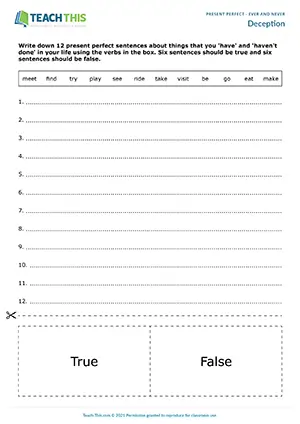
In this fun present perfect game, students use the present perfect to talk about true and false experiences. First, students write 12 present perfect sentences about...

ESL Present Perfect Game - Grammar and Writing: Writing Sentences, Asking and Answering Questions, True or False, Guessing - Pair Work In this fun present perfect game, students use the present perfect to talk about true and false experiences. First, students write 12 present perfect sentences about things they have and haven't done in their lives using verbs from a box. Six sentences should be true and six should be false. Next, in competing pairs, students play a true or false guessing game. One student goes first and reads one of their sentences to the opposing pair. The opposing pair then asks two questions to help them decide if the sentence is true or false. The two students then each put down a true or false card, depending on whether they think the statement is true or not, and the student reveals the answer. The opposing pair scores one point for each correct guess. The pairs then swap roles, and so on. The pair with the most points at the end of the game wins.

Ever and Never

Pre-intermediate (A2) 20 minutes
ESL present perfect worksheet preview: rewriting sentences and questions, writing questions and answers, pair work, pre-intermediate

ESL Ever and Never Worksheet - Grammar Exercises: Rewriting Sentences and Questions, Writing Questions and Answers - Speaking: Controlled Practice - Pair Work

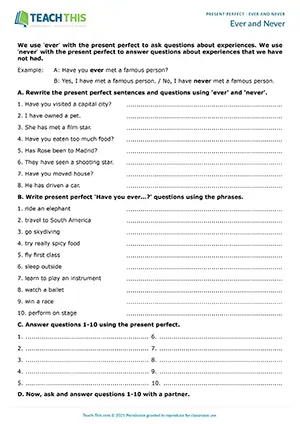
This free present perfect worksheet helps students learn and practice the present perfect with ever and never. First, students read the information about...

ESL Ever and Never Worksheet - Grammar Exercises: Rewriting Sentences and Questions, Writing Questions and Answers - Speaking: Controlled Practice - Pair Work This free present perfect worksheet helps students learn and practice the present perfect with ever and never. First, students read the information about using ever and never with the present perfect. Students then rewrite present perfect sentences and questions using ever and never. Next, students write present perfect 'Have you ever...?' questions using a set of phrases. After that, students answer the questions using the present perfect or the present perfect with never, e.g. 'Yes, I have ridden an elephant.' or 'No, I have never ridden an elephant.' Lastly, in pairs, students ask and answer the questions with their partner.

Find Someone Who...

Pre-intermediate (A2) 30 minutes
ESL Have You Ever activity preview: asking and answering questions, freer practice, pre-intermediate

ESL Have You Ever Activity - Grammar and Speaking: Asking and Answering Questions, Freer Practice

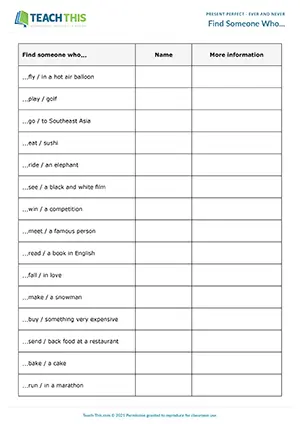
This present perfect Find Someone Who activity helps to teach students how to make 'Have you ever...?' questions to ask about experiences. Students use the prompts on their worksheet to ask...

ESL Have You Ever Activity - Grammar and Speaking: Asking and Answering Questions, Freer Practice This present perfect 'Find Someone Who' activity helps to teach students how to make 'Have you ever...?' questions to ask about experiences. Students use the prompts on their worksheet to ask 'Have you ever...?' questions to their classmates. When a classmate answers 'Yes, I have', the student writes their name next to the prompt. The student then asks follow-up questions to obtain more information, noting down the answer in the last column. When everyone has finished, students tell the class what they found out by making present perfect statements.

Have you ever been to London?

Pre-intermediate (A2) 25 minutes
ESL present perfect game preview: sentence completion, guessing, asking and answering, pair work, pre-intermediate

ESL Present Perfect Game - Grammar and Speaking: Sentence Completion, Guessing, Asking and Answering Questions - Pair Work

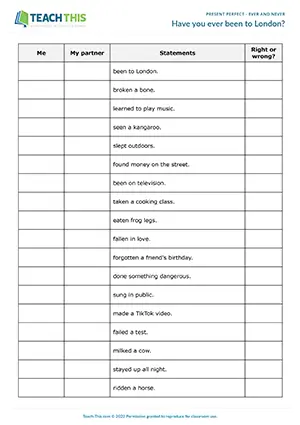
This engaging present perfect guessing game helps students practice talking about experiences and asking questions with 'Have you ever...?' First, students read each statement on the worksheet...

ESL Present Perfect Game - Grammar and Speaking: Sentence Completion, Guessing, Asking and Answering Questions - Pair Work This engaging present perfect guessing game helps students practice talking about experiences and asking questions with 'Have you ever...?' First, students read each statement on the worksheet and write 'I have' or 'I haven't' in the column marked 'Me', depending on whether they have or haven't done the thing mentioned in the statement, e.g. 'I have been to London.' In pairs, students then guess whether their partner has or hasn't had the same experiences by writing 'He/She has' or 'He/She hasn't' in the 'My partner' column, e.g. 'He hasn't been to London.' Next, students take turns finding out if their guesses are right or wrong by asking 'Have you ever...?' questions to their partner, e.g. 'Have you ever been to London?' Their partner then gives their answer. If the student guessed correctly, they put a tick in the last column. If not, the student puts a cross. The student with the most correct guesses in each pair wins.

Have You Ever Bingo

Pre-intermediate (A2) 30 minutes
ESL Have You Ever bingo game preview: forming questions, asking and answering, freer practice, pre-intermediate

ESL Have You Ever Game - Grammar and Speaking: Forming, Asking and Answering Questions

In this free 'Have you ever...?' game, students find classmates who have had the experiences shown on a bingo card. To do this, students change each verb on their bingo card into its past participle form...

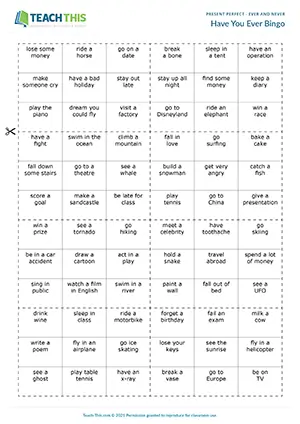
ESL Have You Ever Game - Grammar and Speaking: Forming, Asking and Answering Questions In this free 'Have you ever...?' game, students find classmates who have had the experiences shown on a bingo card. To do this, students change each verb on their bingo card into its past participle form and create a present perfect question with 'ever' from the prompt, e.g. if the prompt was 'lose some money', the student would say 'Have you ever lost some money?' When a classmate answers 'Yes, I have', the student writes down their name under the prompt on their bingo card. The first student to get three names in a row shouts 'Bingo!' This student wins the first round. Students then continue the game to see who can complete all nine squares with names. The first student to do this wins the second round. Students play several rounds using a different bingo card each time.

Have You Ever Game

Pre-intermediate (A2) 45 minutes
ESL present perfect game preview: forming, asking and answering questions from prompts, true or false, guessing, group work, pre-intermediate

ESL Present Perfect Game - Grammar and Speaking: Forming, Asking and Answering Questions, True or False, Guessing - Group Work

In this amusing 'Have you ever...?' activity, students form, ask and answer present perfect questions in a true or false game. In two teams, students write...

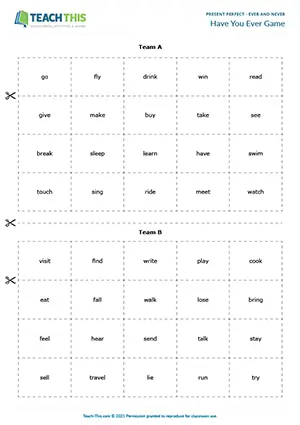
ESL Present Perfect Game - Grammar and Speaking: Forming, Asking and Answering Questions, True or False, Guessing - Group Work In this amusing 'Have you ever...?' activity, students form, ask and answer present perfect questions in a true or false game. In two teams, students write 'Have you ever...?' questions on verb cards. The game then begins with a player from Team A picking up one of Team B's verb cards. Team B then asks the player the 'Have you ever…?' question that corresponds with the verb. The player from Team A answers 'Yes, I have', regardless of whether it's true or not. Team B then asks three past simple follow-up questions and then decides if the player's answer is true or false. The player then reveals the truth. If Team B guesses correctly, they score a point. A player from Team B then picks up one of Team A's verb cards, and so on. The team with the most points at the end of the game wins.

Just Say Yes

Pre-intermediate (A2) 25 minutes
ESL Have You Ever game preview: forming questions, giving answers, true or false, group work, pre-intermediate

ESL Have You Ever Game - Grammar: Forming Questions, Giving Answers, True or False - Group Work

In this humorous present perfect true or false game, students ask 'Have you ever...?' questions about experiences in the past and use the past simple to find out who is lying and who is telling the truth...

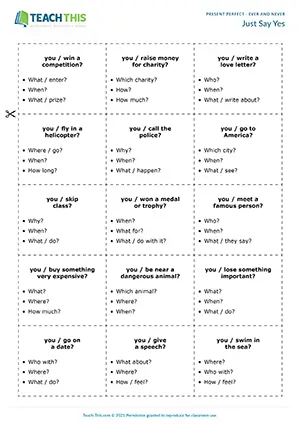
ESL Have You Ever Game - Grammar: Forming Questions, Giving Answers, True or False - Group Work In this humorous present perfect true or false game, students ask 'Have you ever...?' questions about experiences in the past and use the past simple to find out who is lying and who is telling the truth. One student begins by picking up a card and asking the other two students the question on the card using the present perfect with 'ever', e.g. 'Have you ever won a competition?' The other students answer 'Yes, I have', even if it's not true. The interviewer then asks the two students three past simple follow-up questions from the prompts on the card, e.g. 'What competition did you enter?' The interviewer then tries to work out if the students are lying or telling the truth, scoring one point for each correct guess. The next student then picks up a card and takes on the role of the interviewer, and so on. The student with the most points at the end of the game is the winner.

Life in the Fast Lane

Pre-intermediate (A2) 30 minutes
ESL Have You Ever game preview: writing questions, guessing answers, pair work, pre-intermediate

ESL Have You Ever Game - Grammar and Speaking: Forming, Asking and Answering Questions, Guessing - Pair Work

In this light-hearted present perfect game, students write 'Have you ever...?' questions and then guess how a partner would reply to each one. In two groups, students write ten 'Have you ever...?' questions...

ESL Have You Ever Game - Grammar and Speaking: Forming, Asking and Answering Questions, Guessing - Pair Work In this light-hearted present perfect game, students write 'Have you ever...?' questions and then guess how a partner would reply to each one. In two groups, students write ten 'Have you ever...?' questions using verbs in brackets and their own ideas. Students then pair up with someone from the other group. Next, students decide if their partner would reply yes or no to each question on their worksheet and write their guesses in the yes/no column. Students then take turns asking 'Have you ever...?' questions to their partner to find out if their guesses are right or wrong. Students put a tick if their guess is right or a cross if their guess is wrong in the last column of the worksheet. When all the questions have been answered, students tally up their correct guesses. The student with the most correct guesses wins the game.

Talking About Experiences

Pre-intermediate (A2) 30 minutes
ESL present perfect worksheet preview: writing questions, binary choice, writing sentences, pair work, pre-intermediate

ESL Present Perfect Worksheet - Grammar Exercises: Writing Questions, Binary Choice, Writing Sentences - Speaking Activity: Asking and Answering Questions - Pair Work

This useful present perfect with ever and never worksheet helps students learn how to ask questions and make statements with 'ever' to talk about experiences...

ESL Present Perfect Worksheet - Grammar Exercises: Writing Questions, Binary Choice, Writing Sentences - Speaking Activity: Asking and Answering Questions - Pair Work This useful present perfect with ever and never worksheet helps students learn how to ask questions and make statements with 'ever' to talk about experiences and use 'never' to refer to experiences you haven't had. First, students complete present perfect questions with 'have' or 'has' plus 'ever' and the correct form of the verbs in brackets. Next, students use prompts to write 'Have you ever...?' questions that correspond to a set of answers. Students then ask and answer the questions with a partner based on their own experiences. Next, students read sentences and choose between 'never' or 'ever' to complete each sentence by underlining the correct words. Students then move on to use 'never' to write about four experiences they've never had but would like to have someday. Lastly, students write four 'Have you ever...?' questions to ask a partner. Students then ask the questions to their partner and underline their responses.

Well, I never!

Pre-intermediate (A2) 25 minutes
ESL present perfect ever and never activity preview: completing, asking and answering questions, group and pair work, pre-intermediate

ESL Present Perfect Ever and Never Activity - Grammar and Speaking: Completing, Asking and Answering Questions, Controlled and Freer Practice - Group and Pair Work

In this enjoyable present perfect speaking activity, students complete and ask 'Have you ever...?' conversation questions and respond with 'Yes, I have...' or 'No, I have...

ESL Present Perfect Ever and Never Activity - Grammar and Speaking: Completing, Asking and Answering Questions, Controlled and Freer Practice - Group and Pair Work In this enjoyable present perfect speaking activity, students complete and ask 'Have you ever...?' conversation questions and respond with 'Yes, I have...' or 'No, I have never...' First, in two groups, students complete each 'Have you ever...?' conversation question with a verb from a box in its past participle form. Next, students pair up with someone from the other group and take turns asking the 'Have you ever...?' conversation questions to their partner and responding with 'Yes, I have...' or 'No, I have never...' Afterwards, students share what they found out about their partner with the class.

Are You Experienced?

Intermediate (B1) 30 minutes
ESL present perfect activity preview: guessing, asking and answering, sentence completion, group work, intermediate

ESL Present Perfect Activity - Grammar and Speaking: Guessing, Asking and Answering Questions, Sentence Completion - Group Work

In this insightful 'Have you ever...?' activity, students ask and answer questions to find out who has experienced certain things. Working alone, students guess how...

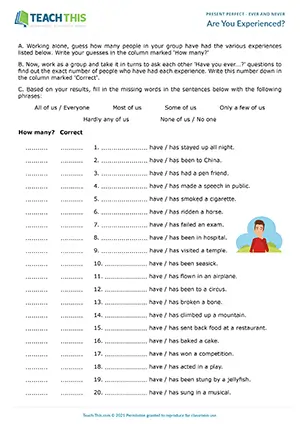
ESL Present Perfect Activity - Grammar and Speaking: Guessing, Asking and Answering Questions, Sentence Completion - Group Work In this insightful 'Have you ever...?' activity, students ask and answer questions to find out who has experienced certain things. Working alone, students guess how many people in their group have had each experience written on the worksheet. Students then take turns asking their group members 'Have you ever...?' questions to find out the exact number of people who have had each experience, e.g. 'Have you ever stayed up all night?' Based on the number of people who have had each experience, students then complete each statement with one of the phrases shown, e.g. All of us, Some of us, etc. Finally, groups read out their sentences to the class and discuss any interesting findings.

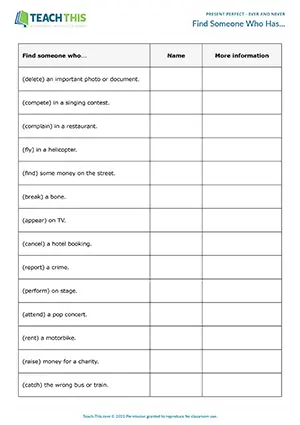
Find Someone Who Has...

Intermediate (B1) 30 minutes
ESL Have You Ever Find Someone Who activity preview: asking and answering, freer practice, intermediate

ESL Have You Ever Activity - Grammar and Speaking: Asking and Answering Questions, Freer Practice

In this free Have you ever 'Find Someone Who' activity, students ask and answer present perfect questions to find out about other students' experiences. To start, students use the prompts on the...

ESL Have You Ever Activity - Grammar and Speaking: Asking and Answering Questions, Freer Practice In this free Have you ever 'Find Someone Who' activity, students ask and answer present perfect questions to find out about other students' experiences. To start, students use the prompts on the worksheet to ask 'Have you ever...?' questions to their classmates, e.g. 'Have you ever annoyed the teacher' When a classmate answers 'Yes, I have', the student writes that person's name next to the item and asks follow-up questions to gain more information. Afterwards, students give feedback to the class on what they found out by making present perfect statements with 'has'.

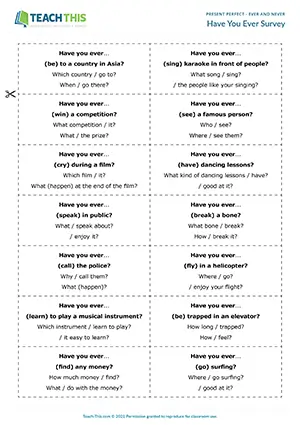
Have You Ever Survey

Intermediate (B1) 25 minutes
ESL Have You Ever survey activity preview: forming, asking and answering questions, intermediate

ESL Have You Ever Activity - Grammar and Speaking: Forming, Asking and Answering Questions

In this productive present perfect speaking activity, students conduct a survey about experiences by asking and answering 'Have you ever...?' questions and using the past simple to ask for and give more...

ESL Have You Ever Activity - Grammar and Speaking: Forming, Asking and Answering Questions from Prompts In this productive present perfect speaking activity, students conduct a survey about experiences by asking and answering 'Have you ever...?' questions and using the past simple to ask for and give more information. Give each student a card containing three question prompts. Students then go around asking the 'Have you ever...?' question on their card. Whenever a classmate answers 'Yes, I have', students ask the past simple follow-up questions on the card and note down the answers. Afterwards, students report back their findings to the class.

Present Perfect for Experience

Intermediate (B1) 30 minutes
ESL ever and never worksheet preview: gap-fill, question completion, error correction, discussion, pair work, intermediate

ESL Ever and Never Worksheet - Grammar Exercises: Gap-fill, Question Completion, Error Correction, Listing, Categorising - Speaking Activity: Discussion - Pair Work

In this comprehensive present perfect worksheet, students review the present perfect with ever and never to talk about experiences. Students begin...

ESL Ever and Never Worksheet - Grammar Exercises: Gap-fill, Question Completion, Error Correction, Listing, Categorising - Speaking Activity: Discussion - Pair Work In this comprehensive present perfect worksheet, students review the present perfect with ever and never to talk about experiences. Students begin by completing a conversation about experiences with ever and never. Next, students complete questions about experiences using 'ever' and activities in brackets. Students then respond 'Yes, I have' or 'No, I haven't' to each question. After that, students rewrite sentences and questions, correcting the mistakes. Students then read a list of experiences and add eight more using their own ideas. Once the list of experiences is complete, students categorize each experience based on what they have done and what they have never done. Finally, in pairs, students then take turns asking their partner about the experiences using 'Have you ever...?'

Understanding Present Perfect with Ever and Never

'Ever' and 'never' are adverbs used with the present perfect to talk about life experiences, with 'ever' appearing in questions and 'never' in statements to say something has not happened at any time. Students who mix them up or drop 'ever' from a question end up saying things like 'Have you never tried sushi?' when they mean the opposite, which immediately changes the meaning and confuses whoever they are talking to.

This page covers present perfect with ever and never across A2 and B1 levels, with 14 games, activities, and worksheets ranging from bingo and true-or-false guessing games to surveys and error correction tasks, including three free downloads.

The table below shows the structure and an example for each form used when talking about experiences with 'ever' and 'never.'

FormStructureExample
Question with 'ever' Have/Has + subject + ever + past participle? 'Have you ever visited New York?'
Affirmative Short Answer Yes, + subject + have/has. 'Yes, I have.'
Negative Short Answer No, + subject + haven't/hasn't. 'No, I haven't.'
Affirmative Statement Subject + have/has + past participle + details. 'I have visited New York twice.'
Negative Statement with 'never' Subject + have/has + never + past participle. 'She has never tried sushi.'
Past Simple Follow-up Wh- word + did + subject + verb? 'When did you go? Who did you go with?'

When to Use Present Perfect with Ever and Never

Expressing Surprise or Disbelief: A speaker uses 'ever' with the present perfect to react with shock or emphasis when something seems hard to believe, making the statement feel stronger than a plain denial, as in 'I have never in my life heard anything so ridiculous.'

Making a Strong Personal Statement: 'Never' with the present perfect lets a speaker stake out a firm personal position on something they have consistently avoided or refused, which carries more weight than simply saying they do not do it, as in 'I have never eaten fast food and I never will.'

Opening a Conversation About Shared Experiences: 'Have you ever...?' is one of the most natural ways to start a conversation with someone new, because it invites the other person to share something personal without putting them on the spot, as in 'Have you ever been to Southeast Asia? I just got back from Vietnam.'

3-Step Framework for Teaching Present Perfect with Ever and Never

1. Nail the Rules Before the Speaking Starts: Give students the clearest possible foundation by starting with a worksheet where they read how 'ever' and 'never' work with the present perfect, then rewrite sentences and questions using both adverbs. The payoff comes when students write and answer their own 'Have you ever...?' questions, choosing between responses like 'Yes, I have ridden an elephant' and 'No, I have never ridden an elephant.' Getting the answer forms right at this stage saves a lot of confusion later.

2. Lock In Question Formation with Bingo: Once students can form the questions accurately, a bingo card game gives them rapid, repeated practice in question building. Students convert each verb prompt on their card into its past participle form and build a 'Have you ever...?' question on the spot: if the prompt is 'lose some money,' the question becomes 'Have you ever lost some money?' The race to get three names in a row keeps the pace high and the repetitions coming naturally.

3. Add Depth with Student-Generated Content: Round off at B1 level with a worksheet where students read a list of experiences, add eight more of their own, and then sort everything into two columns based on what they have done and what they have never done. That personal investment in the content makes the 'Have you ever...?' discussion that follows feel like a real conversation rather than a controlled exercise.

Common Mistakes with Present Perfect with Ever and Never

Using 'Ever' in an Affirmative Statement: Students often use 'ever' in positive statements, carrying it over from question forms without realising it sounds unnatural in a statement. Wrong: 'I have ever visited Paris.' Correct: 'I have visited Paris.' or 'I have never visited Paris.'

Wrong Verb Form After 'Ever' or 'Never': Students often use the base form or simple past of the verb instead of the past participle after 'ever' or 'never,' producing a sentence that breaks the present perfect structure entirely. Wrong: 'Have you ever went to Japan?' Correct: 'Have you ever been to Japan?'

Common Questions About Teaching Present Perfect with Ever and Never

What is a useful 'Have you ever...?' activity for intermediate students?

Find Someone Who Has... is a free B1 mingle activity where students use prompts to ask 'Have you ever...?' questions to classmates, writing down the name of anyone who answers 'Yes, I have' and asking follow-up questions to get more details. At the end, students report back to the class using present perfect statements with 'has.'

What is a good present perfect worksheet for teaching 'ever' and 'never' at pre-intermediate level?

Talking About Experiences is an A2 worksheet that takes students from completing gap-fill questions with 'ever' through to using 'never' to write about four experiences they have never had but would like to have someday. Students finish by writing their own 'Have you ever...?' questions and asking them to a partner, moving naturally from controlled to freer practice.

Which 'Have you ever...?' game works well for pre-intermediate students?

Just Say Yes is a fun A2 group game where one student asks a 'Have you ever...?' question and the other two players both answer 'Yes, I have' whether it is true or not. The interviewer then asks three past simple follow-up questions from card prompts before guessing who is lying and who is telling the truth.