Fact or Fiction?

Intermediate (B1) 45 minutes
ESL past perfect game preview for intermediate B1 showing fact vs. fiction sentence writing activities, classroom voting, and pair work

ESL Past Perfect Game - Grammar: Writing Sentences - Pair Work

In this creative past perfect game, students write two explanations for each situation, one realistic and one imaginative, using the past perfect to show an earlier reason, then share their sentences and vote on their favourites. In pairs, students write two...

ESL Past Perfect Game - Grammar: Writing Sentences from Prompts - Pair Work In this creative past perfect game, students write two explanations for each situation, one realistic and one imaginative, using the past perfect to show an earlier reason, then share and vote on their favourites. In pairs, students write two explanations for each situation on their worksheet, a realistic explanation (fact) and an imaginative explanation (fiction). Next, read the first situation to the class, i.e. 'I walked into class, but I didn't recognize anyone.' Pairs then take turns reading their 'Fact' explanations to the class using the past perfect, e.g. 'You had walked into the wrong class.' The class then votes for the most realistic explanation. The winning pair scores a point. The pairs then read out their 'Fiction' explanations, e.g. 'You had lost your memory.' Again, the class votes for the best one. This process continues with the second situation, and so on. The pair with the most points at the end of the game is the winner.

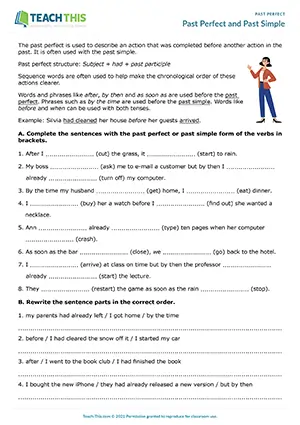
Past Perfect and Past Simple

Intermediate (B1) 30 minutes
ESL worksheet preview for intermediate B1 showing grammar exercises for past perfect and past simple, matching, sentence completion, and writing activities

ESL Past Perfect and Past Simple Worksheet - Grammar Exercises: Gap-fill, Unscrambling, Matching, Sentence Completion, Writing Sentences

This free past perfect vs. past simple worksheet helps students practice using the past perfect with the past simple and common sequence words to...

ESL Past Perfect and Past Simple Worksheet - Grammar Exercises: Gap-fill, Unscrambling, Matching, Sentence Completion, Writing Sentences This free past perfect vs. past simple worksheet helps students practice using the past perfect with the past simple and common sequence words to show the order of past events. Students start by completing sentences with the past perfect or past simple form of the verbs in brackets. Next, students rewrite sentence parts in the correct order. Students then move on to match past perfect and past simple sentence halves together. After that, students complete past perfect and past simple sentence halves with their own ideas. Finally, students answer questions using sequence words.

Past Perfect Explanations

Intermediate (B1) 25 minutes
ESL past perfect game preview for intermediate B1 showing explanation activities, situation cards, group speaking, and grammar practice

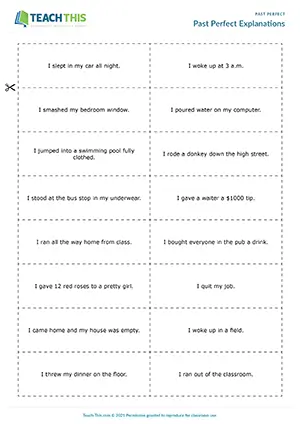
ESL Past Perfect Game - Grammar and Speaking: Giving Explanations - Group Work

In this amusing past perfect game, students explain surprising situations by giving earlier reasons in the past perfect. In groups, students take turns picking up a situation card and reading it to the group, e.g. 'I slept in my car all night.' The other...

ESL Past Perfect Game - Grammar and Speaking: Giving Explanations from Prompts - Group Work In this amusing past perfect game, students explain surprising situations by giving earlier reasons in the past perfect. In groups, students take turns picking up a situation card and reading it to the group, e.g. 'I slept in my car all night.' The other group members then each come up with a different explanation using the past perfect, e.g. 'I slept in my car all night because the car had broken down, and I was miles from home.' If the group agrees that each explanation is believable and it includes the past perfect (had or hadn't + past participle), the speaker scores one point. The next student then picks up a card, and so on. The student with the most points at the end of the game wins.

The Other Half

Intermediate (B1) 30 minutes
ESL past perfect activity preview for intermediate B1 with sentence completion, matching, and pair work practice

ESL Past Perfect Activity - Grammar: Sentence Completion, Matching - Pair Work

In this useful past perfect activity, students complete cause-and-effect sentences using 'had' plus the past participle, then work in pairs to match sentence halves and explain reasons for past outcomes. To begin, students complete sentences in the...

ESL Past Perfect Activity - Grammar: Sentence Completion, Matching - Pair Work In this useful past perfect activity, students complete cause-and-effect sentences using 'had' plus the past participle, then work in pairs to match sentence halves and explain reasons for past outcomes. To begin, students complete sentences in the past perfect using their own ideas. In pairs, students then compare their sentences by reading them to each other. Students then move on to a matching activity. Student A starts by reading the first sentence half to their partner, who listens and finds the other half of the sentence. When Student B thinks they have found a matching ending, they read it to their partner. When both students agree the two halves match, they mark the matching number or letter next to the sentence. This continues until all the sentence halves have been matched. Finally, students check how many sentences were the same as what they wrote in the first activity.

Truth Seekers

Intermediate (B1) 25 minutes
ESL past perfect game preview for intermediate B1 with matching, asking questions, true or false, and pair guessing activities

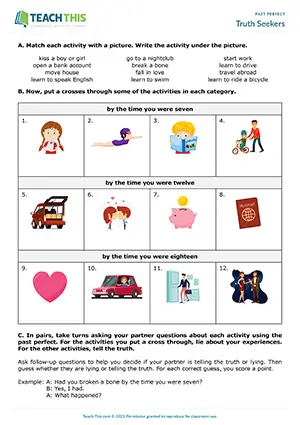
ESL Past Perfect Game - Grammar and Speaking: Matching, Asking Questions, True or False, Guessing, Freer Practice - Pair Work

In this fun past perfect game, students practice asking past perfect questions with 'by the time' and using follow-up questions to identify true and false answers. First, students match each activity...

ESL Past Perfect Game - Grammar and Speaking: Matching, Asking Questions from Prompts, True or False, Guessing, Freer Practice - Pair Work In this fun past perfect game, students practice asking past perfect questions with 'by the time' and using follow-up questions to identify true and false answers. First, students match each activity with one of the pictures on the worksheet and write the activity under the picture. Students then put a cross next to some of the activities in each age category. Students can put any number of crosses. Next, in pairs, students take turns asking their partner a past perfect question with 'by the time' for each activity, e.g. 'Had you broken a bone by the time you were seven?' If their partner crossed out the activity, they lie about their experience. If they didn't put a cross, they tell the truth. The student then asks follow-up questions to help them decide if their partner is telling the truth or lying. The student then guesses whether their partner is lying or telling the truth, and the answer is revealed. For each correct guess, students score a point. The student with the most points at the end of the game wins.

What had happened?

Intermediate (B1) 30 minutes
ESL past perfect game preview for intermediate B1 with matching, gap-fill, word form activities, and pair work

ESL Past Perfect Game - Grammar: Matching, Gap-fill - Pair Work

In this engaging past perfect game, students match past simple sentences with past perfect explanations with 'because' and complete missing verb forms. First, in pairs, students read each past simple sentence and discuss what had happened...

ESL Past Perfect Game - Grammar: Matching, Gap-fill - Pair Work In this engaging past perfect game, students match past simple sentences with past perfect explanations with 'because' and complete missing verb forms. First, in pairs, students read each past simple sentence and discuss what had happened and how the sentence might be continued using the past perfect, e.g. 'Anna was very cold because she had forgotten to take her coat and scarf.' Students then take turns matching each past simple sentence with a past perfect explanation. If their partner agrees that the match is correct, the student completes the explanation with the verb in brackets in the past perfect, keeps the two cards and has another turn. If not, play passes to the other student. Afterwards, go through the correct answers with the class. Students score one point for each correctly matched and completed pair of cards. The student with the most points in each pair wins the game.

Why did you say that?

Intermediate (B1) 25 minutes
ESL past perfect game for intermediate B1: writing and reading sentences, matching, pair work guessing

ESL Past Perfect Game - Grammar: Writing and Reading Sentences, Guessing, Matching - Pair Work

In this free past perfect game, students write explanations for 'Why did you say...?' questions and then try to match a partner's explanations to questions. First, students write an explanation in the past...

ESL Past Perfect Game - Grammar: Writing and Reading Sentences, Guessing, Matching - Pair Work In this free past perfect game, students write explanations for 'Why did you say...?' questions and then try to match a partner's explanations to questions. First, students write an explanation in the past perfect for each 'Why did you say...?' question on their worksheet, e.g. 'Why did you say 'I'm sorry' to your friend?' 'I had forgotten her birthday.' Next, in pairs, students take turns ticking one of their explanations at random and reading it to their partner, who has one chance to match the explanation to the correct 'Why did you say...?' question. If a student makes a correct match, they score one point. This continues until both students have read all 12 explanations. The student with the most points at the end of the game wins.

As soon as

Upper-intermediate (B2) 25 minutes
ESL past simple and past perfect domino game for upper-intermediate B2: matching, sentence reforming, group grammar practice

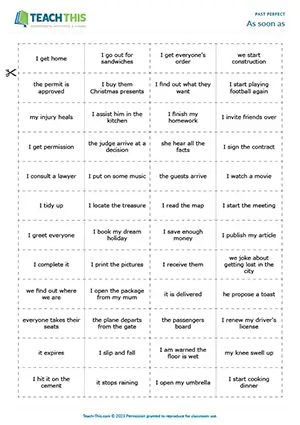
ESL Past Simple and Past Perfect Game - Grammar and Speaking: Matching, Reforming Sentences - Group Work

In this enjoyable past simple and past perfect game, students play dominoes by matching clause halves and saying sentences with a past simple main clause + 'as soon as' + a past perfect clause. To begin...

ESL Past Simple and Past Perfect Game - Grammar and Speaking: Matching, Reforming Sentences, Controlled Practice - Group Work In this enjoyable past simple and past perfect game, students play dominoes by matching clause halves and saying sentences with a past simple main clause + 'as soon as' + a past perfect clause. To begin, the first player pairs two clauses by placing one of their dominoes at either end of the domino on the table. The player then forms a sentence consisting of the first clause in the past simple followed by 'as soon as' and the second clause in the past perfect, e.g. 'It stopped raining as soon as I had opened my umbrella.' The other group members judge the player's sentence. If the sentence is meaningful and grammatically correct, the player leaves the domino where it is. If the sentence is wrong, the player picks up the domino and keeps it. The next player then tries to put down one of their dominoes at either end of the domino chain, and so on. The first player to get rid of all their dominoes wins the game.

Past Perfect Board Game

Upper-intermediate (B2) 25 minutes
ESL past perfect board game for upper-intermediate B2: sentence completion, adverbial time clauses, group practice

ESL Past Perfect Board Game - Grammar and Speaking: Sentence Completion, Controlled and Freer Practice - Group Work

In this rewarding past perfect board game, students create sentences by combining past perfect time clauses with past simple main clauses using after, when, before, and until. Players take turns rolling...

ESL Past Perfect Board Game - Grammar and Speaking: Sentence Completion, Controlled and Freer Practice - Group Work In this rewarding past perfect board game, students create sentences by combining past perfect time clauses with past simple main clauses using after, when, before, and until. Players take turns rolling the dice and moving their counters along the board. When a player lands on a blank square, the student on their left picks up a card and reads out the past perfect time clause, e.g. '...after he had finished his run...' The player listens and completes the sentence with a relevant past simple main clause, e.g. 'After he had finished his run, he took a cold shower.' If a player lands on a square with a past simple main clause, e.g. 'They started laughing', they choose after, when, before, or until from the game board and create a past perfect time clause to complete the sentence, saying the full sentence aloud, e.g. 'When he had finished telling his story, they started laughing.' If the group agrees that the sentence is grammatically correct and logical, the player stays on the square. If not, they move their counter back two squares. The first player to reach the finish wins the game.

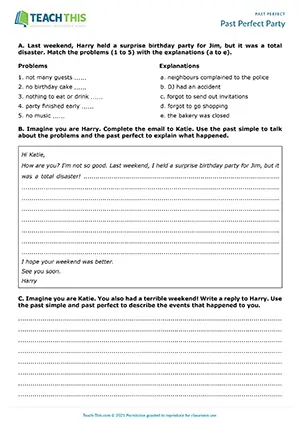
Past Perfect Party

Upper-intermediate (B2) 25 minutes
ESL past perfect and past simple worksheet for upper-intermediate B2: matching, email writing, group grammar and writing

ESL Past Simple and Past Perfect Worksheet - Grammar and Writing Exercises: Matching, Email Writing

In this productive past simple and past perfect worksheet, students write emails about a disastrous party, using the past simple for the problems and the past perfect with 'because' or 'as' to explain earlier...

ESL Past Simple and Past Perfect Worksheet - Grammar and Writing Exercises: Matching, Email Writing In this productive past simple and past perfect worksheet, students write emails about a disastrous party, using the past simple for the problems and the past perfect with 'because' or 'as' to explain earlier causes. First, students read through a scenario about a disastrous party. Students then match problems at the party with explanations of why they happened. Next, students write an email about the party using the past simple to talk about the problems and the past perfect to explain why they happened, e.g. 'There weren't many guests because I had forgotten to send out the invitations.' After that, students write a reply to the email, detailing other unfortunate events, using the past simple to describe what happened and the past perfect to explain earlier causes. Finally, students read their completed emails to the class.

Past Perfect Story Time

Upper-intermediate (B2) 25 minutes
ESL past perfect activity for upper-intermediate B2: chain story writing, group writing, grammar and storytelling

ESL Past Perfect Activity - Grammar and Writing: Chain Story Writing, Writing Sentences - Group Work

In this imaginative past perfect activity, students co-write short chain stories in groups using the past simple for main events and the past perfect to show earlier actions and causes. First, each...

ESL Past Perfect Activity - Grammar and Writing: Chain Story Writing, Writing Sentences - Group Work In this imaginative past perfect activity, students co-write short chain stories in groups using the past simple for main events and the past perfect to show earlier actions and causes. First, each student takes a story card and completes the first sentence of the story in the past perfect tense. Students then pass their story cards to the person on their right, who reads the first sentence and continues the story by writing a second sentence in the past simple and/or past perfect. The student then passes the story to the person on their right, who writes the third sentence. The following student finishes the story with their fourth sentence. The activity is then repeated with another four cards. After that, students take turns reading the stories to the group and choosing the best one. Finally, each group reads out their best story to the class.

Understanding Past Perfect

The past perfect describes an action that was completed before another action or point in the past, using 'had' plus the past participle: 'She had already left when I arrived.' Students who use only the past simple to describe a sequence of past events often produce writing that is ambiguous, leaving readers unable to tell which action came first without relying on context clues alone.

This page covers the past perfect at B1 and B2 levels, with eleven activities including grammar worksheets, speaking games, a board game, a domino game, and a chain story writing task, with two activities available as free downloads.

The table below shows the main forms of the past perfect and the time words and connectors most commonly used with each one.

FormStructureExampleKey Time Words
Affirmative subject + had + past participle 'She had already eaten when he arrived.' already, just, by the time, before, after
Negative subject + had not (hadn't) + past participle 'They hadn't met before the conference.' never, not yet, by the time
Yes/No Question Had + subject + past participle? 'Had you finished the report by noon?' by the time, already
Wh- Question Wh- word + had + subject + past participle? 'What had she said before she left?' before, when
With 'when' or 'after' past simple + when/after + subject + had + past participle 'He called when she had already gone.' when, after
With 'before' subject + had + past participle + before + past simple 'I had checked the map before we set off.' before
With 'as soon as' past simple + as soon as + subject + had + past participle 'She smiled as soon as she had read the news.' as soon as
With 'by the time' By the time + past simple + subject + had + past participle 'By the time we arrived, the show had started.' by the time

When to Use Past Perfect

Reported Speech: When reporting what someone said in the past, speakers shift the verb back one tense by using the past perfect, which keeps the time relationship clear and the register appropriately formal, as in 'She told me she had already spoken to the manager.'

Expressing Regret: Writers and speakers use the past perfect after 'if only' or 'I wish' to express regret about something that went wrong or did not happen, placing the missed action firmly in the past, as in 'If only I had checked the forecast before we left.'

Flashback in Narrative: Fiction writers use the past perfect to signal a flashback, stepping back from the main storyline to explain an earlier event before returning to the present action, as in 'She stared at the letter. She had received it three years ago, on the morning everything changed.'

3-Step Framework for Teaching Past Perfect

1. Establish Form and Sequence First: Students need to see the past perfect and past simple working together before they attempt freer production. A structured worksheet that works through the form step by step, using common sequence words to show the order of past events, gives students the controlled practice they need. The payoff comes in the final exercise, where students answer questions using sequence words, which pushes them to apply everything they have practiced in a more open-ended way.

2. Drive Oral Production Through Situation Cards: Once students can form the past perfect accurately, a speaking game with situation cards is a natural next step because it gives them a real communicative reason to produce the structure. Students pick up a card, read a surprising situation to the group, such as 'I slept in my car all night', and the rest of the group each comes up with a different past perfect explanation, for example 'I slept in my car all night because the car had broken down, and I was miles from home.' If the group agrees the explanation is believable and uses the past perfect correctly, the speaker scores a point.

3. Extend Into Time Clauses With a Board Game: A board game works well at this stage because it keeps energy up while pushing students into more complex past perfect structures. When a player lands on a blank square, the student on their left reads out a past perfect time clause such as 'after he had finished his run', and the player completes it with a logical past simple main clause. Players can also land on a past simple main clause square and choose after, when, before, or until to build their own past perfect time clause. A wrong sentence sends the player back two squares, which keeps everyone focused on accuracy.

Common Mistakes with Past Perfect

Wrong Past Form After 'Had': Students often use the base form or simple past form of a verb after 'had' instead of the past participle, especially with irregular verbs. Wrong: 'By the time we left, she had went home.' Correct: 'By the time we left, she had gone home.'

Overusing the Past Perfect Without a Second Past Action: Students often use the past perfect for a single past action with no earlier event to refer back to, when the past simple is the correct choice. Wrong: 'Yesterday I had eaten breakfast at 8am.' Correct: 'Yesterday I ate breakfast at 8am.'

Common Questions About Teaching Past Perfect

What is a good game for practicing the past perfect at intermediate level?

A game that combines writing and guessing works well for past perfect practice. In the free Why did you say that? game, students write a past perfect explanation for each 'Why did you say...?' question, for example 'I had forgotten her birthday.' A partner then has one chance to match each explanation to the correct question.

What is an effective worksheet for practicing the past perfect at upper-intermediate level?

A past perfect worksheet with a real writing task suits B2 students well. The Past Perfect Party worksheet has students match party problems with their explanations, then write an email using the past simple for problems and the past perfect to explain causes, for example 'There weren't many guests because I had forgotten to send out the invitations.'

What is a fun past perfect game for upper-intermediate students?

The As soon as domino game is an effective choice for upper-intermediate students practicing the past perfect. Students match clause halves and form sentences linking a past simple clause with a past perfect one using 'as soon as', for example 'It stopped raining as soon as I had opened my umbrella.' A wrong sentence means keeping the domino.

Become a Teach This Member

Get unlimited access to the full library, plus new resources added every week.

Unlimited Resource Access

Download from 3000+ worksheets, activities, and games.

Save 5+ Hours Weekly

Cut lesson prep time with ready-to-use resources, plus teacher notes and answer keys.

Trusted Professional Quality

Classroom-tested, editable resources created by experienced ESL professionals.

Fresh Content Weekly

Get 5 new resources added to the library each week.

Join Now Just $29.99 quarterly