
Adverbs of Affirmation & Negation ESL Games & Worksheets
Adverbs of Affirmation or Negation?
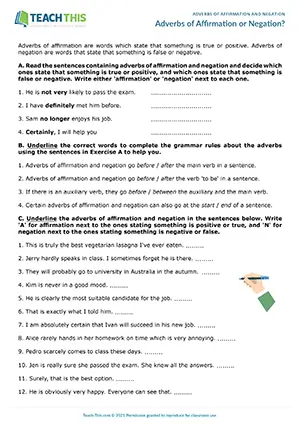
ESL Adverbs of Affirmation or Negation Worksheet - Grammar and Vocabulary Exercises: Identifying, Ordering, Gap-fill - Speaking Activity - Pair Work
This comprehensive adverbs of affirmation and negation worksheet helps students to identify and practice using affirmation and negation adverbs. First...
Trickster
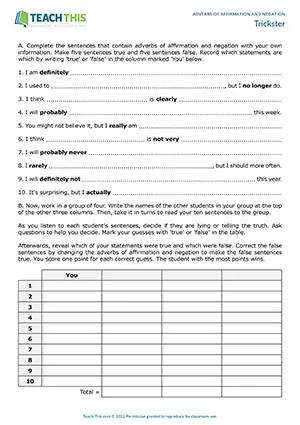
ESL Adverbs of Affirmation and Negation Game - Vocabulary and Speaking: Sentence Completion, True or False, Asking and Answering Questions - Group Work
In this amusing adverbs of affirmation and negation game, students make true and false statements about themselves with adverbs of affirmation and negation and...
Choose One
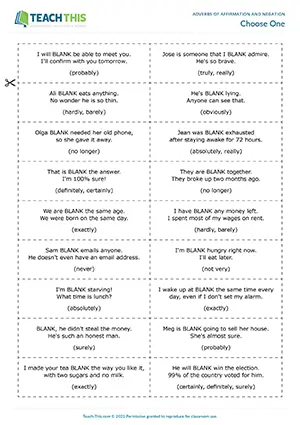
ESL Adverbs of Affirmation or Negation Game - Grammar and Vocabulary: Matching, Sentence Completion - Group Work
In this free adverbs of affirmation and negation game, students race to complete sentences with affirmation or negation adverbs. In groups, students take it in turns to pick up a card and read...
I'll Surely Win!
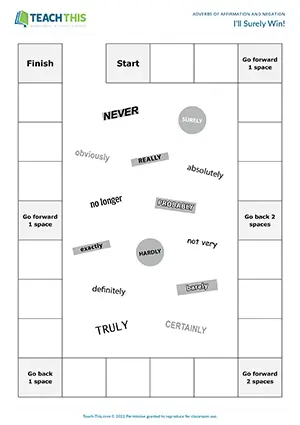
ESL Adverbs of Affirmation and Negation Board Game - Vocabulary and Speaking: Forming Sentences, Freer Practice - Group Work
In this fun adverbs of affirmation and negation board game, students practice creating sentences with affirmation and negation adverbs. In groups, students...
Understanding Adverbs of Affirmation and Negation
Adverbs of affirmation and negation are single-word adverbs that express whether something is true, certain, or agreed ('certainly,' 'definitely,' 'absolutely') or false, denied, or uncertain ('never,' 'hardly,' 'nowhere'). When students confuse or omit these adverbs, they either accidentally commit to claims they did not intend to make, or they leave a statement without the degree of certainty a listener needs to follow their meaning.
This page covers adverbs of affirmation and negation at B1 and B2 levels, with four resources including a worksheet, two speaking games, and a board game totaling 125 minutes of practice, with one activity available as a free download.
When to Use Adverbs of Affirmation and Negation
Confirming Agreement in Conversation: A speaker uses an affirmation adverb when they want to signal clear, immediate agreement with what someone has just said, adding emphasis that a simple 'yes' would not carry, as when someone responds 'Absolutely, that deadline works for me.'
Expressing Surprise or Disbelief: A speaker reaches for a negation adverb when a situation feels unexpected or hard to believe, because it conveys a stronger emotional reaction than simply saying 'no,' as in 'I can barely believe we finished the report on time.'
Signaling Certainty in Written Statements: Writers use affirmation adverbs to show that a claim is definite rather than tentative, which matters in professional or academic writing where readers need to know how confident the writer is, as in 'The results undoubtedly support the original hypothesis.'
3-Step Framework for Teaching Adverbs of Affirmation and Negation
1. Build Recognition Before Production: Start with the worksheet to give students a solid base before they speak. Students work through identifying, ordering, and gap-fill tasks covering the full range of affirmation and negation adverbs. The final section commits them to a choice before the speaking begins: students circle the correct adverb in each true or false statement and then discuss the statements with a partner to decide whether each one is actually true or false.
2. Raise the Stakes with Personal Truth: Move to a guessing game where students write ten statements about themselves, making five true and five false, each built around an adverb of affirmation or negation. Groups listen and guess, but the real learning comes after the reveal: students must correct every false statement by changing the adverbs of affirmation and negation to make the false sentences true, which forces close attention to which adverb carries which meaning.
3. Push for Fluency Under Peer Pressure: Finish with a board game for freer production. Students draw a card showing an adverb and build an original sentence using it correctly. The group acts as judge: each sentence made in the game must be unique, and the group must agree it is both accurate and grammatically correct before the student earns a dice roll. Repeated or incorrect sentences cost the player their turn.
Common Mistakes with Adverbs of Affirmation and Negation
Double Negation: Students often combine a negation adverb with a negative verb form, not realizing that English treats this as a grammar error, whereas their first language may allow or even require it. Wrong: 'I don't know nothing about it.' Correct: 'I know nothing about it.'
Misplacing the Adverb in the Sentence: Students often place an affirmation or negation adverb at the end of a sentence rather than before the main verb or adjective it modifies, which makes the sentence sound awkward or unnatural to a native speaker. Wrong: 'She knows the answer certainly.' Correct: 'She certainly knows the answer.'
Common Questions About Teaching Adverbs of Affirmation and Negation
What is a fun game for practicing adverbs of affirmation and negation?
The game Choose One has one student read a sentence aloud using 'blank' for the missing adverb, for example 'I will BLANK be able to meet you,' while the other students race to grab the correct adverb card and say it aloud. The student who grabs the most cards wins. It is available as a free download.
What is a good speaking activity for adverbs of affirmation and negation?
In the game Trickster, each student completes ten sentences about themselves using adverbs of affirmation and negation, making five true and five false, then reads them to the group. Classmates guess which statements are true and which are false, earning a point for each correct guess. The student with the most points wins.
Become a Teach This Member
Get unlimited access to the full library, plus new resources added every week.
Unlimited Resource Access
Download from 3000+ worksheets, activities, and games.
Save 5+ Hours Weekly
Cut lesson prep time with ready-to-use resources, plus teacher notes and answer keys.
Trusted Professional Quality
Classroom-tested, editable resources created by experienced ESL professionals.
Fresh Content Weekly
Get 5 new resources added to the library each week.
Here's what our members are saying...


