
Used To vs. Would ESL Games, Activities & Worksheets
A Trip Down Memory Lane
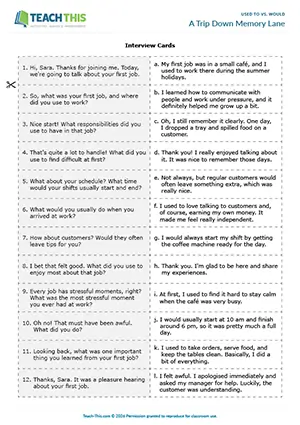
ESL Used To vs. Would Activity - Speaking and Grammar: Matching, Ordering, Gap-fill, Asking and Answering Questions, Controlled and Freer Practice - Pair Work
In this 'used to' vs. 'would' speaking activity, students match an interviewer’s questions with an interviewee’s answers about a first job, then interview a...
Back in the Day
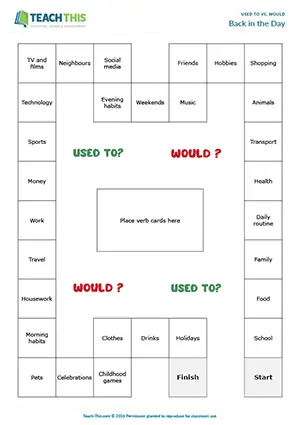
ESL Used To vs. Would Game - Speaking and Grammar: Impromptu Speech, Freer Practice - Group Work
In this useful 'used to' vs. 'would' board game, students practice the distinction between 'used to' and 'would' for past habits by speaking for 30 seconds about familiar topics using verb prompts...
Childhood Habits
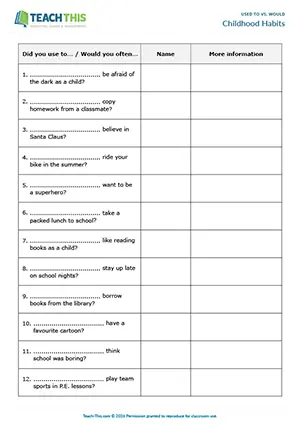
ESL Used To vs. Would Activity - Grammar and Speaking: Asking and Answering Questions from Prompts, Controlled and Freer Practice - Group Work
In this insightful 'used to' vs. 'would' activity, students ask and answer 'Did you use to...?' and 'Would you often...?' questions about childhood habits. First...
What Would I Do?

ESL Used To vs. Would Game - Grammar: Guessing, Forming Sentences, Freer Practice - Pair Work
In this free 'used to' vs. 'would' game, students guess typical past routine actions with 'would' based on past experiences described with 'used to'. In pairs, one student begins by picking up a card...
From Habits to Headlines
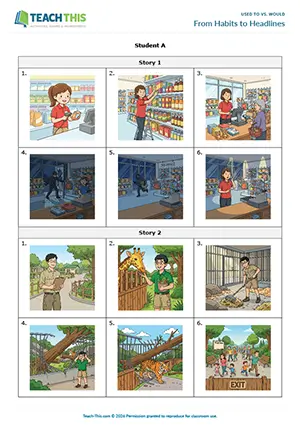
ESL Used To vs. Would Activity - Grammar and Speaking: Storytelling, Freer Practice - Pair Work
In this interesting ‘used to’ vs. ‘would’ activity, students use picture prompts to tell stories, then listen for exact or paraphrased target sentences. In pairs, students take turns telling a story using the pictures on...
Past Life Taboo
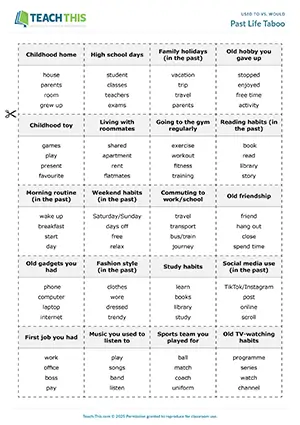
ESL Used To vs. Would Game - Grammar, Vocabulary and Speaking: Describing, Guessing - Group Work
In this engaging 'used to' vs. 'would' game, students practice describing past habits, routines and states using 'used to', 'would' and the past simple. In groups, students take turns picking up a card...
Superhero or Imposter?
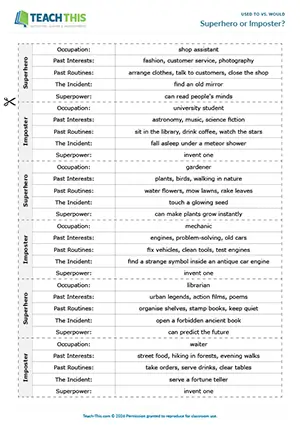
ESL Used To vs. Would Game - Grammar and Speaking: Storytelling, True or False, Guessing, Controlled and Freer Practice - Group Work
In this fun 'used to' vs. 'would' game, students practice telling short stories about superpowers, describing their lives before they got a superpower and the...
Then vs. Now

ESL Used To vs. Would Game - Grammar and Speaking: Sentence Completion, Controlled and Freer Practice - Pair Work
In this rewarding 'used to' vs. 'would' game, students practice describing past habits and states, a past change event, and a present routine or situation using 'used to', 'would', the past simple and the present...
Would Bingo
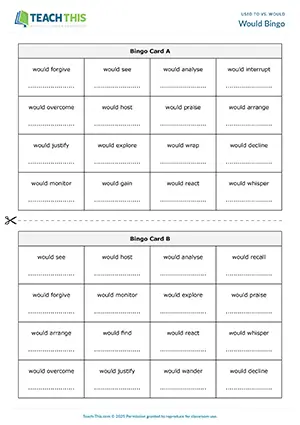
ESL Used To vs. Would Game - Grammar: Bingo, Identifying, Labelling - Group Work
In this enjoyable 'would' game, students play bingo to distinguish between three different grammatical functions of 'would' (past routines, reported speech, and unreal situations) using context clues. To begin the game, the bingo caller...
What's Changed?
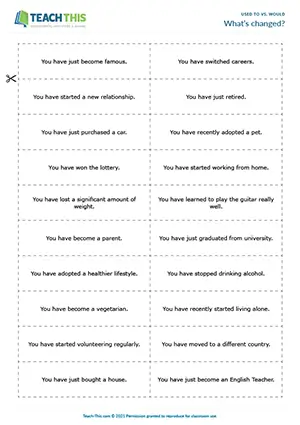
ESL Used to vs. Would Game - Grammar and Speaking: Forming Sentences, Guessing - Group Work
In this fun 'used to' vs. 'would' game, students describe and guess life changes by making sentences using 'used to' and 'didn't use to' for past situations, 'getting used to' for adaptation, and 'would' or...
Understanding Used To vs. Would
Both 'used to' and 'would' can describe repeated past habits, as in 'We used to go to the market on Saturdays' or 'We would go to the market on Saturdays.' Only 'used to' can describe past states, so a student who writes 'She would be shy' instead of 'She used to be shy' produces a sentence that sounds unnatural and signals a gap in understanding.
This page covers 'used to' vs. 'would' across B1 and B2 levels with 10 activities spanning a bingo game, a mingle activity, impromptu speech games, storytelling activities, and a guessing game, including one free download.
The table below shows where 'used to' and 'would' overlap and where only 'used to' is correct, covering the main uses students encounter at B1 and B2 level.
| Use / Function | Used To | Would | Example |
|---|---|---|---|
| Past repeated habit | used to + base verb | would + base verb | 'We used to walk to school.' / 'We would walk to school.' |
| Past state | used to + base verb | NOT possible with 'would' | 'He used to be nervous in crowds.' (cannot use 'would' here) |
| Negation | didn't use to + base verb | wouldn't + base verb (habits only) | 'She didn't use to like coffee.' / 'She wouldn't eat vegetables.' |
| Yes/No question | Did + subject + use to + base verb? | Would + subject + often + base verb? | 'Did you use to play sport?' / 'Would you often play outside?' |
| Setting a past time frame | used to (sets the context) | would (follows to describe routines) | 'I used to live by the sea. Every morning, I would swim before breakfast.' |
| With frequency adverbs | used to + often/always/never | would + often/always/never | 'She used to always arrive early.' / 'She would always arrive early.' |
When to Use Used To vs. Would
Setting the scene before describing a routine: A storyteller uses 'used to' to establish the background context of a past period, then switches to 'would' to describe the individual repeated actions within it, a pattern common in memoirs and personal narratives, as in 'I used to live in a small town. Every evening, I would sit on the porch and watch the sun go down.'
Describing a past identity or state: When a speaker wants to describe who someone was rather than what they did, 'used to' is the only option because states cannot be expressed with 'would,' a distinction that matters in character profiles and biographical writing, as in 'She used to be quite reserved before she started performing.'
Adding literary texture to a narrative: In written narratives, 'would' gives a passage a more literary tone than 'used to' when describing repeated past actions, making it a stylistic choice that signals a higher level of writing proficiency, as in 'On winter evenings, he would sit by the fire and read for hours.'
3-Step Framework for Teaching Used To vs. Would
1. Start with Recognition Before Production: Before students attempt to produce either form, give them a recognition task that forces them to notice what 'would' is actually doing in a sentence. A bingo game that requires students to label each 'would' collocation as PR for past routines, RS for reported speech, or US for unreal situations shows quickly which function students are blurring and gives you a clear diagnostic before any speaking begins.
2. Move into Controlled Speaking with a Mingle: Once students can recognize the forms, a structured mingle pushes them to produce both question forms in conversation. Students complete questions using 'Did you use to' or 'Would you often,' using each phrase exactly six times, then go around the class finding classmates who answer 'Yes, I did' or 'Yes, I would.' The constraint of six uses for each form stops students defaulting to whichever feels easier.
3. Push into Freer Storytelling: With both forms active in speaking, a storytelling game stretches students into sustained freer production. Students pick up either a superhero card or an imposter card and tell a story accordingly, while the audience listens to check that the story includes 'used to', 'would', and the past simple. If something is missing, the listeners ask the speaker to add or correct one sentence, which builds peer monitoring alongside production.
Common Mistakes with Used To vs. Would
Using 'would' for a past state: Students often substitute 'would' for 'used to' when describing a past state or condition, not realizing that 'would' is restricted to repeated actions. Wrong: 'When I was young, I would be very shy.' Correct: 'When I was young, I used to be very shy.'
Starting with 'would' without a past time frame: Students often open a sentence with 'would' to describe a past habit without first establishing when that habit occurred, which leaves the sentence ambiguous about time. Wrong: 'I would go fishing every weekend.' Correct: 'When I was a child, I would go fishing every weekend.'
Common Questions About Teaching Used To vs. Would
What is a fun 'used to' and 'would' game for practicing past habits?
What Would I Do? is a free game that links 'used to' and 'would' in a single task: one student reads a 'used to' sentence such as 'I used to have a dog,' and their partner has 60 seconds to guess three typical routine actions connected to it using 'would.'
What is a good 'used to' and 'would' board game for building speaking fluency?
The board game Back in the Day builds form-switching into the rules: each player starts using 'used to' and only switches to 'would' after speaking successfully for 30 seconds. Students cannot ignore the contrast between the two forms and still move forward, which keeps the grammar pressure on throughout the game.
What is an effective 'used to' and 'would' speaking activity for storytelling?
Every story in the activity From Habits to Headlines follows a fixed structure: students open with 'I used to...' to set the past-time frame, use habitual 'would' twice, then follow with three examples of the past simple. That sequence stops students collapsing everything into the past simple and keeps both target forms in play.
Become a Teach This Member
Get unlimited access to the full library, plus new resources added every week.
Unlimited Resource Access
Download from 3000+ worksheets, activities, and games.
Save 5+ Hours Weekly
Cut lesson prep time with ready-to-use resources, plus teacher notes and answer keys.
Trusted Professional Quality
Classroom-tested, editable resources created by experienced ESL professionals.
Fresh Content Weekly
Get 5 new resources added to the library each week.
Here's what our members are saying...


