
Complaining & Apologizing ESL Role-Plays, Activities, Games & Worksheets
Appropriate Apologies
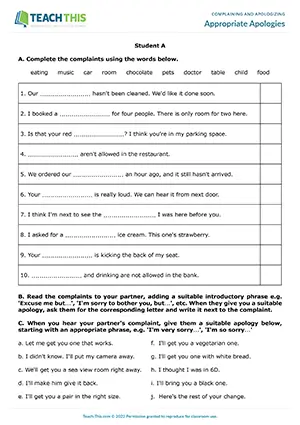
ESL Complaining and Apologizing Activity - Speaking: Gap-fill, Matching, Forming Sentences, Controlled Practice - Pair Work
In this productive complaining and apologizing speaking activity, students practice making complaints and giving apologies using prompts. Working alone, students complete complaints with the words...
How to Complain and Apologize

ESL Complaining and Apologizing Worksheet - Vocabulary and Reading Exercises: Categorising, Reading Comprehension, Gap-fill - Speaking Activity - Pair Work
In this insightful dealing with complaints worksheet, students identify and practice expressions for making complaints and saying sorry. Students begin by...
Always and Never

ESL Complaints Role-Play - Speaking Activity: Communicative Practice - Pair Work
Here is a communicative making complaints role-play activity to help students practice complaining with 'always' and 'never'. In pairs, students take turns picking up a card that shows the subject of a complaint...
Complaint Cards
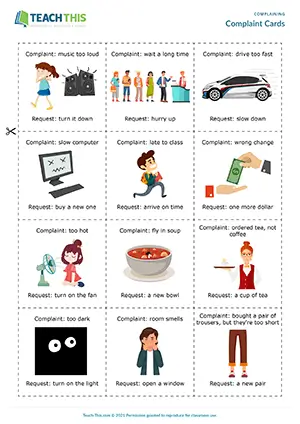
ESL Complaining and Apologizing Role-Play - Speaking Activity: Making Statements and Questions, Communicative Practice - Pair Work
In this free making complaints speaking activity, students role-play making complaints, apologies and requests in different situations. In pairs, students look at...
Customer Complaints
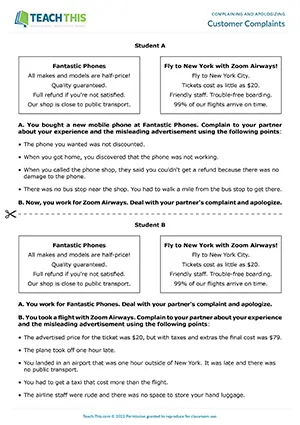
ESL Making Complaints Role-Play - Speaking Activity: Role-Play, Communicative Practice - Pair Work
In this communicative complaining and apologizing role-play, students practice making and dealing with complaints about misleading advertisements. In pairs, students role-play the first complaint...
Dealing with Complaints

ESL Complaints Game - Speaking: Role-Play, Guided Discussion, Communicative Practice - Pair Work
In this communicative dealing with complaints game, students role-play handling complaints using expressions on cards to score points. First, students brainstorm six situations in which people make...
I'm Sorry
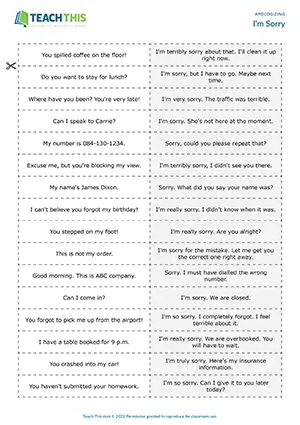
ESL Apologizing Games - Vocabulary and Speaking: Pelmanism, Matching, Forming Sentences - Group Work
In these two engaging apologizing games, students practice expressions with 'sorry'. In groups, students take turns turning over one card from each set. If the statement or question matches the...
Stop Complaining!

ESL Complaints, Requests and Apologies Worksheet - Vocabulary Exercises: Writing Sentences, Matching - Speaking Activities: Discussion, Guessing, Role-Play - Pair Work
In this useful complaining and apologizing worksheet, students learn how to make common complaints, requests and apologies. First, students read...
Back to the Shop
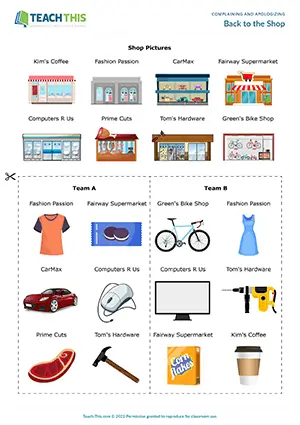
ESL Shop Complaints Game - Speaking: Role-Play, Communicative Practice
In this free shop complaints game, students role-play making complaints in a shop and their classmates try to guess where they are and what product they are complaining about. In teams, students imagine that items they bought are faulty and...
Complaining and Apologizing Language

ESL Complaining and Apologizing Handout
This free complaining and apologizing phrases handout provides students with some useful expressions to use when making and dealing with complaints. The sheet covers language and phrases for making a complaint, apologizing, giving reasons, calming someone down, asking for specifics...
I can't get no satisfaction!
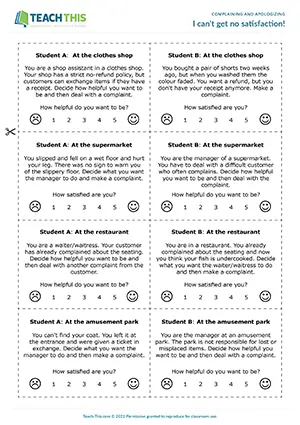
ESL Complaints Role-Play - Speaking Activity: Communicative Practice - Pair Work
In this communicative making complaints role-play activity, students make and deal with complaints in various situations and score how satisfied they are with each outcome. In pairs, students role-play each...
Race to Make It Right

ESL Apologies Game - Speaking: Matching, Completing Sentences, Freer and Communicative Practice - Group Work
In this engaging making apologies game, students race to match and complete apologies in response to complaints and expressions of dissatisfaction. In groups, one student turns over the...
Softening Complaints
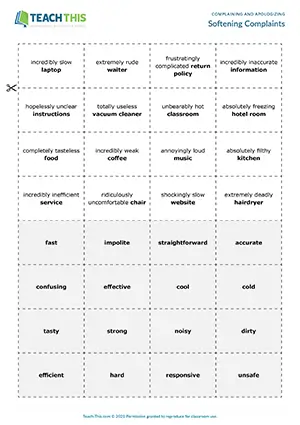
ESL Softening Complaints Activity - Vocabulary and Speaking: Forming Sentences, Communicative Practice - Pair Work
In this communicative making complaints speaking activity, students learn how to soften complaints using 'not very' and 'rather'. In pairs, one student places nine...
Using Complaining and Apologizing Language
Complaining and apologizing language covers the set phrases, softeners, and response patterns that turn a blunt statement like 'This doesn't work' into a socially acceptable version such as 'Excuse me, but this doesn't seem to be working properly,' paired with matching apology structures like 'I'm terribly sorry about that.' Students who translate directly from their own language instead of using these set patterns often sound abrupt when complaining or overly dramatic when apologizing, which can turn a routine exchange in a shop or workplace into one that feels confrontational.
This page covers complaining and apologizing language across three levels from pre-intermediate to upper-intermediate, with thirteen resources ranging from pelmanism games to full role-plays and a phrase handout, including three free downloads.
This table maps common situations to the phrases typically used for complaining and for responding with an apology.
| Situation | Complaint Phrase | Apology Phrase |
|---|---|---|
| Faulty product | 'This doesn't work properly.' | 'I'm so sorry, let me replace that for you.' |
| Late delivery or service | 'This is taking much longer than expected.' | 'I apologize for the delay.' |
| Noise or disturbance | 'Could you keep it down, please?' | 'Sorry about that, I didn't realize.' |
| Being kept waiting | 'I've been waiting for twenty minutes.' | 'I'm sorry for the wait.' |
| Repeated mistake | 'This keeps happening again and again.' | 'I'm really sorry, it won't happen again.' |
When to Use Complaining and Apologizing Language
Returning a Faulty Purchase: A customer complains directly to a shop assistant when a product breaks or doesn't match its description, because a clear complaint is usually the first step toward getting a refund or exchange, as in 'This blender stopped working after two days.'
Preventing a Small Issue From Escalating: A speaker chooses a calm, measured complaint over an emotional outburst when the relationship with the listener matters more than the problem itself, as in 'I think there might be a mistake on this bill.'
Following Up on an Unresolved Problem: A speaker returns to a complaint and restates it more firmly when an earlier apology or promise wasn't followed by any real action, as in 'I was told this would be fixed last week, and it still isn't.'
3-Step Framework for Teaching Complaining and Apologizing Language
1. Pair Up Complaint and Apology Openers: Give students two matching sets of language they can plug straight into a conversation: an opener for making a complaint and an opener for responding to one. Have them practice starting a complaint with 'Excuse me, but...' or 'I'm sorry, but...', then pair it with a matching apology opener like 'I'm very sorry...' or 'I'm so sorry...' so both halves of the exchange feel natural before moving on.
2. Build Complaints Around Repeated Behavior: Push students to complain about ongoing habits rather than one-off problems, since this is where real frustration usually shows up. Have them build a two-part complaint using 'always' for one annoying habit and 'never' for another, something like 'She's always moving things so I can't find them, and she never cleans up after herself,' then get their partner to respond with a practical suggestion.
3. Teach Students to Soften a Complaint: Once students can complain clearly, show them how to dial down the intensity so they don't sound harsh. Introduce 'not very' for softening a positive adjective and 'rather' for softening a negative one, then have them practice shifting a blunt line like 'this computer is incredibly slow' into a gentler 'this computer is not very fast' until the softer version becomes automatic.
Common Mistakes with Complaining and Apologizing Language
Using the Bare Verb Instead of the Gerund After "Apologize For": Students often treat 'for' like the infinitive marker 'to' and follow it with the base form of the verb instead of the required gerund. Wrong: 'I apologize for disturb you.' Correct: 'I apologize for disturbing you.'
Confusing "Sorry" and "Excuse Me": Students often say 'sorry' before interrupting or getting someone's attention, when 'excuse me' is the appropriate phrase to use beforehand. Wrong: 'Sorry, where is the nearest bank?' Correct: 'Excuse me, where is the nearest bank?'
Common Questions About Teaching Complaining and Apologizing Language
What is a fun game for practicing making complaints?
The game Back to the Shop gets students complaining in character without a script. Students role-play returning a faulty item to a shop without naming the shop or product, while classmates guess both from what they hear. It pushes students to use complaint language precisely enough to convey a situation they cannot describe directly.
What is a good worksheet for teaching complaining and apologizing?
The worksheet How to Complain and Apologize walks students through the language in clear stages. Students read real complaint dialogues, decide where each one took place, sort expressions into complaint and apology columns, and then practice immediately by reading complaints aloud while their partner responds with an appropriate apology.
What is an engaging role-play for teaching students to apologize?
The role-play Complaint Cards gives students a clear reason to apologize in every round. One student holds a card with a picture facing them and states a complaint, while their partner reads the written side to identify their role and responds with an appropriate apology before making a request. It's free to download.
Become a Teach This Member
Get unlimited access to the full library, plus new resources added every week.
Unlimited Resource Access
Download from 3000+ worksheets, activities, and games.
Save 5+ Hours Weekly
Cut lesson prep time with ready-to-use resources, plus teacher notes and answer keys.
Trusted Professional Quality
Classroom-tested, editable resources created by experienced ESL professionals.
Fresh Content Weekly
Get 5 new resources added to the library each week.
Here's what our members are saying...


