
Demonstrative Adjectives ESL Games, Worksheets & Activities
These, Those, Let's Go!
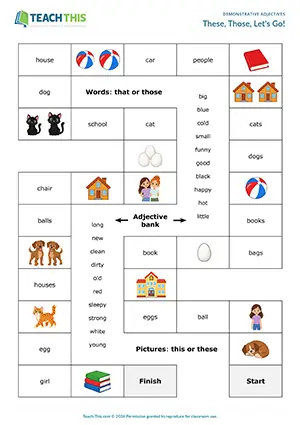
ESL Demonstrative Adjectives Board Game - Grammar, Vocabulary and Speaking: Forming Sentences - Pair Work
In this free demonstrative adjectives board game, students describe various nouns using 'this', 'that', 'these' or 'those' as adjectives. In pairs, students take turns rolling the dice and moving their counter...
This Is My Mime
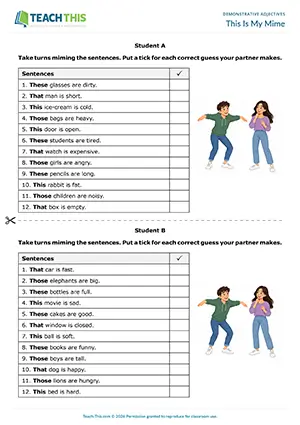
ESL Demonstrative Adjectives Game - Speaking: Miming, Guessing, Forming Sentences - Pair Work
In this entertaining demonstrative adjectives game, students mime and guess simple sentences that use demonstrative adjectives. In pairs, Student A begins by miming the first sentence on their worksheet...
This, That and Everything Around Us
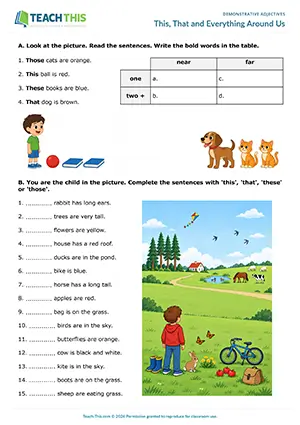
ESL Demonstrative Adjectives Worksheet - Grammar and Vocabulary Exercises: Categorising, Gap-fill, Sentence Rewriting - Speaking Activity - Pair Work
In this comprehensive demonstrative adjectives worksheet, students practice using 'this', 'that', 'these' and 'those' to describe near and far objects...
Demonstrative Match
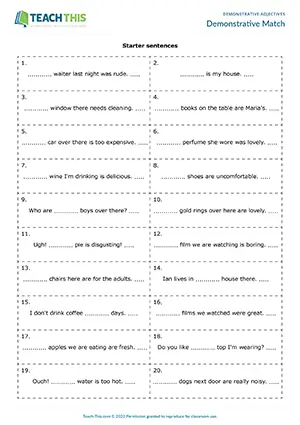
ESL Demonstrative Adjectives Activity - Vocabulary: Matching, Gap-fill - Pair Work
In this engaging demonstrative adjectives activity, pairs of students race to match sentences together and complete them with demonstrative adjectives. In pairs, students match each starter sentence with a suitable follow-on sentence. When...
Is this shirt on sale?
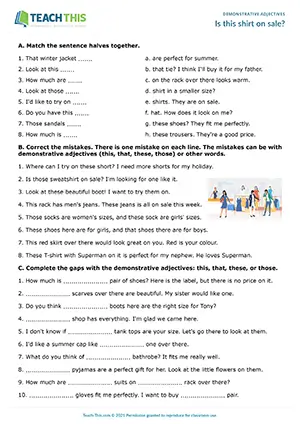
ESL This, That, These, Those Worksheet - Grammar Exercises: Matching, Error Correction, Gap-fill
In this productive demonstrative adjectives worksheet, students practice this, that, these, and those along with clothes shopping language. Students start by matching sentence halves together...
Statements and Questions
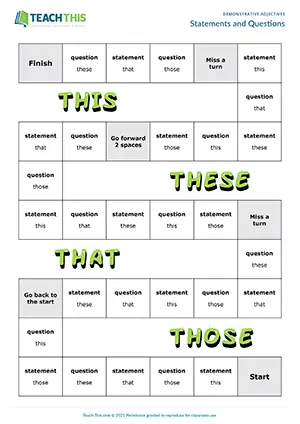
ESL This, That, These, Those Board Game - Grammar and Speaking: Forming Statements and Questions - Group Work
In this fun demonstrative adjectives board game, students practice making statements and questions with this, these, that and those. Players take it in turns to roll the dice and move their counter along...
This and That, These and Those
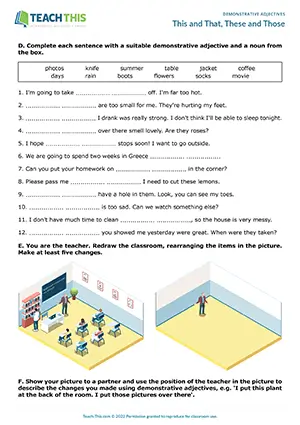
ESL Demonstrative Adjectives Worksheet - Grammar Exercises: Unscrambling, Gap-fill - Speaking Activity: Drawing, Forming Sentences, Freer Practice - Pair Work
Here is a useful demonstrative adjectives worksheet for pre-intermediate students. First, students complete a dialogue by putting letters in the correct order...
Understanding Demonstrative Adjectives
Demonstrative adjectives ('this,' 'that,' 'these,' and 'those') come before a noun to point to something specific, with 'this' and 'these' indicating something near and 'that' and 'those' indicating something further away. Students who mix them up send confusing signals about distance and proximity, making everyday interactions like shopping or giving directions harder to follow.
This page covers demonstrative adjectives at Elementary and Pre-intermediate levels (A1-A2 and A2), with seven resources including miming games, board games, worksheets, pair activities, and one free download.
The table below shows the four demonstrative adjectives, when to use each one, and which noun type each one precedes.
| Form | Number | Distance | Used Before | Example |
|---|---|---|---|---|
| this | singular | near | singular noun | 'This coffee is cold.' |
| that | singular | far | singular noun | 'That restaurant is popular.' |
| these | plural | near | plural noun | 'These seats are taken.' |
| those | plural | far | plural noun | 'Those mountains are beautiful.' |
When to Use Demonstrative Adjectives
Pointing out a specific item when shopping: When a customer wants a particular item rather than any item of that type, demonstrative adjectives make the reference precise without needing to describe the item in full, as in 'Can I try on those boots in the window?'
Referring back to something already mentioned: In conversation and writing, speakers use 'that' or 'those' to refer back to something mentioned earlier in the exchange, creating cohesion without repeating the noun, as in 'She told me about the delay. That news was frustrating.'
Contrasting two things in a comparison: When a speaker wants to place two items side by side, 'this' and 'that' put each item clearly on one side of the comparison, as in 'I prefer this design, but that one is cheaper.'
3-Step Framework for Teaching Demonstrative Adjectives
1. Anchor the Forms to Meaning with Pictures: Before students try to produce the adjectives in speech, give them a visual anchor for all four forms. Students read sentences containing demonstrative adjectives alongside a picture, then sort the adjectives into a table to show what each one means. The key decision they practice is whether the noun they are pointing at is singular or plural, near or far, and they reinforce this by using picture prompts to complete a shopping conversation with this, that, these, or those.
2. Make Distance Physical with Mime: Once students understand the four forms on paper, get them using their bodies to signal the distinction. In pairs, one student mimes a sentence, indicating whether the subject is near for 'this' and 'these' or far for 'that' and 'those' with their hands, holding up one or two fingers accordingly. Once the partner identifies the demonstrative adjective, the miming student goes on to mime the noun and adjective. If the partner guesses correctly, they build a full sentence using the demonstrative adjective, noun, verb 'to be,' and adjective. The physical encoding of near versus far makes the distinction far more memorable than any gap-fill.
3. Produce Spontaneously from a Personalised Context: At pre-intermediate level, students are ready to generate demonstrative adjectives without a fixed prompt. Students redraw a classroom by rearranging items in a picture, then show their version to a partner and use the position of the teacher in the picture to describe the changes they made using demonstrative adjectives. Because each student's drawing is different, the conversation is genuinely communicative rather than scripted.
Common Mistakes with Demonstrative Adjectives
Mismatching demonstrative adjective and noun number: Students often use 'this' with a plural noun or 'these' with a singular noun, forgetting that the demonstrative adjective must agree with the number of the noun it modifies. Wrong: 'These book is on the table.' Correct: 'This book is on the table.'
Using 'this' or 'these' for something far away: Students often use 'this' or 'these' to point to something in the distance because they have not yet internalized the near/far distinction, treating all four demonstrative adjectives as interchangeable. Wrong: 'Look at this mountain over there.' Correct: 'Look at that mountain over there.'
Common Questions About Teaching Demonstrative Adjectives
What is a fun board game for practicing demonstrative adjectives?
If you need a free resource for demonstrative adjectives, the board game These, Those, Let's Go! is the one to print. The square students land on decides the adjective: a picture square means 'this' or 'these,' while a word square means 'that' or 'those.' Students describe the nouns using suitable adjectives, so accuracy matters every turn.
What is a good demonstrative adjectives worksheet?
The worksheet Is this shirt on sale? stands out because the clothes shopping context gives students a genuine reason to get the forms right. Students match sentence halves, spot and correct demonstrative adjective errors, then complete a gap-fill using this, that, these, and those. Three exercises, one real-world context, no setup needed.
What is a creative speaking activity for this, that, these, and those?
For creative speaking practice with demonstrative adjectives, the board game Statements and Questions requires students to produce two different sentence types from the same picture card. A 'statement' square might produce 'This house has two floors,' while a 'question' square produces 'Is this house for sale?' Students cannot settle into a pattern, which keeps the practice sharp.
Become a Teach This Member
Get unlimited access to the full library, plus new resources added every week.
Unlimited Resource Access
Download from 3000+ worksheets, activities, and games.
Save 5+ Hours Weekly
Cut lesson prep time with ready-to-use resources, plus teacher notes and answer keys.
Trusted Professional Quality
Classroom-tested, editable resources created by experienced ESL professionals.
Fresh Content Weekly
Get 5 new resources added to the library each week.
Here's what our members are saying...


