
Business Telephoning Games, Role-Plays & Worksheets
Business Telephoning Board Game
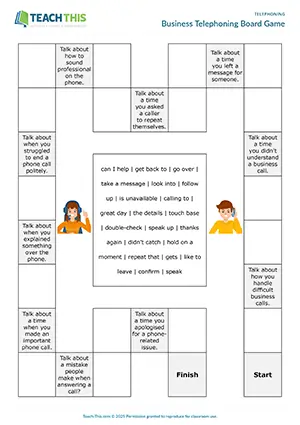
Business Telephone Language Board Game - Vocabulary and Speaking: Gap-fill, Impromptu Speech, Freer Practice - Group Work
In this fun business telephoning board game, students practice business telephone phrases and talking in response to phone-related discussion prompts. Players...
Call and Respond
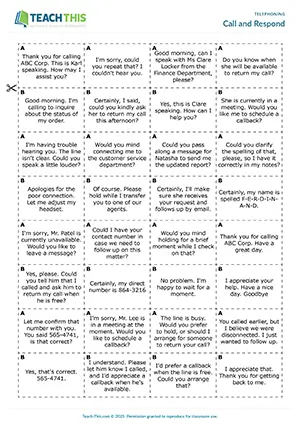
Business Telephone Phrases Game - Speaking: Matching - Group Work
In this free business telephoning game, students race to match common business telephone phrases with appropriate responses. One student begins the game by reading a card to one of the other students, e.g. 'Thank you for calling...
The Business Call Challenge
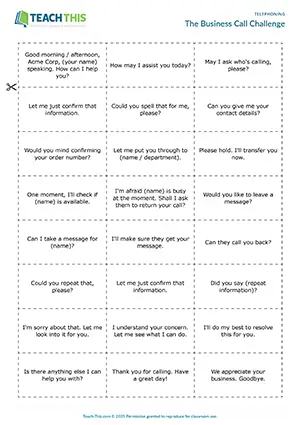
Business Telephoning Game - Vocabulary: Matching - Group Work
This engaging business telephoning game helps students practice common business telephone responses for answering a call, asking for information, connecting a call, taking a message, clarifying information, dealing with issues and...
Would you like to leave a message?

Business English Taking and Leaving Messages Role-Play - Speaking Activity: Communicative Practice - Pair Work
In these business telephoning role-plays, students practice taking and leaving messages over the phone in a business context. In pairs, students take turns being a receptionist and a caller...
Dealing with Service Enquiries
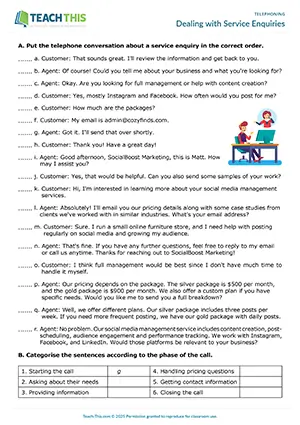
Business Service Enquiries Worksheet - Reading and Vocabulary Exercises: Ordering, Categorising, Gap-fill - Speaking Activity: Role-Play - Pair Work
In this comprehensive telephone service enquiries worksheet, students learn how to structure and handle service enquiry phone calls. First, students put...
Please hold for a moment
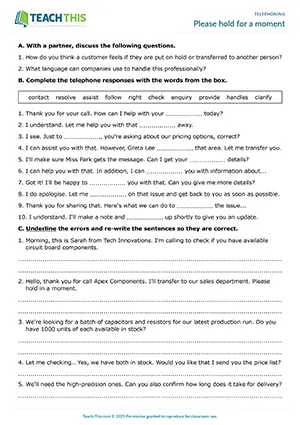
Business Telephoning Worksheet - Reading and Vocabulary Exercises: Gap-fill, Ordering - Speaking Activity: Role-Play - Pair and Group Work
In this business telephoning worksheet, students practice telephoning language with a focus on transferring calls professionally. First, in pairs, students...
Making and Handling Business Phone Calls
Making and handling business phone calls involves identifying the caller's purpose, exchanging information and helping the call reach an appropriate next step. Students need language for answering enquiries, transferring callers, taking messages and checking details when they cannot rely on visual cues.
This page contains six resources across B1 and B2, including games, worksheets and role-plays, with one free game. They cover telephone phrases and responses, taking and leaving messages, service enquiries and transferring calls.
The table gives example language for common business telephone functions.
| Telephone function | Purpose | Example language |
|---|---|---|
| Answer a call | Identify yourself and invite the caller to explain. | 'Good morning, customer services. Maya speaking. How can I help?' |
| State the reason for calling | Make the purpose clear. | 'I'm calling to ask about your delivery service.' |
| Ask the caller to hold | Request time to check information or connect the call. | 'Could you hold for a moment while I check?' |
| Explain a transfer | Tell the caller who will handle the enquiry. | 'I'll put you through to the sales team.' |
| Offer to take a message | Provide an alternative when someone is unavailable. | 'She's unavailable at the moment. Would you like to leave a message?' |
| Check a detail | Confirm that information has been understood correctly. | 'Let me check: your order number is 4826. Is that right?' |
How to Communicate on Business Phone Calls
Establish the purpose early: Identify yourself in a way that suits the workplace, then explain why you are calling or invite the caller to speak. Use a relevant follow-up question to find out what information or help is needed before choosing a response.
Check details before acting: Ask for repetition or spelling when a name, number or message is unclear. Repeat important details back to the caller, and confirm the meaning of a request before recording it or passing it to someone else.
Make the next step clear: Explain when you need to place someone on hold or transfer the call. If you take a message, check the contact details and requested action. Avoid promising a return call at a particular time unless that arrangement is known.
3-Step Framework for Teaching Business Telephoning
The first two stages develop telephone responses and spoken practice at B1. The final B2 stage brings the language into a service-enquiry call. Use the sequence across lessons according to learners' readiness.
1. Match a Situation with a Response: Students listen to questions about telephone functions and race to select a matching response card. To win a pair, they read the response and add any required details. This connects a call-handling need with language students can use before they work with less explicit prompts.
2. Select Phrases and Extend Speaking: Students play a board game that combines completing spoken sentences with telephone phrases and responding to discussion prompts for 30 seconds. The two task types practice choosing language from context and developing a longer response, preparing learners to sustain their contributions during a call.
3. Handle a Service Enquiry: Students order a model telephone conversation, categorise sentences by the phase of the call and complete another exchange with suitable word forms. They then role-play a customer asking a company agent about a service. This brings phrase choice and call structure together in an exchange with a clear purpose.
Common Mistakes with Business Telephone Language
Using direct-question order in an embedded question: After Could you tell me, use statement word order in the clause that follows. Incorrect: 'Could you tell me when does the office open?' Correct: 'Could you tell me when the office opens?'
Confusing taking and leaving a message: The caller leaves a message, while the person receiving the call takes it. Wrong wording for a receptionist offering to record a message: 'Would you like to take a message?' Correct: 'Would you like to leave a message?' or 'Can I take a message?'
Common Questions About Teaching Business Telephoning
What role-play helps practice taking phone messages?
The role-play Would you like to leave a message? gives pairs caller and receptionist roles. Students exchange names, contact details and messages, with the receptionist confirming and recording the information. They swap roles across four scenarios, then compare message cards with caller cards to check how accurately they understood and recorded each call.
What worksheet helps teach transferring calls?
The worksheet Please hold for a moment prepares students to transfer business calls through phrase completion, error correction and an ordered model dialogue. Groups of three then role-play a customer calling a store employee who transfers the call to a manager, applying the language in an exchange involving all three roles.
What game helps practice business telephone phrases?
The free game Call and Respond asks students to match spoken telephone phrases with suitable replies on their cards. Students read their responses aloud, and the group checks whether each exchange fits. The first student to collect four pairs wins, connecting recognition of a phrase with choosing an appropriate conversational response.
Become a Teach This Member
Get unlimited access to the full library, plus new resources added every week.
Unlimited Resource Access
Download from 3000+ worksheets, activities, and games.
Save 5+ Hours Weekly
Cut lesson prep time with ready-to-use resources, plus teacher notes and answer keys.
Trusted Professional Quality
Classroom-tested, editable resources created by experienced ESL professionals.
Fresh Content Weekly
Get 5 new resources added to the library each week.
Here's what our members are saying...


