Academic Skills Collocations

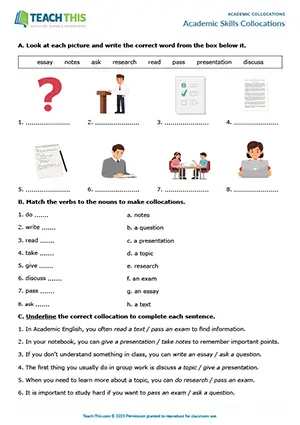
Pre-intermediate (A2) 35 minutes
Academic Skills Collocations preview for Pre-intermediate A2: matching, binary choice, gap-fill, writing sentences, discussion, freer pair work

ACL Academic Skills Collocations Worksheet - Vocabulary, Reading and Writing Exercises: Matching, Gap-fill, Writing Sentences - Speaking Activity: Discussion - Pair Work

In this useful academic skills collocations worksheet, students learn and practice eight common academic verb-noun collocations and then use them to set goals...

ACL Academic Skills Collocations Worksheet - Vocabulary, Reading and Writing Exercises: Matching, Binary Choice, Gap-fill, Writing Sentences - Speaking Activity: Discussion, Freer Practice - Pair Work In this useful academic skills collocations worksheet, students learn and practice eight common academic verb-noun collocations and then use them to set goals for their English studies. First, students match words from a box to pictures. Students then match verbs to nouns to make collocations that represent common academic activities. Next, students underline the correct verb-noun collocation to complete each sentence. After that, students complete a text about a student's study goals with verb-noun collocations from a box. Students then move on to write down three academic skills from Exercise B that they want to practice or improve. Next, students write sentences explaining how they plan to improve and practice these skills using the text in Exercise D as a model. Finally, students answer three reflection questions in pairs.

Academic Collocations 1 to 10

Intermediate (B1) 30 minutes
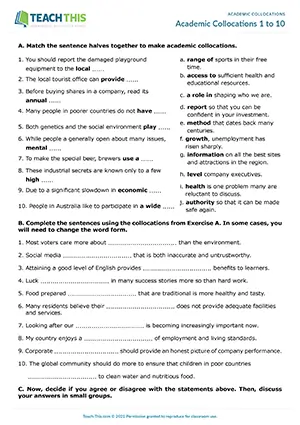
ACL Academic Collocations 1 to 10 Worksheet preview for Intermediate B1: matching, gap-fill, guided discussion, communicative group work

ACL Academic Collocations Worksheet - Vocabulary Exercises: Matching, Gap-fill - Speaking Activity: Discussion - Group Work

In this comprehensive academic collocations worksheet, students become familiar with the meaning and usage of the 10 most frequently encountered collocations used in academic contexts. First, students match...

ACL Academic Collocations Worksheet - Vocabulary Exercises: Matching, Gap-fill - Speaking Activity: Guided Discussion, Communicative Practice - Group Work In this comprehensive academic collocations worksheet, students become familiar with the meaning and usage of the 10 most frequently encountered collocations used in academic contexts. First, students match sentence halves together to form sentences containing academic collocations. Next, students complete gap-fill statements using the academic collocations. In the final exercise, students decide if they agree or disagree with the statements and then discuss their answers in small groups.

Academic Collocations 11 to 20

Intermediate (B1) 25 minutes
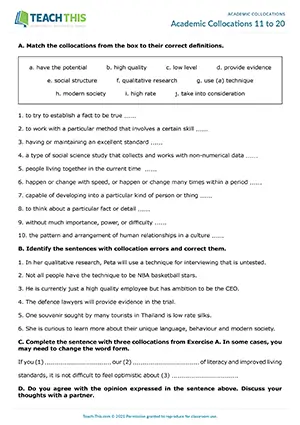
ACL Academic Collocations 11 to 20 Worksheet preview for Intermediate B1: matching, identifying, error correction, gap-fill, guided discussion, pair work

ACL Academic Collocations Worksheet - Vocabulary Exercises: Matching, Identifying, Error Correction, Gap-fill - Speaking Activity - Pair Work

In this free academic collocations worksheet, students learn the meaning and usage of the most frequently used academic collocations 11 to 20. First, students match...

ACL Academic Collocations Worksheet - Vocabulary Exercises: Matching, Identifying, Error Correction, Gap-fill - Speaking Activity: Guided Discussion - Pair Work In this free academic collocations worksheet, students learn the meaning and usage of the most frequently used academic collocations 11 to 20. First, students match academic collocations from a box to their correct definitions. Next, students identify sentences with collocation errors and correct them. After that, students complete gaps in a sentence with three collocations from Exercise A. In the final exercise, students decide if they agree with the opinion expressed in the sentence and then discuss their thoughts with a partner.

Academic Collocations 21 to 30

Intermediate (B1) 25 minutes
ACL Academic Collocations 21 to 30 Worksheet preview for Intermediate B1: matching, gap-fill, discussion, communicative group work

ACL Academic Collocations Worksheet - Vocabulary Exercises: Matching, Gap-fill - Speaking Activity: Discussion - Group Work

In this academic collocations worksheet, students practice the meaning and usage of the 21 to 30 most frequently encountered collocations used in academic contexts. To start, students match...

ACL Academic Collocations Worksheet - Vocabulary Exercises: Matching, Gap-fill - Speaking Activity: Discussion, Communicative Practice - Group Work In this academic collocations worksheet, students practice the meaning and usage of the 21 to 30 most frequently encountered collocations used in academic contexts. To start, students match sentence halves together to form sentences containing academic collocations. Students then complete gap-fill statements using the academic collocations. In the next exercise, students decide if they agree or disagree with particular statements by completing a table, giving reasons for their answers. Finally, students discuss their answers in small groups.

Academic Collocations 31 to 40

Intermediate (B1) 25 minutes
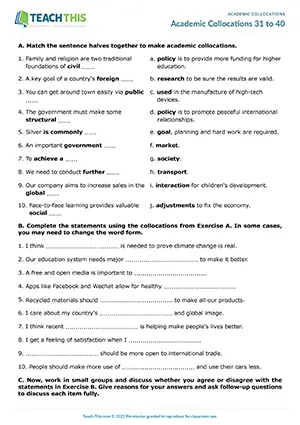
ACL Academic Collocations 31 to 40 Worksheet preview for Intermediate B1: matching, gap-fill, guided discussion, communicative group work

ACL Academic Collocations Worksheet - Vocabulary Exercises: Matching, Gap-fill - Speaking Activity: Communicative Practice - Group Work

In this academic collocations worksheet, students learn the meaning and practice the usage of the 31 to 40 most used academic collocations. First, students...

ACL Academic Collocations Worksheet - Vocabulary Exercises: Matching, Gap-fill - Speaking Activity: Guided Discussion, Communicative Practice - Group Work In this academic collocations worksheet, students learn the meaning and practice the usage of the 31 to 40 most used academic collocations. First, students match sentence halves together to form sentences containing academic collocations. Students then complete statements using the collocations. Finally, in small groups, students discuss whether they agree or disagree with the statements in Exercise B, giving reasons for their answers and asking follow-up questions to discuss each item fully.

Academic Collocation Challenge

Upper-intermediate (B2) 30 minutes
ACL Academic Collocation Games preview for Upper-intermediate B2: pelmanism, matching, snap, sentence formation, pair work

ACL Academic Collocation Matching Games - Vocabulary: Pelmanism, Matching, Snap, Forming Sentences - Pair Work

Here are two enjoyable academic collocation matching games to help students practice recognising and using academic collocations that frequently appear in academic texts. First, students play a pelmanism...

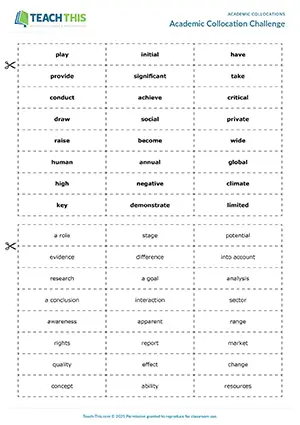
ACL Academic Collocation Matching Games - Vocabulary: Pelmanism, Matching, Snap, Forming Sentences from Prompts - Pair Work Here are two enjoyable academic collocation matching games to help students practice recognising and using academic collocations that frequently appear in academic texts. First, students play a pelmanism game where they match cards together to form academic collocations. In pairs, students take turns turning over one card from each set. If the two cards match to form an academic collocation, the student keeps the two cards and has another turn. If not, the student turns the cards back over and play passes to the other student. When the students have finished, they use a cheat sheet to check their answers. The student with the most correct matches wins the game. After that, students play a game of snap by matching the first part of an academic collocation with the second part. Both students turn over a card from their pile at the same time. If the cards form an academic collocation, the first student to say 'Snap!' scores one point. The winning student then tries to create a sentence using the collocation for an extra point. Students then pick up their own cards, shuffle them and play again. If a student says 'Snap!' when the cards don't match, the other student scores a point and the game continues. The first student to score 20 points wins the game.

Academic Collocations Jeopardy

Upper-intermediate (B2) 25 minutes
ACL Academic Collocation Game preview for Upper-intermediate B2: quiz, guessing, group work

ACL Academic Collocations Quiz Game - Vocabulary: Quiz, Guessing - Group Work

In this academic collocations quiz game, students guess collocations based on their definitions. Choose a square to start the game, e.g. 'Research and Methods' for 100 points. Read the definition of the collocation, e.g. 'the question a...

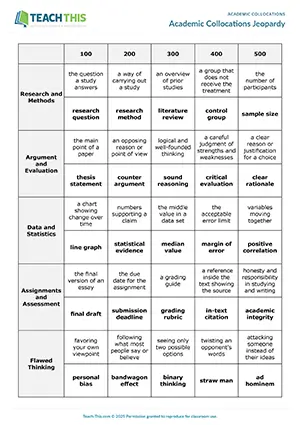
ACL Academic Collocations Quiz Game - Vocabulary: Quiz, Guessing - Group Work In this academic collocations quiz game, students guess collocations based on their definitions. Choose a square to start the game, e.g. 'Research and Methods' for 100 points. Read the definition of the collocation, e.g. 'the question a study answers.' The first student to raise their hand and give the correct academic collocation (e.g. research question) wins that square for their team and the number of points shown in the square. Write the winning team's name in the square. If a student gives an incorrect answer, their team is out for that question and may only answer again if all other teams answer incorrectly. The winning team then chooses the next square, and all the teams raise their hands to answer, as before. At the end of the game, add up the points for each team. The team with the most points wins the game. As a variation, when a student answers correctly, the winning team tries to make a sentence with the academic collocation. If they do this successfully, the points for the square are doubled.

Academic Collocations Race

Upper-intermediate (B2) 30 minutes
ACL Academic Collocation Game preview for Upper-intermediate B2: gap-fill, giving reasons, error correction, freer practice, group work

ACL Academic Collocations Board Game - Vocabulary and Speaking: Gap-fill, Giving Reasons, Error Correction - Group Work

In this engaging academic collocations board game, students practice collocations 41–60 from the Academic Collocation List through gap-fill, context-choice, and error-correction tasks. Players take turns...

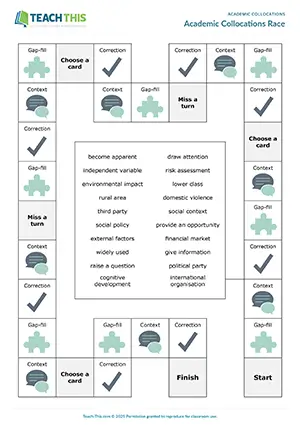
ACL Academic Collocation Game - Vocabulary and Speaking Game: Gap-fill, Giving reasons, Error correction, Freer Practice - Group Work In this engaging academic collocations board game, students practice collocations 41–60 from the Academic Collocation List through gap-fill, context-choice, and error-correction tasks. Players take turns rolling the dice and moving their counter along the board. When a player lands on a 'Gap-fill' square, another student picks up a gap-fill card and reads the sentence aloud using the word 'blank' for the collocation in bold. The player listens to the sentence, chooses a collocation from the game board, and says it aloud to complete the sentence. When a player lands on a 'Context' square, another student takes a context card and reads the situation aloud. The player then chooses a collocation from the game board that could be used in that context and justifies their choice. When a player lands on a 'Correction' square, another student takes a correction card and reads it aloud. The player then chooses a collocation from the game board and says it aloud to correct the sentence. For gap-fill and correction cards, if the player says the correct collocation, they stay on the square. For context cards, the other players evaluate their answer. If the player provides a suitable choice and explanation, they stay on the square. For all cards, if the answer is incorrect or the players agree the answer is inadequate, the player moves back two squares. The first player to reach the finish wins the game.

Collocation Connection Quest

Upper-intermediate (B2) 30 minutes
ACL Academic Collocations Game preview for Upper-intermediate B2: making connections, giving reasons, communicative group work

ACL Academic Collocation Connections Game - Vocabulary and Speaking: Making Connections, Giving Reasons, Communicative Practice - Group Work

In this academic collocation connections game, students link cards by making logical connections between collocations and explaining their reasoning...

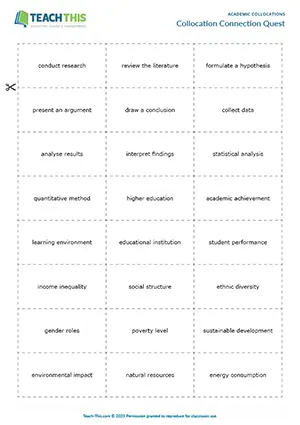
ACL Academic Collocation Connections Game - Vocabulary and Speaking: Making Connections, Giving Reasons, Communicative Practice - Group Work In this academic collocation connections game, students link cards by making logical connections between collocations and explaining their reasoning. Each card shows an academic collocation, and the goal is to make logical connections between different collocations that show a clear relationship, such as steps in a process or cause and effect. To begin, one player picks up the top collocation card from the pile, places it on the desk and reads it aloud. That player then chooses a collocation card from their hand that they think makes a logical connection and places it before or after the card on the table to extend the chain, explaining the connection clearly to the other players, e.g. 'I'm adding collect data because you need to collect data when you conduct research.' If all the other players agree the connection makes sense, the card stays in the chain, and play continues to the next student. If the player is unsuccessful or cannot make a connection, they take back their card, draw a new card from the pile, and play passes to the next student. The other players then take turns making connections in this way to keep the chain going. When no player can make a connection to the current chain, the next player starts a new chain by drawing a card from the pile. The first player to get rid of all their cards wins the game.

Collocations for Research Writing

Advanced (C1) 45 minutes
ACL Academic Collocations Worksheet preview for Advanced C1: gap-fill, ordering, binary choice, identifying, rewriting sentences, paragraph writing

ACL Research Writing Collocations Worksheet - Vocabulary and Writing Exercises: Gap-fill, Identifying, Rewriting Sentences, Paragraph Writing

In this research writing collocations worksheet, students learn and practice advanced collocations commonly used in thesis and research paper writing...

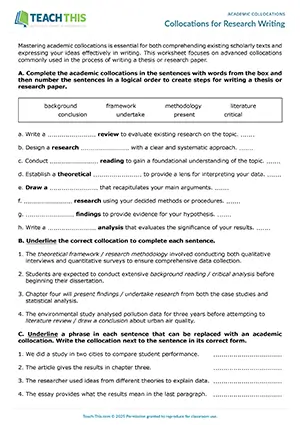
ACL Research Writing Collocations Worksheet - Vocabulary and Writing Exercises: Gap-fill, Ordering, Binary Choice, Identifying, Rewriting Sentences, Paragraph Writing In this research writing collocations worksheet, students learn and practice advanced collocations commonly used in thesis and research paper writing before producing a paragraph in an appropriate academic register. First, students complete academic collocations in sentences with words from a box and then number the sentences in a logical order to create steps for writing a thesis or research paper. Next, students choose the correct collocation to complete each sentence. After that, students identify a phrase in each sentence that can be replaced with an academic collocation. Students then write the collocation next to the sentence in its correct form. Following that, students rewrite sentences using academic collocations and an appropriate register. Next, students rewrite a paragraph that uses informal language, improving it with collocations and an appropriate academic register. Finally, students write a paragraph describing the steps they would take in writing a thesis or research paper on a topic of their choice using collocations from the worksheet and maintaining an appropriate academic register.

Using Academic Collocations

Academic collocations are combinations of words commonly used together in academic contexts, such as 'conduct research' and 'collect data'. Learning these combinations helps students express ideas naturally and choose suitable wording for academic tasks.

This page contains ten resources from pre-intermediate (A2) to advanced (C1), including one free worksheet. The materials cover academic skills, numbered collocation sets, matching and discussion games, and collocations for research writing.

Use the examples below to connect each expression with a communicative purpose. These illustrative combinations are not a claim about which numbered set contains each item.

PurposeCollocationExample
Describe an investigation conduct research 'The team plans to conduct research into language learning.'
Gather information collect data 'Students collected data through interviews.'
Identify a study's focus research question 'The introduction explains the research question.'
Examine information analyse data 'The researchers analysed the data before writing their report.'
Support a point provide evidence 'The essay needs to provide evidence for its main claim.'
Interpret findings draw a conclusion 'We need more information before drawing a conclusion.'

How to Develop Academic Collocations

Record combinations in context: Ask students to note the whole expression and a short example rather than copy isolated words. Highlight any article, preposition or word form needed in the sentence.

Choose language for the task: Connect expressions with what students need to explain, such as a study goal or a research process. Do not encourage them to insert academic phrases merely to make a text sound more advanced.

Check alternatives carefully: More than one combination may be natural. Use examples from suitable academic texts or a dictionary to check unfamiliar choices, and distinguish an unusual combination from a grammatical error.

3-Step Framework for Teaching Academic Collocations

Across intermediate and upper-intermediate lessons, move from supported sentence work to discussion and explaining relationships. The resources use different collocation sets, so introduce unfamiliar expressions before each stage rather than assume the same vocabulary continues throughout.

1. Establish meaning in sentences: Students match sentence halves containing academic collocations and use the expressions to complete statements. Ask them to explain the completed statements before discussing whether they agree with them. This connects recognition with an initial response to meaning.

2. Develop and question opinions: Students complete statements with a further collocation set, then discuss their views in small groups. They give reasons and ask follow-up questions. Encourage them to use the expressions where they fit the point they want to make.

3. Explain connections between expressions: Students place collocation cards in a chain and explain logical relationships, such as stages in a process. The group decides whether each connection makes sense. This extends practice from completing a sentence to explaining how academic actions or ideas relate.

Common Mistakes with Academic Collocations

Translating a verb combination word by word: A familiar verb may not form a natural combination with the intended noun. Unnatural in this context: 'The team made research into study habits.' Natural alternative: 'The team conducted research into study habits.' 'Carried out research' is another suitable option.

Losing the noun's countability pattern: Learning the combination includes knowing how its noun behaves. Incorrect: 'The report provides an evidence for the claim.' Correct: 'The report provides evidence for the claim.' Use 'a piece of evidence' when referring to one individual item.

Common Questions About Teaching Academic Collocations

What game helps students practice academic collocations?

The game Academic Collocations Race combines sentence completion, context choices and error correction on a board. Students select collocations to answer each challenge, explaining their choices on context cards. Suitable answers let them stay on their square, so progress depends on using the expressions appropriately rather than simply recognising them.

What free worksheet helps teach academic collocations?

The worksheet Academic Collocations 11 to 20 begins with matching expressions to definitions. Students then identify and correct collocation errors before completing a sentence with three target expressions. A final partner discussion asks them to respond to the opinion in that sentence, connecting vocabulary accuracy with an exchange of ideas.

How can I teach collocations for research writing?

The worksheet Collocations for Research Writing links academic expressions with the stages of writing a thesis or research paper. Students complete and order sentences, select collocations and revise informal wording. They then improve a paragraph and write their own account of a research-writing process, applying the expressions in connected prose.

Become a Teach This Member

Get unlimited access to the full library, plus new resources added every week.

Unlimited Resource Access

Download from 3000+ worksheets, activities, and games.

Save 5+ Hours Weekly

Cut lesson prep time with ready-to-use resources, plus teacher notes and answer keys.

Trusted Professional Quality

Classroom-tested, editable resources created by experienced ESL professionals.

Fresh Content Weekly

Get 5 new resources added to the library each week.

Join Now Just $29.99 quarterly