
Making Offers & Promises ESL Games & Activities
Count on Me!

ESL Making Promises and Offers Game - Vocabulary and Speaking: Forming Sentences, Communicative Practice
In this free making promises and offers game, students race to respond to statements by making promises with 'will' or 'won't' or offers with 'will' or 'Shall I...?' In groups, students take turns picking up a card...
Helpful Dominoes
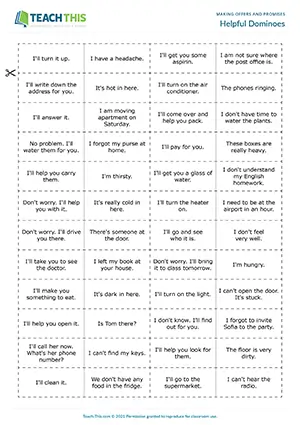
ESL Making Offers Game - Vocabulary: Matching - Group Work
In this enjoyable making offers game, students play dominoes by matching statements to offers of help with will and vice versa. The first player puts a domino down either before or after the domino on the table, making sure the statement or question...
Offer it up
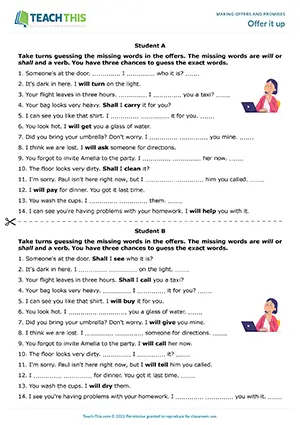
ESL Will and Shall Game - Vocabulary: Guessing - Pair Work
In this engaging making offers game, students guess missing words in sentences and questions that make offers with 'will' or 'shall'. In pairs, students take turns guessing missing words in offers and reading the complete sentence or question to...
Offers and Promises
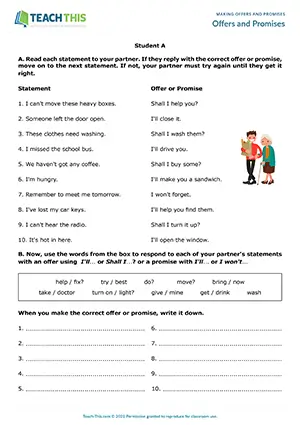
ESL Offers and Promises Activity - Vocabulary and Speaking: Matching, Forming Sentences, Controlled and Freer Practice - Pair Work
In this productive making offers and promises activity, students respond to statements by making offers with 'will' or 'shall' or promises with 'will' or 'won't'. In pairs...
Would you like...?
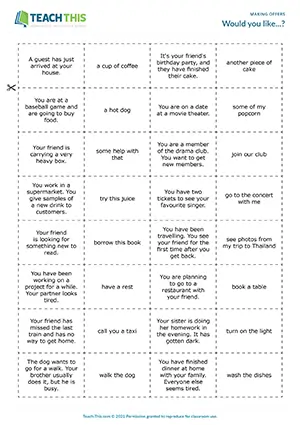
ESL Would You Like Game - Vocabulary and Speaking: Forming Questions, Freer Practice - Group Work
In this rewarding making offers game, students practice making offers in various situations using different forms of 'Would you like...?' In pairs, students take turns turning over two cards. If one card...
On the Spot
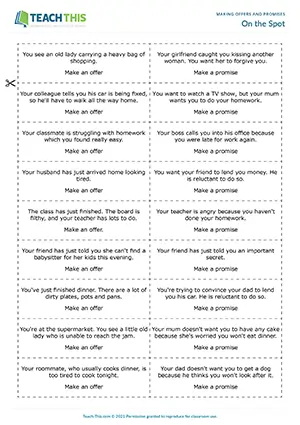
ESL Offers and Promises Game - Speaking: Forming Sentences and Questions, Communicative Practice - Group Work
In this fun making offers and promises game, students race against one another to make offers or promises for certain situations. In groups, students take turns picking up a card, reading the situation on the...
Using Offers and Promises Language
Offers and promises in English both use 'will', but they work in different communicative situations: an offer responds to someone else's need ('Shall I carry that for you?'), while a promise commits the speaker to a future action ('I'll call you tomorrow, I promise'). Learners who treat 'will' as a simple future marker often miss these distinctions and produce responses that are grammatically correct but communicatively wrong, for example reaching for a promise structure when the situation calls for an offer.
This page covers making offers and promises at A2 and B1 levels, with six resources including games, a dominoes matching activity, and a structured pair activity, plus one free download.
This table maps the key structures and typical phrases used when making offers and promises in everyday English.
| Function | Structure | Example Phrase |
|---|---|---|
| Offering to do something for someone | 'Shall I' + verb | 'Shall I open the window?' |
| Offering to do something for someone | 'I'll' + verb | 'I'll help you with that.' |
| Offering something to someone | 'Would you like' + noun | 'Would you like a cup of tea?' |
| Offering to do something for someone | 'Would you like me to' + verb | 'Would you like me to call a taxi?' |
| Offering to do something with someone | 'Would you like to' + verb | 'Would you like to join us for lunch?' |
| Making a positive promise | 'I'll' + verb | 'I'll finish it before the deadline.' |
| Making a negative promise | 'I won't' + verb | 'I won't tell anyone, I promise.' |
| Accepting an offer | 'Yes, please' / 'That would be great' | 'Yes, please. That would be really helpful.' |
| Declining an offer | 'No, thank you' | 'No, thank you. I can manage.' |
When to Use Offers and Promises Language
Responding to Someone in Difficulty: When someone mentions a problem or need in conversation, an offer is the natural response in English rather than a statement of intention, as in 'Shall I give you a hand with that?' rather than 'I will help you.'
Committing to a Social Agreement: When confirming plans or reassuring someone after a disagreement, a promise with 'will' or 'won't' signals a firm personal commitment rather than a simple statement of fact, as in 'I won't be late this time, I promise.'
Offering Something in a Service Context: When working in a customer-facing role or hosting a guest, 'Would you like...?' is the standard English structure for making polite offers, since it invites a yes or no response without pressure, as in 'Would you like me to bring you another one?'
3-Step Framework for Teaching Offers and Promises
1. Show the Cue System: Before students can produce offers and promises spontaneously, they need to understand what triggers each structure. A pair activity where students read statements and form responses using words from a box, with a question mark in the box signalling 'Shall I...?' and no question mark signalling 'I'll...' or 'I won't...', makes the decision logic visible and gives learners a clear rule to work from.
2. Consolidate Through Matching: Once learners know the structures, a dominoes game that requires them to match statements to appropriate offers of help builds fluency with the statement-to-offer connection before any freer production begins. Students place tiles at either end of a growing domino chain, so every turn involves reading the whole context before committing to a match.
3. Race to Respond: With the structures in place, a race game pushes students to produce offers and promises under communicative pressure. After the first round, the game shifts gear: students compete to give the funniest or most imaginative response to each situation, with the reader awarding the card to whichever student produces the best one, for example 'I'll take you there in my Ferrari.'
Common Mistakes with Making Offers and Promises
Making an Offer Without Giving the Other Person a Choice: Students often announce an offer as a statement rather than framing it as a question, which can sound presumptuous in English because it does not give the other person a chance to accept or decline. Wrong: 'I'll carry your bags.' Correct: 'Would you like me to carry your bags?'
Treating 'Would you like...?' as a Preference Question: Students often respond to 'Would you like...?' as a question about general preferences rather than a present offer, producing an answer about liking rather than accepting or declining. Wrong: 'Yes, I like coffee.' Correct: 'Yes, please.'
Common Questions About Teaching Offers and Promises Language
What is a fun game for practicing offers and promises?
The game Count on Me! has two rounds. In the first, students race to respond to statements with a correct offer or promise using 'will', 'won't', or 'Shall I...?' In the second, they compete to give the funniest response, for example 'I'll take you there in my Ferrari', and the reader awards the card to the winner.
What is an engaging activity for practicing 'Would you like' offers?
In the activity Would you like...?, students take turns turning over two cards. When a situation card matches an offer card, they must produce the correct form of 'Would you like...?', 'Would you like to...?', or 'Would you like me to...?' Their partner judges whether the offer is grammatically correct and appropriate before they can keep the cards.
What is a useful game for practicing offers with 'will' and 'shall'?
Accuracy is built into the game Offer it up through a points system: students guess the missing 'will' or 'shall' plus verb in offer sentences and must say the exact sentence on their partner's worksheet to score. A correct first guess earns three points, a second-try guess earns two.
Become a Teach This Member
Get unlimited access to the full library, plus new resources added every week.
Unlimited Resource Access
Download from 3000+ worksheets, activities, and games.
Save 5+ Hours Weekly
Cut lesson prep time with ready-to-use resources, plus teacher notes and answer keys.
Trusted Professional Quality
Classroom-tested, editable resources created by experienced ESL professionals.
Fresh Content Weekly
Get 5 new resources added to the library each week.
Here's what our members are saying...


