Let's Match It!

Elementary (A1-A2) 25 minutes
ESL suggestions game preview showing matching and forming sentences from prompts for elementary A1-A2 students

ESL Suggestions Game - Speaking: Matching, Forming Sentences, Controlled Practice - Group Work

In this dynamic making suggestions game, students practice making suitable suggestions for everyday situations using four common phrases. In groups, students take turns rolling the dice. If the student rolls...

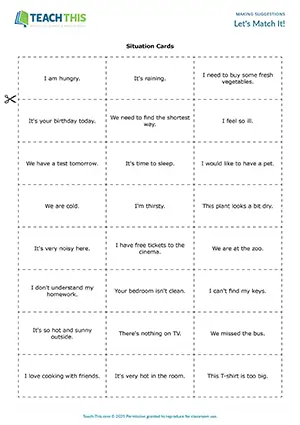
ESL Suggestions Game - Speaking: Matching, Forming Sentences from Prompts, Controlled Practice - Group Work In this dynamic making suggestions game, students practice making suitable suggestions for everyday situations using four common phrases. In groups, students take turns rolling the dice. If the student rolls a suggestion phrase, they pick up a situation card, match it with a suitable suggestion card and make a pair of sentences using the phrase on the dice, e.g. 'I am hungry. Let's go for a meal.' If the sentence pair is correct, the student scores one point and keeps the cards. If the sentence pair is incorrect, the student scores no points and puts the cards back. If a student rolls 'Win a point', they score one point without forming a sentence. If they roll 'Lose a point', the student loses one point from their current score. Students continue taking turns playing until all the cards have been matched. The student with the highest score at the end of the game wins.

Holiday Suggestions

Pre-intermediate (A2) 25 minutes
ESL holiday suggestions activity preview, categorising phrases, asking and answering holiday questions, pre-intermediate A2

ESL Holiday Suggestions Activity - Speaking: Asking and Answering Questions, Discussion, Communicative Practice - Pair and Group Work

In this communicative holiday suggestions activity, students suggest suitable places to go on different types of holidays, including where to stay and things....

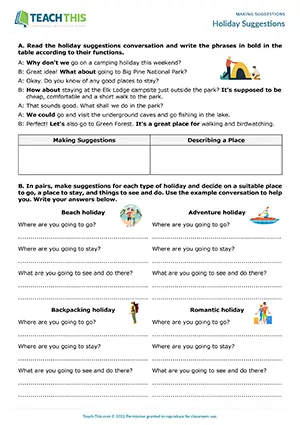
ESL Holiday Suggestions Activity - Speaking: Categorising, Asking and Answering Questions from Prompts, Guided Discussion, Communicative Practice - Pair and Group Work In this communicative holiday suggestions activity, students suggest suitable places to go on different types of holidays, including where to stay and things to see and do. Students begin by reading a holiday suggestions dialogue and categorising key phrases in bold according to their functions. In pairs, students then make suggestions for four types of holidays and decide on a suitable place to go, a place to stay, and things to see and do for each one. Finally, each pair discusses their holiday suggestions with another pair.

Let's Make Suggestions

Pre-intermediate (A2) 35 minutes
ESL making suggestions worksheet, vocabulary, reading, role-play, pair work, pre-intermediate A2

ESL Making Suggestions Worksheet - Vocabulary and Reading Exercises: Gap-Fill, Categorising - Speaking Activity: Role-Play, Freer Practice - Pair Work

In this handy suggestions worksheet, students practice various phrases to make, accept and reject suggestions. First, students look at pictures of eight birthday...

ESL Making Suggestions Worksheet - Vocabulary and Reading Exercises: Labelling, Gap-Fill, Categorising - Speaking Activity: Discussion, Role-Play, Freer Practice - Pair Work In this handy suggestions worksheet, students practice various phrases to make, accept and reject suggestions. First, students look at pictures of eight birthday presents and write the names of the presents below the pictures. Students then complete a dialogue where two children suggest presents for their dad's birthday with words and phrases from a box. Next, students identify and categorise the phrases used to make, accept and reject suggestions from the dialogue. After that, students answer questions about the dialogue and discuss their answers with a partner. In pairs, students then move on to use prompts, and the phrases from the worksheet to create a conversation where they make, accept and reject suggestions for a friend's birthday present. Finally, students present their conversations to the class.

Saturday Suggestions

Pre-intermediate (A2) 25 minutes
ESL making suggestions role-play, accepting and rejecting, Saturday activities, group decision, pre-intermediate A2

ESL Making Suggestions Role-Play - Speaking Activity: Asking and Answering Questions, Communicative Practice - Group Work

In this free making suggestions speaking activity, students role-play making, accepting and rejecting suggestions about things to do on a Saturday. Students...

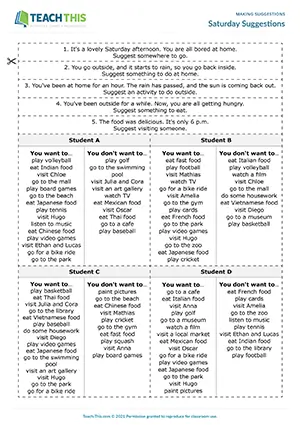
ESL Making Suggestions Role-Play - Speaking Activity: Asking and Answering Questions from Prompts, Communicative Practice - Group Work In this free making suggestions speaking activity, students role-play making, accepting and rejecting suggestions about things to do on a Saturday. Students imagine it's Saturday, and they are at home together feeling bored. The aim of the activity is to make suggestions on things to do until they find something they all agree on. In groups, students begin by turning over the first situation card and making appropriate suggestions according to the prompt. Students suggest, reject and accept suggestions based on the preferences on their role cards until they come up with something they all want to do. When the students have reached an agreement, they write the activity on the situation card and turn over the next card. The role-play continues until the students have completed all the situations and agreed on a suggestion for each one.

Smart Suggestions Showdown

Pre-intermediate (A2) 25 minutes
ESL making suggestions game, logical suggestions, using phrases, pair work, pre-intermediate A2 students

ESL Making Suggestions Game - Speaking: Forming Sentences, Guessing, Freer Practice - Pair Work

In this enjoyable making suggestions game, students practice making related suggestions for specific locations using 'Let's...', 'How about...?', and 'Why don't we...?' In pairs, students take turns...

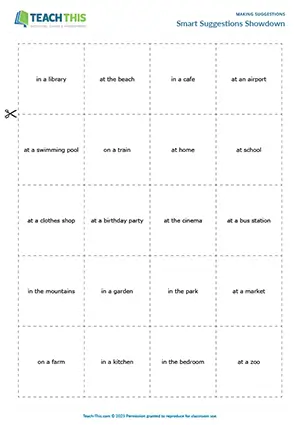
ESL Making Suggestions Game - Speaking: Forming Sentences from Prompts, Guessing, Freer Practice - Pair Work In this making suggestions game, students practice making related suggestions for specific locations using three phrases. In pairs, students take turns picking up a location card and making three related suggestions using 'Let's...', 'How about...?', and 'Why don't we....?' For example, if the location was a library, the student might say, 'Let's find a quiet place to study.' The other student listens and tries to guess the location after each suggestion. If the student guesses the location on the first try, they score three points. On the second try, they earn two points. On the third try, one point. If the student cannot name the location after three guesses, they score no points. The card is then removed from the game. After the round, if a student thinks their partner made an unsuitable suggestion, they can challenge them. If the speaker is found to have given an inappropriate suggestion, they lose one point from their total score. The student with the most points at the end of the game is the winner.

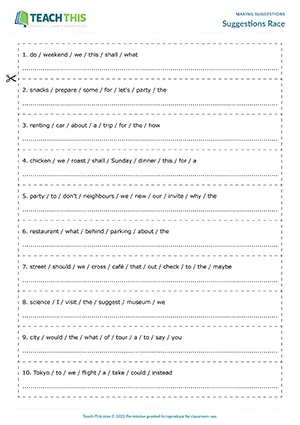
Suggestions Race

Pre-intermediate (A2) 25 minutes
ESL suggestions game, unscrambling, race, forming suggestions, pair work, pre-intermediate A2 students

ESL Making Suggestions Game - Grammar: Unscrambling - Pair Work

In this fun making suggestions game, students race to put words in the correct order to form suggestions about different things. There are ten suggestions in all and each suggestion uses a different phrase. One student from each pair comes to...

ESL Making Suggestions Game - Grammar: Unscrambling - Pair Work In this fun making suggestions game, students race to put words in the correct order to form suggestions about different things. There are ten suggestions in all and each suggestion uses a different phrase. One student from each pair comes to your desk, picks up the first suggestion strip, takes it back to their partner, and together they put the words in order to form a suggestion. Students write the suggestion on the strip, capitalizing the first word and adding in punctuation. When a pair has completed the suggestion, a student from the pair brings the strip back to you. If the suggestion is correct, the student takes the next strip and continues. If the suggestion is incorrect, the student takes the strip back to their partner to find and correct the mistake. The first pair to successfully complete all ten suggestion strips wins the game.

Turn Around

Pre-intermediate (A2) 25 minutes
ESL making, accepting and rejecting suggestions activity, communicative practice, card prompts, pre-intermediate A2 students

ESL Making, Accepting and Rejecting Suggestions Activity - Speaking: Asking and Answering Questions, Communicative Practice

In this productive making suggestions speaking activity, students make, accept and reject suggestions and give excuses using prompts on cards. Students...

ESL Making, Accepting and Rejecting Suggestions Activity - Speaking: Asking and Answering Questions from Prompts, Communicative Practice In this productive making suggestions speaking activity, students make, accept and reject suggestions and give excuses using prompts on cards. Students hold their cards so the picture prompt is facing towards them. Students then go around the class, making and accepting suggestions with as many different partners as possible using the picture prompts. Next, students exchange cards and repeat the activity, but this time, they hold their cards with the picture prompt facing away and make a different suggestion each time they speak to a classmate. Afterwards, students exchange cards again and write an excuse on the blank side of the card. Students hold their cards so that the picture prompt is facing away and the excuse is facing towards them and go around making and rejecting suggestions and giving excuses. Finally, students exchange cards one more time and go around the class with the excuse facing away, making the same suggestion several times but giving a different excuse each time.

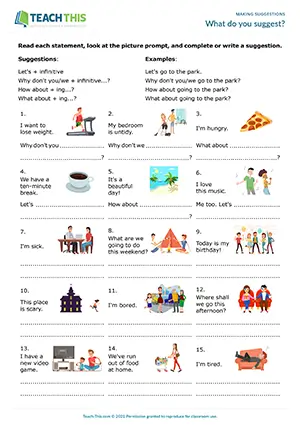
What do you suggest?

Pre-intermediate (A2) 20 minutes
ESL making suggestions worksheet, sentence completion, writing suggestions, pre-intermediate A2 students

ESL Making Suggestions Worksheet - Grammar and Writing Exercise: Sentence Completion, Writing Sentences

In this useful making suggestions worksheet, students practice phrases to make suggestions by completing and writing suggestions from prompts. Students read each statement on the...

ESL Making Suggestions Worksheet - Grammar and Writing Exercise: Sentence Completion, Writing Sentences In this useful making suggestions worksheet, students practice phrases to make suggestions by completing and writing suggestions from prompts. Students read each statement on the worksheet, look at a picture prompt and complete or write a suggestion. For prompts 1 to 6, students complete the suggestion. For prompts 7 to 14, students write a suggestion using one of four phrases.

Why don't we go on holiday?

Pre-intermediate (A2) 30 minutes
ESL suggesting worksheet, gap-fill, categorising, holiday ideas, pre-intermediate A2 students

ESL Suggesting Worksheet - Vocabulary Exercises: Gap-Fill, Categorising - Speaking Activity: Asking and Answering Questions, Freer Practice

This comprehensive making suggestions worksheet helps students learn how to make, accept and reject suggestions related to holidays. First, students...

ESL Suggesting Worksheet - Vocabulary Exercises: Gap-Fill, Categorising - Speaking Activity: Asking and Answering Questions, Freer Practice This comprehensive making suggestions worksheet helps students learn how to make, accept and reject suggestions related to holidays. First, students read how to make suggestions followed by an infinitive, a verb in the -ing form and a noun. Students then complete suggestions with the correct form of the verb in brackets. Next, students read phrases to accept and reject suggestions and categorize them accordingly. After that, students complete a suggestions dialogue with words from a box. Students then move on to suggest going on holiday to their classmates using places in a table, e.g. 'Why don't we go to Hawaii?' When a classmate agrees, the two students write down each other's name and suggest an activity to do together, writing the activity in the table. Students then move on to speak to someone else. Afterwards, students give feedback to the class on their holiday plans.

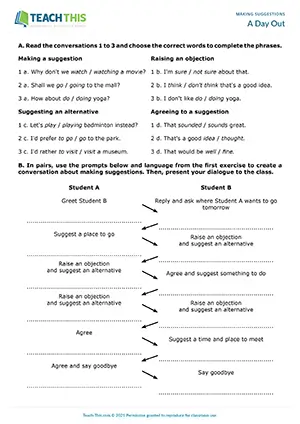
A Day Out

Intermediate (B1) 25 minutes
ESL making suggestions role-play, raising objections, suggesting alternatives, intermediate B1 students

ESL Making Suggestions Role-Play - Speaking Activity: Binary Choice, Role-Play, Writing and Presenting a Dialogue - Pair Work

Here is a rewarding making suggestions role-play to help students practice phrases for suggesting, raising objections, suggesting alternatives and accepting...

ESL Making Suggestions Role-Play - Speaking Activity: Binary Choice, Role-Play, Writing and Presenting a Dialogue - Pair Work Here is a rewarding making suggestions role-play to help students practice phrases for suggesting, raising objections, suggesting alternatives and accepting suggestions. First, students read three short dialogues and choose the correct words to complete the phrases in the conversations. Each dialogue consists of phrases for making suggestions, raising objections, suggesting alternatives and accepting suggestions. Next, in pairs, students create a dialogue where they suggest where to go and what to do tomorrow using the phrases and a set of prompts. Finally, pairs role-play their dialogues to the class.

Can I make a suggestion?

Intermediate (B1) 30 minutes
ESL suggestions worksheet, identifying, matching, discussions, pair and group work, intermediate B1 students

ESL Suggestions Worksheet - Vocabulary Exercises: Matching - Speaking Activity: Asking and Answering Questions, Discussions - Pair and Group Work

In this free making suggestions worksheet, students practice making, accepting and rejecting suggestions using various phrases. Students begin by identifying...

ESL Suggestions Worksheet - Vocabulary Exercises: Identifying, Matching - Speaking Activity: Asking and Answering Questions, Discussions - Pair and Group Work In this free making suggestions worksheet, students practice making, accepting and rejecting suggestions using various phrases. Students begin by identifying phrases to make suggestions in sentences. Students then match sentence halves to form responses that accept or reject suggestions. Next, students write six suggestions using the phrases from Exercise A. After that, students take turns making suggestions to a partner, who accepts and rejects the suggestions using the responses. In small groups, students then discuss everyday problems and make suggestions. Students accept or reject ideas as needed and decide on the best solution for each issue. Finally, students share their decisions with the class, explaining their reasoning.

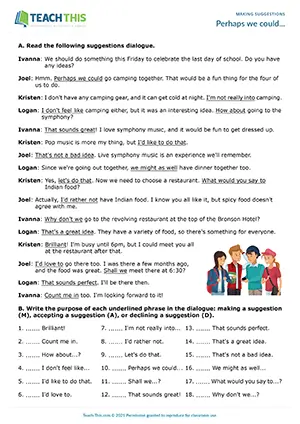
Perhaps we could...

Intermediate (B1) 30 minutes
ESL suggestions worksheet, identifying and categorising, writing questions, intermediate B1 students

ESL Suggestions Worksheet - Vocabulary Exercises: Categorising, Writing Questions - Speaking Activity: Asking and Answering Questions - Pair Work

In this detailed making suggestions worksheet, students learn and practice a variety of phrases for making, accepting and declining suggestions...

ESL Suggestions Worksheet - Vocabulary Exercises: Identifying, Categorising, Writing Questions - Speaking Activity: Asking and Answering Questions - Pair Work In this detailed making suggestions worksheet, students learn and practice a variety of phrases for making, accepting and declining suggestions. Students start by reading a suggestions dialogue and identifying phrases for making a suggestion, accepting a suggestion and declining a suggestion. Students then tick phrases that are not appropriate responses to suggestions. Next, students underline all the phrases for making suggestions in Exercise C. After that, students write their own suggestions using a different phrase and activity each time. Finally, in pairs, students take turns suggesting their ideas to a partner, who responds with accepting or declining phrases from the worksheet.

Suggestions and Solutions

Intermediate (B1) 35 minutes
ESL suggesting activity, writing sentences, guided discussions, group work, intermediate B1 students

ESL Suggesting Activity - Speaking: Writing Sentences, Discussions, Communicative Practice - Group Work

In this engaging making suggestions speaking activity, students suggest solutions to problems and then work together to reach an agreement on the best solution for each one. First, students come up with...

ESL Suggesting Activity - Speaking: Writing Sentences, Guided Discussions, Communicative Practice - Group Work In this engaging making suggestions speaking activity, students suggest solutions to problems and then work together to reach an agreement on the best solution for each one. First, students come up with one or two suggestions to deal with each problem and write them on the worksheet. In groups, students then discuss each problem in turn, give their suggestions and try to reach an agreement on the best solution for each one. Finally, groups share their solutions with the class, who decides on the best one for each problem.

What shall we do?

Intermediate (B1) 30 minutes
ESL making suggestion activities, gap-fill, role-play, pair work, intermediate B1 students

ESL Making Suggestion Activities - Vocabulary Exercise: Gap-fill - Speaking Activity: Asking and Answering Questions, Communicative Practice - Pair Work

In these enjoyable making suggestions activities, students make, accept and reject suggestions for different scenarios. First, students complete two...

ESL Making Suggestion Activities - Vocabulary Exercise: Gap-fill - Speaking Activity: Role-play, Asking and Answering Questions from Prompts, Communicative Practice - Pair Work In these enjoyable making suggestions activities, students make, accept and reject suggestions for different scenarios. First, students complete two dialogues with words and phrases to make, accept and reject suggestions from boxes. Next, in pairs, students read the dialogues with their partner to compare answers. After that, pairs use the phrases from the dialogues to role-play different scenarios on cards where they make, accept and reject suggestions. Students turn over a card and role-play a conversation where they make, accept and reject suggestions and try to come up with a plan of things to do based on the topic on the card. When the students have finished, they turn over the next card, and so on. Finally, pairs role-play one of their dialogues in front of the class.

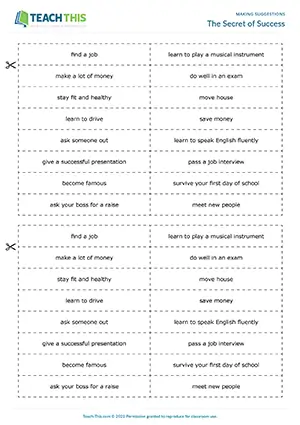
The Secret of Success

Upper-intermediate (B2) 30 minutes
ESL making suggestions activity, guided discussions, group work, upper-intermediate B2 students

ESL Making Suggestions Activity - Speaking: Discussions, Communicative Practice - Group Work

In this imaginative making suggestions speaking activity, students suggest the best way to do different things. In groups, students take turns picking up a topic card and asking, 'What's the best way to...

ESL Making Suggestions Activity - Speaking: Guided Discussions, Communicative Practice - Group Work In this imaginative making suggestions speaking activity, students suggest the best way to do different things. In groups, students take turns picking up a topic card and asking, 'What's the best way to (topic)?', e.g. 'What's the best way to find a job?' Next, each group member suggests the best way to do the thing on the card. Students then discuss the topic and come to an agreement on the best suggestion, writing the idea on the back of the card. This continues until all the cards have been used. Afterwards, the class discusses the best suggestions for each topic.

Using Suggestion Phrases

Making suggestions in English relies on a set of fixed phrases, each with its own grammar rule: 'Let's' and 'Shall we' take a bare infinitive, while 'How about' and 'What about' require the -ing form or a noun. Learners who mix these up, saying 'How about to go?' instead of 'How about going?', produce errors that native speakers notice immediately, which undermines the learner's confidence in real conversations.

This page covers making suggestions across A1-A2, A2, B1, and B2 levels, with 15 resources including games, speaking activities, worksheets, and role-plays, with two available as free downloads.

The table below maps the most common functions in a making suggestions conversation to their typical phrases and example sentences.

FunctionPhrase PatternExample
Making a suggestion Let's + bare infinitive 'Let's go to the cinema.'
Making a suggestion Shall we + bare infinitive 'Shall we take a taxi?'
Making a suggestion Why don't we + bare infinitive 'Why don't we order pizza?'
Making a suggestion How about + -ing/noun 'How about going for a walk?'
Making a suggestion What about + -ing/noun 'What about trying that new café?'
Making a suggestion We could + bare infinitive 'We could check the timetable first.'
Accepting a suggestion That sounds great / Good idea 'That sounds great. Let's do it.'
Accepting a suggestion I'd love to / Yes, let's 'Yes, let's. I'd love to see that film.'
Rejecting a suggestion I'd rather not / I don't feel like it 'I'd rather not. How about staying in?'
Rejecting a suggestion That's not really my thing 'That's not really my thing. What about somewhere closer?'

When to Use Suggestion Phrases

Planning activities with others: When two or more people are deciding what to do together, suggestions let each person contribute ideas without imposing them, keeping the conversation collaborative rather than directive, as in 'Why don't we meet at the station and take the train there?'

Offering solutions considerately: When someone mentions a problem, responding with a suggestion rather than a direct instruction softens the advice and respects the other person's autonomy, as in 'You could try calling them directly instead.'

Keeping negotiations moving: When a suggestion gets turned down, following the rejection immediately with an alternative keeps the conversation going and signals willingness to compromise, as in 'OK, if you don't fancy that, how about going somewhere closer?'

3-Step Framework for Teaching Suggestion Phrases

1. Build Accuracy with Controlled Practice: Start students off with a dice-based matching game where they roll to land on a suggestion phrase, then pick up a situation card and a suggestion card and build a sentence pair using that phrase, for example 'I am hungry. Let's go for a meal.' This ties the phrase directly to a real-world context and gives learners immediate feedback on whether their sentence structure is correct before they move into freer practice.

2. Push Fluency with a Production Game: Once learners have the core phrases under control, move them into a location-guessing game where one student uses 'Let's...', 'How about...?', and 'Why don't we...?' to describe a specific place, for example suggesting 'Let's find a quiet place to study', while their partner tries to name the location. Scoring decreases with each guess, so there is real communicative pressure to make suggestions that are both accurate and contextually logical.

3. Develop Real-World Discussion Skills: Round off the sequence with a problem-solving discussion where learners first write one or two suggestions to deal with each problem individually, then share and debate them in groups to reach an agreement on the best solution. This mirrors the real communicative demand of suggestion-making: learners must not just propose ideas but also listen, evaluate, and negotiate together.

Common Mistakes with Suggestion Phrases

Matching the wrong phrase to the level of formality: Students often use informal suggestion phrases like 'Let's' and 'How about' in professional or semiformal situations where a softer, more tentative phrase is expected, which can make them come across as pushy or presumptuous to a colleague or manager. Wrong: 'Let's move the meeting to Thursday.' Correct: 'I was wondering if we could move the meeting to Thursday?' or 'Perhaps we could move the meeting to Thursday?'

Using 'suggest' with a 'to' infinitive: Students often write 'I suggest you to...' by analogy with verbs like 'advise' and 'encourage', not realising that 'suggest' cannot take a 'to' infinitive and instead requires either a gerund or a 'that' clause. Wrong: 'I suggest you to try the pasta.' Correct: 'I suggest trying the pasta.' or 'I suggest that you try the pasta.'

Common Questions About Teaching Suggestion Phrases

What is a fun game for practicing making suggestions?

In the game Suggestions Race, students race in pairs to unscramble ten jumbled suggestion sentences, each using a different phrase. One student runs to collect the strip, both students write the correct sentence, then one runs back for checking. If it is wrong, they take it back and fix it. The first pair to finish all ten wins.

What is a useful worksheet for teaching making suggestions?

The free worksheet Can I make a suggestion? takes students from controlled exercises into real discussion. They identify suggestion phrases and match sentence halves to form accepting and rejecting responses, then move into a group discussion where they tackle everyday problems, accept or reject each other's ideas, and agree on the best solution before reporting back to the class.

What is an engaging activity for practicing making suggestions?

Students in the activity The Secret of Success take turns picking a card and asking the group 'What's the best way to (topic)?', for example 'What's the best way to find a job?' Each student suggests an answer, the group debates, and they write the agreed best suggestion on the card before moving to the next.

Become a Teach This Member

Get unlimited access to the full library, plus new resources added every week.

Unlimited Resource Access

Download from 3000+ worksheets, activities, and games.

Save 5+ Hours Weekly

Cut lesson prep time with ready-to-use resources, plus teacher notes and answer keys.

Trusted Professional Quality

Classroom-tested, editable resources created by experienced ESL professionals.

Fresh Content Weekly

Get 5 new resources added to the library each week.

Join Now Just $29.99 quarterly