
Past Simple vs. Past Perfect ESL Activities & Worksheets
Cause and Effect Dominoes
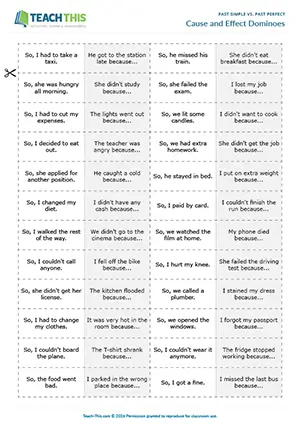
ESL Past Simple vs. Past Perfect Game - Grammar: Forming Sentences, Matching - Group Work
In this productive past simple vs. past perfect game, students play dominoes by matching problems with their effects and creating logical cause-and-effect sentences. The first player places a domino down...
Double-Past Detective
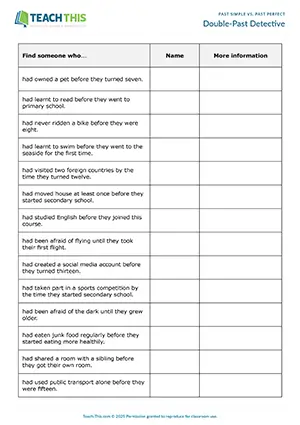
ESL Past Simple vs. Past Perfect Activity - Speaking: Asking and Answering Questions, Controlled and Freer Practice
In this engaging past simple vs. past perfect activity, students ask 'Had you...?' questions about earlier and later past events, and then ask past simple follow-up questions to find out more information...
Past Simple or Past Perfect?
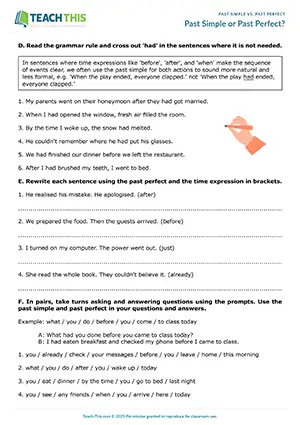
ESL Past Simple vs. Past Perfect Worksheet - Grammar Exercises: Binary Choice, Matching - Speaking Activity: Asking and Answering, Freer Practice - Pair Work
In this comprehensive past simple vs. past perfect worksheet, students practice using the past simple and the past perfect with time words and expressions to...
Timeline Detectives

ESL Past Simple vs. Past Perfect Activity - Grammar and Speaking: Guessing, Asking and Answering Questions, Labelling, Describing, Freer Practice - Pair Work
In this challenging past simple vs. past perfect activity, students practice ordering past events on timelines by asking and answering questions in the past simple...
When Everything Went Wrong
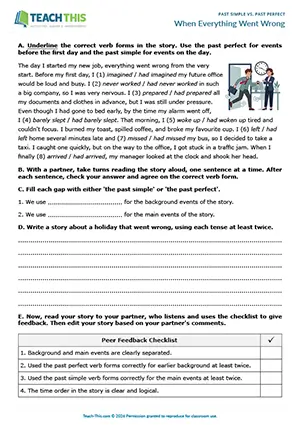
ESL Past Simple vs. Past Perfect Activity - Grammar and Writing: Binary Choice, Gap-fill, Writing Stories, Peer Review, Freer Practice - Pair Work
In this rewarding past simple vs. past perfect activity, students practice using the past perfect for background events and the past simple for the main sequence...
No Time Marker Game
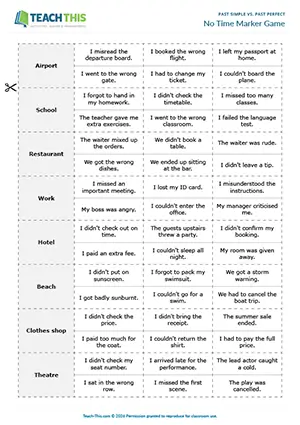
ESL Past Simple vs. Past Perfect Game - Grammar and Speaking: Matching, Forming Sentences, Controlled Practice - Group Work
In this productive past simple vs. past perfect game, students practice matching events to locations and combining two past simple sentences into one sentence using the past perfect to show which event...
Past Perfect Travel Disasters
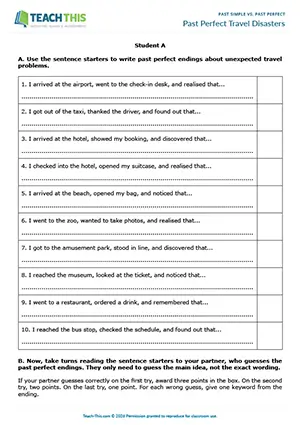
ESL Past Simple vs. Past Perfect Game - Grammar: Forming Sentences, Guessing, Controlled Practice - Group and Pair Work
In this useful past simple vs. past perfect game, students complete sentence starters with past perfect endings about unexpected travel problems and then guess their partner’s endings. First, in two groups...
Story Fix Challenge
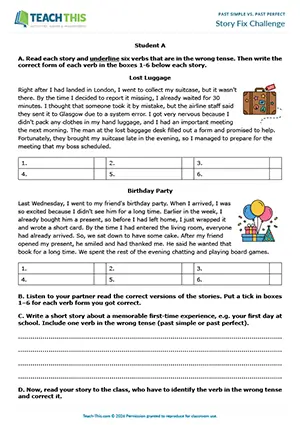
ESL Past Simple vs. Past Perfect Activity - Grammar, Reading and Writing: Identifying, Error Correction, Writing Short Stories - Group and Pair Work
In this free past simple vs. past perfect activity, students improve tense choices in short stories, compare their answers with a partner, and then write and...
Understanding the Past Simple vs. Past Perfect
The past simple describes a completed action in the past, as in 'She left the office.' The past perfect describes an action that was already completed before another past action happened, as in 'She had already left when I arrived.' When students use the past simple for both events in a sequence, they lose the ability to signal which happened first, which can leave a reader genuinely uncertain about the order of events.
This page covers past simple vs. past perfect across B1 and B2 levels, with eight activities and worksheets ranging from grammar exercises and timeline tasks to story writing and card games, with one activity available as a free download.
The table below contrasts the past simple and past perfect across their forms, main uses, time signals, and how each tense handles the sequence of two past events.
| Aspect | Past Simple | Past Perfect |
|---|---|---|
| Form | subject + past verb (regular: add -ed; irregular: use learned form) | subject + had + past participle |
| Main Use | completed action at a specific past time | action completed before another past action |
| In a Sequence | the later of two past events | the earlier of two past events |
| With 'before' | the event that followed | the event that came first: 'She had finished before he arrived.' |
| With 'after' | the event that followed: 'After she had left, he arrived.' | the earlier completed action |
| With 'by the time' | the later event: 'By the time I arrived...' | the already completed action: '...she had gone.' |
| Common Time Signals | yesterday, last week, in 2010, ago, at 6 p.m. | already, just, never, by the time, before, after |
| Omitting 'had' | N/A | Possible when context makes the sequence clear: 'After she left, I arrived.' |
| Single Example | 'She missed the train.' | 'She had already bought her ticket.' |
| Combined Example | '...when he called.' | 'She had just left the office...' |
When to Use the Past Simple vs. Past Perfect
Reporting News with Background Context: When you share news of an event and want to explain what led up to it, the past perfect provides the background without needing to retell the full story, the way a journalist might write 'The team won the final. They had not lost a match all season.'
Expressing Regret About a Missed Opportunity: When you want to convey that something was not done in time for another event to go differently, the past perfect makes the missed chance clear, as in 'I arrived at the cinema late. The film had already started.'
Establishing What Had Already Happened: When you need to prove or explain that one action was complete before a specific point in time, the past perfect makes the order of events unambiguous, the way a witness might say 'By the time the argument started, I had already left the building.'
3-Step Framework for Teaching the Past Simple vs. Past Perfect
1. Build the Contrast: Open with a worksheet that takes students from recognition to production in a single session. A well-structured approach starts with matching sentence halves and choosing the correct tense in each, then moves to gap-fill with both forms, and builds to the most challenging exercise: taking two separate past simple sentences and rewriting them as one, using the past perfect to show which event happened first. The worksheet also covers a practical rule about when 'had' can be left out, testing it by asking students to cross it out wherever it can be omitted without changing the meaning.
2. Write the Story: Once students understand the contrast on paper, move them into extended writing. Give them the frame of a holiday that went wrong and ask them to use the past perfect for any background events that happened before the main story began, and the past simple to carry the main sequence of events forward. When students finish, they read their story aloud to a partner, who follows along and uses a checklist to give structured feedback. Students then edit their draft based on those comments, turning the activity into a genuine two-stage writing task.
3. Domino Chain: Close with a domino game that demands both accuracy and reasoning under social pressure. Students build a chain by matching a problem on one domino with its effect on another, but each match only holds if the player can also complete a because-clause in the past perfect to explain what caused the problem, for example 'He got to the station late because he had overslept.' The rest of the group votes on whether the sentence is both grammatically correct and logically appropriate before the domino stays in place.
Common Mistakes with the Past Simple vs. Past Perfect
'Had' Followed by the Base Verb Instead of the Past Participle: Students often know they need 'had' to form the past perfect but use the base form of the verb rather than the past participle, treating 'had' the same way they treat 'did' in past simple questions. Wrong: 'She had go to the shops before he called.' Correct: 'She had gone to the shops before he called.'
Overusing the Past Perfect After Clear Time Markers: Students often use the past perfect in both clauses of a sentence even when a time marker like 'after' already makes the sequence clear, producing an unnecessarily heavy structure. Wrong: 'After she had left, I had arrived.' Correct: 'After she had left, I arrived.'
Common Questions About Teaching the Past Simple vs. Past Perfect
What is a good speaking activity for the past simple and past perfect?
A good speaking activity for the past simple and past perfect puts both tenses into one exchange. In the Double-Past Detective activity, students mingle asking 'Had you...?' questions such as 'Had you owned a pet before you turned seven?' When a classmate answers 'Yes, I had', the student notes their name and asks a past simple follow-up for more detail.
What is a useful worksheet for practicing past simple and past perfect?
The worksheet Past Simple or Past Perfect? builds both tenses in a single session. Students start by matching sentence halves and selecting the correct tense, move to gap-fill with both forms, and finish by rewriting pairs of past simple sentences as one using the past perfect. A final speaking section gives them freer practice with prompts.
What is an engaging game for practicing the past simple and past perfect?
An engaging game for the past simple and past perfect gets students matching location cards to event cards, then combining both events into one sentence using the past perfect, for example 'I went to the wrong gate because I had misread the departure board', with 'before', 'after', and 'when' all banned.
Become a Teach This Member
Get unlimited access to the full library, plus new resources added every week.
Unlimited Resource Access
Download from 3000+ worksheets, activities, and games.
Save 5+ Hours Weekly
Cut lesson prep time with ready-to-use resources, plus teacher notes and answer keys.
Trusted Professional Quality
Classroom-tested, editable resources created by experienced ESL professionals.
Fresh Content Weekly
Get 5 new resources added to the library each week.
Here's what our members are saying...


