
Singular & Plural Nouns ESL Games, Activities & Worksheets
Make it Plural

ESL Singular and Plural Nouns Game - Vocabulary: Matching, Spelling - Group Work
In this enjoyable singular and plural nouns game, students test their memory and collect matching cards by saying and spelling plural nouns. In groups, students take turns turning over one word card and one...
Singular to Plural Crossword
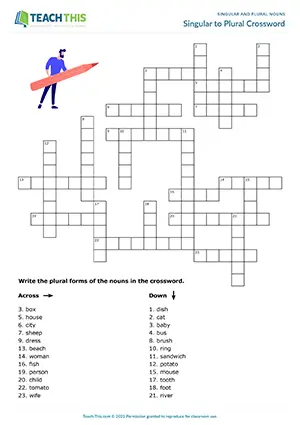
ESL Singular and Plural Nouns Crossword - Vocabulary Activity: Crossword, Changing Word Forms, Spelling
In this free singular and plural nouns activity, students complete a crossword by changing singular nouns into regular and irregular plural forms. Working alone, students read the singular noun for each clue...
Singular or Plural?
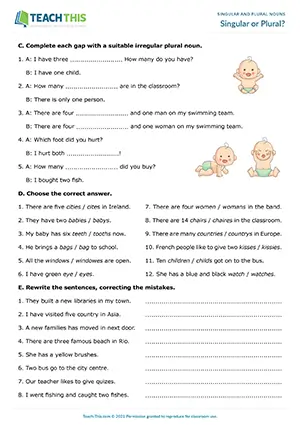
ESL Singular and Plural Nouns Worksheet - Grammar and Vocabulary Exercises: Word Forms, Gap-fill, Error Correction, Sentence Transformation, Picture Prompts
In this useful singular and plural nouns worksheet, students build from spelling plural forms to checking sentences and describing pictures. Students begin by...
What do you see?

ESL Singular and Plural Nouns Board Game - Vocabulary: Forming Sentences, Spelling - Group Work
In this engaging singular and plural nouns board game, students race to reach the finish by describing pictures and spelling plural nouns correctly. In groups, students take turns rolling the dice and...
Perplexing Plurals

ESL Singular and Plural Nouns Activity - Vocabulary and Grammar: Gap-fill, Spelling, Guessing - Pair Work
In this entertaining singular and plural nouns activity, students take part in a quiz where they complete fun facts with plural nouns and numbers. In pairs, students choose a suitable noun to complete each fact...
Singular and Plural Nouns Practice

ESL Singular and Plural Nouns Worksheet - Grammar Exercises: Matching, Changing Word Forms, Identifying, Error Correction, Gap-fill
Here is a productive singular and plural nouns worksheet for pre-intermediate students. Students start by matching sentence halves together to form grammar...
Singular to Plural

ESL Singular to Plural Game - Vocabulary and Grammar: Matching, Forming Sentences, Freer Practice - Group Work
In this useful singular nouns and plural nouns game, students match singular nouns with their correct plural endings and forms. In groups, students take it in turns to turn over two cards. If a student turns...
Singular vs. Plural
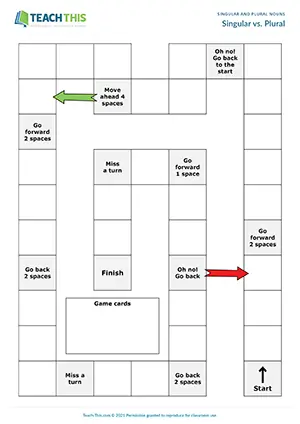
ESL Singular and Plural Nouns Board Game - Vocabulary: Changing Word Forms, Spelling - Group Work
Here is an engaging singular and plural nouns board game to help students practice or revise the two noun forms and their spelling. The game cards are numbered from 1 to 6 and are used instead of a dice...
Understanding Singular and Plural Nouns
Singular nouns usually refer to one person, animal, place or thing, while plural nouns refer to more than one. Most countable nouns form their plural by adding -s or -es, but some change spelling, such as 'baby' becoming 'babies', have irregular forms, such as 'child' becoming 'children', or stay unchanged, such as 'sheep'.
Writing 'childs' instead of 'children,' or 'mouses' instead of 'mice,' signals to a reader that the writer has not yet consolidated these forms, and the error becomes more noticeable as students move toward higher proficiency levels where writing accuracy is expected. This page offers eight ESL resources for practicing singular and plural nouns across A1-A2, A2, and B2 levels, with one free download available.
The table below shows the main spelling rules for forming plural nouns in English.
| Rule | Applies To | Singular | Plural |
|---|---|---|---|
| Add -s | Most nouns | dog | dogs |
| Add -es | Nouns ending in -ch, -sh, -x, -s, -z | match, brush, box | matches, brushes, boxes |
| Change -y to -ies | Nouns ending in consonant + y | city, baby | cities, babies |
| Change -f or -fe to -ves | Some nouns ending in -f or -fe | leaf, knife | leaves, knives |
| Vowel change | Common irregular nouns | man, woman, tooth, foot, mouse | men, women, teeth, feet, mice |
| Different word form | Common irregular nouns | child, person, ox | children, people, oxen |
| Same singular and plural form | Certain animal and object nouns | sheep, deer, fish, aircraft | sheep, deer, fish, aircraft |
| No plural form | Uncountable nouns | information, advice, furniture | (no plural) |
When to Use Singular and Plural Nouns
Getting Subject-Verb Agreement Right: Check subject-verb agreement when changing a subject noun from singular to plural. For example, 'The child runs to school' becomes 'The children run to school', and 'The child is here' becomes 'The children are here'. Some verb forms stay the same: 'The child played outside' becomes 'The children played outside'.
Referring to Items with Plural Nouns: Words such as 'scissors', 'trousers' and 'glasses' (meaning spectacles) normally take plural verbs when referring to these items: 'The scissors are on the table.' To refer to one complete item, use 'a pair of' with a singular verb: 'A pair of scissors is on the table.' Use 'two pairs of scissors' to count two complete items.
Nouns That End in -s but Take a Singular Verb: An -s ending does not always indicate a plural noun. 'News' is uncountable and takes a singular verb: 'The news is on at six.' Names of academic subjects, such as 'mathematics', 'economics' and 'linguistics', also take singular verbs when referring to fields of study: 'Mathematics is her strongest subject.' Teach students to consider meaning rather than the final letter alone.
3-Step Framework for Teaching Singular and Plural Nouns
1. Build the Rule Map First: Start with a structured written task where students write four plural forms in each of four groups: -s, -es, -ies and irregular plurals. Students then complete ten sentences with singular or plural nouns and change six plural nouns back to singular. Next, they check sentences and correct noun errors, change singular sentences into plural sentences using a model and given numbers, and write picture-based sentences with 'There is' or 'There are'. This progression moves from forming individual words to using singular and plural nouns in context.
2. Match the Ending, Make a Sentence: Once students can categorize and apply spelling rules, move them into a game format where the stakes are low but production is required. In groups, students take turns turning over two cards. When a student matches a singular noun card with the correct plural ending or form card, the student scores a point and earns an extra point by making a sentence with the plural noun. If the cards do not match, the student turns them back over. Reviewing the correct plural endings and their pronunciation with the whole class at the end of the game consolidates any forms that caused hesitation.
3. Describe Pictures and Check Spelling: Move from matching written forms to describing pictures. Students roll the dice, pick up a picture card and make a sentence using its number and plural noun, such as 'I see two dogs.' They then spell the plural noun. The group checks both before the player moves forward. This brings sentence formation and spelling together without supplying the written noun.
Common Mistakes with Singular and Plural Nouns
Applying a Regular Rule to an Irregular Noun: Students often add -s or -es to nouns that have their own irregular plural forms, producing errors like 'tooths' or 'foots' instead of the correct irregular form. Wrong: 'She has two tooths.' Correct: 'She has two teeth.'
Adding a Plural Ending to an Uncountable Noun: Students often add -s to uncountable nouns like 'information,' 'advice,' and 'furniture,' treating them as countable when they have no plural form. Wrong: 'Can you give me some informations?' Correct: 'Can you give me some information?'
Common Questions About Teaching Singular and Plural Nouns
What is an engaging activity for practicing plural nouns?
The activity Perplexing Plurals turns plural noun practice into a quiz where students complete fun facts with plural nouns and then guess the real-world number that belongs with each fact. The quiz format and the guessing element make it genuinely engaging, and pairs score one point per correct plural and one point per correct number.
What is a good worksheet for teaching singular and plural nouns?
A logical sequence of seven exercises makes the worksheet Singular and Plural Nouns Practice a good choice for teaching plural nouns. Students move from matching grammar rules and changing word forms to identifying errors and completing sentences, seeing the same structures from different angles each time, which builds both accuracy and confidence.
What is a fun game for teaching plural nouns?
For teaching plural nouns, the game Make it Plural is a fun choice because every match requires both the correct form and correct spelling. Players turn over one word card and one picture card, say the plural aloud when they match a singular noun with its plural picture, and spell it correctly to keep the cards. Only accurate production scores.
Become a Teach This Member
Get unlimited access to the full library, plus new resources added every week.
Unlimited Resource Access
Download from 3000+ worksheets, activities, and games.
Save 5+ Hours Weekly
Cut lesson prep time with ready-to-use resources, plus teacher notes and answer keys.
Trusted Professional Quality
Classroom-tested, editable resources created by experienced ESL professionals.
Fresh Content Weekly
Get 5 new resources added to the library each week.
Here's what our members are saying...


