
Adverb Order ESL Activities, Games & Worksheets
Adverb Order Practice
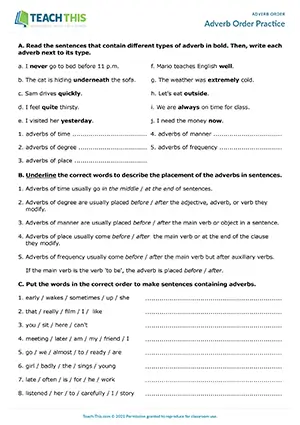
ESL Adverb Order Worksheet - Vocabulary and Grammar Exercises: Matching, Binary Choice, Unscrambling, Gap-fill, Rewriting Sentences
This productive adverb order worksheet helps students learn and practice the placement of five different types of adverbs in sentences. To begin, students read...
Is the order right?
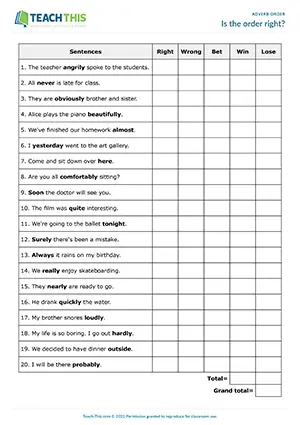
ESL Adverb Order Game - Vocabulary and Grammar: Error Correction, Betting
In this useful adverb order error correction activity, students find and correct mistakes in the placement of adverbs in sentences. First, students read sentences on the worksheet, some of which contain errors in adverb order. If a student thinks...
Adverb Order Race
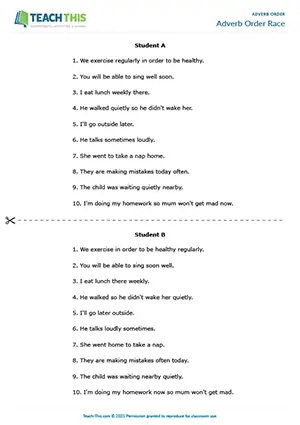
ESL Adverb Order Activity - Vocabulary and Speaking: Running Dictation, Identifying, Labelling, Ordering - Pair Work
Here is a free adverb order running dictation activity to help students practice types of adverbs and their order in sentences. In pairs, students take it in turns to run to their sentences A or B, read the...
Plans for the Summer
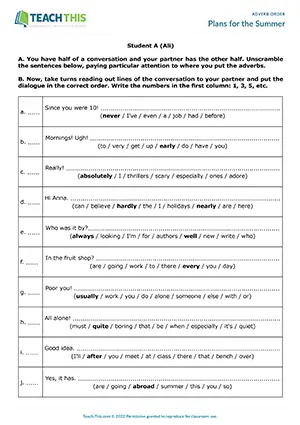
ESL Adverb Order Activity - Vocabulary, Grammar and Speaking: Unscrambling, Ordering a Dialogue - Pair work
Here is an engaging adverb order activity for upper-intermediate students. Working alone, students put words in each line of a dialogue in the correct order to create sentences, paying attention to where...
Understanding Adverb Order
Adverb order is the rule that different types of adverbs follow a set sequence in a sentence, with manner typically coming before place, and place before time. When students ignore this sequence, even a perfectly chosen adverb ends up in the wrong slot, making sentences sound unnatural to a reader, as in 'She went quickly to the park yesterday' versus 'She went to the park quickly yesterday.'
This page covers adverb order at B1 and B2 levels with four resources including a worksheet, a game, and two activities, with one available as a free download.
The table below shows the five main adverb types, their typical position in a sentence, what they describe, and an example of each.
| Adverb Type | Typical Position | What It Describes | Example |
|---|---|---|---|
| Manner | After the verb or its object | How an action is done | 'She spoke quietly.' |
| Place | After manner adverbs, before time | Where an action happens | 'She spoke quietly in the meeting room.' |
| Time | At the end of the sentence (or moved to the front for emphasis) | When an action happens | 'She spoke quietly in the meeting room yesterday.' |
| Frequency | Before the main verb; after the verb 'be' | How often something happens | 'She always arrives on time.' / 'He is rarely late.' |
| Purpose | After the main verb phrase | Why an action is done | 'She stayed late to finish the report.' |
When to Use Adverb Order
Fronting for Emphasis: A writer moves a time adverb to the start of a sentence to signal that the timing is the most important piece of information, as in 'Yesterday, the company announced record profits.'
Frequency Adverbs in Formal Tone: Placing a frequency adverb before the main verb lets a writer express how common or rare something is without overstating a claim, as in 'The committee rarely overturns a previous decision.'
Purpose Adverbs for Professional Clarity: Adding a purpose adverb after the verb phrase tells the reader exactly why an action was taken, making instructions and explanations feel direct and logical, as in 'She sent the draft early to allow time for revisions.'
3-Step Framework for Teaching Adverb Order
1. Build the Map: Before students can arrange adverbs in the right sequence, they need to know what type each adverb is. A worksheet that moves from matching adverbs to their type through binary-choice sentence decisions and on to a final rewriting task, where students add an adverb from a set of choices in a suitable position, takes students from recognition all the way through to producing their own correctly ordered sentences.
2. Pressure-Test the Rule: Once students have a working sense of the five adverb types, sharpen their judgment with an error-correction game. Students read a set of sentences, decide whether the adverb order is correct or incorrect, and then bet between 10 and 100 points on each decision based on how confident they feel. The betting mechanic forces students to commit to a real judgment rather than guess passively, which makes the correction discussion far more memorable.
3. Move and Consolidate: Bring the learning to life with a running dictation that gets students physically moving. Pairs take turns sprinting to a set of sentences, memorizing one, returning, and saying it to their partner, who records it. Once all sentences are complete, students find the two adverbs in each sentence and write them in a table, labeling them as adverbs of time, place, purpose, manner, or frequency, which locks in the terminology students need to talk about adverb order with confidence.
Common Mistakes with Adverb Order
Time Before Place: Students often place the time adverb directly after the verb, putting it before the place adverb and reversing the expected place-then-time sequence. Wrong: 'She worked yesterday in the office.' Correct: 'She worked in the office yesterday.'
Manner Adverb Between Verb and Object: Students often insert a manner adverb between the main verb and its direct object, splitting them awkwardly instead of placing the adverb after the full verb phrase. Wrong: 'She wrote carefully the report.' Correct: 'She wrote the report carefully.'
Common Questions About Teaching Adverb Order
What is an engaging speaking activity for adverb order?
In the activity Adverb Order Race, pairs take turns running to a set of sentences, memorizing one, and dictating it to their partner. Once all sentences are complete, students find the two adverbs in each and label them by type before writing the five adverb types in the order they typically appear in sentences. It is available as a free download.
What is a good game for teaching adverb order?
The game Is the Order Right? has students read sentences, decide whether the adverb order is correct or incorrect, and bet between 10 and 100 points on each answer based on how confident they feel. Points are won or lost in a whole-class review, making the correction far more memorable than a standard exercise.
Become a Teach This Member
Get unlimited access to the full library, plus new resources added every week.
Unlimited Resource Access
Download from 3000+ worksheets, activities, and games.
Save 5+ Hours Weekly
Cut lesson prep time with ready-to-use resources, plus teacher notes and answer keys.
Trusted Professional Quality
Classroom-tested, editable resources created by experienced ESL professionals.
Fresh Content Weekly
Get 5 new resources added to the library each week.
Here's what our members are saying...


