
Summarising Sources EAP Worksheets, Games & Activities
One-Sentence Summaries
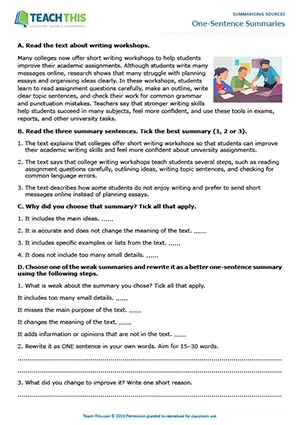
EAP Summarising Worksheet - Reading and Writing Exercises: Identifying, Summarising, Peer Review - Pair Work
In this productive summarising worksheet, students choose the best one-sentence summary, improve weak summaries, and write a one-sentence summary of a short academic text. First, students read...
Signals and Summaries
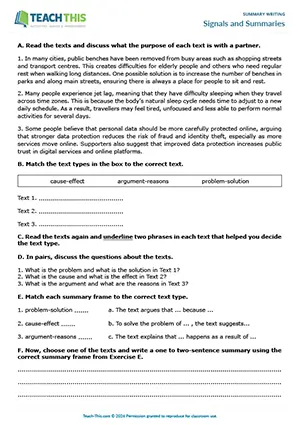
EAP Summary Writing Worksheet - Reading and Writing Exercises: Matching, Identifying, Summary Writing - Speaking Activity: Discussion, Freer Practice - Pair Work
In this free summary writing worksheet, students identify common text types, find signal phrases that indicate each type, and practice writing summaries...
Summarising a Process
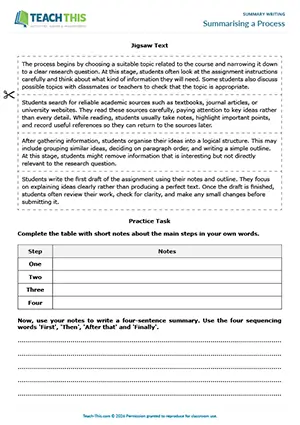
EAP Summarising Activity - Reading and Writing Exercises: Identifying, Table Completion, Summary Paragraph Writing - Pair Work
In this two-part summarising activity, students practice summarising processes by identifying main steps, reducing information to notes, and using sequencing...
Three Sentences, One Chart
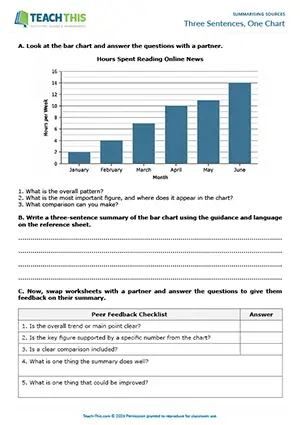
EAP Summarising Data Activity - Reading and Writing Exercises: Chart Analysis, Summary Writing, Peer Feedback
In this summarising data activity, students analyse bar chart trends and write a three-sentence summary of a bar chart using overview language, one key figure, and one clear comparison. First, go...
Attribution and Hedging in Summaries
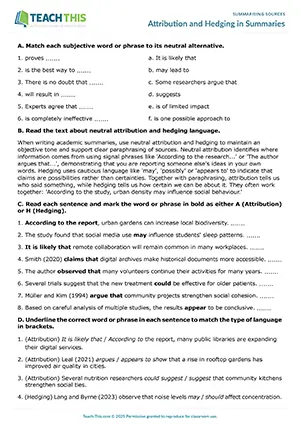
EAP Summarising Sources Worksheet - Reading, Vocabulary and Writing Exercises: Categorising, Binary Choice, Paraphrasing, Summary Writing
In this comprehensive summarising sources worksheet, students practice using neutral attribution and hedging language to paraphrase source extracts...
From Weak to Strong Summaries
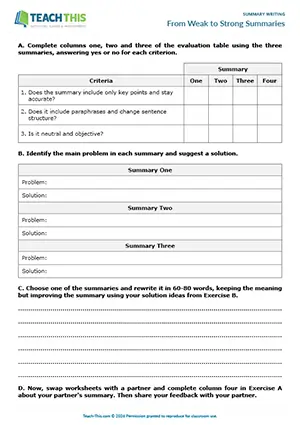
EAP Summary Writing Worksheet - Reading and Writing Exercises: Evaluating, Problem-solving, Summary Rewriting - Pair Work
In this useful summary-writing worksheet, students evaluate weak and strong summaries, identify common problems, and rewrite a summary in 60–80 words. First, students review a text...
Summarising in Four Steps
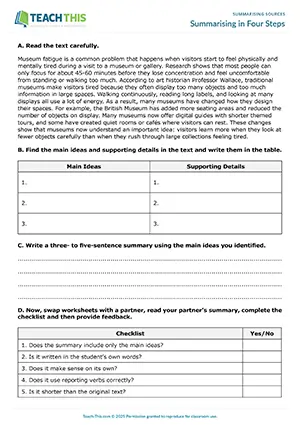
EAP Summarising Sources Worksheet - Reading and Writing Exercises: Identifying, Categorising, Summarising - Pair Work
This useful summarising sources worksheet helps students separate main ideas from supporting details through a four-step process, then apply words. First, students review the four steps and...
Summary Ladder Challenge

EAP Summary Writing Game - Reading and Writing: Summary Writing, Peer Review - Pair Work
In this engaging summary-writing game, students write one-sentence, 50-word and 100-word summaries of the same academic text using reporting verbs, summary frames and expansion strategies...
Summary Opening Sentences
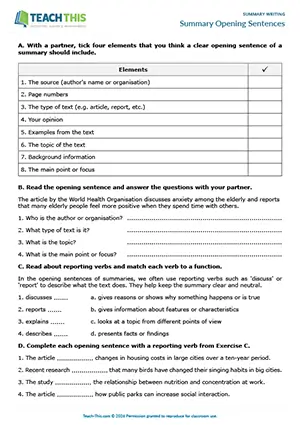
EAP Summarising Worksheet - Reading, Vocabulary and Writing Exercises: Gap-fill, Writing Opening Sentences - Speaking Activity: Discussion - Pair Work
In this comprehensive opening sentences for summaries worksheet, students identify the key elements of an effective opening sentence, practice using...
Annotated Bibliography Basics
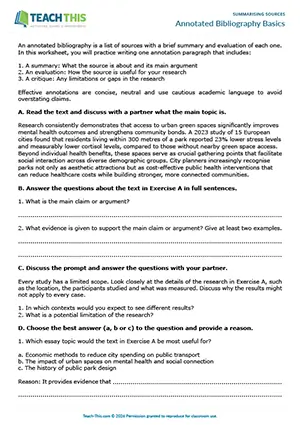
EAP Summarising Sources Worksheet - Reading and Writing Exercises: Comprehension Questions, Multiple-choice, Note-taking, Paragraph Writing
In this summarising worksheet, students practice writing an annotation paragraph that summarises, evaluates, and critiques a source using neutral, cautious...
Understanding Academic Summaries
An academic summary presents a source's main ideas in a shorter form, using the writer's own words while preserving the original meaning. Students need to select essential information, make the source clear and retain important qualifications without adding their own opinions.
This page contains ten resources across B1, B2 and C1, including worksheets, summarising activities and a summary-writing game, with one free worksheet.
The table illustrates decisions students make when summarising. The examples are hypothetical and do not report actual research findings.
| Summarising decision | Purpose | Example |
|---|---|---|
| Select the main message | Retain the central point rather than list every example. | A text describing several ways libraries support learning might become: 'The text explains how libraries support independent study.' |
| Preserve the text's organisation | Keep relationships such as sequence or comparison clear. | 'The process involves collecting samples, analysing them and reporting the results.' |
| Attribute the idea | Distinguish the source's account from the student's own claims. | 'The author argues that clearer guidance could improve participation.' |
| Retain qualifications | Avoid making a claim broader or more certain than the source. | Keep 'may help some students' rather than changing it to 'helps all students'. |
| Select data carefully | State the overall pattern and use a relevant figure or comparison. | 'Bus use was higher than train use, at 60% compared with 25%.' |
| Separate summary from evaluation | Include a judgement only when the task also requires evaluation. | Summary: 'The study examines commuting habits.' Evaluation: 'Its small sample limits the conclusions.' |
How to Summarise Academic Sources
Read for purpose before shortening: Ask students what the source explains, compares or argues. They can then select the main ideas and make brief notes rather than shorten each sentence mechanically.
Write from notes, then check the source: Temporarily covering the text can help students formulate their own wording. Afterwards, they should compare the summary with the original to check meaning, figures and qualifications, and provide the source acknowledgement required by the task.
Match the summary to the assignment: A one-sentence overview cannot include the same detail as a longer summary. An annotated bibliography may also require evaluation and limitations, whereas an objective summary should not introduce the student's personal judgement.
3-Step Framework for Teaching Summarising
This B2 sequence moves from establishing the source and main point to accurate wording and whole-summary revision. It can be taught across several lessons.
1. Establish the Source and Main Point: Students examine model opening sentences, match reporting verbs to their functions and identify missing elements. They then select a paragraph's main point, write an opening sentence and exchange checklist feedback. This gives the summary a clear focus before students develop it further.
2. Preserve Meaning with Neutral Language: Students distinguish attribution from hedging, select appropriate phrases and paraphrase source extracts. They then identify three main ideas and write a short summary using neutral attribution and cautious language. Peer feedback checks whether the wording accurately represents the source rather than strengthening its claims.
3. Evaluate and Revise the Whole Summary: Students compare an original text with three summaries using an evaluation table. They identify each summary's main problem, suggest a solution and rewrite one in 60–80 words. A partner then applies the same criteria, helping students check whether their revision addresses the problem.
Common Mistakes with Summarising Sources
Changing the strength or scope of a claim: A shorter sentence must still preserve meaningful limits in the source. Inaccurate summary: Turning 'The approach may help some learners' into 'The approach helps every learner.' Accurate summary: 'The approach could benefit some learners.'
Adding personal judgement to an objective summary: Praise or criticism changes the task from reporting the source to evaluating it. Personal judgement: 'The author presents an excellent solution to the problem.' Neutral summary: 'The author proposes a solution to the problem.' Add evaluation separately when the assignment requires it.
Common Questions About Teaching Summarising
What game helps students practice summary writing?
Summary Ladder Challenge has pairs write three summaries of the same academic text: one sentence, fifty words and one hundred words. After each timed round, another pair uses a scoring rubric to assess the summary. Increasing the length gives students practice deciding how much information to retain while keeping the main message clear.
What worksheet helps teach students to identify main ideas?
Summarising in Four Steps helps students distinguish main ideas from supporting details before writing a summary. Students read a text about museum fatigue, classify its information in a table and use the main ideas to write three to five sentences. They then exchange summaries and provide feedback using a checklist.
What free worksheet helps teach summarising?
Signals and Summaries introduces text types and the signal phrases that reveal their purpose. Students discuss three texts, identify their types and underline relevant phrases before matching summary frames to each type. They then choose a text and write a one- or two-sentence summary using the appropriate frame to preserve its meaning.
Become a Teach This Member
Get unlimited access to the full library, plus new resources added every week.
Unlimited Resource Access
Download from 3000+ worksheets, activities, and games.
Save 5+ Hours Weekly
Cut lesson prep time with ready-to-use resources, plus teacher notes and answer keys.
Trusted Professional Quality
Classroom-tested, editable resources created by experienced ESL professionals.
Fresh Content Weekly
Get 5 new resources added to the library each week.
Here's what our members are saying...


