
Zero Conditional ESL Activities, Games & Worksheets
It's Generally True
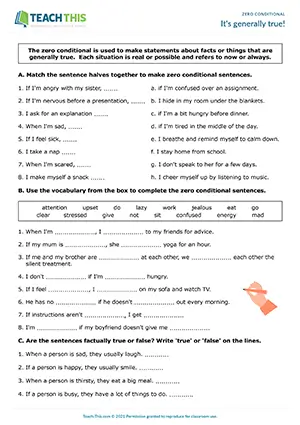
ESL Zero Conditional Worksheet - Grammar Exercises: Matching, Gap-fill, Rewriting Sentences, Sentence Completion
In this useful zero conditional worksheet, students practice how to form the zero conditional tense and use it to describe facts and things that are generally true. Students begin by matching sentence...
If Martians
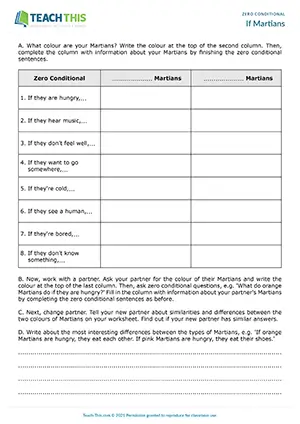
In this imaginative zero conditional activity, students use the zero conditional to write and talk about different groups of Martians. To begin, students choose...
What do you do if...?
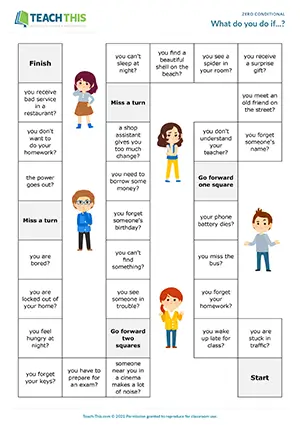
In this free zero conditional board game, students ask and answer 'What do you do if...?' questions using the zero conditional. In groups, players take turns rolling the dice and moving their counters...
Zero Conditional Appliances
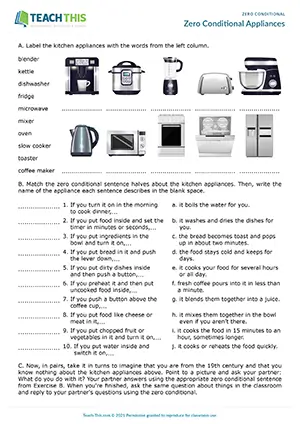
In this engaging zero conditional activity, students use the zero conditional to explain what kitchen appliances do. First, students match words to pictures...
Zero Conditional Guessing Game
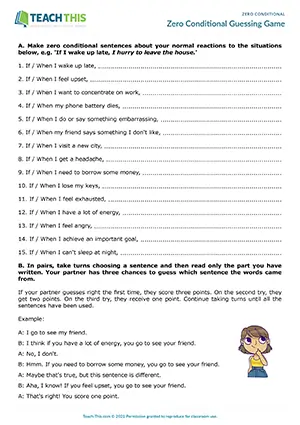
In this entertaining zero conditional game, students complete zero conditional sentences and then play a guessing game based on their own answers To start, students write their normal reactions to the...
Zero Conditional Quiz
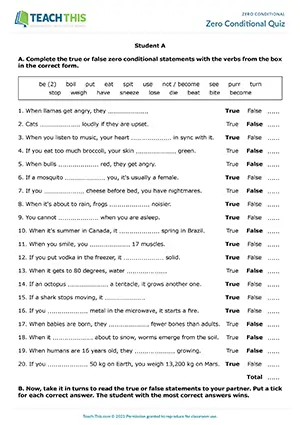
In this fun zero conditional activity, students complete sentences with the correct present simple forms and then quiz a partner by deciding whether each statement is true or false. In two groups, students...
Understanding the Zero Conditional
The zero conditional describes situations where one thing always leads to another, and it uses the present simple in both clauses, as in 'If you heat water to 100 degrees Celsius, it boils.' Students who use 'will' in the result clause instead of the present simple produce sentences that sound speculative rather than factual, which changes the meaning entirely and turns a general truth into a personal prediction.
This page covers the zero conditional at B1 level with six activities including a worksheet, a board game, pair speaking activities, and a guessing game, with one activity available as a free download.
The zero conditional uses the present simple in both clauses to describe facts, habits, and things that are always or generally true.
| Structure Type | If-Clause | Result Clause | Example |
|---|---|---|---|
| Affirmative | If + present simple | present simple | 'If you heat ice, it melts.' |
| Negative if-clause | If + present simple negative | present simple | 'If you don't sleep, you feel tired.' |
| Negative result | If + present simple | present simple negative | 'If it rains, the ground doesn't dry quickly.' |
| Question form | If + present simple | present simple | 'What do you do if you feel nervous?' |
| When variant | When + present simple | present simple | 'When water boils, it turns to steam.' |
When to Use the Zero Conditional
Stating Scientific Facts: Scientists, textbook writers, and teachers reach for the zero conditional when describing a natural or scientific process that always produces the same result, as in 'If you combine hydrogen and oxygen, you get water.'
Explaining Rules and Procedures: The zero conditional suits instruction manuals, workplace rules, and safety guidelines wherever a specific action always produces a predictable consequence, as in 'If the alarm sounds, everyone leaves the building immediately.'
Describing Personal Habits: Speakers use the zero conditional to describe their own habitual behavior in response to regular situations, signaling that this is what they always do rather than a one-time decision, as in 'If I feel stressed, I go for a run.'
3-Step Framework for Teaching the Zero Conditional
1. Form and Meaning First: Start with a written worksheet that moves students from recognition to production in clear stages. After matching and gap-fill exercises establish the form, students rewrite pairs of sentences into single zero conditional sentences, then finish by completing zero conditional sentences with their own ideas about how they feel or what they do in the given situations. That final step matters because it pushes students to connect the structure to personal meaning before they use it in speech.
2. Contextualised Speaking Practice: Move into a speaking activity where students pretend to be people from the 19th century, when many homes had no electricity or modern kitchen appliances. In pairs, students take turns pointing to a picture of an appliance and asking 'What do you use it for?', with their partner answering using a zero conditional sentence they prepared in the matching stage. The historical role-play frame gives students a genuine communicative reason to explain cause and effect rather than just reciting prepared sentences.
3. Freer Production with Error Accountability: Consolidate with a board game where the student to the right of whoever lands on a square asks them a 'What do you do if...?' question from the prompt on that square. If the player forms the zero conditional sentence correctly, they stay on the square; if not, they go back two squares, which keeps every student focused on accurate sentence formation right to the end of the game.
Common Mistakes with the Zero Conditional
Mixing Zero and Second Conditional: Students often use 'would' in the result clause of a zero conditional, confusing it with the second conditional, particularly when the sentence describes a habitual personal reaction. Wrong: 'If I feel tired, I would go to bed early.' Correct: 'If I feel tired, I go to bed early.'
Using 'will' in the If-Clause: Students often write 'will' in the if-clause because they associate conditionals with future meaning, but the if-clause in a zero conditional always takes the present simple. Wrong: 'If you will mix red and yellow, you get orange.' Correct: 'If you mix red and yellow, you get orange.'
Common Questions About Teaching the Zero Conditional
What is a good zero conditional activity for practicing facts and habits?
Students using the activity Zero Conditional Quiz complete true or false zero conditional statements using verbs in their correct present simple forms, then pair up and take turns reading their statements aloud while their partner guesses whether each one is true or false. The student with the most correct guesses wins.
How can I make zero conditional practice more interesting?
The activity If Martians makes the zero conditional engaging by having students invent their own Martians. Students choose a color for their Martians and write zero conditional sentences about them, for example 'If they are hungry, they eat each other', then take turns asking a partner questions like 'What do orange Martians do if they are hungry?'
What is a fun game for teaching the zero conditional?
The game Zero Conditional Guessing Game gets students reading their own zero conditional sentences aloud while their partner tries to guess which sentence it came from. Students have three chances to guess: three points for a correct first guess, two for a second, and one for a third. The student with the highest score wins.
Become a Teach This Member
Get unlimited access to the full library, plus new resources added every week.
Unlimited Resource Access
Download from 3000+ worksheets, activities, and games.
Save 5+ Hours Weekly
Cut lesson prep time with ready-to-use resources, plus teacher notes and answer keys.
Trusted Professional Quality
Classroom-tested, editable resources created by experienced ESL professionals.
Fresh Content Weekly
Get 5 new resources added to the library each week.
Here's what our members are saying...


