
Describing Character & Personality ESL Activities, Games & Worksheets
Matchmaker

ESL Matchmaking Activity - Vocabulary and Speaking: Form Completion, Asking and Answering Questions - Group Work
In this intriguing describing personality speaking activity, students become matchmakers and try to find a match for a friend or relative by asking and answering questions. In two groups...
Who's coming to dinner?

ESL Character Adjectives Activity - Vocabulary and Speaking: Matching, Table Completion, Discussion, Communicative Practice - Pair Work
In this communicative describing character speaking activity, students practice character adjectives through a dinner party scenario. In pairs, students take turns...
You've Got Personality
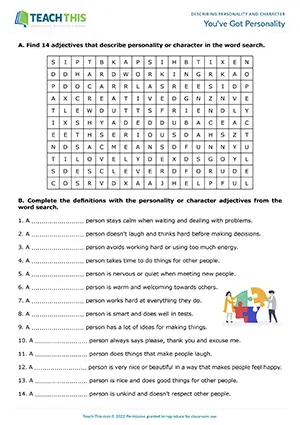
ESL Personality and Character Worksheet - Vocabulary Exercises: Word Search, Gap-fill - Speaking Activity: Discussion, Communicative Practice - Pair Work
In this useful personality and character adjectives worksheet, students learn and practice 14 adjectives that describe personality or character...
Personality Adjectives
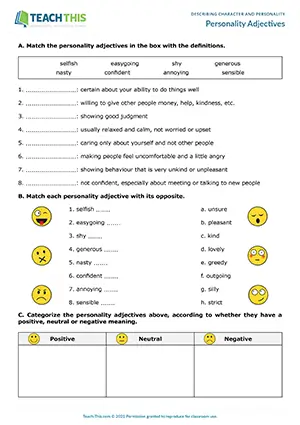
ESL Personality Adjectives Worksheet - Vocabulary Exercises: Matching, Categorising, Gap-Fill, Binary Choice, Writing a Description
Here is a free describing personality worksheet to help students learn and practice a variety of personality adjectives. First, students match personality...
The Happy Days Inn
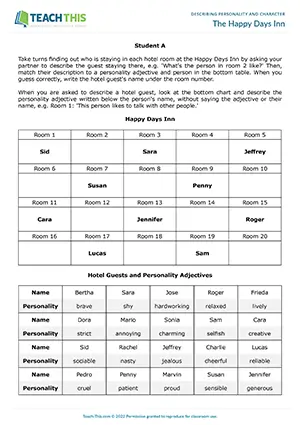
ESL Personality Adjectives Activity - Vocabulary and Speaking: Describing, Guessing, Matching, Table Completion - Pair Work
In this productive describing personality speaking activity, students match hotel guests to rooms from descriptions of their personalities. In pairs...
What do they do for a living?

ESL Characterising Activity - Vocabulary: Writing Descriptions, Matching - Group Work
In this insightful characterising activity, students describe and characterise people in certain jobs and then use the descriptions to match pictures of people to the jobs. In groups, students describe and characterise the sort of person who...
Personality Adjectives Crossword
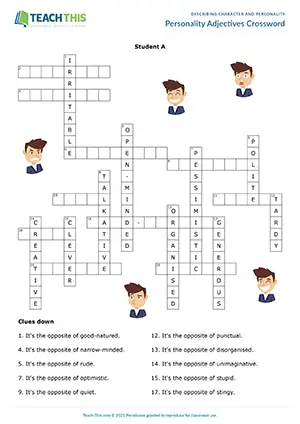
ESL Personality Adjectives Activity - Vocabulary: Defining, Guessing - Pair Work
Here is an enjoyable personality adjectives crossword to help students practice adjectives of personality and their opposites. In pairs, students take turns asking their partner for a clue to one of their missing personality adjectives...
Personality Traits
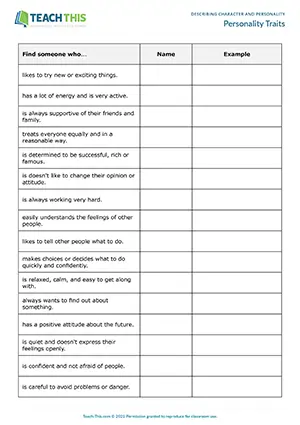
ESL Personality Traits Activity - Vocabulary and Speaking: Asking and Answering Questions, Providing Vocabulary, Freer Practice
In this free describing personality speaking activity, students practice asking and answering questions about personality traits. Students begin by going...
What am I like?
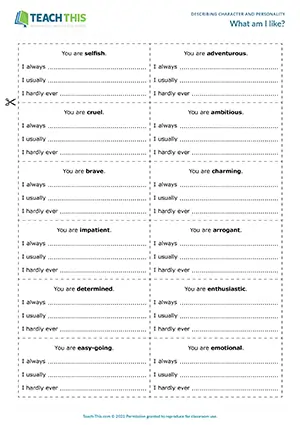
ESL Personality Adjectives Game - Speaking and Vocabulary: Writing Clues, Describing, Guessing - Group Work
Here is an engaging describing personality game to help students practice positive and negative personality adjectives. In groups, students take turns picking up a card and describing the personality...
What are they like?

ESL Personality Adjectives Game - Speaking and Vocabulary: Describing, Guessing - Group Work
In this fun personality adjectives game, students define and guess adjectives related to personality. In groups, students take turns picking up a card and describing the personality adjective in...
You've Changed!
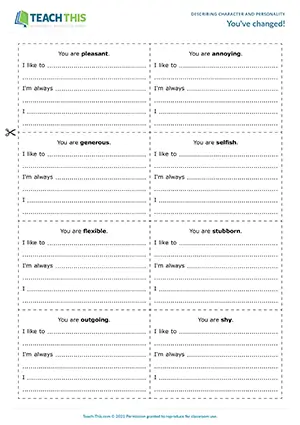
ESL Describing Character Activity - Vocabulary: Sentence Completion, Matching
In this creative describing characteristics activity, students practice the meanings of character adjectives and their opposites. First, students complete sentences on cards demonstrating the characteristic shown without using any form of...
Using Character and Personality Vocabulary
Character and personality vocabulary refers to the adjectives and phrases used to describe how someone behaves, thinks, and relates to other people. Students who rely on a small set of basic adjectives like 'nice' or 'bad' produce descriptions that feel flat and imprecise, which makes it harder for them to talk about people convincingly in conversation, writing, or job-related tasks.
This page covers describing character and personality across A2, B1, and B2 levels, with eleven resources ranging from vocabulary worksheets and information gap activities to group guessing games, including two free downloads.
How to Use Character and Personality Vocabulary
Describing People to Others: Use precise adjectives rather than vague ones when introducing or recommending someone. Instead of saying a person is 'nice' or 'good,' choose adjectives that show a specific quality, for example 'She's methodical, patient, and very supportive of the people she works with.'
Contrasting Positive and Negative Traits: Balance descriptions by pairing a strength with a limitation to give a realistic picture. This sounds far more natural than listing only positives or negatives, for example 'He's incredibly driven, but he can be quite impatient when things move slowly.'
Showing Change Over Time: Use contrasting adjectives with past and present tenses to describe how someone has developed, for example 'She used to be quite reserved, but she's become much more assertive since she changed roles.'
3-Step Framework for Teaching Character and Personality Vocabulary
1. Start with a Vocabulary Foundation: Students work through a word search and gap-fill to build a core set of personality and character adjectives, then practice forming sentences with those adjectives and add the prefix 'un-' where it applies. The session ends with a pair discussion where students use the new vocabulary to weigh up the best and worst qualities of different types of people.
2. Build Fluency with an Information Gap Activity: Move into productive practice with a hotel scenario where students take turns asking their partner to describe a guest in a specific room. Questions like 'What's the person in room 1 like?' prompt the partner to describe the personality without saying the adjective or the person's name, using clues such as 'This person likes to talk with other people.'
3. Sharpen Active Production with a Guessing Game: Push students to describe personality adjectives using sentences with always, usually, and hardly ever. A student describing 'adaptable' might say 'I always adjust to new conditions. I usually respond well to change. I'm hardly ever inflexible.' The student cannot say the adjective itself, so the group has to listen carefully and reason their way to the answer.
Common Mistakes with Character and Personality Vocabulary
Overusing 'Very' Instead of Choosing a Stronger Adjective: Students often intensify adjectives by adding 'very' rather than choosing a more precise word, which makes their descriptions sound repetitive and limits the range of vocabulary they produce. Wrong: 'She is very angry and very tired all the time.' Correct: 'She is furious and exhausted all the time.'
Using the Wrong Preposition with Personality Adjectives: Students often attach the wrong preposition to a personality adjective, or leave it out entirely, which produces phrases that sound unnatural even when the adjective itself is correct. Wrong: 'He is very kind with everyone and interested about his work.' Correct: 'He is very kind to everyone and interested in his work.'
Common Questions About Teaching Character and Personality Vocabulary
What is a useful worksheet for teaching personality adjectives?
The free worksheet Personality Adjectives takes students from matching adjectives with definitions to categorizing them as positive, neutral, or negative in meaning. Students then complete a description of a teacher by underlining the correct adjectives, before writing and reading aloud a description of someone they know.
What is a fun game for practicing personality adjectives?
Describing without naming is one of the most productive ways to lock in new vocabulary. The game What are they like? has students pick up a card and describe the personality adjective in bold to the group, without saying the adjective or using the underlined words on the card. The first to guess correctly wins and keeps the card.
What is a good speaking activity for practicing personality traits?
Mingle activities suit personality vocabulary well because every student becomes both a data collector and a source. In the free activity Personality Traits, students go around the class asking and answering questions about personality traits and noting classmates' answers. When a classmate answers 'yes,' the student writes their name down and asks them to give an example of the trait.
Become a Teach This Member
Get unlimited access to the full library, plus new resources added every week.
Unlimited Resource Access
Download from 3000+ worksheets, activities, and games.
Save 5+ Hours Weekly
Cut lesson prep time with ready-to-use resources, plus teacher notes and answer keys.
Trusted Professional Quality
Classroom-tested, editable resources created by experienced ESL professionals.
Fresh Content Weekly
Get 5 new resources added to the library each week.
Here's what our members are saying...


