
Future Time Clauses ESL Games & Worksheets
Future Fake Outs!

ESL Future Time Clauses Game - Grammar and Speaking: True or False, Forming Sentences, Asking and Answering Questions, Guessing - Pair Work
In this fun future time clauses game, students use time clauses like 'when', 'before', 'after', 'until', 'as soon as' and 'while' to make true or false sentences that try to...
Into the Future!

ESL Future Time Clauses Worksheet - Grammar Exercises: Matching, Identifying, Gap-fill, Unscrambling, Sentence Completion, Freer Practice - Pair Work
This comprehensive future time clauses worksheet helps students practice creating sentences with a variety of future time clauses. First, students read...
When Will It Happen?
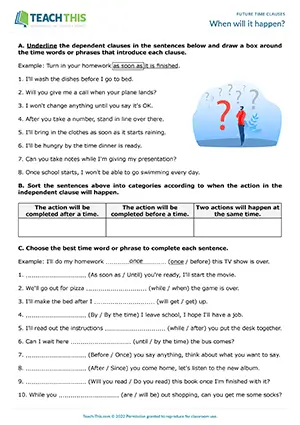
ESL Future Time Clauses Worksheet - Grammar Exercises: Identifying, Categorizing, Binary Choice, Error Correction, Rewriting Sentences
In this useful future time clauses worksheet, students practice using future time clauses to indicate when a future action will take place. First, students underline...
When will you do it?

ESL Future Time Clauses Game - Grammar and Speaking: Battleships, Asking and Answering Questions, Freer Practice - Pair Work
In this free future time clauses game, students play Battleships by asking and answering questions that use future time clauses. Students begin by marking...
Before You Can Blink

ESL Future Time Clauses Game - Grammar: Matching, Forming Sentences - Group Work
In this engaging future time clauses game, students match idiomatic time-clause expressions with their meanings and then use them to complete example sentences In groups, students take turns turning over one future time clause idiom card...
Future Time Clauses Board Game
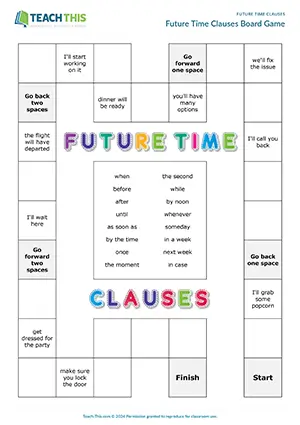
ESL Future Time Clauses Board Game - Grammar and Speaking: Sentence Completion, Controlled and Freer Practice - Group Work
In this enjoyable future time clauses board game, students practice forming sentences with future time clauses. Players take turns rolling the dice and moving...
Future Time Clause Idioms

ESL Future Time Clauses Worksheet - Grammar and Vocabulary Exercises: Gap-fill, Binary Choice, Matching
In this rewarding future time clauses worksheet, students learn future time clause idioms and practice using them in appropriate situations. First, students complete idioms that contain future time clauses...
Understanding Future Time Clauses
Future time clauses are clauses that attach to a main clause using a time conjunction like 'when', 'before', 'after', 'until', 'as soon as', or 'while', and they describe when a future event will happen in relation to another event. The key rule is that the verb inside the time clause takes a present tense form, not 'will', even though the sentence refers to the future, so a student who writes 'When I will arrive, I'll call you' instead of 'When I arrive, I'll call you' produces a sentence that reads as ungrammatical to any fluent English speaker.
This page covers future time clauses at B1 and B2 levels, with seven activities spanning pair games, worksheets, a Battleships game, a board game, and an idioms matching activity, including one free download.
The following table shows the most common future time conjunctions, what each one communicates about timing, and an example sentence showing the present-tense verb rule in action.
| Conjunction | Timing Communicated | Example |
|---|---|---|
| when | at the moment that / at the same time as | 'When I get home, I'll call you.' |
| before | earlier than the stated future event | 'Finish your homework before you go out.' |
| after | later than the stated future event | 'After she passes her exam, she'll celebrate.' |
| until | up to the point when the future event happens | 'I'll wait here until you come back.' |
| as soon as | immediately when the future event happens | 'As soon as the results arrive, I'll let you know.' |
| while | during the same period as the future event | 'While you are cooking, I'll set the table.' |
| once | from the moment the future event is complete | 'Once he finishes the report, we can leave.' |
| by the time | before a specified future moment | 'By the time they arrive, we will have eaten.' |
When to Use Future Time Clauses
Sequencing Future Events: Use a future time clause with 'before' or 'after' to put two upcoming events in a clear order, as a manager might write in an email 'Send me the draft after you finish the first section.'
Triggering a Future Action: Use 'as soon as' or 'when' to show that one event will immediately set off another, the way a project leader might say 'As soon as the budget is approved, we'll start hiring.'
Describing Overlapping Future Events: Use 'while' to show that two future actions will run at the same time, as a speaker might say to a colleague 'While I'm presenting, you can monitor the live comments.'
3-Step Framework for Teaching Future Time Clauses
1. Introduce with a Bluffing Game: Start with a speaking game that puts the structure at the center of a bluffing challenge. Give students a set of time-clause prompt cards featuring conjunctions like 'when', 'before', 'after', 'until', 'as soon as', and 'while', and ask them to invent a sentence about their own life that could be true or false. The pressure comes from the follow-up questions: classmates probe for inconsistencies by asking things like 'Where are you going jogging?' to catch a liar. This generates a high volume of spontaneous future time clause production in a genuinely competitive atmosphere.
2. Consolidate with Structured Written Practice: Follow up with a worksheet that walks students through the grammar in clear stages. Start with matching sentence halves and underlining the time clause in each pair, then move into gap-fills where students choose the right conjunction and verb form. The final task asks students to complete future time clause sentences with their own ideas and then compare with a partner to find out if any are the same, which turns the grammar practice into a natural conversation starter about real plans.
3. Push Production with a Board Game: Round off the sequence with a board game that tests production under pressure. When a player lands on a blank square, a classmate reads out a future time clause from a card, for example '...when she graduates from university...', and the player must complete it with a fitting main clause on the spot. The game also runs in reverse: players who land on a square showing a main clause like 'I'll grab some popcorn' must add their own time clause to finish the sentence. Both directions of the task give students genuine practice building complete sentences from either end.
Common Mistakes with Future Time Clauses
Confusing 'until' with 'when': Students often use 'until' where they mean 'when', producing a sentence that implies a continuous or ongoing action up to a point rather than a single event at a point. Wrong: 'I'll call you until I get there.' Correct: 'I'll call you when I get there.'
Writing a Time Clause as a Complete Sentence: Students often write the time clause alone without attaching a main clause, leaving a sentence fragment that has no independent meaning. Wrong: 'When I finish my homework.' Correct: 'When I finish my homework, I'll watch TV.'
Common Questions About Teaching Future Time Clauses
What is a fun speaking game for practicing future time clauses?
The free game When will you do it? uses a Battleships format where students form yes/no questions combining a household chore with a future time clause, such as 'Will you wash the dishes when you have time?' A hit earns 'Yes, I will' and a miss earns 'I'm sorry, I can't.'
What is a good worksheet for teaching future time clauses?
The worksheet When Will It Happen? is a solid choice for students working on future time clauses. Students underline dependent clauses and identify the time words introducing each one, then choose the best time word to complete sentences, correct errors in context, and finally rewrite sentences using bracket-prompted time clauses.
What is an engaging game for teaching future time clause idioms?
The game Before You Can Blink builds idiom knowledge through a three-card matching challenge. Students pair each idiomatic time-clause expression with its meaning and a main clause that completes it. There are 16 sets in total, and the student who collects the most wins.
Become a Teach This Member
Get unlimited access to the full library, plus new resources added every week.
Unlimited Resource Access
Download from 3000+ worksheets, activities, and games.
Save 5+ Hours Weekly
Cut lesson prep time with ready-to-use resources, plus teacher notes and answer keys.
Trusted Professional Quality
Classroom-tested, editable resources created by experienced ESL professionals.
Fresh Content Weekly
Get 5 new resources added to the library each week.
Here's what our members are saying...


