
Narrative Tenses ESL Worksheets, Activities & Games
Act Out My Story
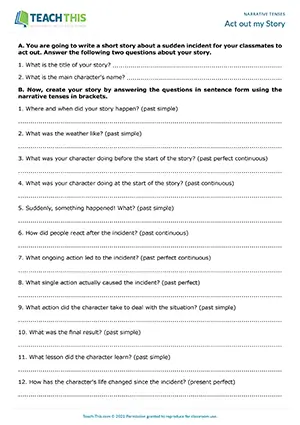
ESL Narrative Tenses Activity - Grammar and Writing: Writing Sentences, Story Writing, Acting - Pair Work
In this engaging narrative tenses activity, students practice using narrative tenses to write a short story from prompts and then read it to another pair, who acts it out. In pairs, students begin by thinking of...
Fairy Tale Fun
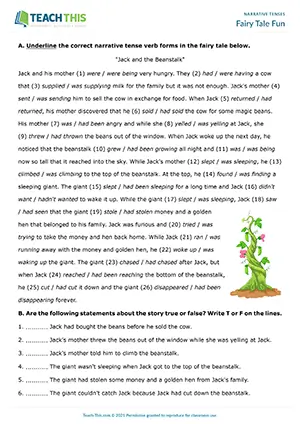
ESL Narrative Tenses Worksheet - Reading and Grammar Exercises: Binary Choice, True or False Reading Comprehension, Gap-fill
In this useful narrative tenses worksheet, students read fairy tale stories and choose and write the correct narrative tense verb forms. Students begin by reading a short version of the fairy tale...
Match and Mime
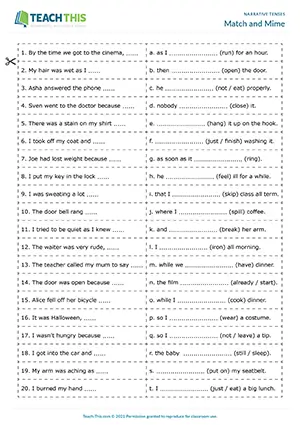
ESL Narrative Tense Games - Grammar: Matching, Gap-fill, Sentence Completion, Miming, Guessing - Pair Work
Here is a fun set of narrative tense games to help students practice narrative tenses. First, students play a pelmanism game where they take turns turning over one sentence beginning card and one ending...
Narrative Tenses Practice
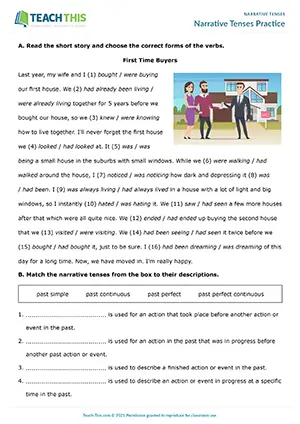
ESL Narrative Tenses Worksheet - Reading, Grammar and Writing Exercises: Binary Choice, Matching, Writing Sentences, Gap-fill, Story Completion
In this free narrative tenses worksheet, students practice four narrative tenses through a short story, matching, and guided writing tasks. Students begin...
Story Time
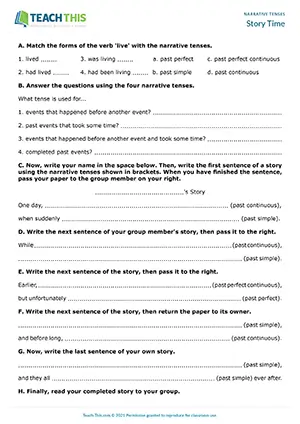
ESL Narrative Tenses Activity - Grammar and Writing: Matching, Short Answer Questions, Story Writing, Sentence Completion - Group Work
This imaginative story writing activity helps students practice using narrative tenses by writing a collaborative circle story. First, students match forms...
Tales from the Waiting Room
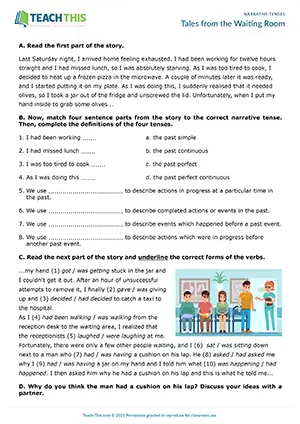
ESL Narrative Tenses Worksheet - Reading and Grammar Exercises: Matching, Gap-fill, Binary Choice - Speaking Activity: Discussion - Pair Work
In this engaging narrative tenses worksheet, students complete and discuss a short story to practise four past narrative tenses. Students begin by reading...
Tell me a Story
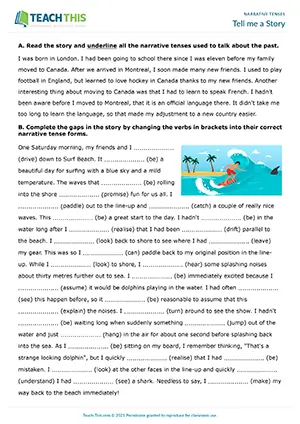
ESL Narrative Tenses Worksheet - Grammar and Reading Exercises: Identifying, Gap-fill, Matching - Speaking Activity: Story Telling - Group Work
In this productive narrative tenses worksheet, students practice narrative tenses to talk about past experiences. First, students read a short story and underline all...
Understanding Narrative Tenses
Narrative tenses are the four verb forms used together in English to tell stories and describe past events: the past simple, past continuous, past perfect, and past perfect continuous. Each tense plays a distinct role in a story — the past simple carries the main events forward, the past continuous sets the scene or describes an action already in progress, the past perfect shows what had already happened before the main events began, and the past perfect continuous explains how long a background action had been going on before it was interrupted.
This page covers narrative tenses at B1 and B2 levels, with seven activities including worksheets, a story-writing activity, a miming game, and a story-building activity, with one free download.
The table below shows each narrative tense, its structure, and a typical storytelling function.
| Tense | Structure | Function in a Narrative | Example |
|---|---|---|---|
| Past Simple | verb + -ed / irregular form | Main completed events | She opened the door and walked in. |
| Past Continuous | was / were + verb + -ing | Background scenes and interrupted actions | It was raining when she arrived. |
| Past Perfect | had + past participle | Events that happened before the main story | She had never been there before. |
| Past Perfect Continuous | had been + verb + -ing | Duration of a background action before another event | He had been waiting for two hours when she finally called. |
When to Use Narrative Tenses
Telling a Story in Sequence: Use the past simple for each main event in the order it happened. Linking words such as 'first', 'then', and 'finally' help signal the sequence, but the tense itself carries the story forward. A student who uses only the past simple throughout a story will be understood, but the narrative will feel flat and mechanical.
Setting the Scene: Use the past continuous to describe what was already happening when the main action began. This tense creates atmosphere and slows the pace of a story at key moments — for example, 'The sun was setting and the streets were filling with people' before the main event is introduced.
Adding a Flashback: Use the past perfect to step back in time and explain something that had already occurred before the main story began. Without the past perfect, readers or listeners cannot easily tell which events are in the main timeline and which are in the background — for example, 'She recognised him immediately. They had met once before, years ago.'
3-Step Framework for Teaching Narrative Tenses
1. Build Awareness with a Fairy-Tale Context: Begin with a worksheet that uses a familiar fairy-tale context to introduce all four narrative tenses together. Students can focus entirely on identifying and using the tense forms because they already know the story, which removes the cognitive load of following an unfamiliar plot at the same time as processing new grammar.
2. Reinforce with a Miming Game: Move to an activity that pairs a pelmanism card-matching game with a miming challenge. Students first match sentence halves using the correct narrative tense, then act out the completed sentences for their group to guess. The physical element forces students to process the meaning of each tense, not just its form.
3. Extend to Free Production with a Story-Building Activity: Finish with an activity where pairs build a story by answering prompt questions, each requiring a different narrative tense. Because each question targets one specific tense, students practise all four forms in a single communicative task before writing their completed story.
Common Mistakes with Narrative Tenses
Using the Past Simple Instead of the Past Perfect for Earlier Events: Students often use the past simple for all past events regardless of sequence, making it impossible for the reader to distinguish the main timeline from the background. Wrong: 'She was nervous because she never did it before.' Correct: 'She was nervous because she had never done it before.'
Using the Past Simple Instead of the Past Continuous for Background Actions: Students replace the past continuous with the past simple even when describing an action that was already in progress, which removes the sense of interrupted or ongoing background activity. Wrong: 'I walked home when it started to rain.' Correct: 'I was walking home when it started to rain.'
Common Questions About Teaching Narrative Tenses
What is a good worksheet for practicing narrative tenses?
The free worksheet Narrative Tenses Practice builds from recognition to free production in stages. Students start with a binary-choice reading task, then match tenses to descriptions, write guided sentences, and complete a story opening before continuing with all four tenses.
What is a fun collaborative writing activity for narrative tenses?
Story Time gives every student a personal stake in the outcome by asking each person to write the opening of a story using narrative tenses and then pass it to a partner to continue. The activity ends with each student reading out the completed story they started, which gives the class a clear reason to listen and compare.
What is an effective speaking activity for narrative tenses?
Tell me a Story is a worksheet that leads students through identifying and gap-filling narrative tenses in three stories before a speaking stage where they talk for two minutes about a personal experience using all four tenses.
Become a Teach This Member
Get unlimited access to the full library, plus new resources added every week.
Unlimited Resource Access
Download from 3000+ worksheets, activities, and games.
Save 5+ Hours Weekly
Cut lesson prep time with ready-to-use resources, plus teacher notes and answer keys.
Trusted Professional Quality
Classroom-tested, editable resources created by experienced ESL professionals.
Fresh Content Weekly
Get 5 new resources added to the library each week.
Here's what our members are saying...


