
Hobbies & Free-Time ESL Activities, Games & Worksheets
Hobbies Board Game
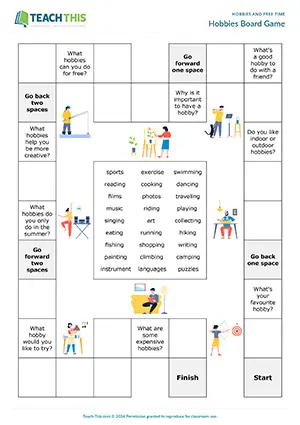
ESL Hobbies Board Game - Vocabulary: Sentence Completion, Controlled Practice - Group Work
In this fun hobbies board game, students review 12 hobbies and free-time activities by listening to sentences and completing them. In groups, students take turns picking up a card and reading the sentence...
Hobby Chain Game
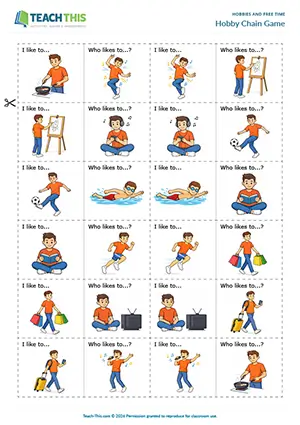
ESL Hobbies Game - Vocabulary: Matching, Controlled Practice - Group Work
In this engaging hobbies and free-time activities game, students practice 12 common hobbies and free-time activities by matching pictures in an 'I like to..., Who likes to...?' chain. In groups, one student starts by placing one of their cards face up...
Hobbies: Flashcards and Worksheet
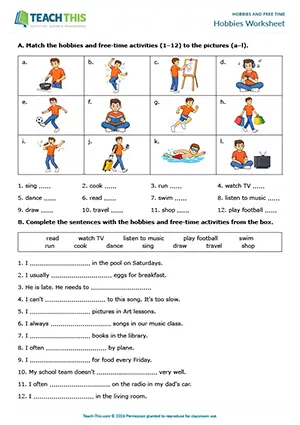
ESL Hobbies Flashcards and Worksheet - Flashcards: Eliciting, Drilling, Vocabulary Exercises: Matching, Gap-fill
In this introductory hobbies resource, students learn the names of 12 common hobbies and free-time activities and practice them with flashcards and a worksheet. To begin, hold up each...
Can you remember?
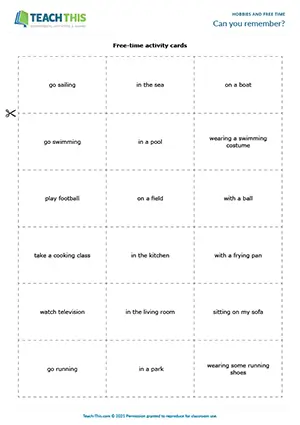
ESL Hobbies Game - Vocabulary: Matching, Memorizing, Table Completion - Group Work
In this useful free-time and hobbies game, students try to remember free-time activities, the places the activities are done and the objects used in each activity. First, students walk around the class, reading aloud the words on their activity card...
Free-Time Likes and Dislikes
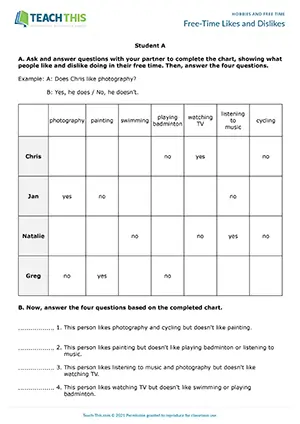
ESL Free-Time Likes and Dislikes Activity - Speaking: Information Gap, Asking and Answering Questions, Freer Practice, Matching - Pair Work
In this free-time likes and dislikes speaking activity, students ask and answer present simple yes/no questions with a partner to complete a chart, showing...
Free-Time Q & A
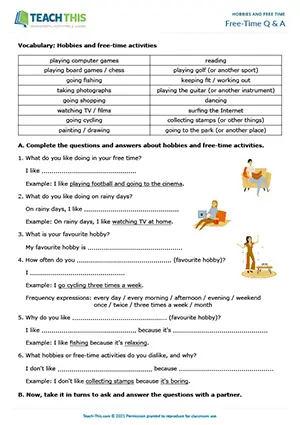
ESL Free-Time and Hobbies Activity - Vocabulary and Speaking: Sentence Completion, Asking and Answering Questions - Pair Work
In this enoyable free-time and hobbies speaking activity, students practice asking and answering guided questions about hobbies and free-time...
Go, Play and Do Questionnaire
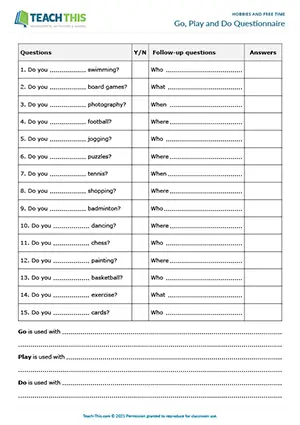
ESL Go, Play and Do Collocations Activity - Vocabulary and Speaking: Gap-fill, Sentence Completion, Asking and Answering Questions, Freer Practice - Pair Work
In this free hobbies questionnaire activity, students complete go, play and do collocations in questions about hobbies and leisure activities and then...
Hobby Talk Challenge
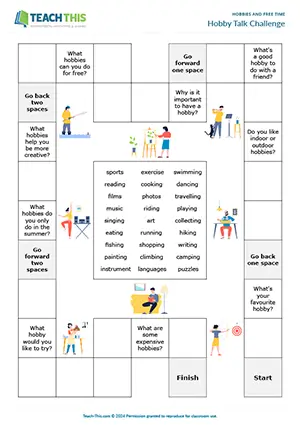
ESL Hobbies Board Game - Vocabulary and Speaking: Gap-fill, Answering Questions, Freer Practice - Group Work
In this engaging hobbies board game, students practice vocabulary related to hobbies and free-time activities and talk in response to topic-related questions. Players take turns rolling the dice...
Common Interests
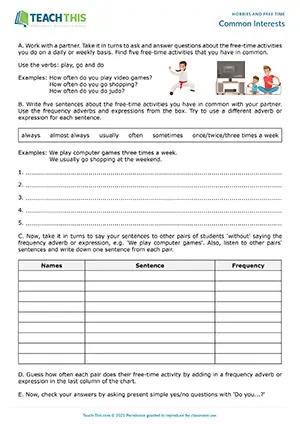
ESL Free-Time Collocations Activity - Speaking: Asking and Answering Questions, Writing Sentences, Guessing - Pair Work
In this productive free-time collocations speaking activity, students write and talk about free-time activities using 'play', 'go' and 'do' collocations together with adverbs and expressions of frequency...
Connections

ESL Hobby Games - Vocabulary: Categorising, Pelmanism, Matching, Forming Sentences, Asking and Answering Questions - Group Work
In this fun set of hobby vocabulary games, students practice making connections between hobbies and free-time activities by playing four card games...
Free-Time Interviews

ESL Hobbies Questionnaire - Speaking Activity: Asking and Answering Questions, Freer Practice
In this insightful hobbies questionnaire activity, students interview their classmates about their favourite hobbies and free-time activities. Students go around the class asking and answering questions...
Free-Time Mime

ESL Free-Time and Hobbies Game - Vocabulary: Miming, Guessing, True or False, Making Statements, Asking and Answering Questions - Group Work
Here is an entertaining hobbies miming and true or false game to help students practice vocabulary related to hobbies and free-time activities. Students take it...
What are my hobbies?

ESL Hobbies Worksheet - Vocabulary Exercises: Matching, Sentence Completion - Speaking Activity: Discussion, Guessing - Pair Work
In this free hobbies worksheet, students learn to talk about things they like and dislike doing and how they correspond to hobbies and leisure activities. First...
Free-Time Collocations Game

ESL Free-Time Collocations Game - Vocabulary: Matching, Forming Sentences - Pair Work
In this rewarding free-time collocations game, students practice 'play', 'go', 'have', 'take' and 'do' collocations related to hobbies and free-time activities. In pairs, students take it in turns to turn over one verb...
Free-Time Fact Finder
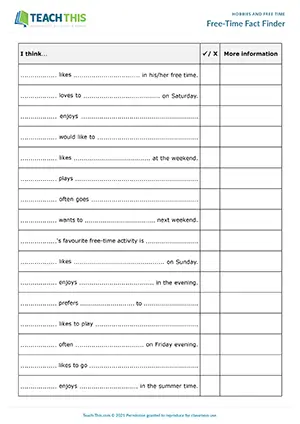
ESL Hobbies and Free-Time Activity - Speaking: Guessing, Sentence Completion, Asking and Answering Questions
In this handy hobbies and free-time speaking activity, students make guesses about what hobbies and free-time activities their classmates like to do and then check whether their guesses are right or...
Hobbies Taboo
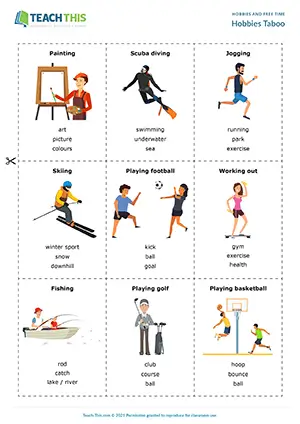
ESL Describing Hobbies Game - Vocabulary and Speaking: Describing, Guessing - Group Work
In this creative describing hobbies game, students describe and guess hobbies and free-time activities. A player from Team A comes to the front of the class and is given a taboo card. The player then...
Phrasal Verbs about Hobbies
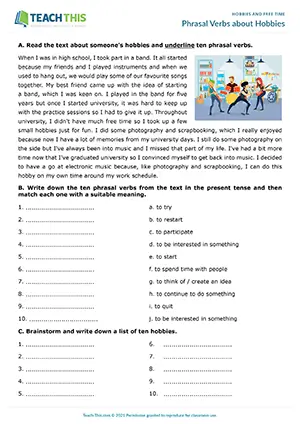
ESL Hobby Phrasal Verbs Worksheet - Reading and Vocabulary Exercises: Matching, Writing Sentences - Speaking Activity: Discussion - Group Work
In this free hobbies worksheet, students practice ten phrasal verbs related to hobbies. Students begin by reading a text about someone's hobbies and...
What did I do at the weekend?

ESL Hobbies and Free-Time Game - Vocabulary and Speaking: Asking and Answering Questions, Guessing, Freer Practice - Group Work
In this engaging hobbies and free-time game, students ask past simple yes/no questions to find out what leisure activity a classmate did at the weekend. In groups...
Which free-time activity?

ESL Hobbies Game - Speaking: Writing Questions from Prompts, Asking and Answering Questions, Controlled and Freer Practice, Guessing - Pair Work
In this interesting hobbies game, students ask yes/no questions in order to find out which hobby or free-time activity is on a card. In pairs, students prepare...
Activity Antics

ESL Hobbies Board Game - Vocabulary and Speaking: Impromptu Speech, Multiple-Choice Questions, Communicative Practice
This fun hobbies board game helps students practice talking about hobbies and free time activities and using related vocabulary. In groups, players take turns rolling the dice and moving their counter...
Free Time Fun

ESL Hobbies Activity - Vocabulary: Gap-fill, Table Completion, Asking and Answering Questions, Guessing, Controlled Practice - Group and Pair Work
Here is a memorable hobbies activity to help students practice vocabulary related to hobbies and free-time activities. In two groups, students begin...
Fun with Hobbies

ESL Hobbies Worksheet - Vocabulary Exercises: Word Search, Matching, Binary Choice, Gap-fill - Speaking Activity: Discussion, Freer Practice - Pair Work
This comprehensive hobbies worksheet helps students practice the names of hobbies and their related vocabulary. First, students take turns asking and answering...
Hobbies Uncovered

ESL Hobbies Activity - Vocabulary and Speaking: Writing and Giving Clues, Guessing, Asking and Answering Questions - Group and Pair Work
Here is a useful hobbies crossword and speaking activity to help students review the names of hobbies and practice asking and answering hobby-related...
Using Hobbies and Free-Time Vocabulary
Hobbies and free-time vocabulary covers activities people choose to do outside work, study and other responsibilities. Learning phrases such as 'go swimming', 'play chess' and 'enjoy reading' helps students describe interests and find things they have in common.
This page has 23 resources across A1, A1-A2, A2, B1 and B2, including games, worksheets and speaking activities, with three free downloads.
The table shows useful patterns for naming activities and explaining preferences.
| Pattern | Use | Example |
|---|---|---|
| go + activity ending in -ing | Common combinations for activities such as swimming and hiking | 'We go hiking at the weekend.' |
| play + game or sport | Name a game or sport such as chess or tennis | 'I play chess with my brother.' |
| do + activity | Use established combinations such as do yoga and do puzzles | 'She does yoga after work.' |
| enjoy + -ing | Say what gives you pleasure | 'I enjoy drawing animals.' |
| be interested in + noun or -ing | Describe an interest | 'He is interested in photography.' |
| take up + hobby | Start a new hobby | 'I want to take up gardening.' |
How to Use Hobbies and Free-Time Vocabulary
Add detail to an interest: Explain what you do, where or with whom. 'I take photos of birds in the park' gives a partner more to respond to than simply saying 'photography'.
Distinguish preferences from routines: Enjoying an activity does not tell the listener how often you do it. 'I love swimming, but I only go once a month' communicates both preference and frequency.
Keep a conversation going: Follow an answer with a related question such as 'How did you get started?' or 'Who do you usually play with?' Use what the speaker has said to choose the next question.
3-Step Framework for Teaching Hobbies and Free-Time Vocabulary
This sequence suits beginner classes, progressing from picture-supported vocabulary to spoken sentences and listening practice.
1. Establish Meaning and Pronunciation: Show hobby pictures, elicit the words and model pronunciation. Students then match activities to pictures and complete sentences on a worksheet. This connects spoken and written forms before students use the words in exchanges.
2. Link Listening with a Response: Students build a picture-card chain using 'I like to...' and 'Who likes to...?' prompts. Each student listens for the activity matching their card before continuing the chain. The repeated structure supports sentence production while giving everyone a reason to listen.
3. Complete Sentences from Spoken Clues: Students listen to a sentence with a missing hobby word, choose an answer from a game board and repeat the complete sentence. A correct answer allows a dice roll and a move towards the finish. This checks whether students can select vocabulary from sentence context rather than only name a picture.
Common Mistakes with Hobbies and Free-Time Vocabulary
Using an infinitive after enjoy: When another verb follows 'enjoy', use its -ing form. Incorrect: 'I enjoy to swim.' Correct: 'I enjoy swimming.'
Using interested on instead of interested in: Follow 'interested' with 'in' when naming a hobby or activity. Incorrect: 'She is interested on photography.' Correct: 'She is interested in photography.'
Common Questions About Teaching Hobbies and Free-Time Vocabulary
What is a fun game for practicing hobbies vocabulary?
The game Free-Time Mime links hobby vocabulary with actions students can recognise. Players mime activities for classmates to guess, with correct guesses earning cards. They then use the cards to make personal statements, which classmates question before deciding whether they are true, extending word recall into spoken exchanges.
What worksheet helps with teaching hobbies and free-time vocabulary?
The free worksheet What are my hobbies? connects hobby names with likes and dislikes. Students match pictures to hobbies, discuss suitable activities for different people and complete sentences about their own preferences. Classmates then guess their chosen hobbies from these sentences, giving the vocabulary work a clear communicative purpose.
How can students practice using go, play and do to talk about hobbies?
The free activity Go, Play and Do Questionnaire combines collocation practice with interviews. Students complete questions and rules for 'go', 'play' and 'do', then prepare follow-up questions. They interview a new partner and report back, using the phrases to discover more about someone's interests rather than only completing isolated sentences.
Become a Teach This Member
Get unlimited access to the full library, plus new resources added every week.
Unlimited Resource Access
Download from 3000+ worksheets, activities, and games.
Save 5+ Hours Weekly
Cut lesson prep time with ready-to-use resources, plus teacher notes and answer keys.
Trusted Professional Quality
Classroom-tested, editable resources created by experienced ESL professionals.
Fresh Content Weekly
Get 5 new resources added to the library each week.
Here's what our members are saying...


