
Causative Verbs ESL Worksheets, Games & Activities
Causative Conversations

ESL Causative Verbs Activity - Vocabulary and Speaking: Gap-fill, Asking and Answering Questions, Controlled and Freer Practice - Group and Pair Work
In this insightful causative verbs speaking activity, students complete, ask and answer conversation questions containing common causative verbs. First, students...
Causative Verbs Board Game
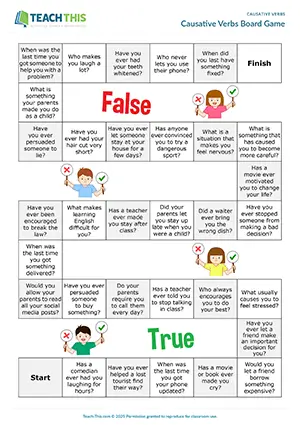
ESL Causative Verbs Board Game - Grammar and Speaking: Asking and Answering Questions, True or False, Guessing - Group Work
In this fun causative verbs board game, students practice a variety of causative verbs by playing a game where they give true or false answers to questions...
Causative Verb Dominoes

ESL Causative Verbs Game - Speaking: Matching, Forming Sentences - Group Work
In this creative causative verbs game, students make sentences with the causative verbs: get, have, make, let and help. The first player puts a domino down either before or after the domino on the table, pairing a causative verb with an action...
Common Causative Verbs

ESL Causative Verbs Worksheet - Grammar Exercises: Gap-fill, Rewriting Sentences, Writing Sentences
In this free causative verbs worksheet, students learn and practice the four commonly used causative verbs: have, make, get and let. First, students complete sentences with causative...
Have/Get Something Done Practice
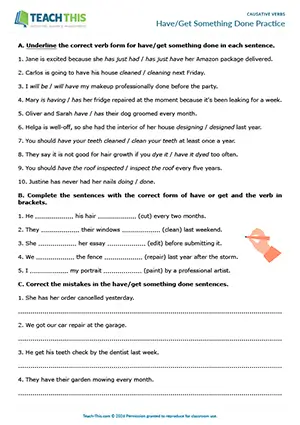
ESL Have/Get Something Done Worksheet - Grammar Exercises: Binary Choice, Error Correction, Rewriting Sentences - Speaking Activity: Discussion - Group Work
Here is a productive have/get something done worksheet to help students practice the have/get + object + past participle structure. First students underline the...
Causative Verbs Practice
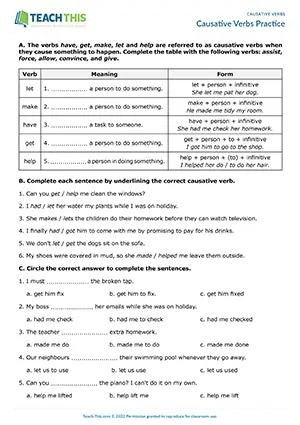
ESL Causative Verbs Worksheet - Grammar Exercises: Gap-fill, Binary Choice, Multiple Choice, Rewriting Sentences, Sentence Completion
Here is a comprehensive causative verbs worksheet for upper-intermediate students. First, students complete causative verb definitions in a table with the...
Find Someone Who...

ESL Causative Verbs Activity - Speaking: Gap-fill, Asking and Answering Questions, Controlled and Freer Practice
In this engaging causative verbs speaking activity, students ask and answer questions with the causative verbs: make, let, have, get, help. First, students complete sentences on the worksheet with the...
Understanding Causative Verbs
Causative verbs are verbs such as make, have, get, let, and help that show one person causing another person to do or experience something. Students who confuse these verbs send the wrong message entirely: 'My teacher makes me study' and 'My teacher lets me study' mean opposite things, and mixing them up can make a speaker sound controlling or overly casual in situations that call for neither.
This page covers causative verbs at B1 and B2 levels with seven activities including gap-fill worksheets, a board game, and a class mingle, with one activity available as a free download.
The five main causative verbs each follow a slightly different grammatical pattern, so this table maps the structure, an example, and the core meaning of each one.
| Causative Verb | Structure | Example | Key Meaning |
|---|---|---|---|
| make | subject + make + object + bare infinitive | 'My boss makes me work late.' | force or compel someone to do something |
| have | subject + have + object + bare infinitive | 'She had the technician fix the printer.' | arrange for someone to do something for you |
| get | subject + get + object + to-infinitive | 'He got his friend to help him move.' | persuade or arrange for someone to do something |
| let | subject + let + object + bare infinitive | 'Her parents let her stay out late.' | allow or permit someone to do something |
| help | subject + help + object + bare infinitive or to-infinitive | 'The teacher helped the students understand the task.' | assist someone in doing something |
| have something done | subject + have + object + past participle | 'She had her hair cut.' | arrange for a service to be performed on your behalf |
| get something done | subject + get + object + past participle | 'He got his car repaired.' | arrange for a service to be performed, often in informal contexts |
When to Use Causative Verbs
Delegating a Task at Work: When a manager or professional wants to express that they arranged for a task to be carried out by someone else, they use 'have' or 'get' to shift the focus onto the outcome rather than the person who did the work, as in 'We had the entire system upgraded before the launch.'
Reporting Rules or Obligations: When a speaker wants to report that an authority figure imposes a requirement on someone, 'make' signals that the person had no choice in the matter, as in 'The school makes students wear uniforms.'
Describing Personal Arrangements: When speakers describe having a service carried out for themselves rather than doing it personally, 'have/get something done' signals that someone else performed the action on their behalf, as in 'I need to get my passport renewed before the trip.'
3-Step Framework for Teaching Causative Verbs
1. Build the Foundation: Start with a structured worksheet that locks in students' understanding of the four core causative verbs: have, make, get, and let. Once students work through the gap-fill and rewriting sections, push them to personalize the grammar by writing sentences about their own classroom life, covering what they are allowed to do, forced to do, persuaded to do, and authorized to do. Getting personal from the start makes the abstract feel immediately real.
2. Add Competitive Pressure: Move to a board game that gets students producing causative verbs under light pressure while keeping engagement high. Players land on squares, answer questions using causative verbs, and choose to tell the truth or bluff. The tension comes from the follow-up stage, where other students ask questions to determine whether the player is lying or telling the truth before making their guess. This keeps everyone listening and producing, not just the player whose turn it is.
3. Open It Up: Round off with a class mingle that pushes students toward freer, more natural use. Students move around the room asking questions containing causative verbs, and when someone answers yes, they note that person's name and ask a follow-up question to gain more information. This creates a genuine communicative reason to produce causative verbs repeatedly across real conversation, building fluency where accuracy drills left off.
Common Mistakes with Causative Verbs
Using 'to' After 'Make' and 'Have': Students often add 'to' before the infinitive after 'make' and 'have,' treating them like other verbs that take a to-infinitive, when both verbs require a bare infinitive. Wrong: 'My teacher makes me to do homework every night.' Correct: 'My teacher makes me do homework every night.'
Using the Base Verb Instead of the Past Participle in 'Have/Get Something Done': Students often write the base form of the verb after the object in the have/get something done structure, forgetting that the past participle is required. Wrong: 'I had my car repair last week.' Correct: 'I had my car repaired last week.'
Common Questions About Teaching Causative Verbs
What is a fun causative verbs game?
The game Causative Verb Dominoes gets students making original causative verb sentences and reading them aloud for the group to judge. Players match a causative verb with an action verb, form a sentence like 'My friend got me to pay for his lunch,' and keep the domino only if the group accepts it. First to use all their dominoes wins.
What is a useful worksheet for teaching have and get something done?
The worksheet Have/Get Something Done Practice covers binary choice, error correction, and rewriting using have + object + past participle, then moves into freer writing and group discussion using the same structure. Students who confuse have and get something done benefit from working through all those error types in a single, structured sequence.
What is a creative speaking activity for causative verbs?
The activity Causative Conversations puts students to work asking and answering real conversation questions that contain causative verbs. They complete the questions first, then work through them with a partner, using the target verb in each response. Afterwards, students share what they found out about their partner with the class, giving the activity a clear communicative purpose throughout.
Become a Teach This Member
Get unlimited access to the full library, plus new resources added every week.
Unlimited Resource Access
Download from 3000+ worksheets, activities, and games.
Save 5+ Hours Weekly
Cut lesson prep time with ready-to-use resources, plus teacher notes and answer keys.
Trusted Professional Quality
Classroom-tested, editable resources created by experienced ESL professionals.
Fresh Content Weekly
Get 5 new resources added to the library each week.
Here's what our members are saying...


