
Clauses of Manner ESL Games & Worksheets
Clauses and Phrases of Manner
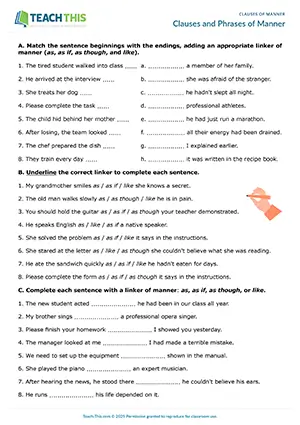
ESL Clauses and Phrases of Manner Worksheet - Grammar and Writing Exercises: Matching, Gap-fill, Writing Sentences and a Paragraph - Speaking Activity - Pair Work
In this comprehensive clauses and phrases of manner worksheet, students practice forming and using clauses and phrases of manner with as, as if, as though, and like...
Clauses of Manner Challenge

ESL Clauses of Manner Board Game - Grammar and Speaking: Forming Sentences, Freer Practice - Group Work
In this engaging clauses of manner board game, students practice forming sentences that express manner using as, like, as if, as though, and the way. Players take turns rolling the dice and moving their...
As If and As Though Challenges
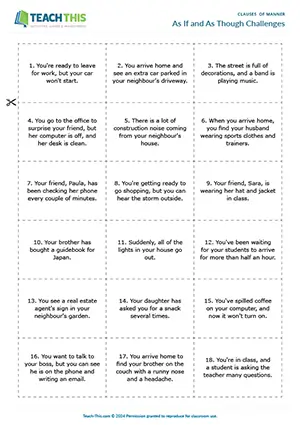
ESL As If and As Though Game - Grammar and Speaking: Matching, Forming Sentences, Controlled Practice - Group Work
In this free 'as if' and 'as though' game, students practice forming sentences using 'as if' and 'as though' with the present simple and present continuous. The first student turns over the top situation card...
Clauses of Manner Bingo
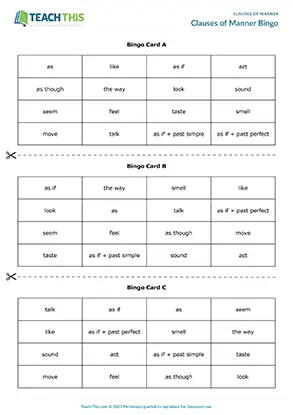
ESL Clauses of Manner Game - Grammar: Bingo, Guessing, Forming Sentences from Prompts - Group Work
In this enjoyable clauses of manner game, students practice clauses of manner and verbs of perception by producing context-appropriate sentences. To start the game, the caller picks up a situation card...
It Looks As If I'm Going to Win
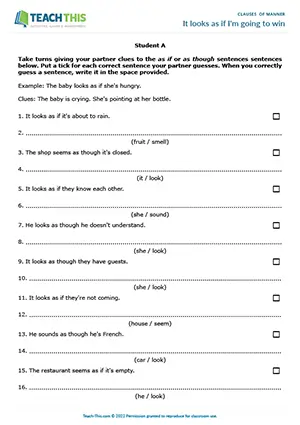
ESL As If and As Though Game - Grammar and Speaking: Giving Clues, Guessing, Forming Sentences, Controlled Practice - Pair Work
In this fun 'as if' and 'as though' game, students guess 'as if' and 'as though' sentences from clues given by a partner. Students take turns giving...
Understanding Clauses of Manner
Clauses of manner are subordinate clauses that describe how an action is done, using linkers such as as, like, as if, and as though, for example 'She spoke as though she already knew the answer.' Students who rely on 'like' for every context, or avoid 'as if' and 'as though' entirely, miss the precision these linkers provide and produce writing that reads as informal even in formal tasks.
This page covers clauses of manner across B1 to B2 levels with five activities ranging from a grammar and writing worksheet to a board game and bingo, with one activity available as a free download.
The five main manner linkers follow distinct structural patterns that affect both register and meaning.
| Linker | Typical Structure | Usage Note | Example |
|---|---|---|---|
| as | subject + verb (same tense as main clause) | Describes manner of action directly; standard in formal and written contexts. | 'He held the pen as his teacher had shown him.' |
| like (informal) | subject + noun phrase or subject + verb | Widely used in speech; generally avoided in formal writing. | 'She stared at me like I had said something wrong.' |
| as if | subject + verb (past simple or past subjunctive for unreal; present simple for factual) | Introduces a hypothetical or apparent comparison; signals the situation may not be real. | 'He talks as if he owns the place.' |
| as though | subject + verb (same patterns as 'as if') | Interchangeable with 'as if' in most contexts; slightly more formal in tone. | 'She walked in as though nothing had happened.' |
| the way | subject + verb (same tense as main clause) | Informal alternative to 'as'; common in everyday speech. | 'Do it the way I showed you.' |
When to Use Clauses of Manner
Describing surprising or unexpected behavior: Speakers use 'as if' or 'as though' to describe how someone behaves without directly stating the cause, keeping the observation measured and open-ended, as in 'She answered every question as if she hadn't prepared at all.'
Giving clear instructions: Speakers use 'as' or 'the way' to anchor an instruction to a demonstrated action, showing exactly how a task should be performed rather than just describing it, as in 'Fold it the way I just showed you.'
Vivid description in storytelling: Writers use 'like' in informal narrative to create a visual image by comparing an action to something the reader can picture immediately, as in 'He moved through the crowd like he was walking on ice.'
3-Step Framework for Teaching Clauses of Manner
1. Build the Forms Through Structured Practice: Start with recognition and controlled written work, taking students through matching linkers to sentence halves, completing gap-fills, and rewriting combined sentences. The goal at this stage is accuracy with all four linkers before students apply them freely. This leads naturally into a speaking discussion and then into extended writing, where students produce a short paragraph about their morning routine using at least three clauses or phrases of manner with the linkers.
2. Push for Spontaneous Production With a Game: Once students have the forms, get them on their feet with a board game where they roll, land on a prompt square, and draw a linker card before building a full sentence from scratch. The combination of a random prompt and a random linker forces genuine processing: a student who draws 'as if' for the prompt 'She smiles...' has to produce something like 'She smiles as if she has won a prize' without preparation time.
3. Extend to Verbs of Perception and Full Context Sentences: Raise the bar by requiring students to connect manner clauses to complete situations rather than isolated prompts. In a bingo format, a caller reads a situation card aloud, for example 'The neighbours' lights are on and extra shoes are by the door,' and each player selects a target word or phrase, says it aloud, and produces a sentence that matches the situation, meeting accuracy, vocabulary, and context demands at the same time.
Common Mistakes with Clauses of Manner
Present simple after 'as if' in unreal comparisons: Students often use the present simple after 'as if' or 'as though' when making an unreal comparison, when the past simple is needed to signal that the situation is not actually true. Wrong: 'She speaks as if she knows everything.' Correct: 'She speaks as if she knew everything.'
Using 'as' alone instead of 'as if' for hypothetical comparisons: Students often drop 'if' when introducing a hypothetical comparison, using 'as' alone, which turns the clause into a factual manner statement rather than a comparison to an unreal situation. Wrong: 'He stared at me as he had seen a ghost.' Correct: 'He stared at me as if he had seen a ghost.'
Common Questions About Teaching Clauses of Manner
What is a fun game for teaching 'as if' and 'as though'?
Matching a situation card to the right sentence prompt pushes students to produce 'as if' and 'as though' with real context. In the free As If and As Though Challenges game, each player finds the prompt card that matches a situation card and forms a sentence, with the group judging grammatical accuracy and context fit.
What 'as if' and 'as though' speaking activity works well at B2 level?
Clue-giving forces students to think in context before they produce the target structure. In the activity It Looks As If I'm Going to Win, a student gives situational clues such as 'The baby is crying. She's pointing at her bottle' and their partner produces the matching 'as if' or 'as though' sentence. Students swap roles after each round.
What is a good worksheet for practicing clauses and phrases of manner?
The Clauses and Phrases of Manner worksheet takes students through matching, gap-fill, and rewriting exercises before moving into freer production. Students finish by writing a short paragraph about their morning routine using at least three clauses or phrases of manner with the linkers as, as if, as though, or like.
Become a Teach This Member
Get unlimited access to the full library, plus new resources added every week.
Unlimited Resource Access
Download from 3000+ worksheets, activities, and games.
Save 5+ Hours Weekly
Cut lesson prep time with ready-to-use resources, plus teacher notes and answer keys.
Trusted Professional Quality
Classroom-tested, editable resources created by experienced ESL professionals.
Fresh Content Weekly
Get 5 new resources added to the library each week.
Here's what our members are saying...


