Ask Me Anything

Intermediate (B1) 30 minutes
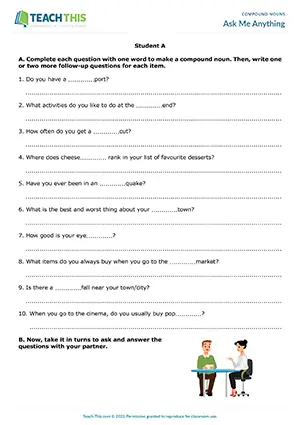
ESL Compound Nouns Activity preview for Intermediate B1 showing gap-fill, question prompts, and pair/group practice

ESL Compound Nouns Activity - Vocabulary and Speaking: Gap-Fill, Asking and Answering Questions, Controlled and Freer Practice - Group and Pair Work

In this fun compound nouns speaking activity, students complete questions with one word to make closed compound nouns. Students then ask and answer the questions...

ESL Compound Nouns Activity - Vocabulary and Speaking: Gap-Fill, Asking and Answering Questions, Controlled and Freer Practice - Group and Pair Work In this fun compound nouns speaking activity, students complete questions with one word to make closed compound nouns. Students then ask and answer the questions with a partner. In two groups, students complete each question on the worksheet with one word to make a compound noun. Next, students write down one or two follow-up questions for each item. Students then pair up with someone from the other group and take it in turns to ask and answer the questions with their partner. Finally, students report back to the class on what they found out about their partner.

Compound Noun Dominoes

Intermediate (B1) 25 minutes
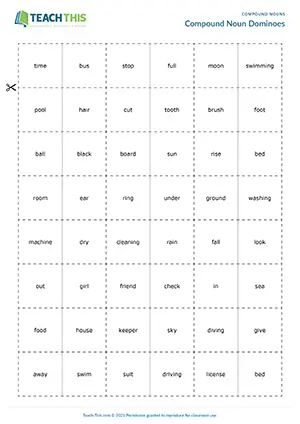
ESL Compound Nouns Game preview for Intermediate B1 showing domino matching and group sentence practice

ESL Compound Nouns Game - Vocabulary and Speaking: Matching, Forming Sentences, Freer Practice - Group Work

In this inventive compound nouns game, students combine words together to form compound nouns and use them in sentences. The first player puts down one of their dominoes on either side of...

ESL Compound Nouns Game - Vocabulary and Speaking: Matching, Forming Sentences, Freer Practice - Group Work In this inventive compound nouns game, students combine words together to form compound nouns and use them in sentences. The first player puts down one of their dominoes on either side of the domino on the table, making sure that the words combine to form a compound noun. If the player forms a compound noun successfully, they score a point. For an extra point, the player then uses the compound noun in a sentence. The other players then take it in turns to match their dominoes in the same way by putting them down at either end of the domino chain and making a suitable sentence when a compound noun is formed. When a player has gotten rid of all their dominoes, the game ends. The player with the most points wins the game. Finally, go through the compound nouns and elicit the compound elements for each one, e.g. noun + noun, noun + verb, etc.

Picture it

Intermediate (B1) 25 minutes
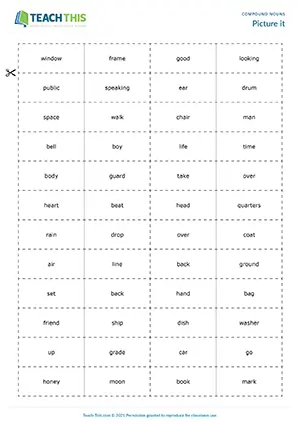
ESL Compound Nouns Game preview for Intermediate B1 showing drawing, guessing, and word formation group activity

ESL Compound Nouns Game - Vocabulary: Drawing, Guessing, Forming Words - Group Work

In this entertaining compound nouns drawing game, students guess compound nouns from pictures. One student from Team A comes up to the board. Give the student a card containing two words that...

ESL Compound Nouns Game - Vocabulary: Drawing, Guessing, Forming Words - Group Work In this entertaining compound nouns drawing game, students guess compound nouns from pictures. One student from Team A comes up to the board. Give the student a card containing two words that when joined together form a compound noun. The student then draws the two words on the board. The first team to guess the compound noun wins and scores a point. For an extra point, the team then defines the compound noun. If the team is unable to define the word, the other team can steal the point by giving a correct definition. Then, a student from Team B comes to the board and so on. The team with the most points at the end of the game wins. As an alternative, instead of asking for a definition, you could ask teams to tell you the compound elements or use the compound noun in a sentence.

Practice Makes Perfect

Intermediate (B1) 25 minutes
ESL Compound Nouns Worksheet preview for Intermediate B1 showing labelling, matching, gap-fill, and sentence writing

ESL Compound Nouns Worksheet - Vocabulary Exercises: Labelling, Matching, Gap-fill, Writing Sentences

This productive compound nouns worksheet helps students learn and practice a variety of compound nouns and their compound elements. Students begin by looking at pictures and completing...

ESL Compound Nouns Worksheet - Vocabulary Exercises: Labelling, Matching, Gap-fill, Writing Sentences This productive compound nouns worksheet helps students learn and practice a variety of compound nouns and their compound elements. Students begin by looking at pictures and completing compound nouns with words from a box. Students then match each compound noun with its compound elements. Next, students complete sentences with suitable compound nouns from Exercise A. Students then move on to match words together to make compound nouns and write the compound elements for each one. In the last exercise, students write a sentence about each picture using a compound noun.

Same Same

Intermediate (B1) 30 minutes
ESL Compound Nouns Game preview for Intermediate B1 showing word formation and group competition

ESL Compound Nouns Game - Vocabulary: Forming Words - Group Work

In this free compound nouns game, students race to create as many compound nouns as they can from specific words. You begin the game by picking up a card and calling out the word in bold, e.g. hair. In teams, students then race to write down as many...

ESL Compound Nouns Game - Vocabulary: Forming Words - Group Work In this free compound nouns game, students race to create as many compound nouns as they can from specific words. You begin the game by picking up a card and calling out the word in bold, e.g. hair. In teams, students then race to write down as many compound nouns as they can think of using the word, e.g. hairbrush, hairdresser, haircut, hairstyle, etc. When a time limit has been reached (e.g. one minute), the teams stop writing and swap papers for marking. For each suitable compound noun that is not on your card, teams score a point. If a team has a compound noun that is on your card, they score two points. The team with the most points at the end of the game wins.

Compound Conundrum

Upper-intermediate (B2) 30 minutes
ESL Compound Noun Game preview for Upper-intermediate B2 showing pelmanism, matching, and pair sentence practice

ESL Compound Noun Game - Vocabulary and Speaking: Pelmanism, Matching, Forming Sentences - Pair Work

This imaginative compound nouns game helps students develop their vocabulary knowledge by matching words together to form compound nouns and using them in sentences. In pairs, students...

ESL Compound Noun Game - Vocabulary and Speaking: Pelmanism, Matching, Forming Sentences, Freer Practice - Pair Work This imaginative compound nouns game helps students develop their vocabulary knowledge by matching words together to form compound nouns and using them in sentences. In pairs, students take it in turns to turn over one card from each set. If the two words match to make a compound noun, the student scores a point. The student can then score an extra point by making a sentence with the compound noun. The student then keeps the cards. If the student is able to make a suitable sentence, they have another turn. If not, play passes to the other student. The student with the most points at the end of the game wins.

Nouns Modifying Nouns

Upper-intermediate (B2) 30 minutes
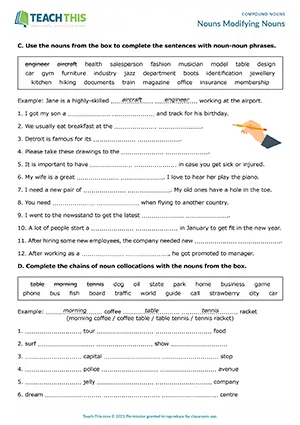
ESL Nouns Modifying Nouns Worksheet preview for Upper-intermediate with identifying, writing definitions, collocations, and gap-fill

ESL Nouns Modifying Nouns Worksheet - Vocabulary Exercises: Identifying, Writing Definitions, Forming Collocations, Gap-fill

This comprehensive noun-noun phrases worksheet helps students learn and practice how to modify nouns with other nouns. These noun-noun collocations are sometimes called noun adjuncts or qualifying...

ESL Nouns Modifying Nouns Worksheet - Vocabulary Exercises: Identifying, Writing Definitions, Forming Collocations, Gap-fill This comprehensive noun-noun phrases worksheet helps students learn and practice how to modify nouns with other nouns. These noun-noun collocations are sometimes called noun adjuncts or qualifying nouns. Students begin by circling phrases containing two nouns and rewriting them in other words. After that, students write three nouns that can modify different nouns. Next, students use nouns from a box to complete sentences with noun-noun phrases. Finally, students complete chains of noun collocations with nouns from a box.

What's the Compound Noun?

Upper-intermediate (B2) 50 minutes
ESL Compound Nouns Game preview for Upper-intermediate B2 showing forming definitions and group guessing

ESL Compound Nouns Game - Vocabulary: Forming Definitions, Guessing - Group Work

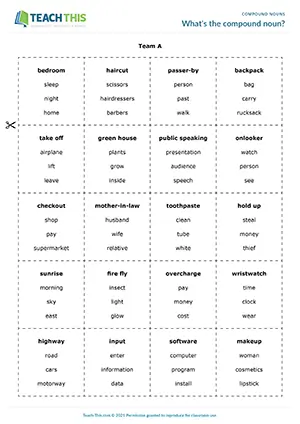
In this creative compound nouns game, students define compound nouns using certain words and guess compound nouns from another team's descriptions. First, teams look at their cards and think about how they can define each compound...

ESL Compound Nouns Game - Vocabulary: Forming Definitions, Guessing - Group Work In this creative compound nouns game, students define compound nouns using certain words and guess compound nouns from another team's descriptions. First, teams look at their cards and think about how they can define each compound noun by using the words on the cards or variations of the words. Teams then take it in turns to pick up a card and define the compound noun to the other team, starting with the compound elements. The opposing team has one minute to listen to the description and guess the compound noun. If the opposing team manages to guess the compound noun before the time limit has been reached, they win and keep the card. If not, the defining team wins and keeps the card. The team with the most cards at the end of the game wins.

Understanding Compound Nouns

Compound nouns combine two or more words to create a single new meaning and can be written as one word, two words, or with a hyphen, as in 'toothbrush,' 'bus stop,' or 'dry-cleaning.' There is no reliable rule for which written form a compound takes, so students need to learn each one as a fixed unit, and guessing wrong produces a form that a reader will immediately notice.

This page covers compound nouns at Intermediate and Upper-intermediate levels, with eight resources including worksheets, drawing and guessing games, a domino game, and a speaking activity, one of which is available as a free download.

The table shows the most common patterns for forming compound nouns in English, with an example of each pattern and a note on whether the compound is typically written as one word, two words, or hyphenated.

Formation PatternStructureExampleWritten Form
Noun + Noun (closed) noun + noun sunflower One word: 'a sunflower'
Noun + Noun (open) noun + noun car park Two words: 'a car park'
Adjective + Noun adjective + noun blackboard One word: 'a blackboard'
Verb + Noun verb + noun washing machine Two words: 'a washing machine'
Noun + Verb noun + verb sunrise One word: 'a sunrise'
Verb + Preposition verb + preposition checkout One word: 'a checkout'
Preposition + Noun preposition + noun underground One word: 'the underground'

When to Use Compound Nouns

Naming New Concepts and Technologies: English constantly creates compound nouns to name new technologies and concepts because combining two familiar words is the quickest way to give something a precise, recognizable name, as in 'smartphone,' 'laptop,' and 'inbox,' where the parts together signal a meaning neither word carries alone.

Workplace and Professional Vocabulary: Professional environments rely heavily on compound nouns to describe roles, processes, and locations efficiently, so a worker needs to know whether to say 'deadline,' 'workflow,' or 'meeting room' rather than reaching for a longer descriptive phrase each time.

Signposting in Formal and Academic Writing: Academic and formal writers use compound nouns as concise labels for complex ideas, allowing a phrase like 'case study,' 'feedback loop,' or 'decision-making process' to carry a precise shared meaning without needing further explanation each time it appears.

3-Step Framework for Teaching Compound Nouns

1. Build Recognition and Form Through Structured Practice: Start with a worksheet that moves students from recognition to production in clear stages. Students look at pictures and complete compound nouns by choosing words from a box, then match each compound noun with its compound elements to make the internal structure visible. After gap-fill practice, they finish by writing a sentence about each picture using a compound noun, so every stage connects form to meaning.

2. Bring the Structure to Life With a Drawing Game: Follow up with a whole-class drawing game that makes compound noun formation visual and competitive. One student draws two separate words on the board and the first team to shout out the compound noun scores a point. A correct definition earns the team an extra point, but if they cannot define it, the other team can steal that point, which keeps every team alert even when it is not their turn.

3. Push Productive Knowledge With a Definition Challenge: At upper-intermediate level, push students to show they truly own the vocabulary by asking them to define compound nouns rather than just recognize them. Teams pick up a card and define the compound noun to the opposing team, starting with the compound elements. The opposing team has one minute to guess, and whichever team wins the exchange keeps the card, so the pressure stays on both sides of the room at once.

Common Mistakes with Compound Nouns

Writing a Closed Compound as Two Separate Words: Students often write a compound noun as two words when it should be one, typically because the component words look like they belong in a regular noun phrase. Wrong: 'She left her tooth brush in the hotel.' Correct: 'She left her toothbrush in the hotel.'

Pluralizing the First Element of a Compound Noun: Students often add a plural -s to the first word in a compound noun, following the logic of a regular noun phrase rather than the compound noun rule. Wrong: 'She works in the cars industry.' Correct: 'She works in the car industry.'

Common Questions About Teaching Compound Nouns

What is an engaging game for practicing compound nouns?

In the free game Same Same, the teacher calls out a word such as 'hair' and teams race to write as many compound nouns as they can using that word, for example 'hairbrush,' 'hairdresser,' or 'haircut.' Teams score one point for each compound noun not on the teacher's card and two points for any that match.

What is a good speaking activity for practicing compound nouns?

Students in the activity Ask Me Anything complete conversation questions with one word to form a closed compound noun, then write one or two follow-up questions for each. They pair up with someone from the other group to ask and answer the questions, then report back to the class what they found out about their partner.

What is a useful worksheet for teaching compound nouns?

The worksheet Practice Makes Perfect takes students through five stages, from recognizing compound nouns in pictures to producing them in sentences. Students complete compound nouns with words from a box, match each compound noun to its compound elements, complete gap-fill sentences, match words to make new compound nouns, and finish by writing a sentence about each picture.

Become a Teach This Member

  • 3,000+ ESL activities, games and worksheets
  • Online teaching platform with unlimited student access
  • Full access to Game Maker, Worksheet Maker and Slide Maker
View Membership Plans

Here’s What Our Members Are Saying

Jose Pinto

★★★★★

ESL Teacher, Timor-Leste

"There are a lot of resources that are useful for teaching English. I downloaded the games which are handy and use them in my classes. With the games, my students never skip class or feel tired to learn English. The resources for teaching English helped my students progress in grammar, vocabulary, writing and comprehension. They also helped me a lot to guide my students to learn in a practical way."

Julia Lohla

★★★★★

English Instructor, United States

"Thank you for providing these incredible resources. Teach-This.com is always my go-to site for class activities, and I recommend it often. I love how it is organized. I can find resources for a specific grammar concept or language function by level and type of activity. Every time I visit your site, I discover a new classroom interaction strategy that's perfect for teaching the concept I'm focusing on! When I return after the holidays, yours will be the first subscription I restart."

Carrie Brooke-Mellor

★★★★★

ESOL Teacher, United Kingdom

"I am an ESOL teacher, and the resources have helped my classes enormously. In particular, the speaking activities were a great help for my intermediate students before their exam. The website is user-friendly, and I will continue to utilise the resources - next term is reading and comprehension, so I will be looking for more resources from you. Thank you for such helpful activities and worksheets. They save me a lot of time in class preparation."

Charlie Sanders

★★★★★

ESL Teacher, France

"Teach This is an absolutely brilliant website, offering a vast amount of high-quality content, much of it free. Everyone involved in its creation deserves commendation. The leadership's vision has my deepest respect and gratitude. It's undoubtedly the best resource for English teachers, with its clear layout, easy navigation, concise messaging, and lack of invasive advertising - rare qualities that Teach This has perfected."

Joy Tebow

★★★★★

English Teacher, Laos

"When I need to add or change an activity from my school's curriculum, I always turn to TeachThis. While our curriculum is usually very good, it sometimes doesn't fit well with my students. With TeachThis, I can easily find activities that match my topic and level, and the resources make my classes more interesting and varied. I look forward to the monthly newsletter and exploring new materials for inspiration. Please keep it up!"

Mina Zolfaghari

★★★★★

English Tutor, Australia

"I like the efficiency and organization of the website. The resources cater to various levels with topic-based options for higher levels. The worksheets are very engaging and the answer keys are particularly helpful for teacher. The resources are also highly specific to levels and outcomes, making planning much easier. Finding what I need is simple and time-saving with the keyword search feature. Everything is clear and straightforward."

Karin Kiss

★★★★★

ESL Teacher, Switzerland

"The easy and ready-to-go materials have helped me a lot during the last few years. Most of all I like the grammar games that activate my pupils and keep them engaged. My lessons have become way more playful and varied. Additionally, I like the grammar worksheets which I use to consolidate what I have worked on during class. The website is very user-friendly, and I have never had any difficulties finding what I was looking for."

David-Wonbae Lee

★★★★★

Business English Teacher, Canada

"A friend told me about the site, and it's awesome. I have found the Business English resources especially engaging and relevant for my students as the materials help them understand business writing and terms. My teaching experience has also improved from using the games on the site as they allow me to teach in a fun way. The user experience is outstanding. Great job!"

Daniela Garcia

★★★★★

English Teacher, Mexico

"I found Teach-This a long time ago when I started teaching. It's always had great resources. I really appreciate the grammar materials, board games, and group activities. They've saved me lots of time on lesson planning. The materials are easy to use and understand, making my job much simpler. The best thing is that many resources can be downloaded for free. I've used it for around 8 years, and it consistently offers great content."

Thomas Wilson

★★★★★

Primary School Teacher, United Kingdom

"I use the resources from the Games Section as part of my daily 30-minute morning warm-up activities, and I've received rave reviews for using them. The games help me maintain student interest and participation and leave the students feeling happy and awake. I like everything about the site, and customer support is very effective as they respond in time."

Eugenia Fernandez

★★★★★

EFL Teacher, Argentina

"Teach-This is one of the best EFL websites I've found. It's extremely user-friendly, and I always find what I need quickly. I like the design, and the content is fun, engaging and original. I am very thankful for all your work and generosity by making some resources free. I always recommend this website to my fellow teachers. Your work is really helpful, and I value it enormously."

Jakub Havlk

★★★★★

Language School Teacher, Czechia

"I like the grammar-focused resources the most as they save me time. The resources also inspire me. If I see an interesting grammar activity, I often rework it for other grammar rules. I like the fact that I simply pay a flat fee, and I can download whatever I want. Teach-This really is a great timesaver. I know that if I am in need of resources for my students, I can go to Teach-This and find something interesting."

Alice Dimpz

★★★★★

English Teacher, Kenya

"Getting familiar with the site and how to use the resources is not difficult. I found the writing skills resources to be the most valuable as they have enhanced my teaching of this skill. The website is elaborate and full of all types of resources to help me teach English. When I contacted customer support, they were super-fast to deal with my enquiry. So overall, I recommend it."

Ikrram Badaoui

★★★★★

ESL Teacher, Morocco

"I have found the grammar and vocabulary resources the most valuable. They have improved my teaching experience because they are easy to use and well-organized. The materials are very engaging for my students. The website is also very user-friendly. The best thing about Teach-This is that it offers ready-made worksheets for busy teachers, and the content is well-organized and full of information."

Tania Ahmed

★★★★★

High School Teacher, Kurdistan

"I'm really glad I found the Teach-This website. The materials in the General English section have proven to be really helpful and made my classes more engaging. The materials are well-structured and cover a wide range of topics, making it easy to keep my students interested and motivated. Overall, my experience using your resources has been great."

Khawla Orq

★★★★★

EFL Teacher, Yemen

"My first impression of the website was that it was amazing. The games and activities have really improved my teaching. The resources are engaging and relevant to my students' needs, and I find the website easy to use and navigate. Thanks."

Anika Yadav

★★★★★

English Teacher, India

"I would like to thank you for making a fantastic website. I particularly enjoy teaching the functional language materials, which have been very helpful in my classes. The resources have significantly improved my students' communication skills in daily life, so it was rewarding to see them benefit in this way. It feels great to be able to make a difference in my students' lives. Please keep up the good work."

Dr. Elena Petrov

★★★★★

Academic English Coordinator, Spain

"I've been teaching Academic English for over eight years, and Teach-This.com has become my go-to resource for university preparation classes. The academic vocabulary exercises and speaking test preparation activities are exceptionally well-designed for advanced learners. My students particularly appreciate the study skills resources and paragraph writing materials, which have significantly boosted their confidence and exam scores."

Suzanne Coleman

★★★★★

Volunteer English Teacher, England

"I like your resources because they are so interesting and attractive. Your resources help to maintain student interest. Your resources have helped with the planning and preparation of my lessons because I have often been able to find resources focusing on specific topics, grammar or vocabulary. I am particularly grateful for your free resources, which I use at the English Club where I am a volunteer and help to support internationals in the community who are learning English."