
Compound Adjectives ESL Games, Worksheets & Activities
Compound Adjective Practice
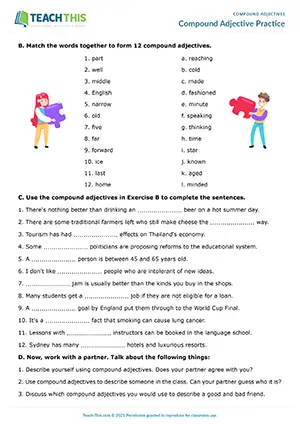
ESL Compound Adjectives Worksheet - Vocabulary Exercises: Forming Words, Matching, Gap-fill - Speaking Activity: Describing Nouns - Pair Work
This free compound adjectives worksheet helps you to teach your students how to form and use compound adjectives. Students begin by reading through the...
Much-Needed Practice

ESL Compound Adjectives Worksheet - Vocabulary Exercises: Identifying, Matching, Gap-fill, Forming Words, Writing Sentences
This productive compound adjectives worksheet helps students learn and practice a variety of compound adjectives. To begin, students indicate which sentences contain compound adjectives and...
Sure Fire Bet
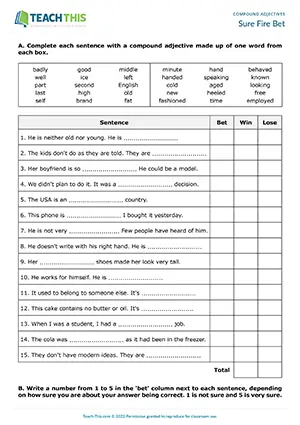
ESL Compound Adjectives Game - Vocabulary: Matching, Gap-fill, Betting
In this insightful compound adjectives game, students complete sentences by creating compound adjectives from words provided and then bet on their answers. Working alone, students complete each sentence with a compound adjective made up...
Compound Adjective Dominoes
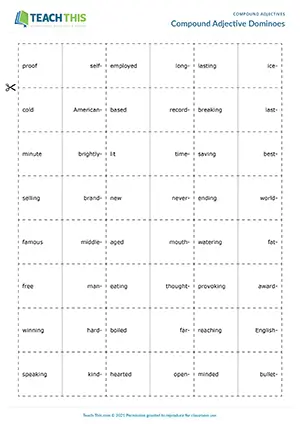
ESL Compound Adjectives Game - Vocabulary and Speaking: Matching, Forming Sentences , Freer Practice - Group Work
In this creative compound adjectives game, students play dominoes by combining words together to form hyphenated compound adjectives and then using...
Compound Catchphrase

ESL Compound Adjectives Game - Vocabulary: Providing Synonyms, Describing, Miming, Guessing - Group Work
In this amusing compound adjectives game, students guess compound adjectives from clues and mimes given by other students. One player from each team comes to the front of the class. Give both players...
Well-Written Questions

ESL Compound Adjectives Activity - Vocabulary and Speaking: Forming Words, Guessing, Asking and Answering Questions, Freer Practice - Pair Work
In this useful compound adjectives speaking activity, students combine words together to form compound adjectives that fit in conversation questions and...
Understanding Compound Adjectives
Compound adjectives combine two or more words to describe a noun and are typically hyphenated before the noun they modify, as in 'a ten-minute walk' or 'a well-known author.' Students who drop the hyphen or use the component words separately risk writing phrases that are ambiguous or simply wrong, which stands out immediately in formal writing.
This page covers compound adjectives at Intermediate (B1) and Upper-intermediate (B2) levels, with six resources spanning worksheets, a betting game, a domino game, and a guessing and miming activity, with one resource available as a free download.
The table below shows the most common patterns for forming compound adjectives in English, with an example of each pattern and a note on hyphenation.
| Formation Pattern | Structure | Example | Notes |
|---|---|---|---|
| Number + Noun | number + singular noun | two-hour | Hyphenated before a noun; the noun stays singular: 'a two-hour delay.' |
| Noun + Past Participle | noun + past participle | sun-dried | Hyphenated before a noun: 'sun-dried tomatoes.' |
| Noun + Present Participle | noun + present participle | mouth-watering | Hyphenated before a noun: 'a mouth-watering meal.' |
| Adjective + Noun + -ed | adjective + noun + -ed | broad-shouldered | Hyphenated before a noun: 'a broad-shouldered man.' |
| Adverb + Past Participle | adverb + past participle | well-known | Hyphenated before a noun: 'a well-known singer.' No hyphen after a linking verb: 'The singer is well known.' |
| Adjective + Past Participle | adjective + past participle | old-fashioned | Hyphenated before a noun: 'an old-fashioned approach.' |
When to Use Compound Adjectives
Describing Precisely in Fewer Words: Writers and speakers use compound adjectives to pack a precise description into a single modifier before a noun rather than using a longer phrase, so 'a five-star hotel' delivers more information more efficiently than 'a hotel with five stars.'
Headlines, Advertising, and Punchy Writing: Compound adjectives appear frequently in headlines and advertising copy because they create vivid, memorable descriptions in tight spaces, where separating the words into a longer phrase would lose the punch, as in 'last-minute deals' or 'an award-winning design.'
Describing Physical Appearance: Compound adjectives are the natural choice in English for describing a person's physical features in a single, economical modifier, rather than listing each feature in a separate clause, as in 'A broad-shouldered, dark-haired man walked into the room.'
3-Step Framework for Teaching Compound Adjectives
1. Introduce the Structure and Get Students Producing: Start with a structured worksheet that walks students through formation before asking them to produce. Students read an introduction to the different ways compound adjectives are formed, then practice describing nouns using the structure immediately, building phrases like 'a ten-minute walk' from prompts. They then match words to build more compound adjectives, complete gap-fill sentences, and finish by describing themselves and others to a partner.
2. Build Accuracy Through a Betting Game: Once students have met the forms, raise the stakes with a game that makes accuracy feel personally meaningful. Students complete sentences by choosing one word from each of two boxes to form the correct compound adjective, then bet between 1 and 5 points on each answer depending on how confident they are. When you reveal the answers, students transfer their stake to the 'win' column for a correct answer or the 'lose' column for a wrong one, so accuracy has a tangible cost.
3. Push Production With a Domino Chain Game: Move up to a game that demands both accurate formation and spontaneous sentence production. Students take turns placing dominoes at either end of a growing chain, combining the two halves to form a correct compound adjective. Forming a valid compound adjective earns one point, and using it correctly in a sentence earns an extra point, so students have a genuine reason to push beyond recognition into active use.
Common Mistakes with Compound Adjectives
Keeping the Hyphen When No Noun Follows: Students often keep the hyphen when a compound adjective follows a verb and describes the subject directly, without a noun immediately after it. The hyphen is only correct when the compound adjective sits directly before a noun. Wrong: 'He is well-known.' Correct: 'He is well known.' / 'He is a well-known actor.'
Pluralizing the Noun in a Number + Noun Compound: Students often pluralize the noun inside a number + noun compound adjective, applying the logic of a regular noun phrase rather than the compound adjective rule. Wrong: 'It was a two-hours delay.' Correct: 'It was a two-hour delay.'
Common Questions About Teaching Compound Adjectives
What is a useful worksheet for teaching compound adjectives?
The worksheet Much-Needed Practice takes students from identifying compound adjectives in sentences and matching them to pictures, through gap-fill and creating compound adjectives from clues, to writing their own sentences with the new vocabulary. Each section builds on the last, so by the end students have both recognized and produced a range of compound adjectives.
What is a fun compound adjectives game?
In the game Compound Catchphrase, players use synonyms and mimes to get their team to guess a compound adjective, without saying any form of the target word or any word used in its definition. The first team to guess correctly scores a point, making it a genuinely competitive way to push vocabulary knowledge beyond simple recognition.
What is a good compound adjectives speaking activity?
The activity Well-Written Questions has students form compound adjectives to complete conversation questions, scoring two points for a correct first guess or one point after their partner gives a clue by saying the first part of the compound adjective. Once the guessing phase ends, students ask and answer the conversation questions with their partner.
Become a Teach This Member
Get unlimited access to the full library, plus new resources added every week.
Unlimited Resource Access
Download from 3000+ worksheets, activities, and games.
Save 5+ Hours Weekly
Cut lesson prep time with ready-to-use resources, plus teacher notes and answer keys.
Trusted Professional Quality
Classroom-tested, editable resources created by experienced ESL professionals.
Fresh Content Weekly
Get 5 new resources added to the library each week.
Here's what our members are saying...


