
Business Follow‑up & Update Emails Worksheets
First Meeting Follow-up
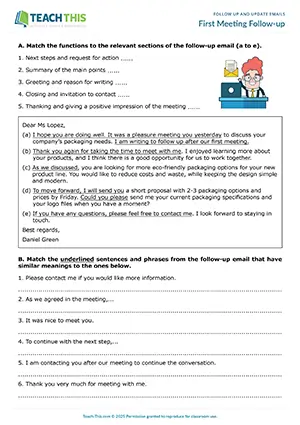
Business English Follow-up Emails Worksheet - Reading, Vocabulary and Writing Exercises: Identifying, Gap-fill, Email Writing - Pair Work
In this comprehensive business follow-up emails worksheet, students learn and practice the structure and language needed for writing effective follow-up emails after...
Job Applications Follow-Up Emails
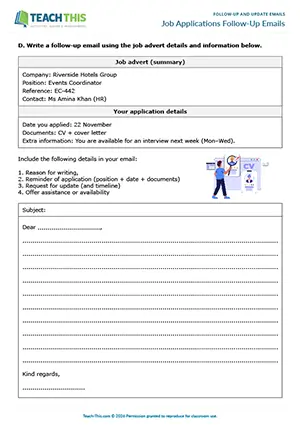
Business English Follow-up Emails Worksheet - Reading, Vocabulary and Writing Exercises: Rewriting Sentences, Email Writing
In this job application follow-up emails worksheet, students learn and practice polite, formal language for following up on a job application and then write...
Polite Follow‑up Emails
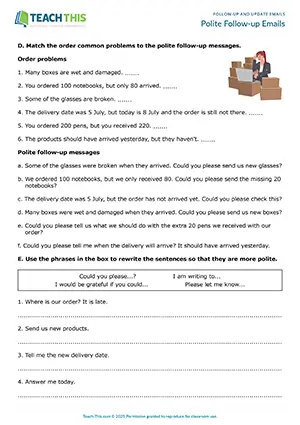
Business English Follow-up Emails Worksheet - Reading, Vocabulary and Writing Exercises: Identifying, Matching, Email Writing
In this free follow-up emails worksheet, students practice useful language for checking on an order and following up on delivery problems, and then...
Project Status Update Emails

Business English Update Emails Worksheet - Reading, Vocabulary and Writing Exercises: Matching, True or False, Gap-fill, Email Writing
In this project status update email worksheet, students read a model internal project update email, complete controlled practice tasks and then write their own short...
Short Follow-up Emails
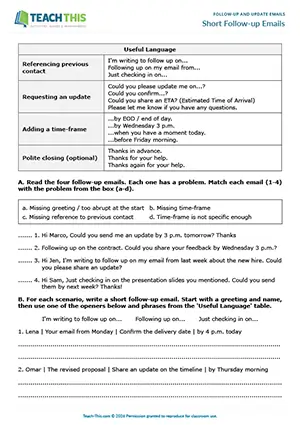
Business English Follow-up Emails Worksheet - Reading, Vocabulary and Writing Exercises: Matching, Writing Sentences from Prompts, Email Writing
In this business follow‑up emails worksheet, students identify common problems in follow-up emails and practice writing short, professional follow‑up emails...
Action-Owner Follow-up
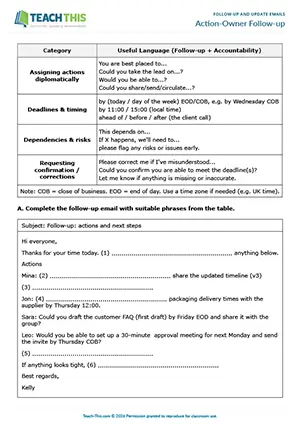
Business English Follow-up Emails Worksheet - Reading, Vocabulary and Writing Exercises: Gap-fill, Rewriting Sentences, Email Writing, Peer Feedback
In this follow-up emails worksheet, students learn to write professional post-meeting emails that assign actions diplomatically and establish clear accountability...
Business Follow-up Emails

Business English Follow-up Emails Worksheet - Reading and Writing Exercises: Matching, Rewriting an Email - Speaking Activity: Discussion - Pair Work
In this handy follow-up emails worksheet, students learn and practice the structure of a business follow-up email and review and practice formal register...
Follow Up Like a Pro
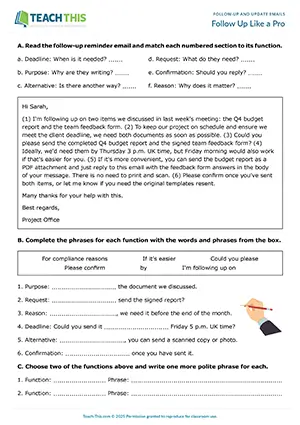
Business English Follow-up Emails Worksheet - Vocabulary and Writing Exercises: Identifying, Matching, Gap-fill, Error Correction, Email Writing
In this follow‑up reminder emails worksheet, students practice identifying the key components of polite follow-up reminder emails and writing their own...
Progressive Follow-ups
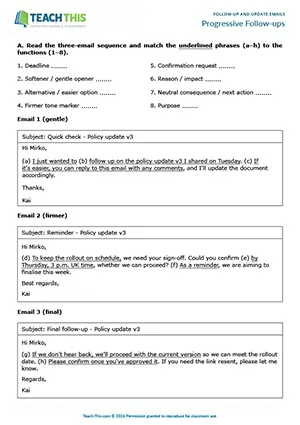
Business English Follow-up Emails Worksheet - Reading, Vocabulary and Writing Exercises: Error Correction, Rewriting Sentences, Email Writing
In this follow-up reminder emails worksheet, students practice writing polite, professional follow-up emails with appropriate escalation. First, students read a model...
Traffic-Light Project Updates
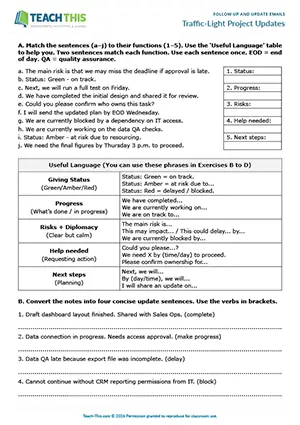
Business English Update Emails Worksheet - Reading and Writing Exercises: Matching, Writing and Rewriting Sentences, Email Writing
In this project update email worksheet, students learn a clear structure for project update emails and practice using Green, Amber, and Red status...
Update Emails
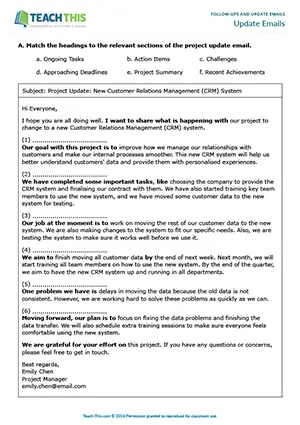
Business English Update Emails Worksheet - Reading, Vocabulary and Writing Exercises: Matching, Writing Sentences, Email Writing, Error Correction
In this update emails worksheet, students learn useful expressions for update emails and use them to write an email about a project update. First, students read...
Business Follow-up and Update Emails
A follow-up email returns to earlier contact, an outstanding request or an agreed action, while an update email reports new information about progress or changes. Students need to make the context, current situation and next step clear so readers can respond or act without reconstructing the whole exchange.
This page contains eleven worksheets across B1 and B2, including one free worksheet, covering meeting follow-ups, reminders, job applications, order enquiries and project updates.
The table shows useful email functions with hypothetical workplace examples.
| Email function | Purpose | Example language |
|---|---|---|
| Refer to earlier contact | Help the reader identify the relevant exchange. | 'I'm following up on our discussion about the training schedule.' |
| Request a response | State exactly what information or action is needed. | 'Could you confirm the delivery date for order 245?' |
| Report completed work | Distinguish progress from work still outstanding. | 'We have completed the first draft and sent it for review.' |
| Explain a risk | Identify an issue that could affect the plan. | 'The supplier has not confirmed availability, so the start date may change.' |
| Confirm responsibility | Make an agreed action and its owner explicit. | 'As agreed, Maya will send the revised figures by Thursday.' |
| State the next update | Set a clear expectation for further information. | 'I will send another update on Friday, including any changes to the schedule.' |
How to Write Follow-up and Update Emails
Choose the message's purpose: Decide whether the reader needs to answer an outstanding question, complete an action or understand new progress. Put that purpose near the beginning instead of relying on a general phrase such as 'Just checking in'.
Separate completed, current and planned work: In updates, distinguish what has happened from what is still underway or proposed. In follow-ups, refer accurately to previous agreements without implying that someone accepted a deadline or responsibility when they did not.
Make timing useful and proportionate: Include a date when it matters and explain any dependency. The appropriate timing and firmness of a reminder depend on the situation, relationship and prior agreement; there is no single interval that suits every email.
3-Step Framework for Teaching Follow-up and Update Emails
This sequence starts with concise B1 follow-ups and extends into B2 action-focused messages and project updates. Use the stages across lessons according to learners' readiness.
1. Write a Focused Follow-up: Students identify problems in short messages, write emails from scenarios and rewrite abrupt or unclear lines. They compare their emails with a partner. This develops the core connection between previous contact, a specific request and an appropriate time frame.
2. Clarify Actions and Responsibilities: Students match meeting notes to action lines, rewrite unclear wording and identify missing details before writing clarification questions. They then produce a post-meeting email and review it with a partner. This extends a clear request into an account of who will deliver what and when.
3. Report Progress and Request Support: Students match update sentences to functions, turn notes into concise sentences and adjust blunt wording about problems. They then write a project update using a supplied template and status categories. This gives them practice reporting progress, risks, help needed and next steps; the colour categories are a task framework rather than a universal workplace convention.
Common Mistakes with Follow-up and Update Emails
Using a noun-form spelling as a verb: Use follow up as the verb and follow-up before a noun. Incorrect: 'I am writing to follow-up on my request.' Correct: 'I am writing to follow up on my request' or 'This is a follow-up email about my request.'
Leaving the required action unclear: A polite message may still fail to tell the reader what response is needed. Vague: 'Any news on this?' More specific: 'Could you confirm whether the revised schedule has been approved? We need confirmation before booking the room.'
Common Questions About Teaching Follow-up and Update Emails
What worksheet helps teach project update emails?
The worksheet Project Status Update Emails uses a model message to introduce the sections of an internal update. Students work with time expressions, sequencing and sentence corrections before turning project notes into sentences and a complete email to a manager. A partner checklist then supports feedback on the finished message.
What free worksheet helps teach polite follow-up emails?
The worksheet Polite Follow‑up Emails compares two messages about a late order and asks students to explain which they would send. Students match problems with suitable responses and soften direct sentences before writing to a supplier. Peer feedback and editing help them refine the clarity and tone of their follow-up.
What worksheet helps teach follow-up emails after meetings?
The worksheet First Meeting Follow-up introduces email structure and useful phrases through a model message. Students match sections to functions, work with equivalent expressions and complete phrases before using meeting details to write sentences and a full email. Partners then give one positive comment and one suggestion using a review checklist.
Become a Teach This Member
Get unlimited access to the full library, plus new resources added every week.
Unlimited Resource Access
Download from 3000+ worksheets, activities, and games.
Save 5+ Hours Weekly
Cut lesson prep time with ready-to-use resources, plus teacher notes and answer keys.
Trusted Professional Quality
Classroom-tested, editable resources created by experienced ESL professionals.
Fresh Content Weekly
Get 5 new resources added to the library each week.
Here's what our members are saying...


