
The Writing Process EAP Worksheets & Activities
Analysing Essay Questions
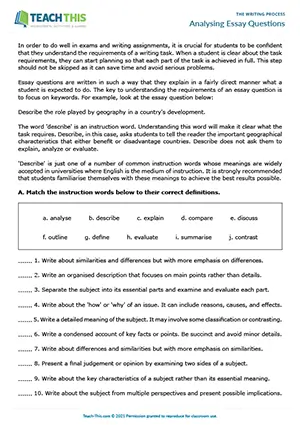
EAP Analysing Essay Questions Worksheet - Reading and Writing Exercises: Matching, Writing a Thesis Statement and Main Ideas
In this comprehensive analysing essay questions worksheet, students learn instruction words and practice strategies for understanding and clarifying writing task requirements. Students begin...
Brainstorming and Mind Mapping

EAP Brainstorming and Mind Mapping Worksheet - Reading and Writing Exercises: Brainstorming, Creating a Mind Map and an Essay Outline, Writing an Essay
In this useful brainstorming and mind mapping worksheet, students learn and practice two common pre-writing techniques. Students then use one of the techniques...
Revising and Editing an Essay
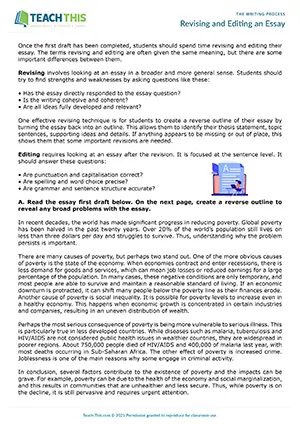
EAP Revising and Editing an Essay Worksheet - Reading and Writing Exercises: Creating an Essay Outline, Writing Notes, Editing and Revising a Paragraph
In this free revising and editing worksheet, students learn the differences between revising and editing and use revising and editing techniques to identify...
Two-Draft Sprint
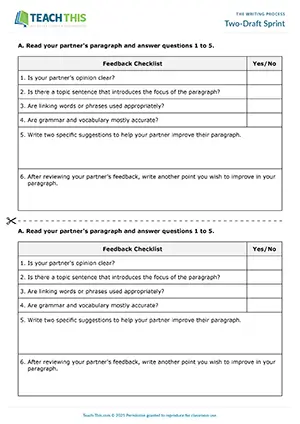
EAP Drafting and Revising Activity - Reading and Writing: Paragraph Writing, Peer Review and Feedback, Self-Reflection
In this handy drafting and revising activity, students draft a paragraph and then use peer feedback and self-reflection to revise and improve their work. First, students have five minutes to read a prompt and...
Writing Process Relay
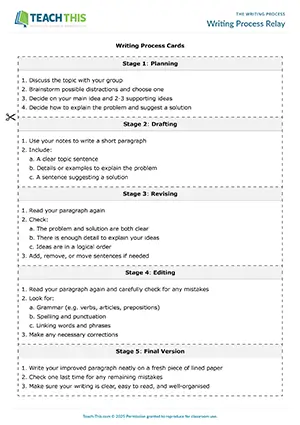
EAP Writing Process Activity - Writing: Brainstorming, Outlining, Drafting, Revising, Editing, Peer Feedback - Group Work
In this collaborative writing process activity, students plan, draft, revise, and edit a short academic paragraph, then exchange focused peer feedback in a gallery walk to refine their writing. In groups, students...
Gallery Walk Peer Review
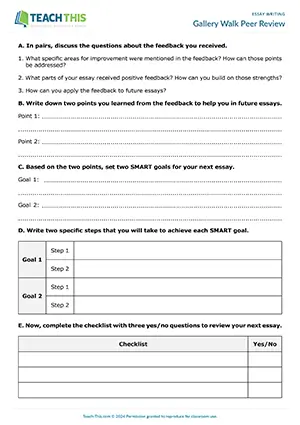
EAP Writing Process Activity - Reading, Writing and Speaking Activity: Peer Review, Writing Sentences, Discussion, Setting SMART goals, Freer Practice - Pair Work
In this engaging writing process activity, students participate in a gallery walk where they give and receive peer feedback on essay writing and set related SMART...
How to Analyse an Essay Question

EAP Writing Process Worksheet - Writing Exercises: Matching, Identifying, Writing an Essay Question and Essay, Peer Review
In this productive analysing essay questions worksheet, students learn and practice topic words, instruction words and limiting words that can be used to decode essay writing prompts. Students then...
The Writing Assignment Research Process
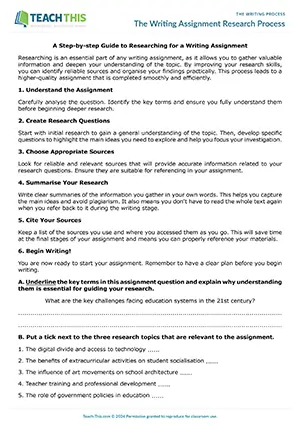
EAP Writing Process Worksheet - Reading and Writing Exercises: Research Questions, Summary Writing - Speaking Activity: Peer Review, Freer Practice - Pair Work
In this informative writing process worksheet, students learn key steps in the research process with a particular focus on developing research questions and...
Understanding the Academic Writing Process
The academic writing process involves understanding a task, developing ideas, drafting, revising and editing. These stages help students turn initial ideas into a clear response, while allowing them to return to their plans when writing or feedback reveals something that needs changing.
This page contains eight resources across B1 and B2, including worksheets and activities for analysing questions, planning, researching, drafting and reviewing writing, with one free worksheet.
The table shows the purpose of each stage and a question students can use to check their progress.
| Stage | Purpose | Checking question |
|---|---|---|
| Analyse the task | Identify the topic, required response and limits of the assignment. | 'What does the question ask me to explain, compare or evaluate?' |
| Generate and research ideas | Develop relevant points and find suitable evidence when sources are required. | 'Which ideas answer the question, and what support do they need?' |
| Plan | Organise selected ideas into a workable structure. | 'What will each paragraph contribute to my response?' |
| Draft | Develop the plan into connected sentences and paragraphs. | 'Have I explained my point and supported it with a relevant example or evidence?' |
| Revise | Improve the content, organisation and clarity of the draft. | 'Do I need to add, remove, move or explain anything?' |
| Edit | Check language accuracy and consistency. | 'Have I checked grammar, punctuation, vocabulary and spelling?' |
How to Develop an Academic Text
Start with the assignment: Help students identify instruction words and the scope of the question before generating ideas. A response to 'compare' needs a different organisation from a response that explains the causes of a problem.
Keep the plan flexible: Treat an outline as a working guide. If drafting reveals a missing explanation or an irrelevant point, students can return to their notes, adjust the outline and continue writing.
Review meaning before polishing language: Check whether the draft answers the question and develops its ideas before concentrating on sentence-level corrections. Separate review passes make it easier to distinguish a content problem from a language error.
3-Step Framework for Teaching the Writing Process
This sequence develops task analysis and drafting at B1, then extends feedback skills at B2. Use it across lessons as appropriate to the class, rather than treating the resources as one continuous assignment.
1. Clarify the Task and Plan a Response: Students match essay instruction words to their meanings and apply a strategy for breaking down an essay question. They then develop a working outline. This establishes what the writing needs to achieve before students focus on producing sentences.
2. Draft, Review and Redraft: Students plan a response to a paragraph prompt, write a first draft and exchange checklist feedback with a partner. They use two peer suggestions and one self-identified improvement to redraft, highlight their changes and explain them in a short reflection. This makes revision visible rather than treating the first draft as finished work.
3. Turn Feedback into Future Writing Goals: With a completed short essay, B2 students circulate to read classmates' work and record a strength and an area for improvement. They discuss the feedback on their own essays, set two SMART goals and identify steps towards each goal. Creating a short checklist then helps them apply what they learned to their next essay.
Common Mistakes with the Writing Process
Writing about the topic without answering the task: Relevant information is not enough if the response ignores the instruction word. Incomplete response: A question asks students to compare two study methods, but the draft only describes one. Better approach: Plan points that examine both methods using the same criteria.
Treating revision as spelling correction: Correct language cannot fix a missing explanation or an unrelated paragraph. Limited revision: Correcting spelling while leaving an unsupported main point unchanged. Better approach: Develop the point with relevant support, check its connection to the question, and then edit the language.
Common Questions About Teaching the Writing Process
What activity helps students practice the writing process?
Writing Process Relay takes groups through planning, drafting, revising and editing a short academic paragraph, with students taking turns as the main writer. Groups then read each other's paragraphs in a gallery walk and record strengths and improvements. They use the feedback to identify what to continue and what to change in future writing.
What worksheet helps teach essay planning?
Brainstorming and Mind Mapping introduces two ways to generate ideas before writing. Students create a brainstorming list or mind map for an essay about work-life balance, then organise their ideas into an outline. They use that outline to write a complete essay, connecting the planning stage with the text they produce.
What free worksheet helps teach revising and editing?
Revising and Editing an Essay distinguishes changes to content and organisation from corrections to language. Students create a reverse outline of a first draft and note necessary revisions. They then check a body paragraph separately for grammar and punctuation, and for vocabulary and spelling, before rewriting it to correct the errors.
Become a Teach This Member
Get unlimited access to the full library, plus new resources added every week.
Unlimited Resource Access
Download from 3000+ worksheets, activities, and games.
Save 5+ Hours Weekly
Cut lesson prep time with ready-to-use resources, plus teacher notes and answer keys.
Trusted Professional Quality
Classroom-tested, editable resources created by experienced ESL professionals.
Fresh Content Weekly
Get 5 new resources added to the library each week.
Here's what our members are saying...


