
Discussion Essays EAP Worksheets & Activities
Cancel Culture
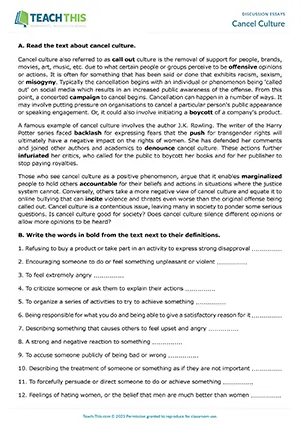
EAP Discussion Essays Worksheet - Reading and Writing Exercises: Matching, Outline and Essay Writing - Speaking: Discussion, Communicative Practice - Group Work
In this comprehensive discussion essay writing practice, students read and discuss a text on the topic of cancel culture and then plan and write a discussion...
Explore the Issue
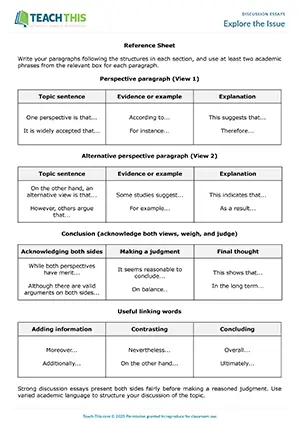
EAP Discussion Essays Activity - Writing and Speaking: Paragraph Writing, Guided Discussion, Communicative Practice - Group Work
In this effective discussion essay activity, students collaboratively build a balanced essay by writing one paragraph presenting a perspective, one paragraph...
From Dice to Draft

EAP Discussion Essays Activity - Speaking and Writing Activity: Impromptu Speech, Writing a Paragraph, Peer Review, Communicative Practice - Pair Work
In this engaging discussion essay activity, students collaboratively generate ideas about a discussion essay topic and then write a paragraph using the ideas...
Introduction to Discussion Essays
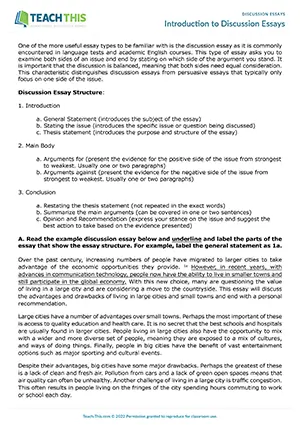
EAP Discussion Essays Worksheet - Writing Exercises: Previewing a Model Essay Structure, Identifying Essay Features, Writing an Outline and Essay, Peer Feedback
In this free discussion essays worksheet, students are introduced to discussion essay structure and attempt a discussion essay writing practice. First, students...
Jigsaw Essay Building
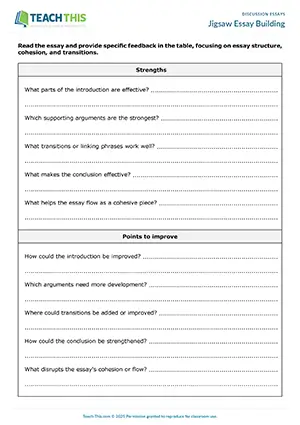
EAP Discussion Essays Activity - Writing: Brainstorming, Paragraph Writing, Essay Writing, Peer Review and Feedback - Group Work
In this collaborative writing activity, students practice organising a discussion essay and improving cohesion between sections. First, in groups of four, students discuss...
Referring to Widely Held Beliefs
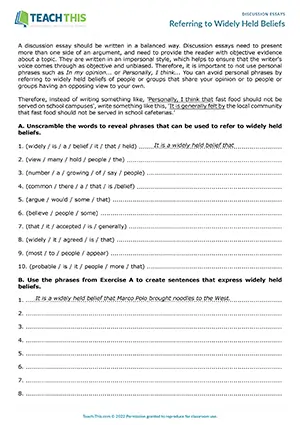
EAP Discussion Essays Worksheet - Writing Exercises: Unscrambling, Writing Sentences, Writing an Outline and Essay - Speaking Activity: Freer Practice - Pair Work
In this productive discussion essays worksheet, students practice phrases used to refer to widely held beliefs and phrases that introduce reasons for those...
Understanding Discussion Essays
A discussion essay examines different perspectives on an issue and develops a response supported by reasons and examples. Writers need to represent the views fairly, explain their significance and reach a conclusion that follows from the discussion and the assignment's requirements.
This page contains six upper-intermediate (B2) resources, including one free worksheet. The materials cover essay structure, exploring opposing perspectives, generating ideas, collaborative writing, referring to widely held beliefs and reviewing drafts.
Use the reference below to connect each part of the discussion with its purpose. Adapt the organisation and treatment of the writer's position to the question rather than imposing one structure on every essay.
| Essay task | Purpose | Useful language or check |
|---|---|---|
| Introduce the issue | Establish what the discussion will examine | Define the topic and keep the scope manageable. |
| Present a perspective | Explain a view and its reasoning | 'Supporters of this approach argue that...' |
| Develop support | Show why the point deserves consideration | 'For example...' followed by a relevant example and an explanation of its significance. |
| Present another perspective | Explore an alternative explanation or priority | 'An alternative view is that...' |
| Evaluate a point | Consider its strength, limitations or conditions | 'This argument is convincing when..., but it does not account for...' |
| Conclude | Bring the discussion together and answer the question | Weigh the points already developed without adding a new major argument. |
How to Develop Discussion Essays
Read the question before choosing a structure: Identify which views need discussing and whether the task asks for the writer's opinion. Students should plan their response around those requirements rather than memorise a fixed number of paragraphs.
Develop perspectives fairly: Ask students to explain why someone might reasonably support each view and what would count as relevant support. Fair treatment does not require pretending that every claim has equally strong evidence or that every issue has only two possible positions.
Connect examples with evaluation: After an example, ask what it demonstrates and where its limits lie. Distinguish a hypothetical illustration from evidence about the real world, and check that the conclusion reflects the discussion rather than simply repeat a preference.
3-Step Framework for Teaching Discussion Essays
For upper-intermediate students, move from explaining views and reasons to organising a shared essay and reviewing an individual draft. Use the selected resource stages across lessons, introducing each topic before asking students to develop arguments about it.
1. Explain views and the reasons behind them: Students reconstruct phrases for referring to widely held beliefs, use them in sentences and add follow-up reasons. They then discuss views about online learning and prepare an outline. Remind students that a phrase such as 'It is widely believed' does not itself establish that a view is common or true.
2. Build a coherent discussion together: Groups brainstorm points for different sides of an essay question and keep shared notes. Each student drafts a section, then the group reads the sections in order and combines them. They revise inconsistencies and transitions before another group gives feedback.
3. Draft and review independently: Students read a topic text, discuss its competing arguments and organise their ideas in an outline before writing an essay. They exchange drafts and use a checklist to give feedback. Ask writers to identify a specific revision that would improve their reasoning, organisation or response to the question.
Common Mistakes with Discussion Essays
Treating a list of opinions as a developed discussion: Naming different views does not explain their reasoning. Underdeveloped: 'Some people support online learning, while others oppose it.' Better approach: Explain a reason for each view, develop it with a relevant example and consider its limitations. Avoid inventing evidence or claiming that a view is widespread without support.
Introducing a new major argument in the conclusion: A point first mentioned at the end has not been examined in the discussion. Weak organisation: Ending with a new cost argument after discussing only access and interaction. Better approach: Develop the cost point in the body if it is relevant, or base the conclusion on the points already examined.
Common Questions About Teaching Discussion Essays
How can students practice discussing both sides of an issue?
The activity Explore the Issue uses shared writing to develop different perspectives. Students write a paragraph, pass it on for an alternative viewpoint and pass it again for a concluding evaluation. Reading the completed texts together prompts discussion about how the ideas developed and whether the final judgement weighs both perspectives.
What free worksheet helps teach discussion essay structure?
The worksheet Introduction to Discussion Essays introduces an example structure and asks students to identify its parts in a model essay. Students then prepare an outline and write their own essay using guidance on key features. A partner checklist supports constructive feedback on how effectively those features appear in the draft.
What activity helps students generate ideas for discussion essays?
The activity From Dice to Draft uses six speaking prompts to explore a topic from opposing viewpoints. Pairs discuss opinions, examples and counterarguments before each student writes a paragraph using the ideas. They then exchange paragraphs and complete a peer review table, connecting spoken preparation with writing and feedback.
Become a Teach This Member
Get unlimited access to the full library, plus new resources added every week.
Unlimited Resource Access
Download from 3000+ worksheets, activities, and games.
Save 5+ Hours Weekly
Cut lesson prep time with ready-to-use resources, plus teacher notes and answer keys.
Trusted Professional Quality
Classroom-tested, editable resources created by experienced ESL professionals.
Fresh Content Weekly
Get 5 new resources added to the library each week.
Here's what our members are saying...


