
Tag Questions ESL Games, Activities & Worksheets
Introduction to Question Tags
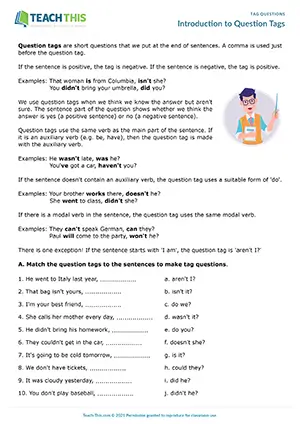
ESL Tag Questions Worksheet - Grammar Exercises: Matching, Gap-fill, Error Correction, Question Completion
This useful tag questions worksheet helps students learn how to make tag questions. In the first exercise, students match question tags to sentences to make tag questions. Students then complete...
Two Halves
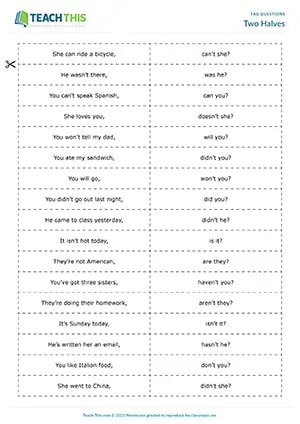
ESL Tag Question Games - Grammar: Matching, Pelmanism - Pair Work
In these enjoyable tag question games, students match affirmative and negative statements with their respective tags to make tag questions. In pairs, students have five minutes to match affirmative or negative sentence cards and tag...
You can use tag questions, can't you?
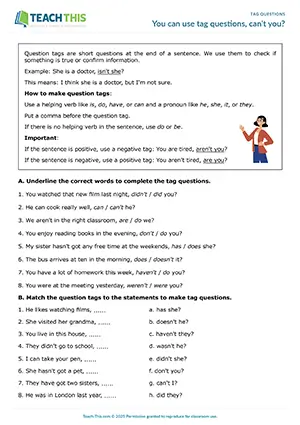
ESL Tag Questions Worksheet - Grammar Exercises: Binary Choice, Matching, Gap-fill - Speaking Activity: Role-Play, Freer Practice - Pair Work
This comprehensive tag questions worksheet helps students practice forming and understanding tag questions for everyday conversations. First...
Do you know your classmates?
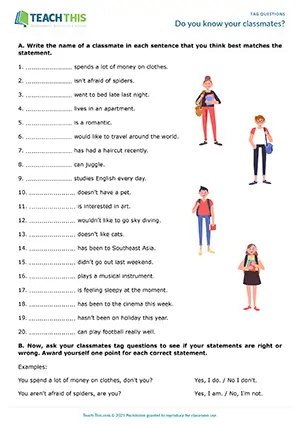
ESL Tag Questions Activity - Grammar and Speaking: Guessing, Sentence Completion, Asking and Answering Questions
Here is a free tag questions speaking activity to help students practice tag questions and short answers. Students begin by writing the name of a classmate in each sentence that they think best matches...
How much can you remember?

ESL Tag Questions Game - Grammar and Speaking: Asking and Answering Questions, Confirming Information - Group Work
Here is a productive tag questions game that helps students practice mixed question and answer forms, tag questions and short answers. First, students use the cards marked number 1 and take turns...
I'm right, aren't I?
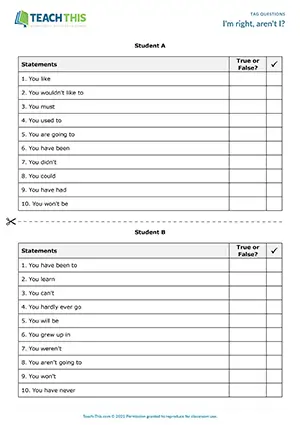
ESL Tag Questions Game - Grammar and Speaking: Sentence Completion, True or False, Asking and Answering Questions, Freer Practice - Pair Work
In this amusing tag questions game, students guess whether statements about a partner are true or false and then ask tag questions to confirm the information...
It's true, isn't it?
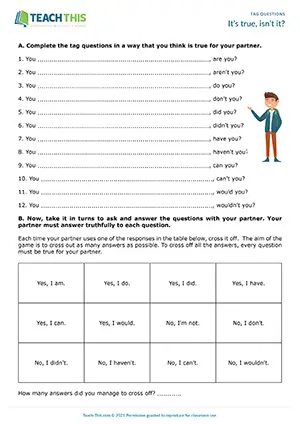
ESL Tag Questions Game - Grammar and Speaking: Guessing, Writing, Asking and Answering Questions - Pair Work
In this insightful tag questions game, students write and ask tag questions in order to confirm true information about a partner. To begin, in pairs, students complete tag questions in a way that...
Let's Find Out
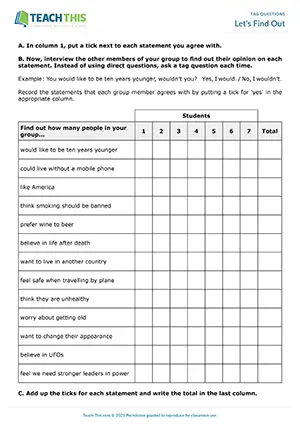
ESL Tag Questions Activity - Grammar, Speaking and Writing: Asking and Answering Questions, Writing Sentences - Group Work
In this interesting tag questions activity, students conduct a survey to find out their classmates' opinions on certain topics using tag questions and then...
No Doubt
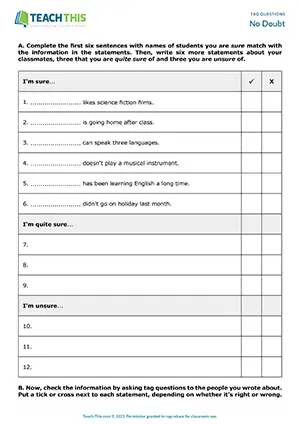
ESL Tag Questions Activity - Grammar and Speaking: Guessing, Completing and Writing Sentences, Asking and Answering Questions
In this engaging tag questions activity, students use tag questions to check information that they are sure and unsure of. To begin, students complete six sentences on the worksheet with the...
Question Tag Dominoes
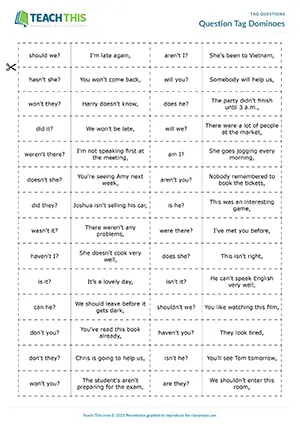
ESL Tag Questions Game - Grammar: Matching - Group Work
In this rewarding tag question dominoes game, students match question tags to affirmative and negative statements and vice-versa. The first player puts a domino down either before or after the domino on the table, making sure the affirmative...
Question Tag Snap
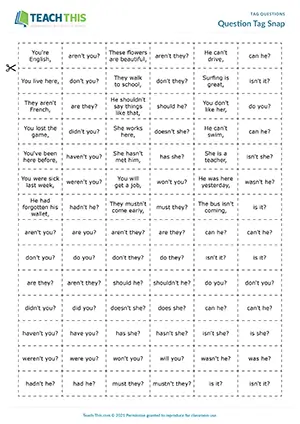
ESL Question Tags Game - Grammar: Matching - Group Work
In this fun question tags game, students play snap by matching affirmative and negative sentences to question tags and vice-versa. One player goes first and turns over the top card from their pile and places it face-up in the 'sentence' or 'tag' box...
Tag Questionnaire
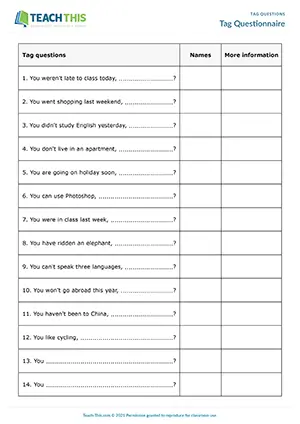
ESL Tag Questions Activity - Grammar and Speaking: Completing, Asking and Answering Questions, Freer Practice
In this free tag questions speaking activity, students conduct a class questionnaire using tag questions. First, students complete questions on the worksheet with positive and negative tags. Students...
Tagged
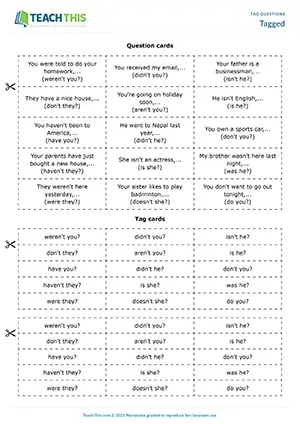
ESL Question Tags Game - Grammar and Listening: Matching, Question Completion - Group Work
In this entertaining question tags game, students race to complete sentences with positive or negative question tags. In groups, the student with the questions picks up a card and reads the beginning of...
Tag Talk
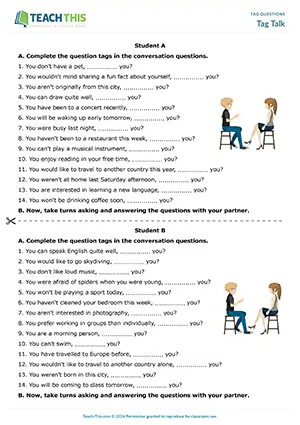
ESL Question Tags Activity - Grammar and Speaking: Completing, Asking and Answering Questions, Controlled and Freer Practice - Group and Pair Work
In this handy tag questions speaking activity, students practice completing, asking and answering tag conversation questions. First, in two groups, students...
Tic-Tac-Toe Tags
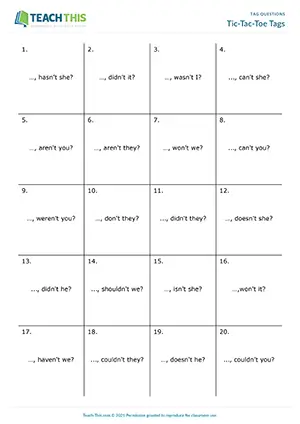
ESL Question Tags Game - Grammar and Speaking: Forming, Asking and Answering Questions - Group Work
This creative question tags game can be used to review tag questions and short answers. Draw a four by five grid on the board. Number the squares and write a question tag in each one. Next, teams take...
You remember, don't you?
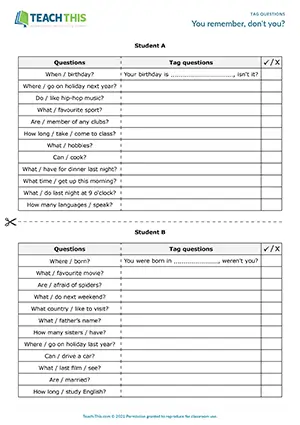
ESL Tag Questions Game - Grammar and Speaking: Writing, Asking and Answering Questions, Guessing - Pair Work
In this intriguing tag questions game, students form, ask and answer questions and then check how many answers they can remember by asking tag questions. Students fold their worksheets and hold the...
Who's talking to who?
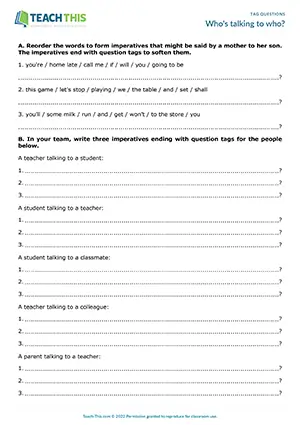
ESL Tag Questions Game - Grammar: Unscrambling, Writing Sentences, Guessing, Matching - Group Work
In this memorable question tags game, students practice using affirmative or negative tags after imperative clauses to soften the imperatives. Students begin by unscrambling words to form imperative...
Understanding Tag Questions
Tag questions are short phrases added to the end of a statement to check information or invite agreement: a positive statement takes a negative tag and a negative statement takes a positive tag, each using the same helping verb as the main clause. Students who flip the tag incorrectly, writing 'She isn't coming, isn't she?' instead of 'She isn't coming, is she?', produce questions that confuse listeners and break the natural back-and-forth of conversation.
This page covers tag questions across A2, B1, and B2 levels, with seventeen resources including worksheets, card games, dominoes, speaking activities, and a survey, two of which are available as free downloads.
The table below shows how to form tag questions across the most commonly taught statement types at A2 to B2 level.
| Statement Type | Example Statement | Question Tag | Full Tag Question |
|---|---|---|---|
| Positive present simple (be) | She is a teacher | isn't she? | 'She is a teacher, isn't she?' |
| Negative present simple (be) | They aren't ready | are they? | 'They aren't ready, are they?' |
| Positive present simple (other verbs) | He works here | doesn't he? | 'He works here, doesn't he?' |
| Negative present simple (other verbs) | You don't know her | do you? | 'You don't know her, do you?' |
| Positive present continuous | She is coming tonight | isn't she? | 'She is coming tonight, isn't she?' |
| Positive past simple | She visited Paris | didn't she? | 'She visited Paris, didn't she?' |
| Positive past continuous | They were watching TV | weren't they? | 'They were watching TV, weren't they?' |
| Positive present perfect | They have finished | haven't they? | 'They have finished, haven't they?' |
| Positive future with will | He will come | won't he? | 'He will come, won't he?' |
| Positive with modal (can) | You can drive | can't you? | 'You can drive, can't you?' |
| Imperative (to soften) | Pass me that file | will you? | 'Pass me that file, will you?' |
When to Use Tag Questions
Drawing a Listener Into Conversation: Speakers use tag questions as a social tool to turn a statement into an invitation to respond, keeping the conversation moving rather than making a one-sided comment, for example 'The weather has been terrible lately, hasn't it?' opens a topic without demanding a reply.
Expressing Surprise or Disbelief: When a speaker uses a rising intonation on the tag, the tag question signals genuine uncertainty or surprise rather than a simple request for confirmation, making it the natural choice when reacting to unexpected news, for example 'She resigned this morning, did she?'
Softening a Command: Adding a tag to an imperative sentence turns a direct instruction into a polite request, which is especially useful in professional or service contexts where a softer tone matters, for example 'Pass me that file, will you?' sounds considerably more courteous than 'Pass me that file.'
3-Step Framework for Teaching Tag Questions
1. Introduce the Form with a Worksheet: Open at A2 level with a structured worksheet that walks students through every key skill they need to build tag questions from scratch. Start with matching, where students pair question tags to statements to see how the structure fits together, then move through gap-fill and error correction before reaching the final exercise, where students write tags independently to complete tag questions without any support.
2. Consolidate with a Dominoes Game: Once students can form tags reliably, shift to a dominoes game at B1 level that turns accuracy into a game consequence. Each player places a domino either before or after the domino on the table, making sure the affirmative or negative statement matches with the question tag, then reads the tag question to the group for confirmation. If the tag question is incorrect, the player must take the domino back, so every error has a direct cost.
3. Extend into Freer Production with a Survey: Push students into extended communicative use at B1 level with a survey activity where they use tag questions to find out classmates' real opinions on a range of topics, for example 'You would like to be ten years younger, wouldn't you?' After collecting responses, students write up their group's findings using phrases like All of us, Most of us, Some of us, and None of us before reporting back to the class.
Common Mistakes with Tag Questions
Using the Wrong Helping Verb in the Tag: Students often use a default helping verb in the tag that does not match the tense or verb in the main clause, rather than mirroring whatever helping verb the statement uses. Wrong: 'She has finished the report, doesn't she?' Correct: 'She has finished the report, hasn't she?'
Using a Noun Instead of a Pronoun in the Tag: Students often repeat the subject noun from the main clause in the tag, not realizing that the tag always requires a pronoun to refer back to the subject. Wrong: 'David is coming to the party, isn't David?' Correct: 'David is coming to the party, isn't he?'
Common Questions About Teaching Tag Questions
What is a fun tag questions game?
In the game I'm right, aren't I?, students complete statements about a partner, swap worksheets, and decide whether each statement is true or false. They then ask a tag question to confirm, such as 'You don't like going to parties, do you?' The student with the most correct guesses wins.
How do I teach tag questions with a worksheet?
The worksheet You can use tag questions, can't you? moves students from written exercises into a spoken role-play. Students work through binary choice, matching, and gap-fill to build accuracy, then role-play a conversation between a new student and a teacher where the student asks tag questions to check information. Both students swap roles for equal practice.
What is a good tag questions speaking activity?
Real communicative purpose is what lifts tag question practice beyond gap-fill. In the free activity Tag Questionnaire, students complete tag questions with positive and negative tags, then create two more of their own before going around the class asking each question to students they think can confirm the information. When a classmate answers appropriately, the student writes down their name.
Become a Teach This Member
Get unlimited access to the full library, plus new resources added every week.
Unlimited Resource Access
Download from 3000+ worksheets, activities, and games.
Save 5+ Hours Weekly
Cut lesson prep time with ready-to-use resources, plus teacher notes and answer keys.
Trusted Professional Quality
Classroom-tested, editable resources created by experienced ESL professionals.
Fresh Content Weekly
Get 5 new resources added to the library each week.
Here's what our members are saying...


