
Mixed Conditionals ESL Games, Activities & Worksheets
Conditional Time Warp
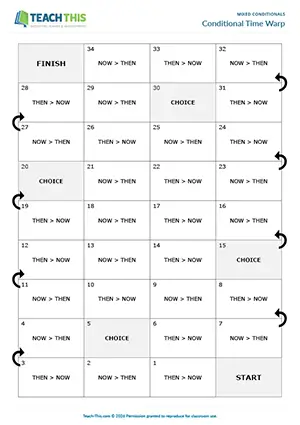
ESL Mixed Conditionals Game - Grammar and Speaking: Forming Sentences from Prompts - Group Work
In this challenging mixed conditional board game, students use verb prompts and the time cues 'now' and 'then' to create mixed conditional sentences. In groups, players take turns rolling the dice and moving...
Mixed Conditional Café
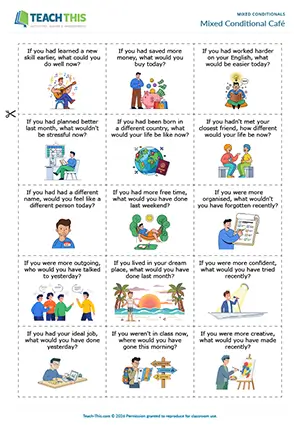
ESL Mixed Conditionals Activity - Grammar and Speaking: Asking and Answering Questions, Discussion, Freer Practice - Group Work
Here is an insightful mixed conditionals discussion activity that helps students practice using mixed conditional forms to talk about a broad range of 'what...
Mixed Conditional Chains
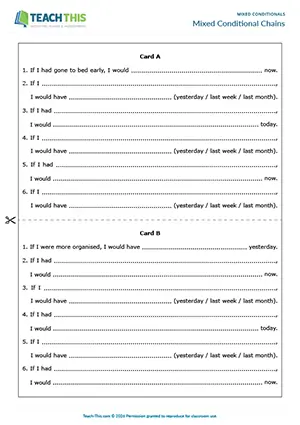
ESL Mixed Conditionals Activity - Grammar and Writing: Writing Sentences - Group Work
In this useful mixed conditionals activity, students practice mixed conditionals by writing sentence chains that alternate between past and present time reference. To begin, students read the...
Mixed Conditionals Domino Challenge
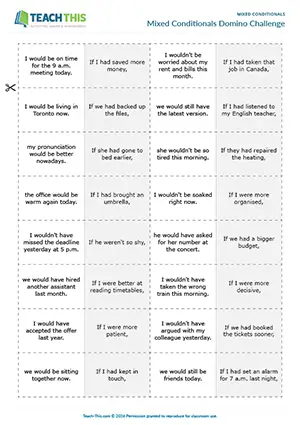
ESL Mixed Conditionals Game - Grammar: Matching - Group Work
In this rewarding mixed conditionals game, students play dominoes by matching sentence halves to form mixed conditional sentences with past and present time references. To begin, the first player tries to make a mixed conditional sentence by...
Mixed Conditionals in Action
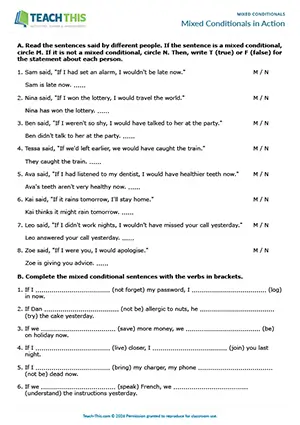
ESL Mixed Conditionals Worksheet - Grammar Exercises: Binary Choice, True or False, Gap-fill, Rewriting Sentences, Sentence Completion
In this comprehensive mixed conditionals worksheet, students practice using mixed conditionals to connect past situations with present results and present...
Mixed Conditional Medley
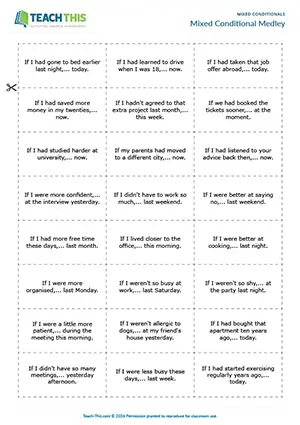
ESL Mixed Conditionals Game - Grammar and Speaking: Sentence Completion, Freer Practice - Group Work
In this free mixed conditionals game, students race to complete time-shift conditional sentences. In groups, one student begins by picking up a card and reading the if-clause and time marker, using the...
Sticky-Note Time Machine
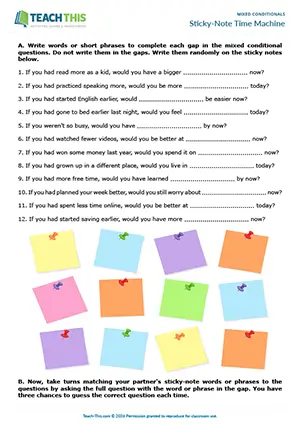
ESL Mixed Conditionals Game - Grammar and Speaking: Writing Short Answers, Asking and Answering Questions, Guessing, Discussion, Freer Practice - Pair Work
In this rewarding mixed conditionals game, students practice asking and answering questions using mixed conditional forms to connect past situations with...
Time-Shift Countdown
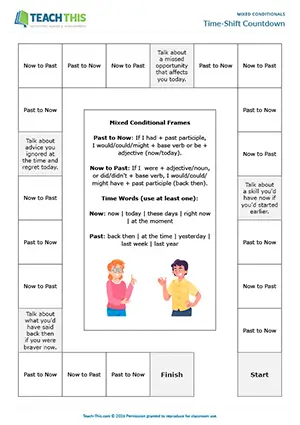
ESL Mixed Conditionals Game - Grammar and Speaking: Forming Sentences, Short Answers, Freer Practice - Group Work
In this engaging mixed conditionals board game, students practice forming and using mixed conditional sentences with past and present time expressions. Players take turns rolling the dice and moving...
What If?
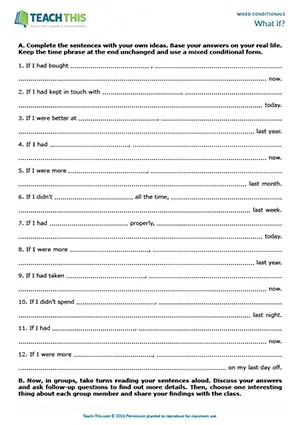
ESL Mixed Conditionals Activity - Grammar, Writing and Speaking: Sentence completion, Discussion, Communicative Practice - Group Work
In this interesting mixed conditionals activity, students complete sentences based on their real lives using mixed conditional forms and then discuss their answers...
Understanding Mixed Conditionals
Mixed conditionals are conditional sentences that link two different time frames in a single sentence: one common pattern pairs a past if-clause with a present result, as in 'If I had studied harder, I would have a better job now', and the other pairs a present if-clause with a past result, as in 'If I were more ambitious, I would have applied for that role last year.' When students avoid mixed conditionals and stick to standard second or third conditional forms instead, they can only describe hypothetical situations within a single time frame, which means they cannot naturally express how a past decision is still affecting them today or how a current trait might have changed something in their past.
This page covers mixed conditionals at B2 level with nine activities including board games, a worksheet, writing activities, and discussion activities, with one activity available as a free download.
The table below maps the two mixed conditional patterns with their if-clause and result clause structures, including the three main modal verbs used in each pattern.
| Pattern | If-Clause Structure | Result Clause Structure | Example |
|---|---|---|---|
| Pattern 1 (Past to Present) with 'would' | If + past perfect | would + base verb | 'If I had studied medicine, I would be a doctor now.' |
| Pattern 1 (Past to Present) with 'could' | If + past perfect | could + base verb | 'If I had practiced more, I could play the piano well now.' |
| Pattern 1 (Past to Present) with 'might' | If + past perfect | might + base verb | 'If I had left earlier, I might be there by now.' |
| Pattern 2 (Present to Past) with 'would have' | If + past simple / were | would have + past participle | 'If I were more organized, I would have finished on time.' |
| Pattern 2 (Present to Past) with 'could have' | If + past simple / were | could have + past participle | 'If I were braver, I could have said something yesterday.' |
| Pattern 2 (Present to Past) with 'might have' | If + past simple / were | might have + past participle | 'If I were more careful, I might have avoided that mistake.' |
When to Use Mixed Conditionals
Expressing Ongoing Regret: When a speaker wants to connect a past mistake directly to their current situation, Pattern 1 lets them make that link explicit in a single sentence, as in 'If I hadn't quit the gym three years ago, I would be in much better shape now.'
Reflecting on Character and Past Outcomes: When a speaker reflects on how a personal quality or habit shaped what happened in the past, Pattern 2 lets them frame the connection naturally in a single sentence, as in 'If I were a better listener, I would have understood what she meant at the time.'
Imagining Cross-Time Hypotheticals: When writers or speakers want to speculate about how a past event would change the present, only a mixed conditional can capture that cross-time logic in a single sentence, as in 'If the project had launched on schedule, we would already be seeing results.'
3-Step Framework for Teaching Mixed Conditionals
1. Establish the Two Patterns on Paper: Before students attempt free production, give them structured written work that builds their understanding of both patterns. A useful progression moves from recognition (identifying which sentences are mixed conditionals and which are not) through controlled practice (completing sentences with correct verb forms) to transformation, where students rewrite second or third conditional sentences as mixed conditionals. That rewriting stage is the most demanding and the most valuable, because it forces students to consciously shift tense frames rather than just fill in a gap.
2. Add Time-Direction Pressure with a Game: Once students can produce both patterns in writing, move them to spoken production under time pressure. A board game works well here because the square a student lands on dictates which pattern they must use: a THEN > NOW square requires a past condition paired with a present result, while a NOW > THEN square requires a present condition paired with a past result. Students must also include the correct time markers in their sentence, and the group decides whether the pattern, the time markers, and the grammar are all correct before the player can stay on the square.
3. Open It Up to Real Discussion: The final step is freer practice where students use both patterns to talk about their own lives and ideas. Give each student a discussion question card that specifies the time direction, and ask them to choose the pattern that matches the time reference before they respond. A question like 'If you had learned a new skill earlier, what could you do well now?' gives students a genuine communicative reason to use the structure, because it only makes sense if they answer in the correct mixed conditional form. After each answer, the group asks follow-up questions, which naturally generates more production without the grammar feeling forced.
Common Mistakes with Mixed Conditionals
Third Conditional Result Clause Used in Pattern 1: Students often use 'would have + past participle' in the result clause of a Pattern 1 sentence instead of 'would + base verb', producing a third conditional rather than a mixed conditional. Wrong: 'If I had taken that job, I would have earned more now.' Correct: 'If I had taken that job, I would earn more now.'
Simple Past Used Instead of Past Perfect in the If-Clause: Students often use the simple past in the if-clause of a Pattern 1 mixed conditional instead of the past perfect, sliding back into a second conditional structure. Wrong: 'If I studied harder at school, I would have a better job now.' Correct: 'If I had studied harder at school, I would have a better job now.'
Common Questions About Teaching Mixed Conditionals
What is a good worksheet for practicing mixed conditionals?
The worksheet Mixed Conditionals in Action covers both patterns in a single sequence. Students identify which sentences are mixed conditionals, mark true or false statements based on them, complete sentences with correct verb forms, then rewrite second or third conditional sentences as mixed conditionals before finishing with their own if-clause completions.
What is a fun game for teaching mixed conditionals?
The free game Mixed Conditional Medley is fast-paced: one student reads an if-clause aloud, using 'blank' for the missing main clause, for example 'If I had gone to bed earlier last night, BLANK today.' The group races to complete the sentence, and the first student with a grammatically correct answer wins the card.
What is an interesting speaking activity for mixed conditionals?
In the game Sticky-Note Time Machine, students write their mixed conditional answers on sticky notes rather than in the question gaps. Partners then ask the full question to match each note to the correct gap, scoring three points for a first guess, two for a second, and one for a third. Discussing real-life examples follows once all gaps are filled.
Become a Teach This Member
Get unlimited access to the full library, plus new resources added every week.
Unlimited Resource Access
Download from 3000+ worksheets, activities, and games.
Save 5+ Hours Weekly
Cut lesson prep time with ready-to-use resources, plus teacher notes and answer keys.
Trusted Professional Quality
Classroom-tested, editable resources created by experienced ESL professionals.
Fresh Content Weekly
Get 5 new resources added to the library each week.
Here's what our members are saying...


