
Third Conditional ESL Games, Activities & Worksheets
Complete the Conditional
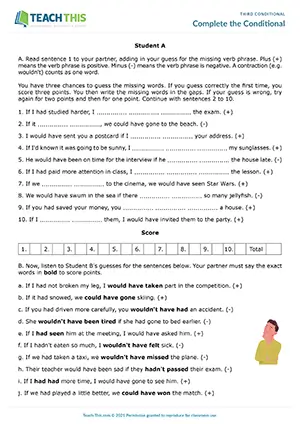
ESL Third Conditional Game - Grammar: Gap-fill, Guessing - Pair Work
In this engaging third conditional game, students practice the third conditional by completing and guessing missing verb phrases in sentences. Student A starts by reading the first third conditional sentence to their partner and guessing...
Guess my Sentence
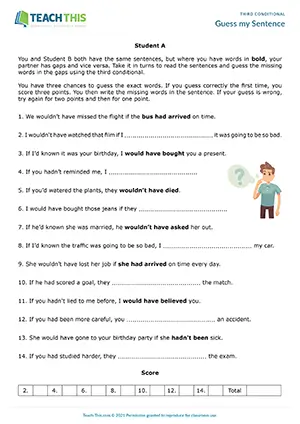
ESL Third Conditional Game - Grammar: Gap-fill, Guessing - Pair Work
In this fun third conditional game, students guess missing if-clauses or result clauses in third conditional sentences. Both students have the same third conditional sentences, but where they have words in bold, their partner has gaps and vice versa...
If Things Were Different
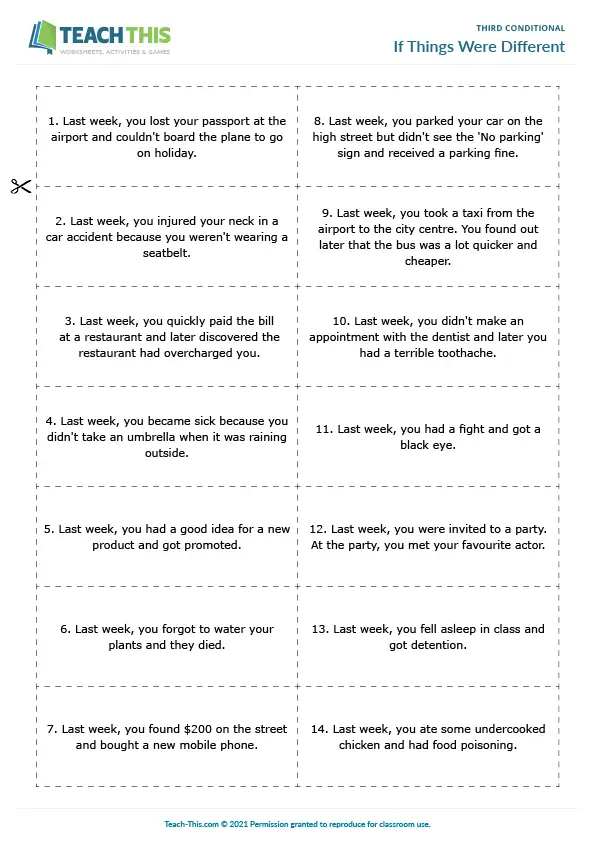
ESL Third Conditional Activity - Grammar and Speaking: Asking and Answering Questions, Writing Sentences
In this free third conditional speaking activity, students find out what happened to their classmates last week and write third conditional sentences about how things could have been different. First...
If you had...?
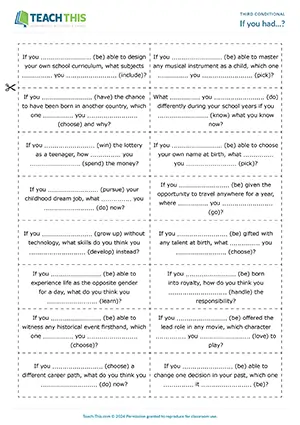
ESL Third Conditional Activity - Grammar and Speaking: Completing, Asking and Answering Questions, Discussion, Communicative Practice - Group Work
In this third conditional speaking activity, students ask, answer and discuss what they would have done in hypothetical past situations. In groups, students...
It's Regrettable

ESL Third Conditional Game - Grammar and Speaking: Forming Sentences, Guessing, Freer Practice - Group Work
In this thought-provoking third conditional game, students guess the underlying problem from classmates' third conditional sentences expressing regret. In groups, each student takes a card and thinks about...
Just Imagine
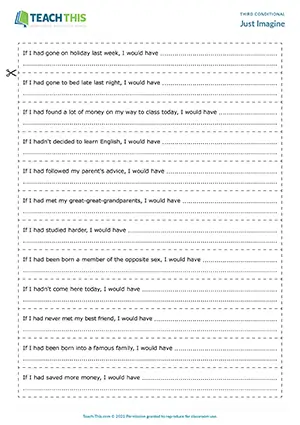
ESL Third Conditional Game - Grammar and Speaking: Sentence Completion, Asking and Answering Questions, Freer Practice - Group Work
In this free third conditional game, students first complete sentence prompts about hypothetical past situations and then race to identify who wrote each...
Mary's Disastrous Dinner Party
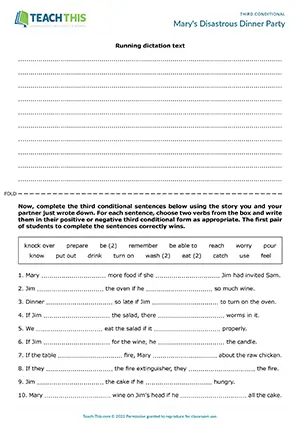
ESL Third Conditional Activity - Grammar and Speaking: Running Dictation, Gap-fill - Pair Work
In this productive third conditional running dictation activity, students race to dictate a story and then use it to complete third conditional sentences. One student is the reader and the other is the...
Mastering the Third Conditional

ESL Third Conditional Worksheet - Grammar Exercises: Matching, Gap-fill, Error Correction, Rewriting Sentences, Sentence Completion
In this comprehensive third conditional worksheet, students practice forming and using the third conditional to talk about unreal past situations and their results...
My Mistake
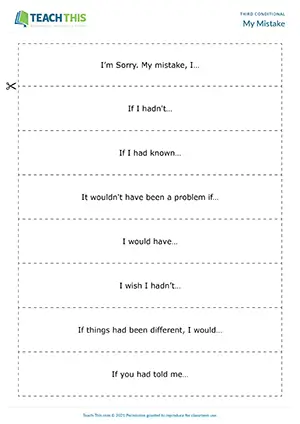
ESL Third Conditional Role-Play - Speaking Activity: Preparing and Delivering a Dialogue, Identifying, Forming Sentences, Freer Practice - Group Work
In this creative third conditional activity, students role-play situations where someone made a mistake and needs to accept responsibility. In groups...
Third Conditional Board Game
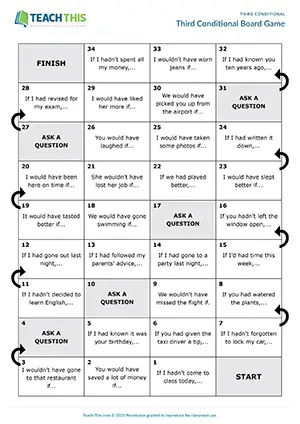
ESL Third Conditional Board Game - Grammar and Speaking: Sentence Completion, Asking and Answering Questions, Freer Practice - Group Work
In this enjoyable third conditional board game, students practice the third conditional by completing prompts and asking and answering questions...
Third Conditional Practice
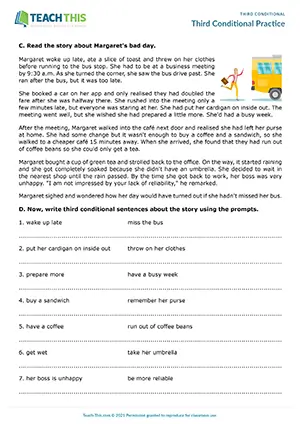
ESL Third Conditional Worksheet - Grammar and Reading Exercises: Gap-fill, Unscrambling, Writing Sentences, Reading for Detail
This useful third conditional worksheet helps students practice forming and using affirmative and negative third conditional sentences. After reading...
What Might Have Happened?
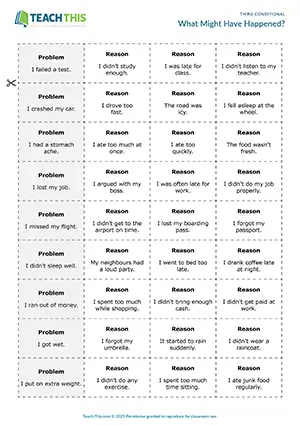
ESL Third Conditional Game - Grammar and Speaking: Matching, Forming Sentences, Controlled Practice - Group Work
In this rewarding third conditional game, students practice forming third conditional sentences to express regrets about unreal past situations. In groups, students take turns picking up a problem card and...
Understanding the Third Conditional
The third conditional uses the structure 'if + past perfect, would have + past participle' to talk about imaginary situations in the past and their hypothetical results, as in 'If I had studied harder, I would have passed the exam.' Students who confuse it with the second conditional produce sentences that sound as though they are talking about a present or future situation rather than a finished past one, which undermines the meaning entirely.
This page covers the third conditional with 13 activities spanning gap-fill pair games, card-matching games, a running dictation, a role-play, and a full speaking mingle, including two free downloads.
Note that 'had' is used for all subjects including 'I,' the result clause can use 'would,' 'could,' or 'might' to vary the degree of certainty, and in formal writing the if-clause can be inverted by placing 'had' first and dropping 'if' entirely. The table below shows the fixed if-clause structure and the main result clause options for the third conditional.
| Form | Structure | Example |
|---|---|---|
| Standard if-clause | if + subject + had + past participle | 'If he had studied harder' |
| Standard result clause (would) | subject + would have + past participle | 'he would have passed the exam.' |
| Result clause (could) | subject + could have + past participle | 'he could have passed the exam.' |
| Result clause (might) | subject + might have + past participle | 'he might have passed the exam.' |
| Negative if-clause | if + subject + hadn't + past participle | 'If she hadn't missed the bus' |
| Negative result clause | subject + wouldn't have + past participle | 'she wouldn't have been late.' |
| Inverted formal if-clause | had + subject + past participle, no 'if' | 'Had he arrived on time' |
When to Use the Third Conditional
Analyzing Cause and Effect After the Fact: Writers and speakers reach for the third conditional when they want to trace how one past decision shaped a chain of consequences, as in a post-project review where a team notes, 'If we had set clearer deadlines, we would have delivered on time.'
Offering Tactful Criticism Without Direct Blame: The third conditional lets a speaker point out what went wrong while framing it as a hypothetical rather than an accusation, which softens the impact, as in 'If you had confirmed the booking, we wouldn't have lost the reservation.'
Exploring Historical Turning Points: Historians, journalists, and students writing analytical essays use the third conditional to speculate about how events might have unfolded differently, as in 'If the ceasefire agreement had held, the conflict might have ended within months.'
3-Step Framework for Teaching the Third Conditional
1. Build the Foundation First: Before students attempt any speaking, give them time to work through the structure systematically. Start with exercises that move from matching clause halves to completing verb forms, and then to finding and correcting mistakes in third conditional sentences. That error-correction step is especially valuable: students who can spot a wrong form in someone else's sentence are much better placed to monitor their own production.
2. Move to Controlled Speaking with Cards: With the structure secure, shift to a card activity where students pick up a problem card, read it aloud, then match it with a reason card from their hand. The real challenge comes in combining both cards into a correctly formed third conditional sentence, producing examples like 'If I had studied enough, I wouldn't have failed the test.' Other group members act as judges for accuracy and logical fit, which keeps everyone focused.
3. Push into Freer Production with a Role-Play: Once students can form the structure accurately, a role-play pushes them into more spontaneous territory. Groups prepare a short scene about a mistake, building their dialogue from eight prompts on strips. While one group performs, the others listen and hold up a corresponding strip each time they hear one of the eight prompts, which drives focused listening alongside production.
Common Mistakes with the Third Conditional
Using 'Would Have' in the If-Clause: Students often copy the result clause pattern into the if-clause, writing 'would have' where the past perfect is required. Wrong: 'If I would have known about the meeting, I would have attended.' Correct: 'If I had known about the meeting, I would have attended.'
Dropping 'Have' from the Result Clause: Students often write the result clause as 'would + past participle' instead of 'would have + past participle,' leaving out the 'have' that marks the event as a completed past action. Wrong: 'If I had called earlier, I would arrived on time.' Correct: 'If I had called earlier, I would have arrived on time.'
Common Questions About Teaching the Third Conditional
What is an engaging third conditional board game?
The board game Third Conditional Board Game combines controlled and freer practice as players move around the board completing sentence prompts. When they land on an 'Ask a question' square, they ask a third conditional question to another student, such as 'What would you have done if you had woken up at 5 a.m.?' Group members judge each answer.
What third conditional worksheet can I use in class?
The worksheet Third Conditional Practice covers three task types and moves from controlled to freer production. Students complete gap-fill sentences with verbs in brackets, then reorder words to form sentences starting with an if-clause, and finally read a story about someone's bad day and write third conditional sentences about it using prompts.
What is a good third conditional speaking activity?
If Things Were Different is a free speaking activity where students use real personal information to practice the third conditional. They imagine a situation from their card happened to them last week, go around the class asking classmates 'What happened to you last week?' and write a third conditional sentence about how things could have been different.
Become a Teach This Member
Get unlimited access to the full library, plus new resources added every week.
Unlimited Resource Access
Download from 3000+ worksheets, activities, and games.
Save 5+ Hours Weekly
Cut lesson prep time with ready-to-use resources, plus teacher notes and answer keys.
Trusted Professional Quality
Classroom-tested, editable resources created by experienced ESL professionals.
Fresh Content Weekly
Get 5 new resources added to the library each week.
Here's what our members are saying...


