
Love, Romance & Dating ESL Games & Worksheets
Let's Talk about Love!
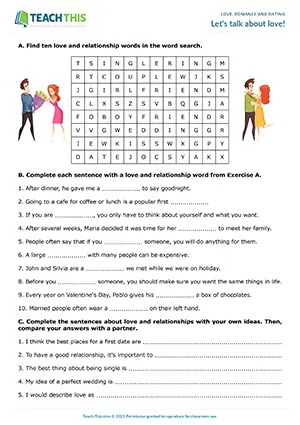
ESL Love and Dating Worksheet - Vocabulary and Writing Exercises: Word Search, Gap-fill, Sentence Completion, Listing - Speaking Activity - Pair Work
In this intriguing love and dating worksheet, students practice love and relationship vocabulary. First, students find ten love and relationship words in a word...
Love Story Scramble
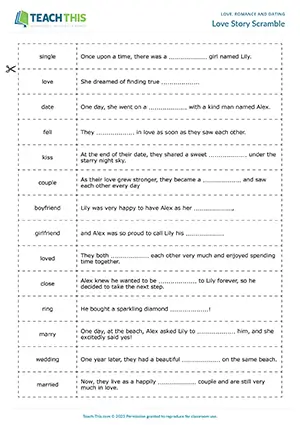
ESL Love Story Game - Vocabulary: Matching, Pelmanism, Gap-fill, Ordering - Pair Work
In this enjoyable love story game, students match gap-fill sentences from a love story with related vocabulary and then race to put the story in order. First, students play a pelmanism game where...
What makes you feel loved?
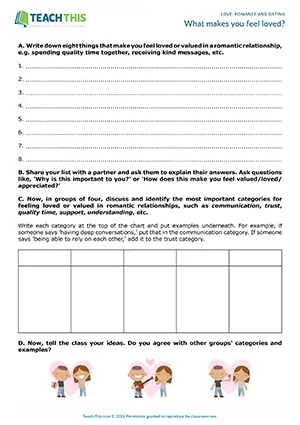
ESL Love and Relationships Activity - Speaking: Listing, Discussions, Categorising - Pair and Group Work
In this intriguing love and relationships activity, students consider what makes them feel loved and valued in a romantic relationship, share the information with their classmates, and discuss...
Happily Ever After
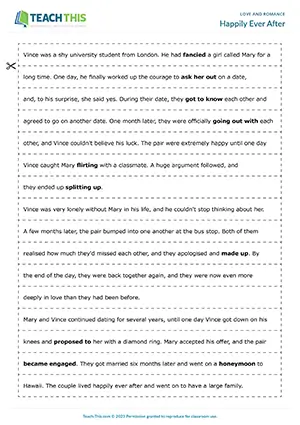
ESL Love and Romance Activity - Vocabulary and Reading Exercises: Ordering, Matching - Speaking Activity: Asking and Answering Questions, Freer Practice - Pair Work
This free love story activity helps students practice vocabulary related to love and romance. First, in pairs, students arrange sentence strips in the...
The Game of Love
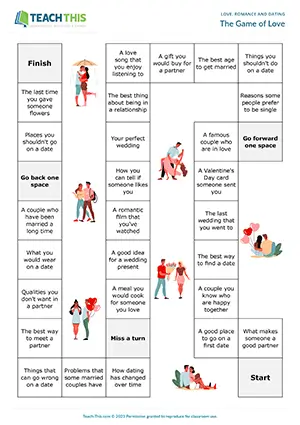
ESL Love, Romance and Dating Board Game - Vocabulary and Speaking: Impromptu Speech, Communicative Practice - Group Work
Here is an engaging love-themed board game to help students practice talking about love, romance and dating. In groups, students take turns rolling the dice and...
The Language of Love
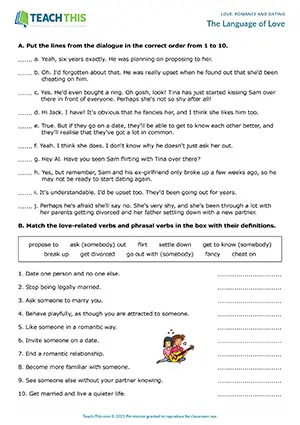
ESL Love and Dating Board Worksheet - Reading and Vocabulary Exercises: Binary Choice, Gap-fill - Speaking Activity: Discussion - Pair Work
This love vocabulary worksheet helps students practice verbs and phrasal verbs related to love, romance and dating. First, students put lines from a...
Using Love, Romance and Dating Vocabulary
Love, romance and dating vocabulary includes words and phrases for feelings, relationships and the events that bring people together or apart. Learning these expressions in stories and conversations helps students describe relationships and explain ideas without relying on a few general words.
This page has six resources across A2, B1 and B2, including games, worksheets and speaking activities, with one free download.
The table connects useful expressions with their meanings and sentence patterns.
| Word or phrase | Meaning or use | Example |
|---|---|---|
| ask someone out | Invite someone on a date | 'Alex asked Sam out for dinner.' |
| go on a date | Meet someone socially with a romantic interest | 'They went on a date last Friday.' |
| fall in love with | Begin to feel romantic love for someone | 'She fell in love with her best friend.' |
| be in a relationship | Have a romantic partner | 'The main character is in a relationship.' |
| get engaged | Agree to marry | 'They got engaged last summer.' |
| break up with | End a romantic relationship with someone | 'He broke up with his partner.' |
How to Use This Vocabulary
Describe events in sequence: Connect relationship events with time expressions. 'They met at university and started dating a year later' gives a listener a clear timeline.
Explain feelings with reasons: Add a concrete example when discussing an abstract idea. 'The character feels valued because her partner listens to her' connects a feeling with an action.
Discuss stories and opinions: Use fictional characters or general situations when personal questions would feel intrusive. Students can explore the language without sharing their own relationship history.
3-Step Framework for Teaching This Vocabulary
This sequence suits upper-intermediate classes, moving from language in context to organised ideas and extended speaking.
1. Establish Meaning in Context: Students put a dialogue in order, match relationship verbs and phrasal verbs to definitions and choose the correct expressions in sentences. This checks both meaning and form before students use the vocabulary to explain their own ideas.
2. Organise Ideas and Reasons: Students list things that make someone feel loved and valued, discuss their reasons and group examples under categories such as trust or communication. Use an imagined person if preferred. Organising examples gives students material to draw on when speaking at greater length.
3. Sustain a Short Response: Students move around a board and speak about the topic they land on for 30 seconds. Encourage them to develop a point with a reason and an example, drawing on the earlier discussion. The timed turn provides practice in maintaining speech beyond a single sentence.
Common Mistakes with This Vocabulary
Leaving out in after fall: Use the complete expression 'fall in love with someone'. Change 'fall' to suit the tense, but keep 'in love with'. Incorrect: 'She fell love with him.' Correct: 'She fell in love with him.'
Putting a pronoun after out in ask someone out: In this expression, an object pronoun goes between 'ask' and 'out'. Incorrect: 'He asked out her.' Correct: 'He asked her out.'
Common Questions About Teaching This Vocabulary
What game helps students practice love and dating vocabulary?
The game Love Story Scramble combines vocabulary practice with a story-ordering challenge. Students match words to sentences with gaps, read completed sentences aloud and keep correct pairs. They then race to arrange the sentences into a love story, connecting individual word choices with the meaning of the whole narrative.
What worksheet can I use for teaching love and relationship vocabulary?
The worksheet Let's Talk about Love! introduces ten love and relationship words through a word search and sentence completion. Students add their own ideas, compare answers and choose words to complete a love story. Final partner questions move the vocabulary from written exercises into discussion about love and relationships.
How can students practice talking about love and romance?
The free activity Happily Ever After gives students a shared story to support speaking practice. They order sentence strips, match words and phrases with definitions using the story for context, then complete conversation questions. Discussing these in pairs gives students prepared language and prompts for talking about love and romance.
Become a Teach This Member
Get unlimited access to the full library, plus new resources added every week.
Unlimited Resource Access
Download from 3000+ worksheets, activities, and games.
Save 5+ Hours Weekly
Cut lesson prep time with ready-to-use resources, plus teacher notes and answer keys.
Trusted Professional Quality
Classroom-tested, editable resources created by experienced ESL professionals.
Fresh Content Weekly
Get 5 new resources added to the library each week.
Here's what our members are saying...


